
Mori Atlas logo
Protected landscapeHostýnské vrchy Nature Park

Mapped protected landscape featuring upland beech forests, meadow mosaics, and spring habitats

Hostýnské vrchy Nature Park: A Detailed Geographic Atlas of the Outer Western Carpathians

(Přírodní park Hostýnské vrchy)

Hostýnské vrchy Nature Park spans the forested Carpathian ridge in the Moravian region of Czechia, serving as a critical example of integrated protected landscapes. This area encompasses a complex mosaic of beech and beech-fir forest enclaves, spring-fed meadows, and open pastures that define its unique ecological character. The terrain is shaped by continuous slopes and valleys that bridge the transition from higher Carpathian elevations to the surrounding lower basins, offering a distinct record of Moravian natural heritage.

nature parkCarpathian foothillsbeech forestmixed forestorchidsupland meadows
A flat-style digital illustration depicting a mountain range and pine forest under a rising sun, with a snow-covered foreground.

Hostýnské vrchy Nature Park

Protected landscape

Park overview

Structured park overview, official facts, and landscape profile for Hostýnské vrchy Nature Park

Hostýnské vrchy Nature Park park facts, protected area profile, and essential visitor context

Review the core facts for Hostýnské vrchy Nature Park, including designation, size, terrain, visitor scale, habitats, and operating context in one park-focused overview.

About Hostýnské vrchy Nature Park

Hostýnské vrchy Nature Park is a protected landscape area in the eastern Czech Republic that preserves a substantial section of the Hostýn Hills, a ridge belonging to the outer Western Carpathians. The park covers approximately 204 square kilometers and spans two districts, Kroměříž in the west and Zlín in the east, anchoring a large block of semi-natural Moravian countryside northeast of Brno.

Geologically and ecologically, the area combines forested hill country with agricultural valleys, creating a mosaic of woodland, pasture, meadow, and spring habitats. Within the broader forested matrix there are notable enclaves of mature beech forest and mixed beech-fir stands, which contrast with the more intensively used lowlands around them and give the higher slopes a distinctly Central European montane character.

The park was created in stages. The Kroměříž portion was first declared as an oblast klidu (quiet area) in 1989, then reclassified as a přírodní park in 1995, while the Zlín portion was added as a přírodní park in 1993. The park's establishment date on Czech protected-area records is given as 29 June 1989. This layered administrative history mirrors the practical reality of Czech protected areas, where landscape-scale conservation is often built up from adjoining municipal and regional initiatives rather than being imposed in a single act.

For visitors and researchers, the park's significance lies less in any single dramatic feature and more in the integrity of its landscape mosaic. The combination of extensive forest cover, traditional pastures, and spring-fed meadows supports a flora that includes several rare or notable species, particularly orchids, which find refuge in the open, semi-natural habitats that complement the surrounding woodlands.

Quick facts and research context for Hostýnské vrchy Nature Park

Hostýnské vrchy Nature Park is a Czech přírodní park established on 29 June 1989, covering approximately 204 square kilometers across the Zlín and Kroměříž districts of Moravia. The Kroměříž portion, about 9,800 hectares, was originally designated as an oblast klidu (quiet area) in 1989 and was reclassified as a přírodní park in 1995, while the Zlín portion of about 10,600 hectares was designated in 1993.

The park lies in the outer Western Carpathians and protects enclaves of beech and beech-fir forest along with upland pastures and spring-fed habitats. It is recognized for harboring rare plant species, particularly orchids, on its meadows and around its springs.

Park context

Deeper park guide and search-rich context for Hostýnské vrchy Nature Park

Hostýnské vrchy Nature Park history, landscape, wildlife, and travel context

Explore Hostýnské vrchy Nature Park through its history, landscape character, ecosystems, wildlife, conservation priorities, cultural context, and seasonal travel timing in a structured park guide built for atlas discovery and search intent.

Why Hostýnské vrchy Nature Park stands out

Hostýnské vrchy Nature Park is best known for its forested Carpathian ridge scenery and for the rare orchid species that grow on its upland pastures and around its springs. The park's combination of enclosed beech and beech-fir forest enclaves with open meadow and spring habitats makes it a notable site for botanically rich Carpathian landscape in central Moravia.
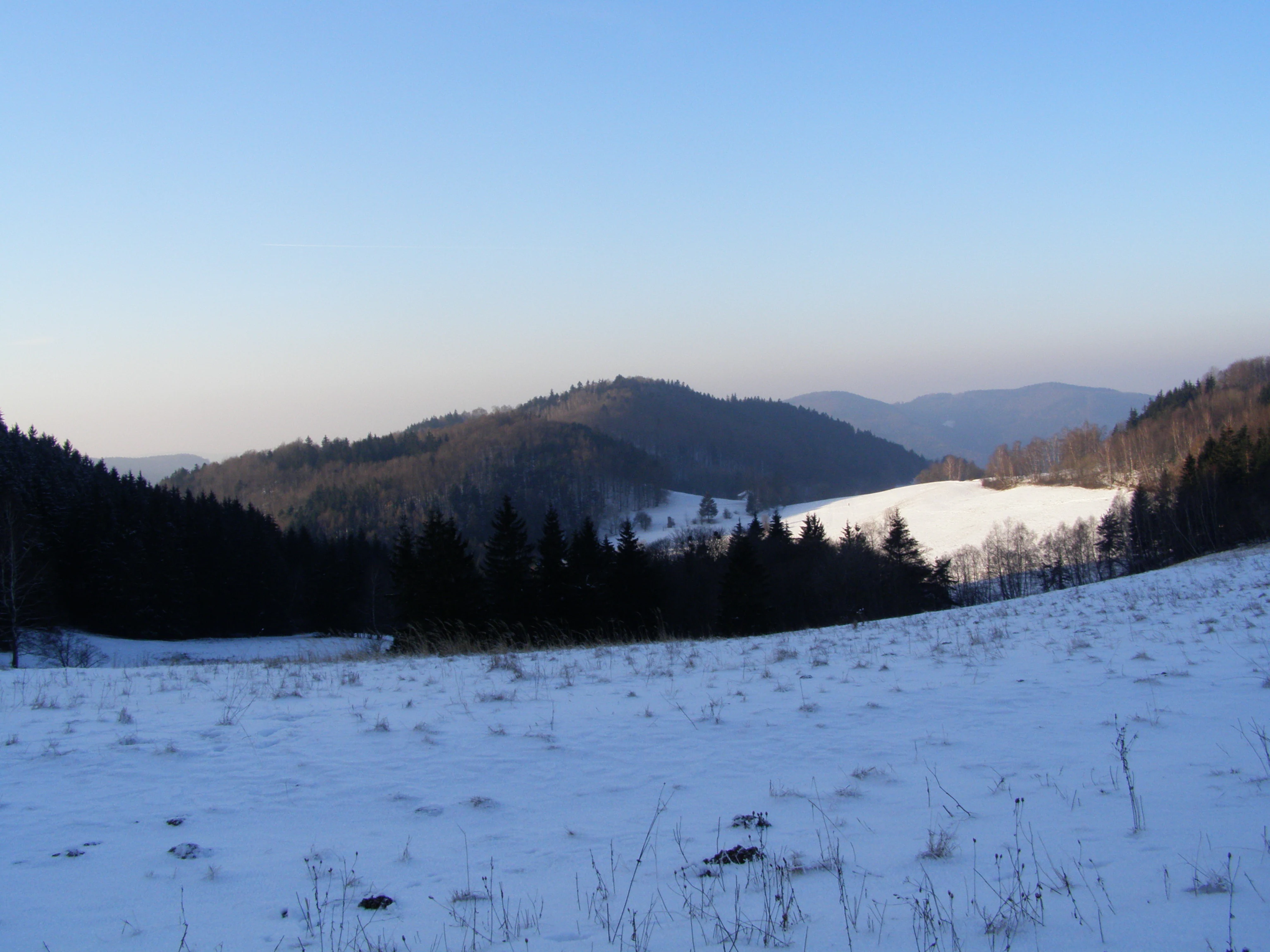
A wide, snowy landscape of the Hostýnské vrchy hills under a clear blue sky, featuring snow-covered fields in the foreground and dark forested hills in the distance.
A winter view overlooking the Klapinov area within Hostýnské vrchy Nature Park.

Hostýnské vrchy Nature Park history and protected-area timeline

Hostýnské vrchy Nature Park has a layered administrative history that reflects how many Czech landscape-scale protected areas were assembled. The western, Kroměříž portion of the area was first established as an oblast klidu, a quiet or protected landscape zone, in 1989. It was later reclassified as a přírodní park in 1995, bringing it under the more formal nature park designation used for larger areas of valuable countryside.

The eastern, Zlín portion of the area was established directly as a přírodní park in 1993. The park's official establishment date is recorded as 29 June 1989, corresponding to the original designation of the Kroměříž section. Together, these two adjacent designations form the present-day Hostýnské vrchy Nature Park, covering roughly 204 square kilometers across the two districts.

Hostýnské vrchy Nature Park landscape and geographic character

The landscape of Hostýnské vrchy Nature Park is defined by a long, forested ridge within the outer Western Carpathians. The hills rise above the surrounding lowlands of central Moravia, with valleys and small watercourses cutting into the ridge and producing a varied terrain of slopes, saddles, and sheltered basins.

The park's topography is not extreme, but it is continuous enough to create clear contrasts between the wooded upper slopes and the open valleys below. Forests cover much of the higher ground, while the lower flanks and valley floors retain a patchwork of meadows, pastures, small fields, and settlements typical of long-inhabited Moravian countryside.

This combination of upland forest and open valley gives the park its character. Viewpoints along the ridge and the edges of forest clearings offer broad panoramas over the surrounding region, while the interior of the woodlands feels enclosed and distinctly Carpathian, especially where beech and beech-fir stands dominate.

Hostýnské vrchy Nature Park ecosystems, habitats, and plant life

Ecologically, Hostýnské vrchy Nature Park belongs to the Carpathian forest zone of Moravia. The park's vegetation is shaped by elevation, substrate, and long-standing patterns of land use, producing a mosaic of habitats rather than a single dominant ecosystem.

The core forest habitats are enclaves of beech forest and mixed beech-fir forest, which occupy parts of the ridge and the cooler upper slopes. These woods, together with other deciduous and mixed stands, form the wooded backdrop of the park and harbor the more shade-tolerant plant communities typical of the Carpathian foothills.

Open habitats are equally important within the protected area. Upland pastures, hay meadows, and spring-fed areas add variety to the forested landscape and support a different set of species. It is on these open and semi-natural habitats, as well as around the park's springs and seepage zones, that the most botanically notable plants, especially orchids, are found.

Hostýnské vrchy Nature Park wildlife and species highlights

Although the source material focuses primarily on the vegetation of Hostýnské vrchy Nature Park, the landscape it protects inherently supports a range of Carpathian forest and meadow wildlife. The combination of extensive deciduous woodland, edge habitats, and open pasture creates conditions for typical Moravian forest fauna, including woodland birds, small mammals, and a characteristic community of invertebrates associated with beech and beech-fir stands.

The open meadows and pastures are also significant for wildlife, particularly for pollinators and other groups tied to traditional grassland habitats. Spring-fed wet areas add further habitat diversity, supporting amphibians and invertebrates that depend on clean, cool water sources.

Hostýnské vrchy Nature Park conservation status and protection priorities

Hostýnské vrchy Nature Park is significant from a conservation perspective because it protects a substantial and relatively coherent block of Carpathian foothill landscape in central Moravia. The park safeguards not only forest cover but also the open habitats, such as pastures, meadows, and spring areas, that often hold the highest botanical diversity but are most vulnerable to changes in land use.

The presence of rare orchid species on the park's pastures and around its springs is one of the clearest signals of its conservation value. These habitats, and the traditional land-use practices that maintain them, are an integral part of what the přírodní park designation is intended to protect.

Maintaining the park's value depends on balancing forest management, agriculture, and recreation across two administrative districts. The fact that the area was assembled from two adjoining designations, one originally an oblast klidu, also illustrates how landscape-scale conservation in the Czech Republic often succeeds by stitching together smaller protective efforts into a larger, more resilient whole.

Hostýnské vrchy Nature Park cultural meaning and human context

The Hostýnské vrchy area sits within a part of Moravia with deep cultural and religious associations. The ridge takes its name from the nearby site of Svatý Hostýn, one of the most important pilgrimage destinations in the Czech lands, and the surrounding countryside has long been shaped by small-scale farming, forestry, and pilgrimage traffic.

Traditional Moravian land use patterns, including pasturing on hill slopes and management of small meadows and orchards, are part of the cultural backdrop of the park. These practices have helped maintain the open habitats on which much of the park's botanical richness depends, linking the cultural history of the region directly to its present-day ecological character.

Top sights and standout views in Hostýnské vrchy Nature Park

Hostýnské vrchy Nature Park stands out for the scale and coherence of its Carpathian foothill landscape, combining extensive forest cover with a still-intact mosaic of pastures, meadows, and spring habitats. The enclaves of beech and beech-fir forest are a defining feature, as are the rare orchid populations found on the park's open ground.

Its position at the meeting point of two administrative districts and its assembly from two separate designations also make it a representative example of how Czech přírodní parky knit larger landscape units together. For anyone interested in Moravian natural and cultural heritage, the park offers a compact but rich cross-section of both.

Best time to visit Hostýnské vrchy Nature Park

The experience of Hostýnské vrchy Nature Park shifts meaningfully with the seasons. Late spring through early summer is generally the richest time botanically, when upland meadows and pasture edges come into flower and rare species, including orchids, are most visible against the green backdrop of the hills.

Summer offers the fullest access to forest trails and ridge viewpoints, with long daylight hours and warm conditions favorable for walking through mixed deciduous woodland. Autumn brings strong color to the beech and beech-fir forests and a quieter atmosphere in the valleys, while winter can transform the higher parts of the ridge into a noticeably colder, snowier landscape compared with the lowlands below. Because conditions vary with elevation, visitors may encounter distinctly different weather between the valley floors and the upper slopes at any time of year.

Monthly climate preview

Representative long-term temperature and precipitation records measured across twelve monthly intervals

Hostýnské vrchy Nature Park Climate Normals and Annual Temperature Patterns

Hostýnské vrchy Nature Park exhibits a measured annual climate rhythm ranging from deep sub-zero winter minimums to warm summer maximums alongside varying daily precipitation rates. Examining the complete twelve-month profile provides granular meteorological context across all recorded monthly averages.
Annual mean8 °C
-4 °C19 °C
Jan-4°
Feb-2°
Mar
Apr
May13°
Jun17°
Jul19°
Aug19°
Sep14°
Oct
Nov
Dec-2°
Warmest month
July

19.3 °C

Coolest month
January

-3.8 °C

Wettest month
July

2.9 mm/day

Driest month
January

1.3 mm/day

Park location guide

Geography guide, regional context, and park location map for Hostýnské vrchy Nature Park

Hostýnské vrchy Nature Park park geography, regions, and map view in Czechia

Understand where Hostýnské vrchy Nature Park sits in Czechia through a broader geographic reading of the surrounding landscape, nearby location context, and its mapped position within the national park landscape.

How Hostýnské vrchy Nature Park fits into Czechia

Czech Republic is a landlocked Central European country with a population of approximately 10.9 million people. The nation was established as an independent state on January 1, 1993, following the dissolution of Czechoslovakia. Its capital and largest city is Prague, with other major urban centers including Brno, Ostrava, Plzeň, and Liberec.

Wider geography shaping Hostýnské vrchy Nature Park in Czechia

The Czech Republic is a landlocked country in Central Europe. It is bordered by Germany to the west, Austria to the south, Poland to the northeast, and Slovakia to the southeast. The landscape is predominantly hilly, with the territory covering 78,871 square kilometers.

Map view of Hostýnské vrchy Nature Park

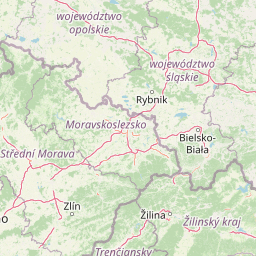
Use this park location map to pinpoint Hostýnské vrchy Nature Park in Czechia, understand its exact geographic position, and read its mapped placement within the surrounding landscape more clearly.

Pigeon | © OpenStreetMap contributors

Visualizing the forested ridges, beech enclaves, and upland meadow habitats of Moravia

Hostýnské vrchy Nature Park Photos, Landscape Scenery, and Protected Area Views

Visual documentation captures the varied terrain, steep forested slopes, and open spring-fed pastures defining the protected environment of Hostýnské vrchy Nature Park. Examination of these landscape photographs provides clear insight into the ecological character and Carpathian geography of the central Moravian region.

A wide, snowy landscape of the Hostýnské vrchy hills under a clear blue sky, featuring snow-covered fields in the foreground and dark forested hills in the distance.

Park atlas

Compare adjacent Carpathian foothill terrain and regional Moravian conservation areas.

Other Parks Near Hostýnské vrchy Nature Park and Surrounding Protected Landscapes

Continue exploring protected areas near Hostýnské vrchy Nature Park to examine similar upland forest ridges and valley mosaics across the Moravian region. Comparing adjacent nature parks reveals broader ecological patterns and regional terrain variations within the outer Western Carpathians.
A watercolor painting depicting a wide, soft-toned landscape with rolling green hills, a cluster of trees on a small rise, and forested areas in the background.
Natural monumentZlínský kraj
About 21 km away#1 closest

South

Na želechovických pasekách Natural Monument: Geographic Context and Botanical Protected Area

Located in Zlínský kraj, eastern Moravia, Czech Republic.

Na želechovických pasekách represents a significant protected area within the Czech Republic. This small natural monument safeguards light-rich deciduous woodland slopes and serves as the sole known site for specific local flora. Explore the mapped terrain and environmental boundaries of this unique botanical site nested within the broader Vizovické vrchy natural park landscape.

Area
0.011 km²
Established
1949
IUCN
IV
Relief
Upland
Protected landscapeZlín District
About 22 km away#2 closest

South

Želechovické paseky Protected Landscape: Map and Regional Geography in Zlín District

Carpathian foothill terrain and mosaic meadow landscapes

An extensive protected area near Zlín, Želechovické paseky features a blend of traditional forest clearing, hillside meadows, and stream valleys. This mapped landscape demonstrates the continuity of the Moravian Carpathian foothills, providing a distinct look at historical land use patterns and natural ecological corridors.

Area
10.479 km²
Relief
Upland
Climate
Temperate
Scope
Terrestrial
Natural monumentOlomouc Region
About 23 km away#3 closest

West

Vlkoš - statek Natural Monument: Geography and Protected Area Context in the Olomouc Region

Small-scale conservation in the Morava river floodplain

Vlkoš - statek is a significant natural monument comprising a single farmhouse attic that serves as a vital summer refuge for protected bat species. Situated within the flat alluvial terrain of the Olomouc Region, this site highlights the role of anthropogenic structures as key ecological components of the surrounding lowland landscape.

Established
2013
IUCN
III
Relief
Lowland
Climate
Temperate
Natural monumentOlomouc Region
About 24 km away#4 closest

Northwest

Veselíčko Natural Monument: Geographic Profile of a Czech Protected Area

Concentrated conservation and habitat mapping in the Olomouc Region

Located in the Olomouc District, Veselíčko is a compact natural monument dedicated to specialized habitat protection. This site acts as a key component of the regional conservation network, offering insight into the intersection of cultural heritage and wildlife refuge management in the Czech Republic.

Area
0.001 km²
Established
2013
IUCN
III
Relief
Lowland
Natural monumentZlín Region
About 25 km away#5 closest

South

Uhliska Natural Monument: Protected Stream Valley Geography and Moravian Habitats

A diverse protected wetland and meadow mosaic in the Zlín Region.

The Uhliska natural monument protects a narrow, meandering valley corridor along the Černý potok stream in eastern Moravia. This high-value habitat mosaic features wet Cirsium meadows, broad-leaved dry grasslands, and ash alder gallery forests. The site provides a critical refuge for protected butterflies of European importance, serving as an exemplary model of small-scale landscape conservation in the Zlín Region.

Area
0.143 km²
Established
1991
IUCN
IV
Relief
Upland
Watercolor illustration of a lush, green landscape featuring rolling hills and grassy meadows under a pale sky.
Nature reserveZlín District
About 27 km away#6 closest

Southwest

Na letišti Nature Reserve: Mapped Floodplain Landscapes in the Zlín District

A rare oxbow wetland refuge in Eastern Czechia

Located in the Zlín District, Na letišti is a protected natural monument formed from a regulated meander of the Morava River. This site functions as an isolated aquatic refuge, featuring a rich community of beetles and wetland flora that define the character of this lowland floodplain landscape within the Czech Republic.

Area
0.027 km²
Established
1956
IUCN
IV
Relief
Lowland
A horizontal watercolor painting showing a green wetland area in the foreground with hills and coniferous trees in the background.
Natural monumentZlínský kraj
About 28 km away#7 closest

West

Rameno Moravy Natural Monument: Protected Oxbow and Wetland Geography in Zlínský kraj

Mapping floodplain habitats and riverine natural monuments.

Rameno Moravy is a significant natural monument in the Czech Republic, encompassing a unique oxbow of the Morava River. The site provides a rare example of preserved still-water wetland habitats and diverse marsh communities within the lowland geography of the Zlínský kraj, standing out as a critical botanical site in the broader river basin.

Area
0.02 km²
Established
1995
IUCN
IV
Relief
Lowland
A horizontal watercolor illustration of a river landscape with lush green banks and rolling purple hills in the background against a white background.
Natural monumentMoravskoslezský kraj
About 29 km away#8 closest

Northeast

Meandry Staré Odry: Geography of a Protected Natural Monument in Moravian-Silesian Region

Historic river meanders and floodplain riparian ecosystems

Meandry Staré Odry represents a vital conservation fragment within the Czech Republic, preserving the original meandering path of the Odra River. This natural monument is defined by quiet oxbow pools, seasonally flooded meadows, and dense riparian forests. Its geographic profile highlights the contrast between historical water dynamics and the surrounding landscape of the Moravskoslezský kraj, providing a precise look at riparian terrain.

Area
0.278 km²
Established
1999
IUCN
IV
Relief
Lowland

Common questions about visiting, size, designation, and location context for Hostýnské vrchy Nature Park

Hostýnské vrchy Nature Park FAQs for park facts, access, geography, and protected area context

Find quick answers about Hostýnské vrchy Nature Park, including protected-area facts, park geography, trail and visitor context, and how the park fits into its surrounding country and regional landscape.
MoriAtlas Explorer

Continue Your Protected Areas Search Across the Global Atlas

Deepen your exploration by continuing the structured search for national parks and protected areas worldwide. Utilize the comprehensive filtering capabilities to compare different conservation landscapes and refine your understanding of global park geography. Discover more about the distribution and characteristics of protected natural areas.

Global natural geography