


Why Limoy Reserve stands out
Limoy Reserve is best known as one of the principal biological reserves of the Itaipu system, protecting a substantial block of Alto Paraná sub-tropical forest on the edge of the massive artificial Itaipu Lake. The reserve is recognized for combining tall stratified forest, lowland vegetation, fallow habitats, and extensive lake and river shoreline into a single protected area. It is also known for the wildlife richness concentrated in and around its forested and aquatic habitats. Documented fauna include jaguar and puma among the larger predators, tapir, peccaries, brocket deer, and coatis, alongside a particularly rich bird community that includes raptors such as the king vulture and swallow-tailed kite, and characteristic Atlantic Forest interior species like the bare-throated bellbird and the red-ruffed fruitcrow.
Limoy Reserve history and protected-area timeline
The Limoy Reserve was created in 1984, two years after the Itaipu reservoir began filling in 1982. Its establishment was part of the larger Itaipu Binacional program to conserve representative samples of the Alto Paraná ecosystems that were being altered by the construction and filling of what was then the world's largest operational hydroelectric dam, shared between Paraguay and Brazil.
The reserve was conceived as one of eight ecological reserves surrounding the reservoir, intended to compensate, at least partially, for ecological disruption caused by the dam and the associated regional development. Over time, Itaipu expanded its environmental management role beyond the original reserve boundaries, working with some 77 neighboring municipalities whose economies gradually shifted from agriculture toward tourism, recreation, and services linked to the new lake landscape.
Internally, the reserve's history is also one of evolving management. Rather than being treated as a single uniform block, Limoy has been progressively subdivided into distinct management zones, including core, buffer and recovery, extensive use, intensive use, and special use areas, reflecting modern protected-area planning approaches aimed at balancing strict conservation with controlled public access.
Limoy Reserve landscape and geographic character
The landscape of the Limoy Reserve is dominated by gently undulating sub-tropical forest on basaltic substrates. Slopes are modest, generally between 3 and 6 percent, and the terrain rolls softly across the right bank of the Paraná River before meeting the reservoir. Soils are reddish-brown laterite and latozoles derived from basalt, typically deep and of silt-clay texture, providing a stable foundation for the tall forest that blankets most of the reserve.
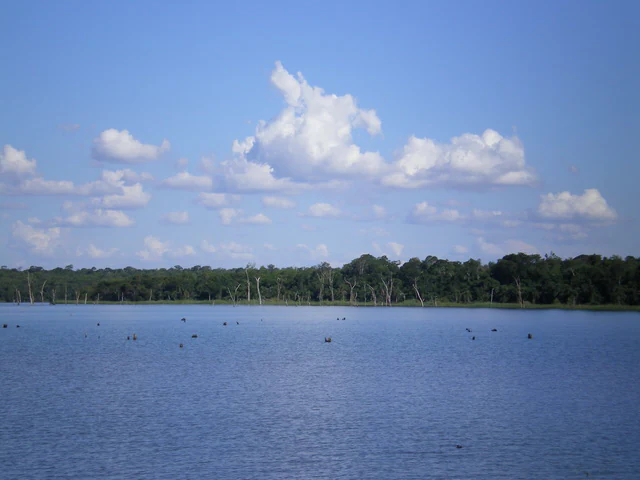
Water defines the edges of the protected area and penetrates well into its interior. The Itambey and Limoy rivers form natural northern and southern boundaries, while the enormous Itaipu Lake lies immediately to the east, its shoreline fringed by forest. Inside the reserve, the Azul, Abanico, and Santa Teresa rivers carve quiet corridors into the forest, creating small ribbons of riparian habitat and sheltering particularly rich wildlife zones.
From the reserve's panoramic viewpoint, the combination of continuous forest canopy and the broad expanse of the Itaipu Lake is the single most striking landscape feature. The result is a landscape that reads simultaneously as intact inland forest and as lake country, with water and wooded ridges alternating in views that extend for many kilometers along the reservoir.
Limoy Reserve ecosystems, habitats, and plant life
Ecologically, Limoy lies within the Alto Paraná ecological region, a transitional sub-tropical zone characterized by tall humid forest, well-distributed rainfall, and relatively mild thermal conditions. The reserve is organized into plant associations that range from mature high forest through lowland forest to fallow and disturbed vegetation, giving it a layered vegetation profile uncommon in more uniform Paraguayan protected areas.
The high forest is the most ecologically complex stratum, displaying a clear five-level vertical structure of canopy, sub-canopy, intermediate trees, shrubs, and ground cover. Dominant tree species include lapacho, ybyrá pytá, and cedar, while the lower layers hold myrtles such as ñangapiry and yva poroty, along with a dense herbaceous understory composed of bromeliads, ferns, and members of the Asteraceae, Poaceae, Malvaceae, and Piperaceae families. Tree ferns occur in patches, adding further structural diversity to the understory.
Rivers, lake margins, and forest interior work together to support a wide range of habitat conditions within a compact geographical footprint. This habitat diversity is what allows the reserve to host such a varied fauna despite its relatively modest size and the heavy human modification of the surrounding region.
Limoy Reserve wildlife and species highlights
Limoy Reserve harbors a notably diverse vertebrate fauna for an eastern Paraguayan protected area of its size, with documented records of 41 mammal species, 234 bird species, and 20 reptile species. The mammal community is particularly characteristic of the broader Alto Paraná forest block and includes the collared peccary, red brocket deer, crab-eating fox, Brazilian tapir, and South American coati, with larger predators such as jaguar and puma also present.
Birds are the most species-rich group, reflecting the reserve's combination of interior forest, river corridors, and lake edge. Characteristic species include the king vulture, swallow-tailed kite, squirrel cuckoo, white-tipped dove, Atlantic Forest trogons, the bare-throated bellbird, anhinga, red-ruffed fruitcrow, and a range of caciques and herons that exploit the reservoir shoreline. This richness makes the reserve a significant area for bird observation within Paraguay.
Reptile diversity is also notable. Recorded species include jararca pit vipers, rattlesnakes, coral snakes, broad-snouted caiman in the wetter habitats, and the gold tegu, a large lizard associated with forest edges and watercourses. Together, mammals, birds, and reptiles give Limoy an ecological profile that closely mirrors, at a smaller scale, the wildlife communities historically associated with the Alto Paraná Atlantic Forest interior.
Limoy Reserve conservation status and protection priorities
As one of eight Itaipu-administered biological reserves, Limoy plays a central role in the binational conservation strategy for the region around the Itaipu dam. Its purpose is to maintain a representative sample of Alto Paraná sub-tropical forest and the associated wildlife communities in a regional context where agriculture, colonization, and infrastructure development have heavily modified the surrounding landscape.
The reserve is also a working demonstration of zoned protected-area management. Core zones, buffer and recovery areas, and extensive and intensive use zones are managed explicitly to separate the most sensitive habitats from public use, and to concentrate any ecological disturbance in areas that can recover. This zoning is critical because the reserve is bordered by Itaipu Porâ settlements and a perimeter road, putting it under direct pressure from adjacent human populations.
Limoy's conservation importance is amplified by the Itaipu Lake itself. The reservoir transformed the regional climate and habitat mosaic, and the reserve now serves as a forested refuge and biological corridor along a heavily altered shoreline, helping to maintain forest-dependent species populations that would otherwise be isolated in a region of expanding soybean cultivation and settlement.
Limoy Reserve cultural meaning and human context
The Limoy Reserve sits within a regional cultural landscape shaped by the Itaipu hydroelectric project and by the agricultural colonization of the Alto Paraná. The reserve itself was named after the Limoy River, which forms its southern boundary, and its territory is bordered by the Itaipu Porâ settlements and a perimeter road, both products of the planned colonization associated with the dam.
The Itaipu Lake, filling since 1982, has redefined daily life across roughly 77 neighboring municipalities. Traditional agricultural economies have gradually given way to tourism, recreation, and service industries organized around artificial beaches, water sports, and lake-edge visitation. Limoy fits into this evolving regional identity as a destination for ecological and scenic tourism rather than industrial or agricultural activity, complementing the lake-oriented tourism economy with a forest experience that would otherwise be largely absent from the area.
Top sights and standout views in Limoy Reserve
Limoy Reserve stands out for combining a sizeable block of Alto Paraná sub-tropical forest with an extensive lake and river shoreline in a single protected area. The reserve's zoned management system, with clearly defined core, buffer, extensive-use, and intensive-use areas, allows it to function simultaneously as a strict conservation zone and a controlled tourism destination, which is relatively uncommon in Paraguay's protected-area network.
Its panoramic viewpoint, overlooking both forested ridges and the immense Itaipu Lake, is the reserve's signature visual experience. Combined with the wildlife richness documented within the reserve, including 234 recorded bird species and a mammal community that still includes jaguar and tapir, this viewpoint makes Limoy one of the most distinctive ecological reserves along the entire Paraná reservoir system.
Best time to visit Limoy Reserve
Because Limoy lies in a sub-tropical climate with abundant rainfall distributed throughout the year, the reserve remains green and biologically active across all seasons. Periods with somewhat drier and cooler conditions, typically associated with the southern winter, are often considered more comfortable for visiting because daytime temperatures are milder and nighttime drops make walking trails and viewpoints more pleasant than during the hottest and most humid summer months.
The cooler season also tends to produce clearer atmospheric conditions, improving views from the reserve's panoramic lookout over the Itaipu Lake and the forested ridges. Wildlife observation can be productive year-round, but cooler months often make it easier to spot mammals and birds along forest edges and watercourses without the intensity of mid-summer heat and humidity.