
Why Šárka-Lysolaje Natural Park stands out
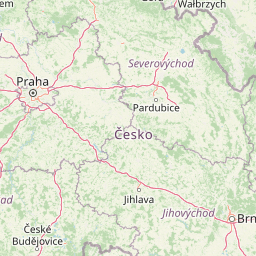
Šárka-Lysolaje is best known for embedding a system of deep, forested stream valleys and hillside habitats directly within the urban fabric of Prague. The park's signature feature is the way it surrounds and structures the Divoká Šárka area, combining a broad landscape-level protection regime with a network of smaller reserves that protect specific botanical, geological, or ecological values. The park is also recognized for its role as one of the largest coherent natural areas within Prague itself, providing a continuous link between protected habitats and the surrounding cityscape. The nested natural monuments, each named for a local valley, hill, or feature, reinforce the park's identity as a conservation mosaic rather than a single uniform landscape.
Šárka-Lysolaje Natural Park history and protected-area timeline
Šárka-Lysolaje Natural Park has a relatively short but clearly defined administrative history. The territory was formally designated as a protected Quiet Area (Území klidu) in 1990, by decree of the National Committee of the City of Prague (Národní výbor hl. města Prahy, decree 8/90 Sb.). This initial designation established the area as a recognized zone of landscape protection within the city limits.
Following the adoption of Czech nature conservation law 114/1992 Sb., the area was reclassified from a Quiet Area into a přírodní park, or natural park. This change aligned the territory with the broader national system of landscape protection categories in the Czech Republic and gave it a more formal and durable legal basis.
Over time, the layered structure of the park evolved further as additional smaller protected sites were recognized within its boundaries. Today, these include the nature reserve Divoká Šárka and the natural monuments Vizerka, Jenerálka, Zlatnice, Nad Mlýnem, Dolní Šárka, Baba, and Housle. While the source page does not detail the individual establishment dates of each nested site, their presence reflects a continuing process in which particular ecological values within the broader park have been recognized as deserving more specific forms of protection.
Šárka-Lysolaje Natural Park landscape and geographic character
The landscape of Šárka-Lysolaje is defined by a series of valleys and slopes typical of the northwestern edge of Prague. Rather than presenting a single dramatic landform, the park is shaped by its incision of small stream valleys into the surrounding plateau, producing a varied terrain of forested slopes, narrow valley bottoms, and occasional rocky or exposed sections.
These valleys and their associated slopes form the structural backbone of the park. They create natural transitions between higher, drier habitats and moister, sheltered environments along the streams, which contributes significantly to the ecological diversity of the area. The terrain also produces scenic enclosures where steep slopes, outcrops, and vegetation combine to create some of the more visually distinctive natural settings within Prague.
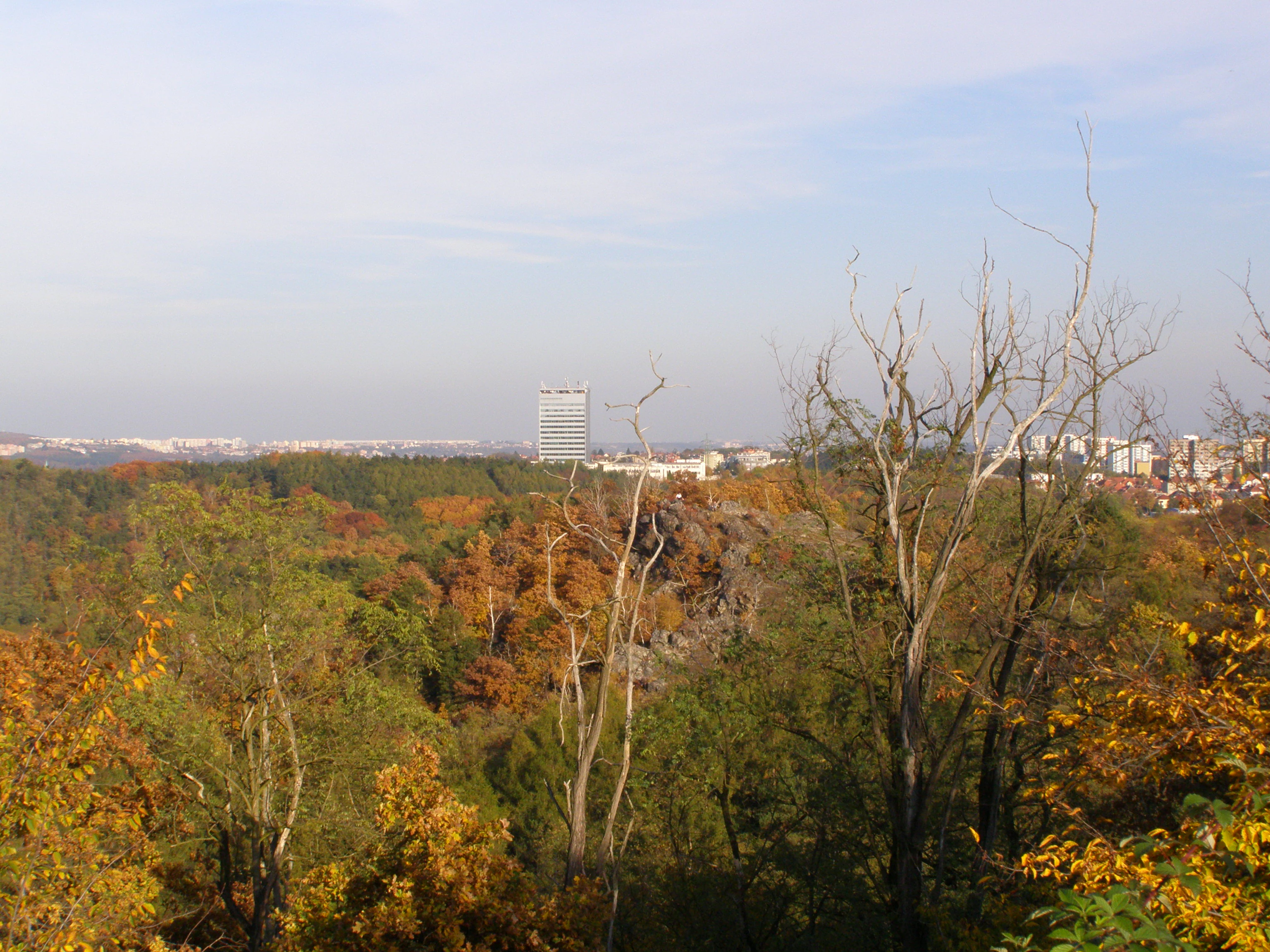
Because the park is enclosed within a major urban area, the landscape is also notable for its proximity to built environment. Views from higher points within the park include both natural forest scenery and the urban skyline of Prague, highlighting the unusual character of the site as a protected natural area embedded directly in the city.
Šárka-Lysolaje Natural Park ecosystems, habitats, and plant life
The ecological character of Šárka-Lysolaje is closely tied to its valley and slope structure. The park encompasses a range of habitats typical of Central Bohemian landscapes, including deciduous and mixed forests on valley slopes, more open and drier habitats on exposed terrain, and a riparian environment associated with local streams.
This habitat diversity is a defining feature of the park. Because the area is characterized by repeated transitions between valley bottoms, slopes, and higher ground, it supports a mosaic of microhabitats in close proximity to one another. The result is an environment in which forest, meadow, rocky, and stream-associated communities can all be found within a relatively small spatial range.
The combination of broad natural park protection and more strictly designated small reserves within the same territory underscores the conservation importance of these habitat patterns. By protecting both the overall landscape and its most ecologically sensitive components, the park is designed to maintain the integrity of the full ecological system rather than just isolated patches.
Šárka-Lysolaje Natural Park wildlife and species highlights
Wildlife in Šárka-Lysolaje reflects the broader habitat diversity of the park's valley and slope systems. The forested slopes and stream corridors provide shelter and movement corridors for species typical of Central Bohemian woodlands and edge habitats, while the more open sections and rocky exposures support organisms associated with drier, warmer conditions.
Because the park contains a network of natural monuments and a dedicated nature reserve, it is recognized as an area where particular species or ecological communities have been formally identified as worth conserving in detail. While the source material does not enumerate specific species, the layered protection structure implies that the area supports communities of conservation interest, including those tied to specific forest, meadow, or rocky habitats.
The park's proximity to dense urban areas in Prague makes its wildlife presence particularly significant from a conservation standpoint. It allows species and ecological communities typical of the wider Central Bohemian landscape to persist in close proximity to human population centers, contributing to regional biodiversity in a way that purely remote protected areas cannot.
Šárka-Lysolaje Natural Park conservation status and protection priorities
Šárka-Lysolaje is primarily a landscape-level conservation designation, intended to preserve the overall character and ecological integrity of the area rather than a single habitat or species. The natural park status provides a framework that regulates land use, guides development, and shapes management across the roughly 1,005-hectare territory.
The conservation significance of the park is significantly enhanced by the layered system of more strictly protected sites within its boundaries. The nature reserve Divoká Šárka offers the highest level of protection for specific ecological values, while the seven natural monuments, including Vizerka, Jenerálka, Zlatnice, Nad Mlýnem, Dolní Šárka, Baba, and Housle, target individual habitats, communities, or features that require more focused protection.
Together, these designations establish Šárka-Lysolaje as a conservation mosaic in which broad landscape protection and targeted site protection reinforce one another. This layered approach is particularly important in an urban context, where pressures from development, recreation, and infrastructure require multiple levels of safeguard to preserve the ecological character of the area over time.
Šárka-Lysolaje Natural Park cultural meaning and human context
Šárka-Lysolaje has long been part of the regional identity of northwestern Prague. The areas of Šárka and Lysolaje themselves carry historical associations that predate the modern natural park designation, with these names being deeply embedded in local and citywide geography.
The park reflects a broader tradition in the Czech Republic of recognizing the cultural and historical importance of natural landscapes on the edges of cities. Beyond ecological protection, the existence of the park acknowledges that such areas hold value as places of recreation, local identity, and continuity with the surrounding region's natural heritage.
The persistence of named localities such as Divoká Šárka and the various natural monuments within the park demonstrates how the landscape continues to shape the sense of place for residents of Prague, linking ecological protection with the everyday experience of the city.
Top sights and standout views in Šárka-Lysolaje Natural Park
Šárka-Lysolaje stands out for its scale and ecological quality within a major European capital. Its roughly 1,005-hectare extent makes it one of the larger continuous natural areas in Prague, and its formal establishment in 1990 demonstrates an early commitment to urban-adjacent conservation in the post-1989 Czech environmental framework.
The park's nested protection system is itself a highlight. Having one nature reserve and seven natural monuments within a single natural park is unusual and indicates a particularly rich concentration of small-scale ecological values. The presence of named sites such as Divoká Šárka, Vizerka, Jenerálka, and others gives the park a distinctive internal geography that is meaningful both ecologically and culturally.
Finally, the park combines ecological function, recreational role, and landscape identity in a way that few urban-edge protected areas manage to achieve. It is at once a conservation territory, a local green space, and a recognizable part of Prague's natural heritage.
Best time to visit Šárka-Lysolaje Natural Park
Šárka-Lysolaje offers a varied experience across the seasons due to its mix of forested slopes, valleys, and stream environments. Spring is typically the most florally expressive season, when valley vegetation comes alive and the forest floor shows renewed growth, making it an appealing time for those interested in botanical and ecological features.
Summer brings full canopy cover and rich green scenery across the park's slopes, with shaded valley paths offering relief from urban heat. The contrast between the dense forest environment and nearby city districts is particularly striking this time of year.
Autumn highlights the structural character of the park, with deciduous trees turning color and the contours of the valleys becoming visually clearer as foliage thins. Winter offers quieter visits and unobstructed views of the terrain, though conditions on slopes and valley paths may be more demanding. Across all seasons, the park remains an accessible natural area within the city.