
Mori Atlas logo
Natural monumentVelká skála

A rare siliceous rock outcrop preserved within the urban geography of the Troja district.

Velká skála Natural Monument and the Geological Landscape of the Prague Plateau Region

(Přírodní památka Velká skála)

Velká skála stands as a distinct geological formation rising above the Prague Plateau, marking a protected natural monument within the Czech capital. This site showcases a rare siliceous rock outcrop that serves as a localized landmark, providing insight into the geomorphological character of central Bohemia. The protected area preserves this rugged terrain as a key representative of small scale geological conservation in a metropolitan setting.

geological monumentsiliceous rockrock outcropPrague Plateauurban nature reservesmall protected area
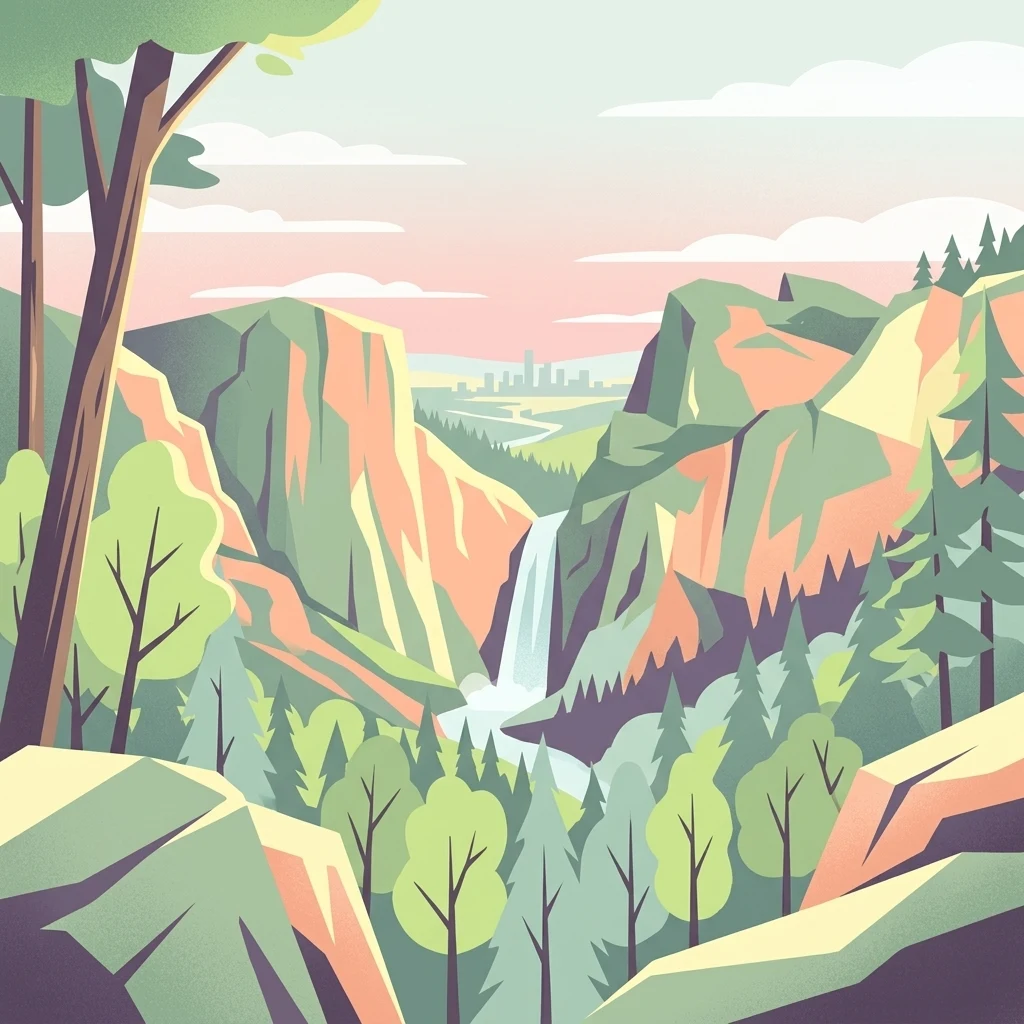
A flat-style digital illustration showing a valley framed by rocky cliffs and evergreen trees, with a waterfall cascading in the center and a distant city skyline visible on the horizon.

Velká skála

Natural monument

Park overview

Structured park overview, official facts, and landscape profile for Velká skála

Velká skála park facts, protected area profile, and essential visitor context

Review the core facts for Velká skála, including designation, size, terrain, visitor scale, habitats, and operating context in one park-focused overview.

About Velká skála

Velká skála is a small protected natural monument located in the Troja district of Prague 8, on the left bank of the Vltava River. Although it lies within the territory of the Czech capital, the site preserves a fragment of natural geology that stands out from the surrounding urban and suburban landscape. The protected area is centered on a rocky outcrop perched on the summit of a hill of the same name, with the broader reserve covering 1.81 hectares between roughly 284 and 314 meters in elevation.

Geologically, Velká skála is significant for its composition. The outcrop is formed of buližník, a siliceous rock variety that is relatively uncommon in the geological record of central Bohemia. Its presence on a distinct hilltop gives the site both geological and geomorphological importance, illustrating the kind of resistant rock outliers that occasionally survive above the surrounding plateau surfaces. Within the Czech system of geomorphological classification, the hill belongs to the Prague Plateau (Pražská plošina), specifically the Kladenská tabule sub-unit and the small Zdibská plošina district.

The monument was formally declared on 29 April 1968 by the National Committee of the City of Prague, placing Velká skála among the early wave of small-scale nature protections established around the capital. It is administered today by the magistracy of Prague, and its official code within the national registry of protected areas is 494. Although modest in size, Velká skála exemplifies the role of small protected natural monuments in safeguarding representative geological features, providing a compact window into the broader geological history of the Bohemian region even within city limits.

Beyond its scientific value, Velká skála also functions as a local landscape landmark within Troja, an area otherwise known for the Prague Zoo, the Troja Chateau, and the botanical gardens. The rock outcrop offers a quiet reminder that Prague's natural heritage extends well beyond its parks and gardens, into the rugged geology that shaped the city's setting along the Vltava.

Quick facts and research context for Velká skála

Velká skála lies in Prague 8, in the Troja neighborhood near the Vltava River. The protected area covers 1.81 hectares and sits between roughly 284 and 314 meters in elevation, with the hill summit reaching the upper end of that range.

The monument was declared on 29 April 1968 by the National Committee of the City of Prague and is administered by the Prague City Hall. Its official protection code within the Czech nature conservation register is 494. The protected subject is a buližník (siliceous) rock outlier classified as a notable geological and landscape feature.

Protection and recognition

Examine documented protection scope and international recognition records for Velká skála.

Velká skála Protection Status and Designated Terrestrial Conservation Framework

Velká skála maintains a documented terrestrial protection scope within its designated conservation framework. Recorded management details and international recognition sources provide a structured overview of the protected area profile.

Protection details

Protection scope
Terrestrial
Park context

Deeper park guide and search-rich context for Velká skála

Velká skála history, landscape, wildlife, and travel context

Explore Velká skála through its history, landscape character, ecosystems, wildlife, conservation priorities, cultural context, and seasonal travel timing in a structured park guide built for atlas discovery and search intent.

Why Velká skála stands out

Velká skála is best known as a geologically distinctive siliceous rock outcrop, known in Czech as a buližníkový skalní suk. Such siliceous formations are uncommon in central Bohemia, which gives this small Prague site its principal scientific and landscape value. The hill itself is also a recognizable local landmark within the Troja district, and the combination of rocky terrain, summit position, and protected status makes Velká skála a representative example of small-scale geological conservation within an urban setting.
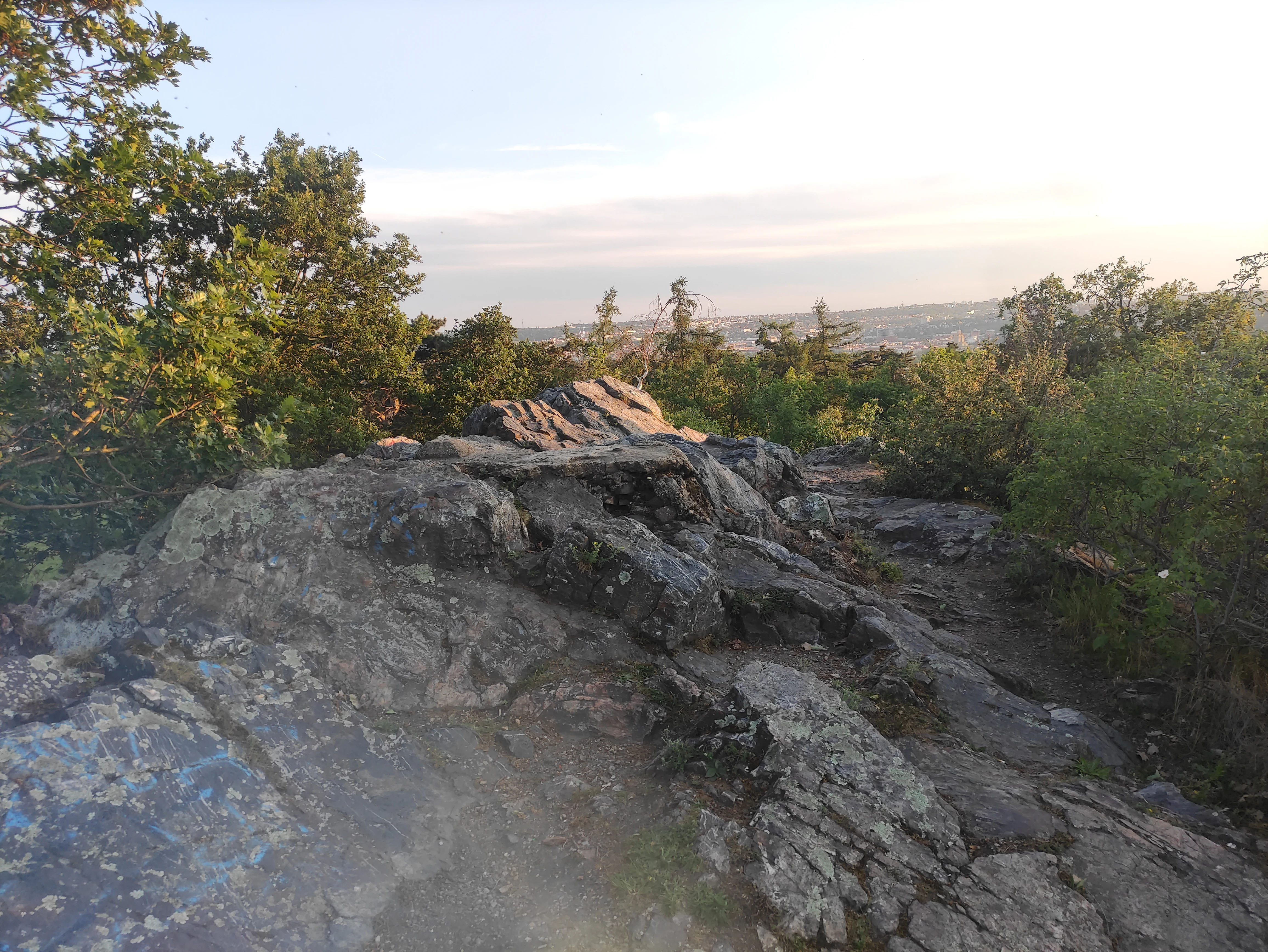
A rocky outcrop at the top of a hill surrounded by trees, with a view of a city in the distance under a pale sky.
The siliceous rock outcrop at Velká skála in the Troja district of Prague.

Velká skála history and protected-area timeline

Velká skála was formally designated as a protected natural monument on 29 April 1968, when it was declared by the National Committee of the City of Prague. Its establishment placed it among the small-scale geological protections created in the Czech capital during that era, reflecting an interest in preserving representative natural features even within densely populated urban territory.

The monument has been managed since its declaration by the administrative authorities of Prague. It now falls under the responsibility of the Prague City Hall (Magistrát hlavního města Prahy), and the site is registered under the official code 494 in the Czech nature conservation database.

Velká skála landscape and geographic character

The landscape of Velká skála is defined by a small but prominent rocky summit rising above the surrounding Prague Plateau. The hill reaches an elevation of about 314 meters, with the protected zone extending downward to roughly 284 meters, giving the site an appreciable vertical range despite its compact overall extent.

Geomorphologically, the hill belongs to the broader Prague Plateau system, specifically within the Kladenská tabule sub-unit and the local Zdibská plošina district. This positions Velká skála within the characteristic flat-to-rolling plateau terrain of central Bohemia, where resistant rock outcrops occasionally punctuate otherwise gentler land surfaces. The result is a localized landscape contrast, in which the rugged siliceous rock forms a clearly defined natural feature against the smoother plateau backdrop.

Velká skála ecosystems, habitats, and plant life

As a geological protected monument, Velká skála's primary natural significance lies in its rock composition rather than in its biological communities. The siliceous buližník outcrop is recognized as a notable geological and landscape object, and its protection is aimed at preserving an uncommon rock type within the regional geological context.

The site's natural character therefore centers on lithology and geomorphology rather than on forest cover or species diversity. Its ecological value is best understood in terms of the small-scale rocky habitats it provides within an otherwise heavily built environment, offering a fragment of mineral and geological heritage that complements the broader network of natural monuments distributed across Prague.

Velká skála conservation status and protection priorities

Velká skála is protected at the third category of the International Union for Conservation of Nature (IUCN) classification, corresponding to a natural monument or protected natural feature. Within the Czech national system, it is designated as a přírodní památka (natural monument), a category reserved for smaller areas preserving focused natural values, such as geological formations.

The conservation significance of the site is primarily geological rather than ecological. By safeguarding a relatively rare siliceous rock outcrop on the Prague Plateau, Velká skála contributes to the representation of central Bohemian geology within the broader network of Czech protected natural monuments. Its establishment was a deliberate act to retain a representative example of this lithology within the territory of the capital, preventing its loss to urban development pressures that affect much of the surrounding landscape.

Velká skála cultural meaning and human context

Velká skála sits within Troja, one of Prague's historically distinct districts on the left bank of the Vltava River. The neighborhood is widely known for landmarks such as the Prague Zoo, the Troja Chateau, and the Prague Botanical Garden, which together give the area a strongly cultural and recreational character. Against this backdrop, the small natural monument represents an effort to retain a piece of the district's natural geological identity alongside its built and cultivated heritage.

The siliceous rock outcrop itself has a local identity as a recognizable hilltop feature, and its protected status reflects a wider Czech tradition of using small-scale nature monuments to anchor geological and landscape values within urban and suburban settings.

Top sights and standout views in Velká skála

A compact siliceous rock outcrop of notable geological value on the Prague Plateau.

Formally protected as a natural monument since 1968 and managed by the Prague City authorities.

A representative example of small-scale geological conservation inside the territory of a major European capital.

A recognizable hilltop landmark within the Troja district, complementing the area's broader cultural and natural attractions.

Best time to visit Velká skála

Velká skála can be appreciated at any time of year, as its principal interest is geological rather than seasonal. The rock outcrop and summit views are most comfortably visited in the milder months of spring, early summer, and early autumn, when walking conditions on and around the hill are easiest.

Winter visits are also possible, and the bare rocky terrain takes on a distinct character when lightly snowed or frosted, though icy surfaces on the rocky slopes may make the outcrop itself more difficult to approach safely.
Monthly climate preview

Track measured monthly temperature ranges and precipitation patterns for Velká skála

Velká skála Climate and Long-Term Temperature Normals

Long-term representative coordinate data captures the annual temperature and precipitation rhythm across Velká skála from measured monthly records. Detailed climate normals provide a complete month-by-month breakdown of average minimum and maximum thresholds.
Annual mean9 °C
-2 °C20 °C
Jan-2°
Feb-1°
Mar
Apr
May13°
Jun17°
Jul20°
Aug19°
Sep14°
Oct
Nov
Dec-1°
Warmest month
July

19.7 °C

Coolest month
January

-2.2 °C

Wettest month
June

2.6 mm/day

Driest month
February

1.1 mm/day

Park location guide

Geography guide, regional context, and park location map for Velká skála

Velká skála park geography, regions, and map view in Czechia

Understand where Velká skála sits in Czechia through a broader geographic reading of the surrounding landscape, nearby location context, and its mapped position within the national park landscape.

How Velká skála fits into Czechia

Czech Republic is a landlocked Central European country with a population of approximately 10.9 million people. The nation was established as an independent state on January 1, 1993, following the dissolution of Czechoslovakia. Its capital and largest city is Prague, with other major urban centers including Brno, Ostrava, Plzeň, and Liberec.

Wider geography shaping Velká skála in Czechia

The Czech Republic is a landlocked country in Central Europe. It is bordered by Germany to the west, Austria to the south, Poland to the northeast, and Slovakia to the southeast. The landscape is predominantly hilly, with the territory covering 78,871 square kilometers.

Map view of Velká skála

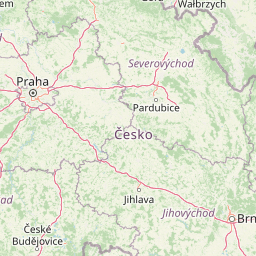
Use this park location map to pinpoint Velká skála in Czechia, understand its exact geographic position, and read its mapped placement within the surrounding landscape more clearly.

Pigeon | © OpenStreetMap contributors

Location context for Velká skála

Prague

Explore detailed imagery of the siliceous rock formation and protected plateau terrain.

Velká skála Photos and Landscape Scenery: Visualizing the Protected Rock Outcrop

Visual records capture the rugged topography and rare geological features defining the Velká skála natural monument. Examining protected area imagery reveals the distinctive landforms and urban fringe environment characterizing this Bohemian plateau landmark.

A rocky outcrop at the top of a hill surrounded by trees, with a view of a city in the distance under a pale sky.

A sloped woodland area featuring exposed rocky outcrops among deciduous trees with bare branches in early spring.

Park atlas

Compare regional geology, neighboring hill summits, and protected natural monuments across the Prague Plateau.

Explore Parks Near Velká Skála and Surrounding Protected Landscapes in Central Bohemia

Browsing other protected areas near Velká skála reveals broader geological formations and characteristic plateau terrain across central Bohemia. Comparing adjacent natural monuments provides deeper context for urban conservation efforts and regional landscape diversity.
A pale watercolor painting showing a river winding through green hills and gentle slopes.
Protected landscapePrague
About 2.4 km away#1 closest

North

Přírodní park Drahaň-Troja: Protected Landscape Geography and Mapped Terrain Analysis

Deep stream valleys and rocky steppe habitats in Prague

Přírodní park Drahaň-Troja represents a vital protected landscape characterized by its pronounced relief, including the Bohnické, Čimické, and Drahanské valleys. This area reveals the geological history of the Prague region through its exposed shales and volcanic rhyolite veins. Discover how this continuous green corridor integrates rare steppe ecosystems with the metropolitan urban edge.

Area
5.79 km²
Established
1990
Relief
Upland
Climate
Temperate
A horizontal watercolor illustration showing a soft, dreamy landscape with rolling green hills, light purple and yellow tones, a winding path or stream, and a lone bare tree in the foreground.
Protected landscapePraha
About 5.6 km away#2 closest

West

Přírodní park Šárka-Lysolaje: Protected Landscape Mapping and Geographic Identity in Praha

A dense mosaic of stream valleys and protected natural monuments near the heart of Praha

Examine the detailed geography of Přírodní park Šárka-Lysolaje, an extensive protected landscape in Praha that functions as a critical green corridor. Its terrain, defined by deeply incised stream valleys and steep forested slopes, hosts a unique concentration of smaller nature reserves and monuments, creating a coherent ecological framework directly adjacent to the urban metropolitan environment.

Area
10.05 km²
Established
1990
Climate
Temperate
Scope
Terrestrial
Natural monumentPrague
About 6.4 km away#3 closest

West

Vizerka Natural Monument: Mapped Protected Landscapes and Rocky Terrain in Prague

A rare xerothermic steppe refuge on the edge of the Šárka Valley

Vizerka represents a compact yet significant natural monument located on the rocky slopes of the Šárecké údolí in Prague. Featuring exposed Proterozoic shale and shallow soils, this protected site serves as a vital island of thermophilic grasslands and shrubby terrain. It offers a fascinating look at relict warm-loving habitats and rare species survival within the dense geographical context of a European capital city.

Area
0.031 km²
Established
1988
IUCN
IV
Relief
Upland
Nature reservePraha 5
About 8.6 km away#4 closest

Southwest

Prokopské údolí Nature Reserve: Geological Mapping and Protected Area Discovery

A limestone karst landscape situated within the Praha 5 district

Prokopské údolí is an essential protected nature reserve in Praha 5, featuring a deep limestone valley that serves as a globally significant site for Paleozoic fossils and karst geography. This protected landscape encompasses a range of habitats including rock steppes, thermophilic woodlands, and volcanic outcrops, providing a unique look at urban-adjacent nature conservation and historical limestone quarrying within the Czech Republic.

Area
1.71 km²
Established
1978
IUCN
III
Relief
Upland
Natural monumentPrague
About 9.1 km away#5 closest

Southwest

Vidoule Natural Monument: Geological Profile and Protected Landscape Context in Prague

A table mountain remnant with exposed Cretaceous sandstone formations.

Vidoule stands as a significant natural monument in western Prague, defined by its flat-topped table mountain geometry and horizontal Cretaceous strata. The site offers a unique perspective on the regional geology of the Prague Plateau, where protected slopes guard rare dry grassland habitats and fossil-rich layers against a backdrop of dense urban development.

Area
0.087 km²
Established
1988
IUCN
III
Relief
Upland
A soft watercolor painting of a green landscape featuring a small body of water, rolling hills, and trees, painted in a minimalist style on a white background.
Protected landscapePrague
About 10 km away#6 closest

Southeast

Hostivař-Záběhlice Nature Park: Protected Landscape and Mapped Prague Geography

River valleys and reservoir terrain within the capital city.

Hostivař-Záběhlice Nature Park represents a vital natural zone in Prague, characterized by the mature forests and meandering river paths along the Botič stream. This record highlights the park's geographic composition, including its reservoirs, lowland forest patches, and its function as a preserved natural corridor within the city.

Area
4.23 km²
Established
1990
Relief
Lowland
Climate
Temperate
A soft watercolor painting of a winding stream moving through green meadows with distant rolling hills and a light, misty atmosphere.
Natural monumentPrague
About 11 km away#7 closest

Southeast

Meandry Botiče Natural Monument: Mapped Geography and Protected Stream Landscapes in Prague

Analyzing the ecological boundaries and riparian terrain of the Botič stream corridor

Meandry Botiče represents a significant natural monument in Prague, distinguished by its pronounced stream meanders and dense bankside vegetation. This site offers deep insights into urban conservation, documenting the delicate balance between native riparian flora and the pressures of encroaching residential districts within a managed protected environment.

Area
0.067 km²
Established
1968
IUCN
III
Relief
Lowland
Nature reservePrague
About 13 km away#8 closest

South

V hrobech Nature Reserve: A Protected Botanical Island within the Urban Landscape of Prague

Rare dry-grassland habitats in the Kamýk district

V hrobech is a designated nature reserve in Prague featuring 1.3 hectares of southeast-facing slopes and species-rich grassland. This site is home to rare thermophilic plants and represents an important example of intensive conservation management in an urban environment. Its protected boundaries connect with local forest fragments to maintain ecological value amidst the residential developments of Lhotka and Libuš.

Area
0.013 km²
Established
1988
IUCN
IV
Relief
Lowland

Common questions about visiting, size, designation, and location context for Velká skála

Velká skála FAQs for park facts, access, geography, and protected area context

Find quick answers about Velká skála, including protected-area facts, park geography, trail and visitor context, and how the park fits into its surrounding country and regional landscape.
MoriAtlas Explorer

Continue Your Protected Areas Search Across the Global Atlas

Deepen your exploration by continuing the structured search for national parks and protected areas worldwide. Utilize the comprehensive filtering capabilities to compare different conservation landscapes and refine your understanding of global park geography. Discover more about the distribution and characteristics of protected natural areas.

Global natural geography