Why Lagarpampa Natural Area stands out
Lagarpampa is best known for hosting populations of the red-fronted macaw (Ara rubrogenys), a critically threatened parrot endemic to a small region of Bolivia's inter-Andean dry valleys. Its landscape of semi-arid inter-Andean scenery, native dry-forest vegetation, and mix of traditional agricultural and pastoral land uses also gives the area a strong cultural-ecological identity. The area is also notable for being established through a community-driven process led by the subcentral organizations and rural syndicates of Lagarpampa and Mollepampa, rather than by a national-level parks authority. This origin story connects Lagarpampa to broader trends in Bolivia toward municipal and community-based protected areas.
Lagarpampa Natural Area history and protected-area timeline
Lagarpampa's origin as a protected area is rooted in local political organization rather than in a national parks decree. The initiative emerged from an organic congress of the subcentral organizations of Lagarpampa and Mollepampa, along with six rural syndicates: Lagarpampa, Tunaspampa, La Seja, Chaupiloma, Duraznal, and Mollepampa. This congress represented the customary community governance structures of the Bolivian highlands, where decisions about land, resources, and conservation are often made through such assemblies.
The decisions reached in that process were translated into municipal legal instruments in late 2009. Ordenanza Municipal N.º 040/2009, issued on November 24, 2009, provided for the establishment of the protected area, while Ordenanza Municipal N.º 041/2009, issued on the same date, complemented that designation. Together, the ordinances created a municipally administered protected landscape of roughly 30,308 hectares within the municipality of Aiquile.
The protection designation arrived at a time when Bolivia was actively expanding municipal and community-based conservation frameworks. Local campaigns in the region had also drawn attention to the conservation of the red-fronted macaw, which had become a symbol of efforts to protect Bolivia's inter-Andean dry valleys. Lagarpampa's creation can therefore be seen as part of a broader regional movement linking local livelihoods, cultural identity, and the conservation of a distinctive and threatened habitat.
Lagarpampa Natural Area landscape and geographic character
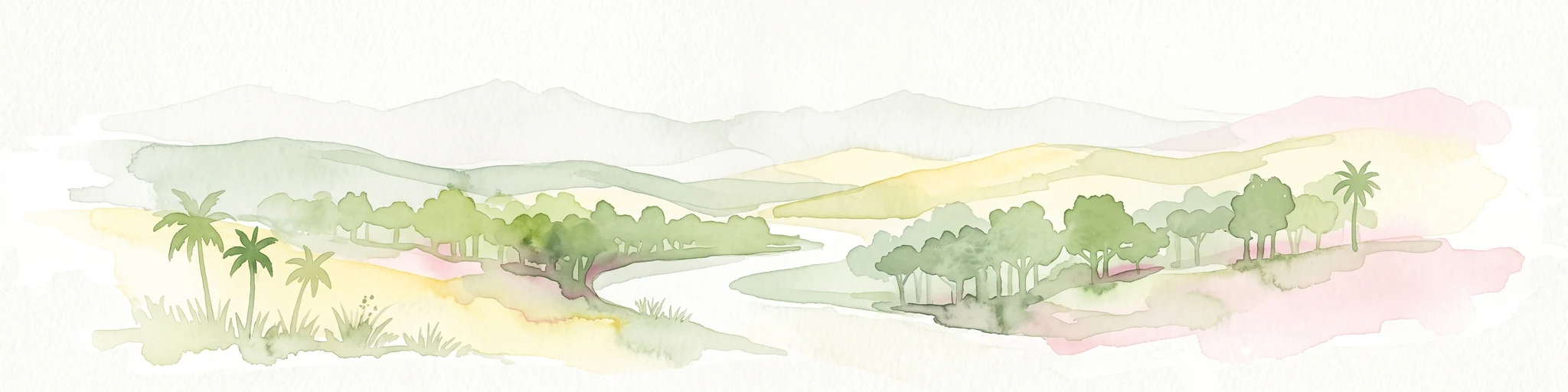
The landscape of Lagarpampa reflects the character of Bolivia's inter-Andean dry valleys, a transitional zone between higher Andean terrain and the eastern lowlands. Elevations in the area sit at roughly 1,800 meters above sea level, placing the park within a mid-elevation valley environment where temperature contrasts are significant and seasonal rainfall is limited and irregular.
The topography is shaped by the geological structure typical of the Bolivian preparation valleys: rolling hills, eroded slopes, dry riverbeds that flow intermittently, and narrow valley floors bordered by shallow ridges. Vegetation patterns follow these landforms closely, with more xerophytic, thorn-dominated communities on exposed slopes, and denser stands of dry forest in sheltered ravines and along watercourses.
Because these valleys have long been inhabited, the landscape carries visible signs of traditional agricultural use, including cultivated fields, pasture, and pathways that connect dispersed rural settlements. This gives the area a hybrid character: a working cultural landscape in which scenic dry-valley views and ecological value coexist with everyday rural life.
Lagarpampa Natural Area ecosystems, habitats, and plant life
Lagarpampa's ecological identity is defined by the inter-Andean dry valley ecosystem, locally classified within the Valle Seco Interandino ecoregion. This ecoregion is characterized by semi-arid conditions, a strong seasonal climate with dry winters, and a vegetation cover dominated by drought-adapted species such as thorn scrub, cactus, and deciduous dry forest.
Native plant species of note within the area include the mara valluna, the caraparí, and Myrocarpus emarginatus, the latter being a tree that is valued both ecologically and historically for its hard wood. The combination of native vegetation, agricultural mosaics, and remaining patches of undisturbed dry woodland creates a heterogeneous habitat structure that supports a wide range of resident and seasonally visiting fauna.
Because dry inter-Andean valleys occupy a narrow geographic band, their ecological importance is amplified. Lagarpampa's protected designation contributes to a still-limited network of conservation areas covering this ecoregion, which itself provides vital refuge for species that are adapted to seasonally harsh conditions and that have been pushed back by long-term habitat conversion.
Lagarpampa Natural Area wildlife and species highlights
Lagarpampa is most noted for its birdlife, especially for the presence of the red-fronted macaw (Ara rubrogenys). The red-fronted macaw is endemic to a small portion of Bolivia's inter-Andean dry valleys, and its conservation has become a focal point for regional biodiversity efforts. The species nests in cliff and ravine habitats within dry valleys and depends on the availability of appropriate food trees, conditions that Lagarpampa's vegetation and topography help to provide.
Beyond the red-fronted macaw, the area's birdlife reflects the broader diversity of inter-Andean dry valley avifauna, which includes raptors, smaller parrots, doves, and numerous passerines adapted to semi-arid conditions. The mosaic of native woodland, agricultural land, and seasonal water sources supports a varied community of birds across seasons.
Large and medium-sized mammals typical of Bolivian preparation valleys may also be present, though the area's human population and traditional land uses shape the distribution and abundance of these species. Where large mammals persist, they tend to use rougher, less accessible parts of the valleys. Hunting and other traditional resource uses also influence wildlife populations, which is why conservation and traditional activities are managed in parallel under the park's ordinances.
Lagarpampa Natural Area conservation status and protection priorities
Lagarpampa's conservation significance rests on its role in safeguarding one of Bolivia's most threatened and geographically restricted ecosystems. The inter-Andean dry valleys host a distinctive assembly of plants and animals that do not occur in moister Andean habitats or lowland forests, and very little of this habitat is included in Bolivia's national protected-area system. By formalizing protection at a municipal scale, Lagarpampa extends conservation coverage into a zone that national-level parks have historically under-represented.
The park is also recognized as an important refuge for the red-fronted macaw. Conservation efforts for this species have been a catalyst for several local and regional protection initiatives in Bolivia's dry valleys, and the presence of suitable habitat within Lagarpampa makes the area a component of the broader conservation strategy for this parrot.
The municipal protection model applied at Lagarpampa is itself a conservation strategy. Rather than displacing local communities, it seeks to integrate conservation with the continuation of agriculture, livestock raising, and other traditional activities, under legal frameworks set by municipal ordinances. This combination of local legitimacy, legal backing, and habitat protection gives Lagarpampa relevance beyond its borders as an example of community-rooted conservation in the Bolivian Andes.
Lagarpampa Natural Area cultural meaning and human context
Lagarpampa sits within a region of Bolivia with a strong tradition of community-based land management. The area is shaped by the social structure of the rural syndicates and subcentral organizations that represent highland communities, and it was through these institutions that the decision was made to seek protected-area status for the surrounding landscape.
The name Lagarpampa itself reflects Quechua-influenced regional naming, combining pampa, a term for flat or open land, with a local qualifier. The area is part of a wider cultural region in which agriculture, sheep and goat herding, and seasonal migration patterns have shaped identities for many generations.
Traditional livelihoods continue to play a central role. Agriculture, small-scale hunting, fishing, use of forest resources, and sheep and goat herding are all listed as socioeconomic aspects of the area, indicating that the cultural fabric of Lagarpampa is inseparable from its ecological management. The protected-area designation is not a separation of culture and nature, but a formalization of their coexistence.
Top sights and standout views in Lagarpampa Natural Area
Lagarpampa Natural Area stands out for combining inter-Andean dry valley scenery with one of Bolivia's most iconic endangered bird species, the red-fronted macaw. Its mix of native dry vegetation, agricultural landscapes, and seasonally active watercourses creates habitat that is both ecologically distinctive and visually striking.
Equally notable is the area's community-based conservation origin. The protection of Lagarpampa was driven by the subcentral organizations and rural syndicates of Lagarpampa and Mollepampa, and was formalized through municipal ordinances in 2009, making it a tangible example of how Bolivia's highland communities have shaped a new generation of protected landscapes from the bottom up.
Best time to visit Lagarpampa Natural Area
The character of a visit to Lagarpampa is shaped largely by the dry-season rainfall pattern of the inter-Andean valleys. The dry season, generally extending through the cooler months of the southern winter, tends to offer more stable weather, clearer views across the valleys, and easier access along rural roads, though temperatures can be cool at the area's elevation of about 1,800 meters. The landscape during this period has a dry, open, and warm-toned character.
The wet season changes the atmosphere of the area substantially. As seasonal rains arrive, vegetation greens up, watercourses flow more actively, and bird activity increases, which can be favorable for observing species such as the red-fronted macaw. However, rural roads and tracks may become more difficult to navigate, and weather can be less predictable. For visitors interested primarily in birdwatching and in seeing the area at its most biologically active, the transition into the wet season or its early phase is often especially rewarding.