Why Death Valley National Park stands out
Death Valley is best known for its extreme climate and dramatic topography. It holds the record for the highest ambient air temperature ever recorded on Earth at 134 degrees Fahrenheit, recorded at Furnace Creek in 1913. The park contains the second-lowest point in the Western Hemisphere at Badwater Basin, while Mount Whitney, visible in the distance, rises to 14,505 feet, creating the greatest elevation gradient in the contiguous United States. The famous moving rocks of Racetrack Playa, the extensive Mesquite Flat sand dunes, and the historic twenty-mule team borax mining operations are among the park's most recognizable features. The park is also renowned as an International Dark Sky Park, offering exceptional stargazing opportunities.
Death Valley National Park history and protected-area timeline
The human history of Death Valley spans thousands of years, beginning with Native American groups who inhabited the area from as early as 7000 BCE. The most recent inhabitants were the Timbisha people, who arrived around 1000 CE and practiced a vertical migration pattern, moving between winter camps in the valley bottoms and summer grounds in the mountains to take advantage of seasonal food sources. The valley acquired its grim name in 1849 when a group of California Gold Rush travelers, known as the Bennett-Arcane Party, became lost while seeking a shortcut and gave the valley its ominous designation despite only one fatality among their group. Mining activity followed, with borax proving the most profitable resource, leading to the famous twenty-mule team operations that hauled ore to Mojave starting in 1884. Tourism developed in the 1920s when resorts were built around natural springs at Stovepipe Wells and Furnace Creek. President Herbert Hoover proclaimed Death Valley National Monument in 1933, and the Civilian Conservation Corps subsequently developed infrastructure during the Great Depression. The monument was expanded and redesignated as a national park in 1994 through the California Desert Protection Act, making it the largest national park in the contiguous United States.
Death Valley National Park landscape and geographic character
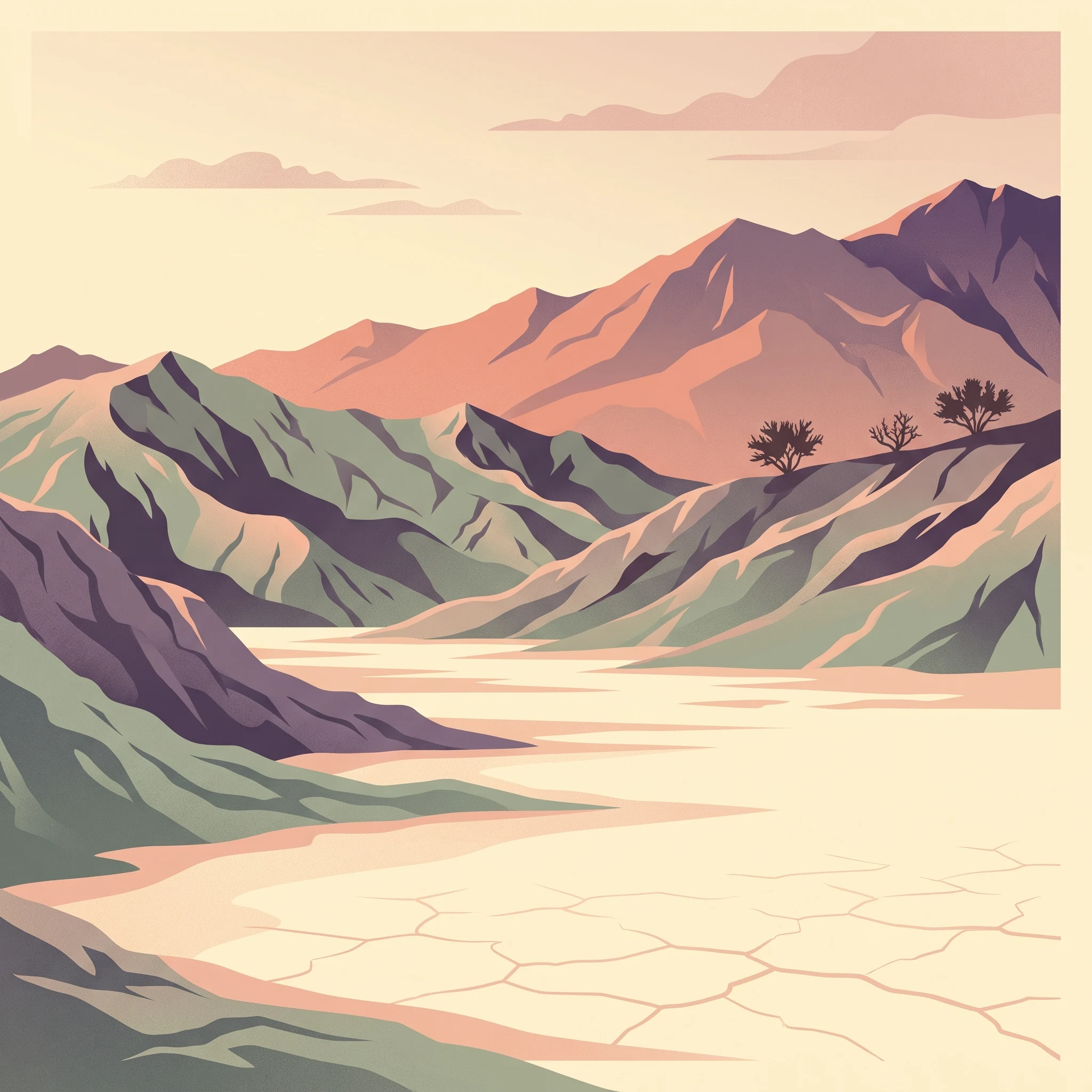
The landscape of Death Valley represents some of the most dramatic topography in North America, shaped by hundreds of millions of years of geological processes. The park contains two major valleys, Death Valley and Panamint Valley, both bounded by north-south trending mountain ranges characteristic of Basin and Range topography. The valley floor is a graben, a down-dropped block of crust between parallel faults, with the oldest exposed rocks being extensively metamorphosed and at least 1.7 billion years old. At Badwater Basin, the lowest point sits 282 feet below sea level, while Telescope Peak in the Panamint Range rises to 11,049 feet, creating the greatest elevation gradient in the contiguous United States within just 85 miles. The park contains extensive salt pans, including a 200-square-mile salt pan extending 40 miles across the valley floor. Sand dunes are present but more limited than their fame suggests, with the Mesquite Flat dune field being the most accessible. The landscape also features badlands, deep canyons, alluvial fans, and the famous Racetrack Playa where mysterious rock movement has been observed.
Death Valley National Park ecosystems, habitats, and plant life
The ecological diversity of Death Valley results from its position at the intersection of three major deserts and its extraordinary elevation range from 282 feet below sea level to over 11,000 feet. This transition zone supports vegetation typical of three biotic life zones: lower Sonoran, Canadian, and arctic/alpine. Vegetation zones progress from creosote bush, desert holly, and mesquite at the lowest elevations through shadscale and blackbrush to Joshua tree woodlands, then pinyon-juniper, and finally limber pine and bristlecone pine at the highest elevations. The salt pan itself is devoid of vegetation, while sparse cover dominates the valley floor. Plants have adapted remarkably to the harsh environment, with creosote bush and mesquite developing taproot systems extending 50 feet down to reach year-round groundwater. The park supports over 1,000 plant species, with 23 found nowhere else on Earth, including the rare rock lady.
Death Valley National Park wildlife and species highlights
Despite being one of the hottest and driest places in North America, Death Valley supports a surprising diversity of wildlife adapted to the harsh desert environment. The park is home to 51 species of native mammals, 307 species of birds, 36 species of reptiles, 3 species of amphibians, and 2 species of native fish. Small mammals are more numerous than large mammals, though bighorn sheep, coyotes, bobcats, kit foxes, cougars, and mule deer are present in the park. The most famous resident is the Death Valley pupfish, an endangered species that survives in isolated populations in Salt Creek and Cottonball Marsh, remnants of the ancient Lake Manly that once filled the valley. These small fish are survivors from much wetter times, having swum to the area from the Colorado River via a now-dried river system. The park also supports the endangered Devils Hole pupfish at a separate location added to the monument in 1952.
Death Valley National Park conservation status and protection priorities
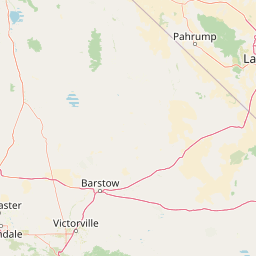
Death Valley National Park represents one of the most significant conservation designations in the United States, protecting a unique desert ecosystem that faces multiple pressures. More than 93 percent of the park carries wilderness area designation, providing the highest level of federal protection. UNESCO designated the park as the principal feature of the Mojave and Colorado Deserts Biosphere Reserve in 1984, recognizing its global significance as a desert conservation area. The park was designated as an International Dark Sky Park in 2013, protecting its exceptional night sky from light pollution. Conservation challenges include groundwater depletion from regional population growth in Las Vegas and Pahrump, which threatens the springs and habitats that sustain endemic species like the Death Valley pupfish. The park's mining history, though largely past, required ongoing restoration efforts, with the last mine closing in 2005.
Death Valley National Park cultural meaning and human context
The cultural landscape of Death Valley reflects thousands of years of human habitation and adaptation to extreme desert conditions. The Timbisha people, formerly known as Shoshone and also called Panamint or Koso, maintained a presence in the area for centuries, practicing vertical migration between valley bottoms and mountain regions to exploit seasonal food resources. Their winter camps were located near water sources in the valleys, while summer grounds in the mountains allowed access to pinyon pine nuts. The arrival of European-American travelers during the California Gold Rush brought the first non-indigenous visitors, and the valley's name emerged from this period of hardship and survival. The subsequent mining era, particularly the borax operations featuring the iconic twenty-mule teams, left a lasting cultural legacy. The construction of resorts in the 1920s, including the famous Scotty's Castle built by a Chicago millionaire, added another layer to the valley's cultural history.
Top sights and standout views in Death Valley National Park
Death Valley National Park offers extraordinary experiences centered on its extreme landscape, geological wonders, and dark sky resources. Badwater Basin, the lowest point in North America with its vast salt flat, remains the park's signature feature. The moving rocks of Racetrack Playa defy explanation and draw visitors from around the world. Hiking opportunities range from accessible walks to challenging backcountry routes across the park's 350 miles of unpaved roads. The park's designation as an International Dark Sky Park makes it one of the best places in the United States for stargazing, with the Milky Way casting visible shadows at night. Historic sites like the borax operations, Scotty's Castle, and remnants of mining towns provide cultural context to the landscape. The dramatic elevation change from Badwater Basin to Telescope Peak offers extraordinary scenic diversity within a single park boundary.
Best time to visit Death Valley National Park
The optimal time to visit Death Valley is during the cooler months from October through May, when daytime temperatures are more tolerable and nighttime temperatures can drop below freezing in the higher elevations. Summer temperatures routinely exceed 120 degrees Fahrenheit and can be dangerous, though the park remains open. Winter brings more moderate conditions with average highs in the 60s and 70s, making it ideal for hiking, sightseeing, and photography. The park has experienced exceptional wildflower displays during unusually wet winters, such as in 2005, when an ephemeral lake formed at Badwater Basin. Visitors should be aware that flash floods can occur during rain events, occasionally causing road closures and stranding visitors, as happened during major storms in 2015 and 2022.