Mori Atlas logo
National parkGrand Teton National Park

Discover the mapped boundaries and regional geographic context of this prominent national park.

Grand Teton National Park: United States of America's Protected Landscape and Atlas Geography

Grand Teton National Park stands as a significant protected landscape within the United States of America, offering a unique lens through which to explore national park geography and mapped terrain. This page serves as an authoritative entry point for understanding the park's protected identity, its specific place within the broader geography of North America, and the visual context provided by its mapped boundaries, inviting detailed atlas exploration.

mountain peaksalpine environmentglacier landscapelake and river systemswildlife viewingmountaineering

Grand Teton National Park

National park

Park overview

Structured park overview, official facts, and landscape profile for Grand Teton National Park

Grand Teton National Park park facts, protected area profile, and essential visitor context
Review the core facts for Grand Teton National Park, including designation, size, terrain, visitor scale, habitats, and operating context in one park-focused overview.

About Grand Teton National Park

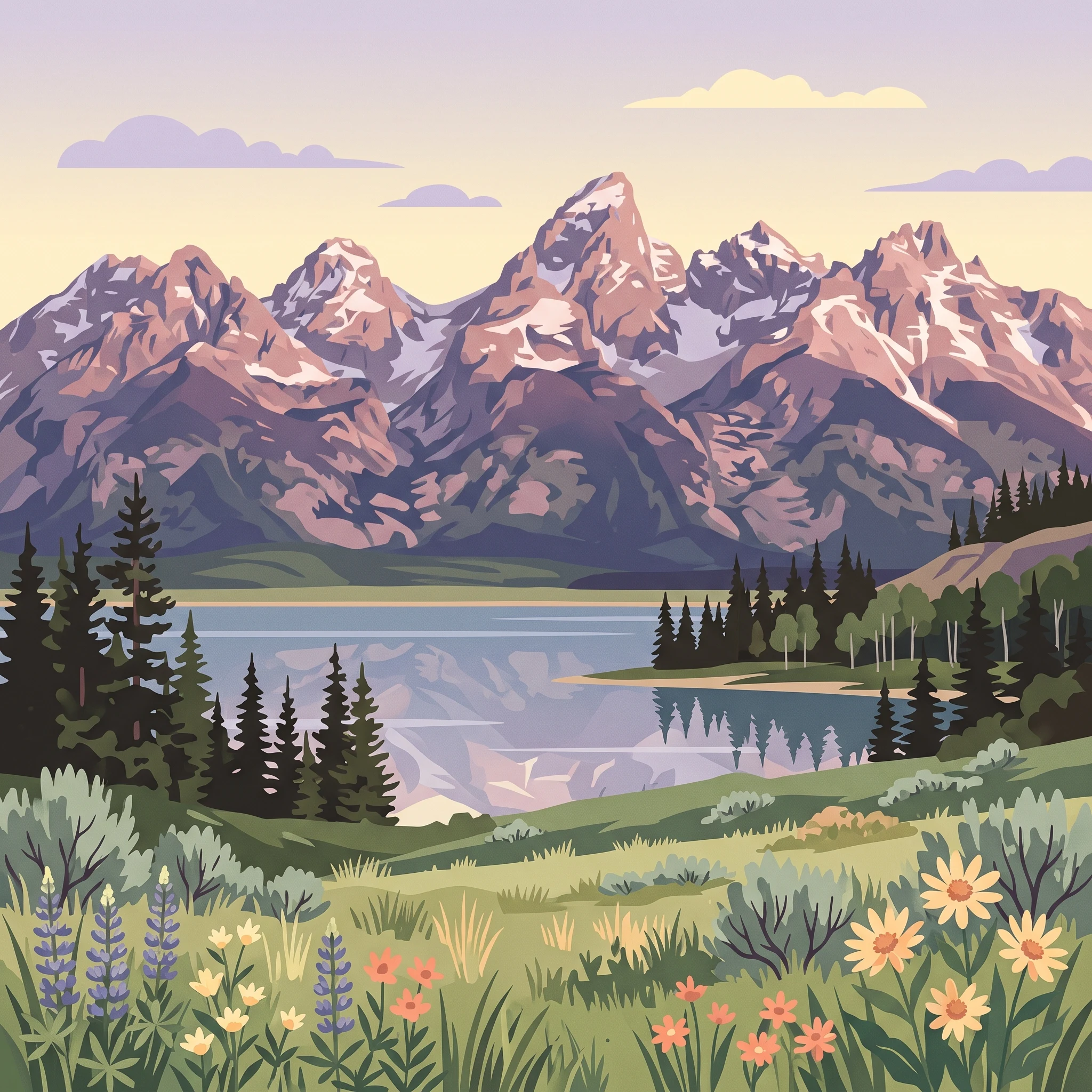
Grand Teton National Park preserves a landscape of exceptional geological and ecological significance in northwestern Wyoming. The park encompasses the dramatic Teton Range, which began forming between 6 and 9 million years ago through fault-block mountain building, making it the youngest range in the Rocky Mountains. The range rises abruptly from the valley floor without any foothills, creating a striking visual boundary between Jackson Hole and the mountains beyond. Ten peaks in the range exceed 12,000 feet above sea level, with Grand Teton reaching 13,775 feet. The valley of Jackson Hole itself is a graben valley created by the Teton Fault, which has displaced the valley downward approximately 30,000 feet relative to the mountains. The park includes Jackson Lake, formed by glacial activity and enlarged by dam construction, as well as the Snake River which flows through the length of the valley. Glacial activity, particularly during the Pinedale glaciation that ended roughly 15,000 years ago, carved the characteristic U-shaped canyons visible today, including Cascade Canyon, Death Canyon, and others that provide access into the heart of the range. Though currently in recession, approximately a dozen glaciers persist at high elevations, including Teton Glacier below the northeast face of Grand Teton, which researchers have determined could disappear within 30 to 75 years due to changing climate conditions.

Quick facts and research context for Grand Teton National Park

Grand Teton National Park covers 310,000 acres in Teton County, Wyoming, established on February 26, 1929. The park includes the major peaks of the 40-mile-long Teton Range and most of the northern Jackson Hole valley, situated 10 miles south of Yellowstone National Park. Notable features include Jackson Lake, the Snake River, a dozen small glaciers at high elevations, and over 100 alpine lakes scattered throughout the range. The park receives approximately 2.8 million visitors annually and contains more than 200 miles of hiking trails and over 1,000 drive-in campsites.

Park context

Deeper park guide and search-rich context for Grand Teton National Park

Grand Teton National Park history, landscape, wildlife, and travel context
Explore Grand Teton National Park through its history, landscape character, ecosystems, wildlife, conservation priorities, cultural context, and seasonal travel timing in a structured park guide built for atlas discovery and search intent.

Why Grand Teton National Park stands out

Grand Teton National Park is best known for its dramatically steep granite peaks of the Teton Range, which rise abruptly from the floor of Jackson Hole to create one of the most iconic mountain landscapes in North America. The park is renowned for world-class mountaineering opportunities, with the first ascent of Grand Teton in 1898 spurring a climbing tradition that continues today through guide services like Exum Mountain Guides. The park is also celebrated for its exceptional trout fishing, particularly for the Snake River fine-spotted cutthroat trout, a subspecies found only in the Snake River system.

Grand Teton National Park history and protected-area timeline

The human history of Grand Teton National Park extends back more than 11,000 years to when Paleo-Indian hunter-gatherers migrated through Jackson Hole, spending summers in the valley and wintering west of the Teton Range. When European-American explorers first entered the region in the early 19th century, they encountered the eastern Shoshone people, including the Sheep-eaters or Tukudika who maintained a close spiritual relationship with the Teton Range and relied on bighorn sheep for sustenance. Between 1810 and 1840, the region attracted fur trading companies vying for control of the lucrative beaver pelt trade, with John Colter becoming the first European-American to see the Teton Range around 1807-1808 during his fur trapping expeditions. Permanent white colonization began in the 1880s, and efforts to preserve the region as a national park commenced in the late 19th century. Grand Teton National Park was established in 1929, protecting the Teton Range's major peaks. In the 1930s, conservationist John D. Rockefeller Jr. began purchasing land in Jackson Hole through the Snake River Land Company to protect it from commercial development. Despite local opposition and Congressional attempts to prevent expansion, President Franklin Roosevelt used the Antiquities Act to establish Jackson Hole National Monument in 1943. The monument was abolished in 1950 and most of its land was added to Grand Teton National Park, creating the park as it exists today. In 1972, additional land between Grand Teton and Yellowstone was added and named the John D. Rockefeller Jr. Memorial Parkway, and in 2008 the Laurance S. Rockefeller Preserve was dedicated.

Grand Teton National Park landscape and geographic character

Grand Teton National Park showcases a dramatic landscape shaped by geological forces and glaciation. The Teton Range, the youngest in the Rocky Mountains, rises abruptly from the floor of Jackson Hole along a 40-mile-long fault-block front without foothills. The range tilts westward, rising steeply above the valley to the east and more gradually into Teton Valley to the west. Ten peaks exceed 12,000 feet, with Grand Teton at 13,775 feet, and the often-photographed Cathedral Group comprises eight peaks between Avalanche and Cascade Canyons. Mount Moran, rising 5,728 feet above Jackson Lake, is a prominent monolithic peak to the north. Jackson Hole is a 55-mile-long graben valley with an average elevation of 6,800 feet, created by the Teton Fault which has displaced the valley block downward relative to the mountains. The valley floor is relatively flat, dotted with isolated buttes such as Blacktail Butte and Signal Mountain. Most lakes in the park were formed by glaciation, with Jackson Lake being the largest at 15 miles long, 5 miles wide, and 438 feet deep. Small alpine lakes in cirques number more than 100 throughout the high country. The Snake River flows through the valley, entering Jackson Lake near the park's northern boundary and exiting near the southern edge.

Grand Teton National Park ecosystems, habitats, and plant life

Grand Teton National Park supports diverse ecosystems across an elevation range exceeding 7,000 feet. The park contains multiple ecological zones including alpine tundra above the tree line at approximately 10,000 feet, subalpine spruce-fir forests dominated by whitebark pine, limber pine, subalpine fir, and Engelmann spruce, and valley floor forests of lodgepole pine intermixed with aspen, cottonwood, alder, and willow. The sagebrush plains covering the tablelands above the Snake River represent the most widespread habitat in the park, supporting 100 species of grasses and wildflowers. Wetlands near lakes and along rivers cover large expanses, particularly along the Snake River near Oxbow Bend and Willow Flats near Jackson Lake Lodge. The park hosts over 1,000 species of vascular plants. The whitebark pine, a keystone and foundation species, is under threat from white pine blister rust and mountain pine beetles, prompting collaborative conservation efforts to protect this important tree that provides food for grizzly bears, red squirrels, and Clark's nutcrackers.

Grand Teton National Park wildlife and species highlights

Grand Teton National Park supports remarkable biodiversity with 61 species of mammals, over 300 bird species, fish, reptiles, and amphibians. The gray wolf, extirpated from the region by the early 1900s, has returned to the park from Yellowstone following reintroduction there, ensuring every indigenous mammal species now exists in the park. Large mammals include elk numbering in the thousands whose migration route passes through the park, moose staying near waterways and wetlands, bison, and pronghorn, the fastest land mammal in the western hemisphere. Approximately 100 to 125 bighorn sheep inhabit the alpine and rocky zones. Carnivores include grizzly bears, American black bears, coyotes, cougars, Canada lynx, wolverines, and river otters. Over 300 bird species have been recorded, including the calliope hummingbird, the smallest bird species in mainland North America, and trumpeter swans, North America's largest waterfowl. The Snake River fine-spotted cutthroat trout is the only native trout species in the park and is managed as a distinct subspecies by the state of Wyoming.

Grand Teton National Park conservation status and protection priorities

Grand Teton National Park plays a crucial role in preserving one of the world's largest intact mid-latitude temperate ecosystems as part of the Greater Yellowstone Ecosystem, which spans portions of three states. The park protects critical habitat for species including the gray wolf, which returned to the area after reintroduction to Yellowstone, and grizzly bears, whose recovery in the Greater Yellowstone area represents a significant conservation success. Conservation efforts focus on protecting native fish, particularly the Snake River fine-spotted cutthroat trout, the only native trout in park waters. The whitebark pine, considered a keystone and foundation species, is the subject of collaborative intervention efforts due to threats from white pine blister rust and mountain pine beetles. The park's air and water quality remain generally pristine, with monitoring showing virtually pristine water quality in Jackson, Jenny, and Taggart Lakes. Fire management plans recognize the important role of wildfire in maintaining plant and animal species diversity, with many tree species evolved to germinate after fire.

Grand Teton National Park cultural meaning and human context

The Grand Teton region has been inhabited by humans for at least 11,000 years, with the eastern Shoshone people present when European explorers arrived in the early 19th century. The Sheep-eaters or Tukudika were mountain-dwelling Shoshone who relied on bighorn sheep as a staple of their diet and maintained a close spiritual relationship with the Teton Range. Several stone enclosures on peaks, including The Enclosure on the upper slopes of Grand Teton, are thought to have been used by Shoshone during vision quests. The Teton and Yellowstone region Shoshone were relocated to the Wind River Indian Reservation after it was established in 1868. French-speaking Iroquois or French Canadian trappers may have named the Teton Range, with les trois tétons (the three breasts) shortened to Tetons. Homesteaders began settling Jackson Hole in 1884, establishing ranching operations that continued through the early 20th century before tourism became the primary economic activity.

Top sights and standout views in Grand Teton National Park

Grand Teton National Park offers exceptional mountain scenery with the Teton Range rising dramatically above Jackson Hole, world-class mountaineering on peaks like Grand Teton and Mount Moran, and renowned trout fishing for the Snake River fine-spotted cutthroat trout. The park provides extensive outdoor recreation including more than 200 miles of hiking trails, over 1,000 drive-in campsites, and boating on Jackson and Jenny Lakes. TheCraig Thomas Discovery and Visitor Center and Laurance S. Rockefeller Preserve Center provide modern visitor amenities. The park's location adjacent to Yellowstone creates opportunities for combined visits to both parks.

Best time to visit Grand Teton National Park

Grand Teton National Park offers distinct experiences across seasons. Summer and early fall provide the most comprehensive access for hiking, climbing, fishing, and wildlife viewing, with all trails and facilities open and warm daytime temperatures. Fall brings the elk migration through the valley and fewer crowds, while spring offers wildflower displays and emerging green landscapes. Winter transforms the park into a serene backcountry destination for cross-country skiing and snowshoeing on groomed trails along Teton Park Road, though many areas are closed and visitor services are limited. Summer thunderstorms are common in the afternoons, and visitors should be aware of afternoon lightning hazards in the mountains.
Park location guide

Geography guide, regional context, and park location map for Grand Teton National Park

Grand Teton National Park park geography, regions, and map view in United States of America
Understand where Grand Teton National Park sits in United States of America through a broader geographic reading of the surrounding landscape, nearby location context, and its mapped position within the national park landscape.

How Grand Teton National Park fits into United States of America

The United States of America is a federal presidential republic and one of the world's largest countries by area and population. It consists of 50 states across a vast territory spanning multiple time zones, with its capital in Washington, D.C. and largest city in New York City. The nation has a diverse economy, influential political system, and significant cultural and military presence globally.

Wider geography shaping Grand Teton National Park in United States of America

The United States occupies a vast territory in North America, bordered by Canada to the north and Mexico to the south. The 48 contiguous states stretch from the Atlantic to the Pacific Ocean, while Alaska occupies the northwestern region and Hawaii is an archipelago in the Pacific. The country encompasses diverse terrain including the Rocky Mountains, Appalachian Mountains, Great Plains, and extensive river systems.

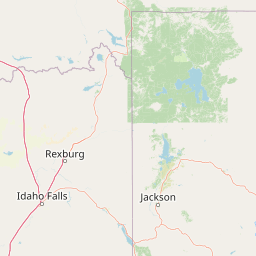
Map view of Grand Teton National Park

Use this park location map to pinpoint Grand Teton National Park in United States of America, understand its exact geographic position, and read its mapped placement within the surrounding landscape more clearly.

Pigeon | © OpenStreetMap contributors

Location context for Grand Teton National Park

Teton CountyWyoming
Park atlas

Trace regional park geography and connected protected landscapes within the iconic Greater Yellowstone Ecosystem for broader context.

Discover Other National Parks and Protected Areas Surrounding Grand Teton National Park
After exploring Grand Teton National Park, browse other national parks and protected areas with similar mountain landscapes or those that comprise the vast Greater Yellowstone Ecosystem. Compare these mapped conservation landscapes to understand their regional spread, unique geological features, and the interconnected protected ecosystems.
National parkWyoming

Yellowstone National Park: US National Park Protected Landscape & Geographic Atlas

Explore mapped boundaries and regional natural landscape context.

Yellowstone National Park represents a significant protected landscape within Wyoming, designated as a US national park. This entry offers detailed insight into its geographic scope, mapped boundaries, and the unique natural terrain that defines it. Understand its role in regional geography and discover its protected-area identity through a structured atlas exploration, providing context for its conservation landscape.

Area
8,983.18 km²
Established
1872
IUCN
II
Visitors
4.7M annual
National parkColorado

Rocky Mountain National Park: National Park Protected Landscape in Colorado

Explore its mapped boundaries and regional geographic context.

Rocky Mountain National Park is a designated National Park within Colorado, crucial for understanding the distribution and geographic context of protected areas in the United States. This detail page provides an atlas-oriented perspective, emphasizing the park's mapped boundaries and its place within the natural landscape of the region. It is designed to facilitate a clear understanding of the park's protected status and its contribution to the atlas of natural landscapes, offering factual insights for geographic discovery.

Area
1,074.28 km²
Established
1915
IUCN
II
Visitors
4.2M annual
National parkUtah

Arches National Park: Utah National Park Protected Landscape Exploration

Explore mapped terrain and geographic context.

Delve into the specifics of Arches National Park, a protected national park located in Utah. This atlas-focused entry provides detailed insight into the park's protected landscape features and geographic distribution. Understand the mapped park boundaries and the unique natural terrain that shapes this significant conservation area within the United States' broader regional geography.

Area
310.31 km²
Established
1971
IUCN
II
Visitors
1.5M annual
National parkCuster County

Wind Cave National Park: A National Park with Distinct Protected Landscape and Geographic Identity

Explore the mapped terrain and regional context of this US protected area.

Wind Cave National Park represents a key protected area within Custer County, offering users a deep dive into its unique geography and landscape characteristics. As a designated national park in the United States, its mapped boundaries provide crucial context for understanding its ecological and geological significance. This MoriAtlas entry facilitates detailed exploration, focusing on the protected land's identity and its role within the wider regional geography and natural landscape.

Area
136.97 km²
Established
1903
IUCN
II
Visitors
489.4K annual
National parkMontana

Glacier National Park: A Montana National Park with Distinct Protected Landscape Geography

Explore its mapped boundaries and regional natural terrain.

Glacier National Park represents a significant national park entity within Montana, providing a unique lens for understanding protected landscapes and regional geography. As a key component of the US protected areas network, it offers valuable insights into mapped park boundaries and the surrounding natural terrain. This page serves as a gateway to exploring the specific geographic context and landscape identity of Glacier National Park.

Area
4,100.77 km²
Established
1910
IUCN
II
Visitors
2.9M annual
National parkNevada

Great Basin National Park: Nevada's Protected National Park Geography and Map Details

Understanding its mapped boundaries and regional context.

Delve into the protected landscape of Great Basin National Park, a significant national park located in Nevada. This entry focuses on the park's geographic attributes, providing users with essential map context, details on its protected area boundaries, and an understanding of its place within the broader regional geography. It serves as a focused resource for exploring the park's unique natural terrain and landscape characteristics through an atlas-driven lens.

Area
312.3 km²
Established
1986
IUCN
II
Visitors
144.9K annual
National parkUtah

Capitol Reef National Park: Utah National Park Protected Landscape and Geography

Explore Capitol Reef National Park's mapped terrain and boundaries.

Delve into the protected landscape and geographic identity of Capitol Reef National Park, a key national park in Utah. This resource provides detailed context on its mapped terrain and regional setting, supporting a structured understanding of protected areas for atlas exploration. Discover the specific geographic features and park boundaries that define this protected natural area.

Area
978.95 km²
Established
1971
IUCN
II
Visitors
1.4M annual
National parkAlberta

Waterton Lakes National Park: Alberta's Protected Landscape and Geographic Atlas

Explore mapped boundaries and regional terrain context.

Waterton Lakes National Park represents a vital protected area situated within the province of Alberta. This atlas view focuses on its mapped boundaries and the characteristic natural terrain, providing essential geographic context for understanding its significance. Discover its role as a national park and its placement within the regional geography of Western Canada, ideal for users seeking structured data on protected lands and landscape features.

Area
505 km²
Established
1895
IUCN
II
Visitors
475.8K annual

Common questions about visiting, size, designation, and location context for Grand Teton National Park

Grand Teton National Park FAQs for park facts, access, geography, and protected area context
Find quick answers about Grand Teton National Park, including protected-area facts, park geography, trail and visitor context, and how the park fits into its surrounding country and regional landscape.
MoriAtlas Explorer

Continue Your Protected Areas Search Across the Global Atlas

Deepen your exploration by continuing the structured search for national parks and protected areas worldwide. Utilize the comprehensive filtering capabilities to compare different conservation landscapes and refine your understanding of global park geography. Discover more about the distribution and characteristics of protected natural areas.

Global natural geography