
Why Inyo Mountains Wilderness stands out
The Inyo Mountains Wilderness is best known for the extreme ecological compression within a desert mountain setting, where creosote flats give way to sagebrush slopes and ultimately to ancient bristlecone pine forests, all within a relatively short horizontal distance. The range is also recognized for its high concentration of rare and endemic plant species that have evolved on its unique limestone soils. Equally important is the wilderness's role as the only known habitat of the Inyo Mountains salamander, an endangered species found nowhere else. Combined with populations of desert bighorn sheep on the higher, more rugged slopes, the Inyo Mountains constitute one of the most botanically and zoologically distinctive arid mountain ranges in the American West.
Inyo Mountains Wilderness history and protected-area timeline
The Inyo Mountains were long utilized by Indigenous peoples of the Owens Valley and surrounding Great Basin region, including the Paiute, who moved seasonally between the valley floors and the higher mountain slopes to harvest pine nuts, hunt game, and gather plant resources. The arrival of Euro-American settlers in the 19th century brought mining, ranching, and prospecting activity into the range, leaving a scattered legacy of mining roads and diggings, particularly along the limestone-rich zones.
In the late 20th century, growing recognition of the range's ecological and geological significance led to formal wilderness designation. The Inyo Mountain Wilderness was established to protect the bulk of the range, roughly 199,000 acres, with the Bureau of Land Management administering the southern portion and the U.S. Forest Service, through Inyo National Forest, administering about 73,300 acres in the north. The designation reflected concern over the fragility of the range's endemic flora, the limited range of the Inyo Mountains salamander, and the value of preserving an intact cross-section of Basin and Range geology.
Inyo Mountains Wilderness landscape and geographic character
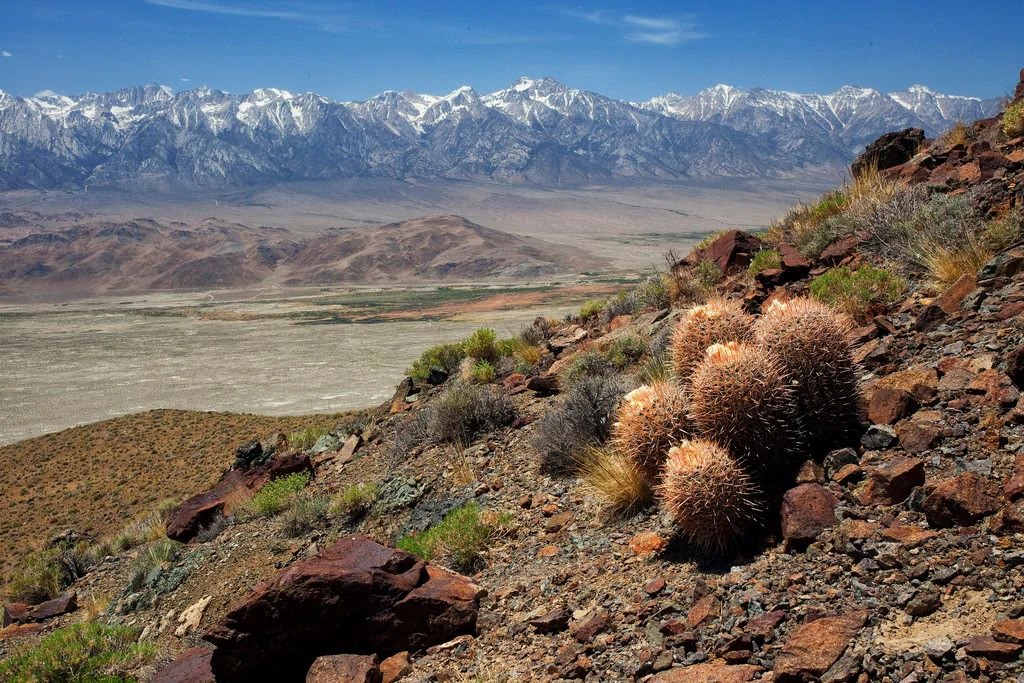
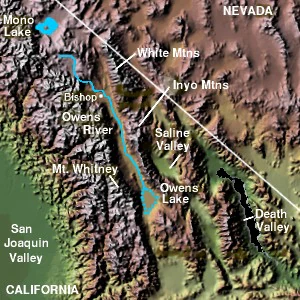
The Inyo Mountains form a classic fault-block range: a long, narrow spine tilted upward along a major fault system, with a steep eastern face and a more gradual western slope descending toward the Owens Valley. The crest is sharp and rugged, marked by prominent peaks such as Waucoba Mountain, which exceeds 11,000 feet, and a series of buttes and ridges that create dramatic skylines visible from both Owens Valley and Saline Valley.
The range's western side drops sharply toward the Owens Valley, with long alluvial fans and sagebrush-covered bajadas spreading toward the valley floor. The eastern side faces the more isolated Saline Valley, a deep basin ringed by escarpments. Between the two flanks lies a network of deep canyons, dry washes, and limestone ridges that create the range's distinctive texture of alternating cliffs and basins.
Although less visually famous than the Sierra Nevada immediately to the west, the Inyo Mountains possess a stark, layered beauty of their own, defined by long ridgelines, exposed bedrock, and the absence of human structures visible across most of the wilderness.
Inyo Mountains Wilderness ecosystems, habitats, and plant life
Ecologically, the Inyo Mountains act as a vertical island, compressing several life zones into a relatively small horizontal area. At the lowest elevations, the flora resembles that of the broader Mojave and northern Sonoran deserts, dominated by creosote bush and other drought-tolerant shrubs. Moving upward, sagebrush scrub takes over the mid-elevations, with juniper and pinyon often present on rocky slopes.
The highest elevations support stands of Great Basin bristlecone pine, among the longest-lived trees in the world. The bristlecone zone is especially significant on the Inyo Mountains because it sits in close proximity to warmer desert communities, creating unusual ecological juxtapositions. Limestone outcrops throughout the range support a specialized flora of endemic species, including the cliffdweller, bristlecone cryptantha, and Inyo rock daisy, plants found only on the Inyos' particular soil chemistry.
The combination of limestone substrate, steep topography, and elevation layering produces ecological conditions unlike those of the neighboring Sierra Nevada and White Mountains, giving the Inyo Mountains a botanical identity that is unusually distinct for an arid mountain range.
Inyo Mountains Wilderness wildlife and species highlights
The Inyo Mountains Wilderness is ecologically significant largely because of a small number of highly localized species. The most famous is the Inyo Mountains salamander, an endangered amphibian known only from talus and rocky slopes in the higher parts of the range. Its restricted distribution makes the wilderness's protection critical to its long-term survival.
Desert bighorn sheep inhabit the steep, rocky ridges and canyon walls, where their climbing ability allows them to use terrain that is inaccessible to most other large mammals. Mountain lions, coyotes, mule deer, and a variety of small mammals such as chipmunks and ground squirrels occupy the more vegetated mid-elevations.
Birdlife varies with elevation and habitat. Raptors, including golden eagles and red-tailed hawks, nest on cliffs, while smaller songbirds and woodpeckers are found in sagebrush and bristlecone habitats. The range's ecological gradients create a relatively rich avifauna for such an arid landscape.
Inyo Mountains Wilderness conservation status and protection priorities
Wilderness designation provides the Inyo Mountains with a high level of protection from development, motorized vehicle use, and mineral extraction, helping to preserve both its ecological and geological values. The wilderness is managed to maintain its natural character, with restrictions on roads, structures, and resource exploitation.
The most pressing conservation concern in the range is the survival of the Inyo Mountains salamander, which is restricted to a small number of sites and is listed as endangered. Protecting intact talus habitat and maintaining cool, shaded microclimates are central to its conservation. The range's endemic plants, especially those tied to its limestone substrates, are similarly vulnerable to disturbance and climate change.
The wilderness also preserves one of the best exposures of late Proterozoic to Cambrian strata in North America, giving it scientific as well as ecological conservation value. By keeping these rock sequences intact, the wilderness supports ongoing research into early Earth history.
Inyo Mountains Wilderness cultural meaning and human context
The Inyo Mountains have long been part of the traditional homeland of Indigenous peoples of the eastern Sierra and Great Basin, most notably the Paiute, who used the range's varied elevations for seasonal subsistence. Pine nut harvests from the higher elevations, hunting in the canyons, and gathering of plant materials in the lower slopes all drew people into the range well before Euro-American contact.
In the 19th and 20th centuries, mining activity left a visible but largely abandoned imprint on the mountains, with old roads, diggings, and small prospects scattered across the range. These features are now part of the cultural landscape but do not dominate it; the wilderness today feels largely empty of modern human presence.
Top sights and standout views in Inyo Mountains Wilderness
The Inyo Mountains Wilderness compresses an extraordinary range of environments into a narrow desert mountain range, from creosote flats near the valley floors to bristlecone pine forests near the summit. The presence of the endangered Inyo Mountains salamander and multiple endemic plant species tied to the range's limestone soils makes it one of the most biologically distinctive arid mountain ranges in the western United States.
Equally compelling is the range's geology, with extensive exposures of late Proterozoic to Cambrian rock that have made it a classic site for the study of early Earth history. The combination of scientific, ecological, and scenic values, all preserved within a single large wilderness, gives the Inyo Mountains Wilderness a depth of significance beyond its relative obscurity.
Best time to visit Inyo Mountains Wilderness
Spring and fall are generally the most comfortable seasons for visiting the Inyo Mountains Wilderness. Spring brings mild temperatures, wildflowers on the sagebrush slopes, and active wildlife, while fall offers cooler air, clear skies, and the chance to see high-elevation bristlecone groves under early-season snow. Summer can be extremely hot at lower elevations, though the higher elevations remain cooler. Winter brings cold temperatures and snow in the upper range, which can limit access but dramatically highlights the bristlecone forests.