
Why Jakobsgrund bei Gammelsbach stands out
Jakobsgrund bei Gammelsbach is best known for hosting a remarkably diverse mosaic of grassland habitats within a very small area of the sandstone Odenwald. In just a few hectares, dry mat-grass swards, heaths, and poor oatgrass meadows on south-facing slopes give way to wet meadows, small sedge fens, and low bog-like mires along the Gammelsbach stream. The site is also recognised for its traditional orchard meadows (Streuobstwiesen) and for the rare plant and insect communities these habitats support. Species such as white hyacinth orchid, marsh violet, heath bumblebees, marbled white butterflies, and meadow ants' blues are typical of the reserve, making it a textbook example of how small, extensively used valley landscapes can carry high conservation value.
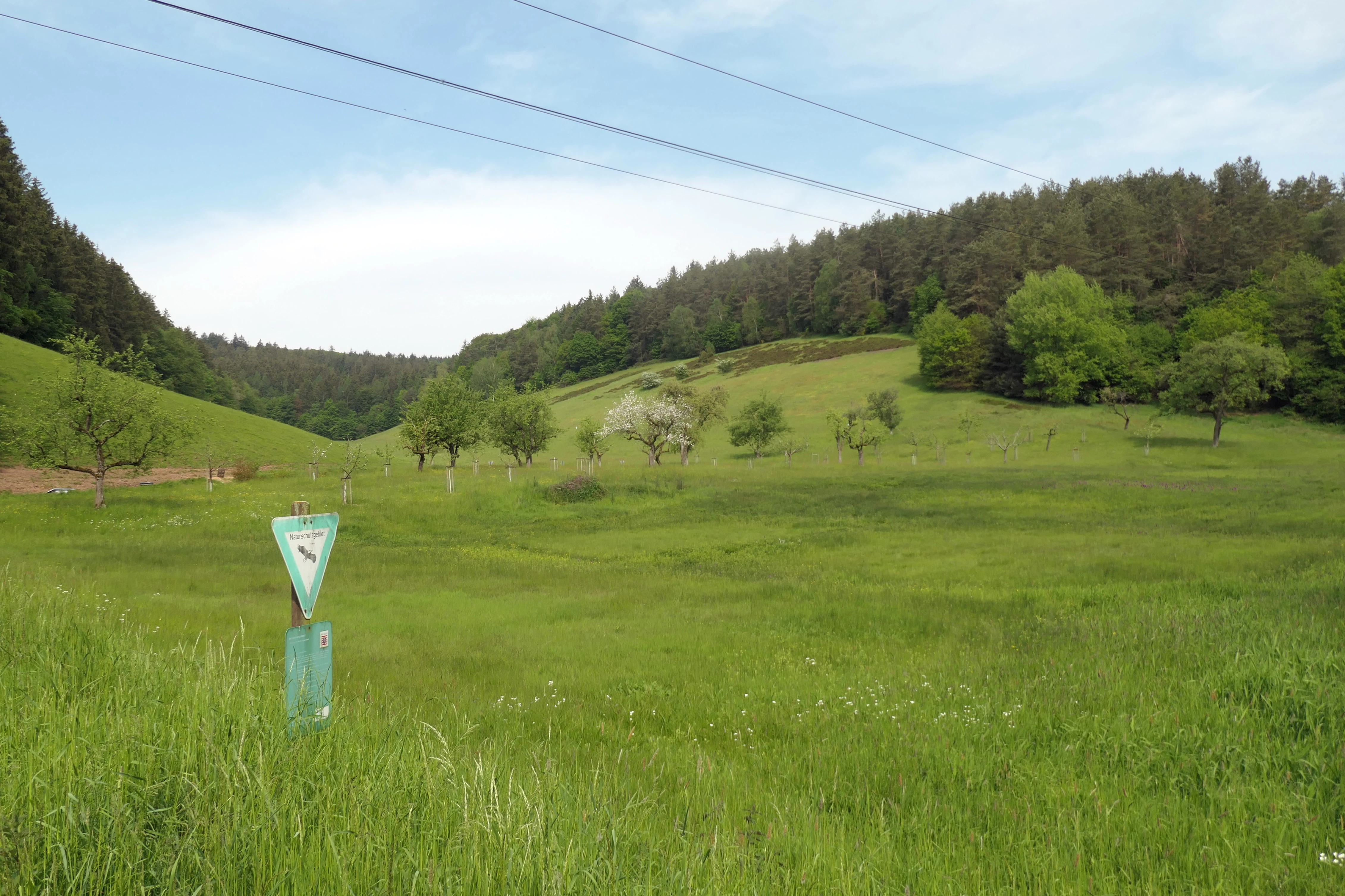
Jakobsgrund bei Gammelsbach history and protected-area timeline
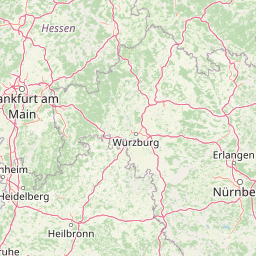
Jakobsgrund bei Gammelsbach was officially designated as a nature reserve (Naturschutzgebiet) on 4 March 1996, recognising the long-standing ecological value of the meadow valley northwest of the village of Gammelsbach. Before formal protection, the area had been shaped by centuries of traditional, low-intensity agricultural use: hay-making, grazing, and the management of scattered orchard trees had created and maintained the open grassland habitats on which the site's botanical diversity depends.
In 2008 the reserve's status was elevated in practical terms when it became part of the larger FFH area "Jakobsgrund und Gammelsbachaue", joining the European Natura 2000 network. This integration connected the small national reserve to a wider landscape management framework, with mowing schedules and habitat measures now coordinated under the FFH management plan. The shift reflected a broader trend in German conservation toward embedding small, high-value nature reserves into larger landscape-scale protection schemes.
Jakobsgrund bei Gammelsbach landscape and geographic character
The landscape of Jakobsgrund bei Gammelsbach is shaped by the narrow, V-shaped valley of the Gammelsbach and its westward-opening side valley. The reserve occupies a tight stretch of valley floor and slope in the sandstone Odenwald, with elevations ranging from roughly 320 to 390 metres above sea level.
Slopes are steep and locally exposed, particularly on south-facing sections where sun and dryness create conditions more typical of open heaths than of central European forest. The valley floor is comparatively flat and damp, carved by the stream and softened by accumulated sediment and peat-like deposits. The contrast between the dry, sunlit slopes and the cool, humid valley bottom is one of the defining features of the scenery, and it produces the patchwork of habitats that makes the reserve unusual.
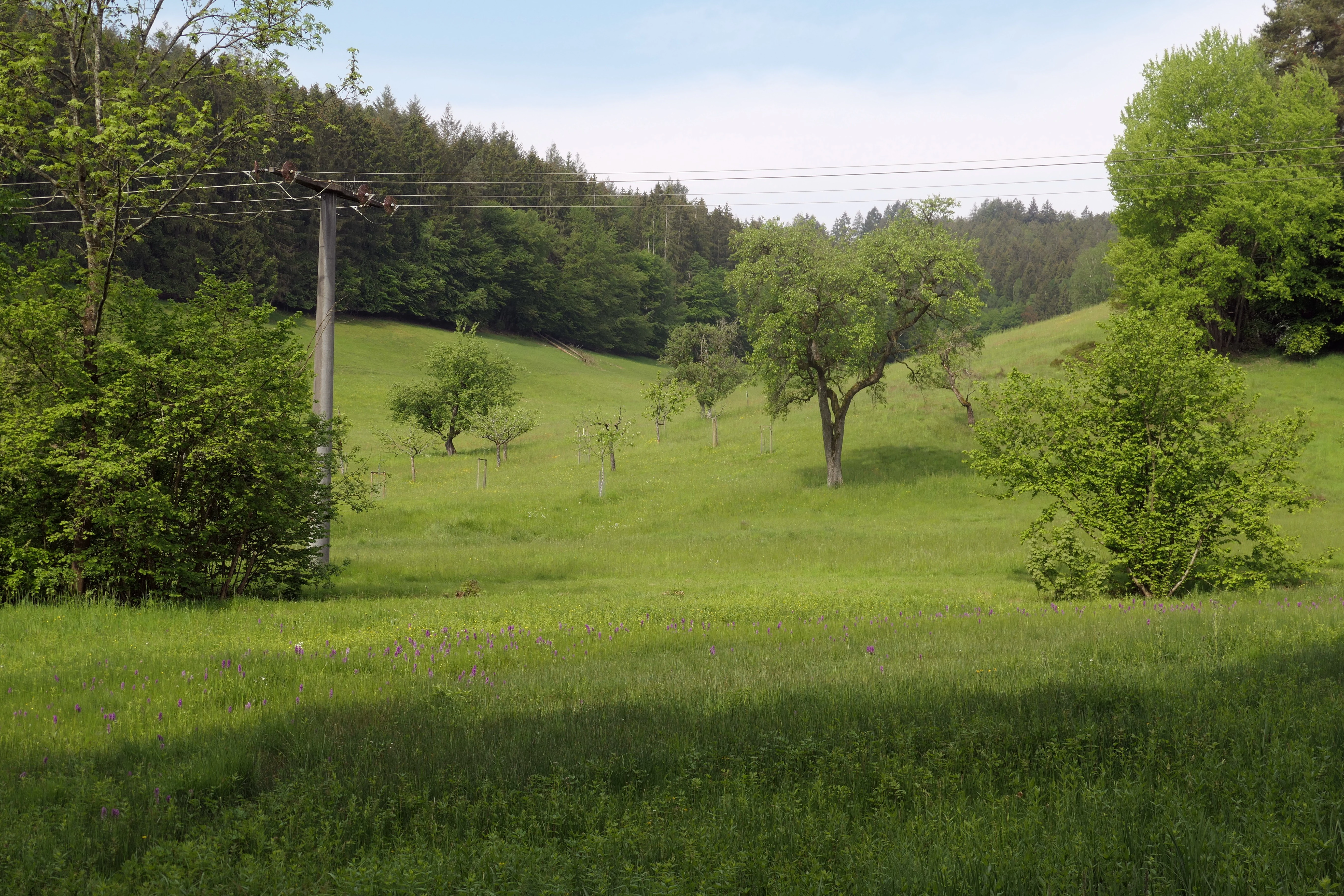
Jakobsgrund bei Gammelsbach ecosystems, habitats, and plant life
Ecologically, Jakobsgrund bei Gammelsbach stands out because it preserves a remarkable variety of grassland communities compressed into a very small area. On dry, acidic, south-facing slopes, the vegetation is dominated by mat-grass swards (Borstgrasrasen) with elements of heath and broom heather, while neighbouring, slightly richer areas support poor meadow oatgrass (Glatthafer) meadows. The valley bottom, in contrast, is characterised by small sedge fens, wet meadows, and patches that approach low bog-like (Niedermoor) conditions.
Orchard meadows (Streuobstwiesen) along the valley sides add a further distinct habitat layer, linking traditional land use to biodiversity. The combination of dry and wet, poor and slightly richer, open and structurally complex habitats creates transitions that are rare in such a concentrated setting, and that sustain a diverse community of plants adapted to very different moisture and nutrient conditions. The site is a textbook example of the ecological richness produced by traditional small-scale farming in the sandstone Odenwald.
Jakobsgrund bei Gammelsbach wildlife and species highlights
The mosaic of habitats supports an unusually rich insect fauna. Warm, dry slopes host species such as the marbled white butterfly, the two-coloured bush cricket, and the wart-biter cricket, while the damp meadows along the stream are home to the large and small meadow ants' blue butterflies (Dunkler and Heller Wiesenknopf-Ameisenbläuling), whose larvae depend on specific ant species living in the wet meadow vegetation.
Birds also make use of the varied habitats: the red-backed shrike (Neuntöter) uses the dry, open slopes as a hunting territory, taking advantage of the abundant insect life. In wetter areas near the Gammelsbach, the common frog (Grasfrosch) is a typical resident of the damp meadows and the stream margins. The combination of flower-rich grasslands, scrub edges, heaths, and riparian zones supports pollinators, predatory insects, amphibians, and birdlife together within a very small footprint.
Jakobsgrund bei Gammelsbach conservation status and protection priorities
Conservation at Jakobsgrund bei Gammelsbach centres on maintaining the open, semi-natural grassland mosaic that has developed through long use of the valley. The reserve aims to protect rare plant and animal species associated with both dry habitats, such as mat-grass swards and heaths, and wet habitats, including small sedge fens and low bog-like mires. Orchards of traditional fruit trees form a third conservation priority, both for their biodiversity value and for the cultural landscape character they sustain.
Management focuses on extensive, low-intensity use of the meadows: no fertilisers or pesticides, late or carefully timed mowing, and grazing practices compatible with the conservation goals. Since 2008, these measures have been formally coordinated through the management plan of the FFH area "Jakobsgrund und Gammelsbachaue", aligning the small national nature reserve with broader European habitat protection objectives under the Natura 2000 network.
Jakobsgrund bei Gammelsbach cultural meaning and human context
The cultural dimension of Jakobsgrund bei Gammelsbach lies in the traditional rural landscape that surrounds and sustains it. The reserve's mosaic of orchards, hay meadows, and grazed slopes reflects centuries of small-scale farming in the Odenwald, where the interplay of village life, livestock, and wood pasture shaped a rich man-made landscape of high biodiversity.
The valley still carries traces of this heritage in its scattered traditional fruit trees, small fields, and stream-fed meadows. The persistence of these practices, alongside formal protection, is what gives the site not just ecological value but also a clear cultural-landscape identity rooted in the history of the Gammelsbach and Beerfelden communities.
Top sights and standout views in Jakobsgrund bei Gammelsbach
A small valley protected for an unusually dense mosaic of dry and wet grassland habitats in the sandstone Odenwald. Steep south-facing slopes with mat-grass and heaths sit directly alongside small sedge fens, wet meadows, and traditional orchards along the Gammelsbach stream.
The reserve supports rare plants such as white hyacinth orchid and marsh violet, harbours meadow ants' blue butterflies along its damp meadows, and provides hunting territory for red-backed shrikes on its drier slopes. Since 2008 it has been integrated into the European Natura 2000 network through the FFH site "Jakobsgrund und Gammelsbachaue".
Best time to visit Jakobsgrund bei Gammelsbach
The valley has a distinct seasonal character that reflects the different habitats it protects. Late spring and early summer are the most rewarding periods for wildflowers and orchids, when the wet meadows around the Gammelsbach come into bloom and plants such as white hyacinth orchid and marsh violet are visible. This period is also peak time for many of the butterflies and other insects that the reserve is known for.
Late summer and early autumn bring warmer, drier conditions that favour the insect communities on the south-facing slopes, including bush crickets and butterflies of dry habitats. Visits should generally be timed to coincide with mild, dry weather, since the valley bottom can be wet and muddy, and several of the most interesting habitats lie along the stream and its margins.