Why Kuop stands out
Kuop is best known for being the largest officially designated marine protected area in the Federated States of Micronesia, despite having almost no permanent land area. Its remote, uninhabited status and its position just south of one of the most famous lagoon systems in the Pacific give it a distinctive dual identity: a near-barren coral atoll above water and a substantial conserved marine zone below. It is also notable among Pacific atolls for its clean, undisturbed reef environment.
Kuop history and protected-area timeline
Kuop is believed to have first been recorded by the Spanish navigator Alonso de Arellano in 1565, placing it among the early European-known atolls of the western Pacific. Like many islands in Chuuk State, it would have been part of long-established Micronesian maritime and cultural networks before that point, though documented history in the European sense begins with this Spanish contact.
During World War II, Kuop became an incidental site of military history when, on February 4, 1944, as part of Operation Hailstone at Chuuk Lagoon, the Japanese destroyer Tachikaze ran aground on the atoll's reef and later sank. The broader Operation Hailstone was a major American naval assault on the Japanese fleet anchored at Truk, and Kuop's reef became a small but tangible part of that campaign simply because of its proximity to the lagoon.
In the modern era, Kuop's history has shifted from one of navigation and wartime hazard to one of conservation designation. As an uninhabited desert island, it has been formally recognized as the largest marine protected area in the Federated States of Micronesia, a status it continues to hold.
Kuop landscape and geographic character
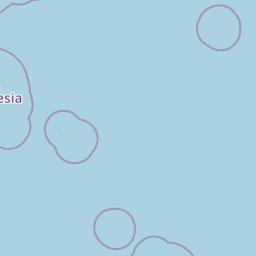
Kuop is a classic low-lying coral atoll, defined more by its reef and lagoon geometry than by any dramatic land features. The atoll stretches about 21.5 kilometers along its long axis with a maximum width of around 8 kilometers, forming an elongated oval ring of reef enclosing a central lagoon. Its land area is exceedingly small in proportion to this reef structure, amounting to only about 0.5 square kilometers in total.
The visible land consists of two small islands and two islets perched on the reef. The largest of these, known both as Givry and Feneppi, lies at the northern end of the atoll. These land surfaces are typical of Micronesian atolls: narrow, low, and composed largely of coral-derived material, with vegetation shaped by salt spray, wind, and limited freshwater resources. The reef rim itself is the dominant landscape feature, marking the boundary between the open Pacific and the protected lagoon waters within.
Kuop conservation status and protection priorities
Kuop's principal significance lies in its conservation status. As an uninhabited coral atoll, it has been officially designated the largest marine protected area in the Federated States of Micronesia, a status that remains in place currently. Its protected designation reflects the value of its largely undisturbed reef and lagoon ecosystem in a region where populated islands and busy lagoons face increasing environmental pressure.
The atoll's combination of very small land area and substantial marine protected zone illustrates a conservation model in which the surrounding ocean, rather than the islands themselves, is the primary habitat of concern. This makes Kuop an important reference site for understanding what Micronesian reef ecosystems look like in the absence of sustained human settlement or industrial activity.
Top sights and standout views in Kuop
Kuop stands out as one of the few truly uninhabited atolls in Chuuk State, with no permanent population and a land area of only 0.5 square kilometers spread across two islands and two islets. It holds the formal distinction of being the largest marine protected area in the Federated States of Micronesia, giving its reefs and lagoon a protected status that contrasts with the heavily used Chuuk Lagoon just a few kilometers to the north. Its remoteness, combined with its WWII-era role as the grounding site for the Japanese destroyer Tachikaze in 1944, gives the atoll both a modern conservation identity and a small but visible place in Pacific military history.