Why Modrzyna Nature Reserve stands out
Modrzyna is best known for being one of Poland's key natural sites for the rare Polish larch (modrzew polski), a Carpathian conifer subspecies. The reserve preserves mature mixed fir-larch forest with trees well over two centuries old and exceptionally wide trunks.
Modrzyna Nature Reserve history and protected-area timeline
Modrzyna Nature Reserve was established in 1953 as a floristic reserve under Polish law. Its founding act designated the protection of a natural stand of Polish larch growing in mixed stands with fir, reflecting early post-war conservation priorities focused on preserving rare native tree populations in the Carpathians.
Originally the reserve covered 6.80 hectares. In 1959 it was expanded to 14.46 hectares, and it has since reached its current size of 17.32 hectares. The reserve was also reclassified as a floristic reserve of the shrubs and trees subtype, underscoring its lasting emphasis on woody plant communities rather than open communities or non-vegetation features.
Today Modrzyna remains a small but well documented example of Poland's tradition of creating specialist forest reserves. Its location inside Jaśliska Landscape Park and its integration into the Dukla Forest Inspectorate's management framework reflect the broader evolution of Polish nature protection from isolated reserve creation toward broader landscape-scale conservation in the Carpathians.
Modrzyna Nature Reserve landscape and geographic character
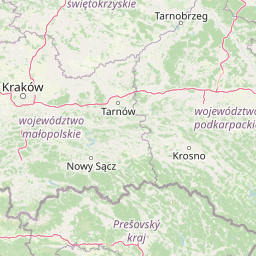
Modrzyna lies on the slopes of the Beskid Niski, a part of the Western Carpathians characterized by relatively gentle, heavily forested ridges rather than dramatic alpine peaks. The terrain is typical of the lower mountain and submontane zone, with mixed deciduous and coniferous forest stretching across the surrounding landscape.
Approximately half of the protected area consists of mixed fir-larch forest, with the remainder made up of related Carpathian forest communities that grade outward into the wider forest mosaic of the Jaśliska Landscape Park. The reserve fits naturally into this broader forested terrain, the surface shaped by long-term forest cover rather than by open meadows or human-modified land.
The reserve's relatively low elevation and sheltered Carpathian slope context create a cool, humid microclimate consistent with the region's mixed fir-dominated forests. This climatic setting is central to the survival of the Polish larch stand and of the associated ancient fir-larch grąd that defines the reserve.
Modrzyna Nature Reserve ecosystems, habitats, and plant life
The reserve's nature is defined by its core plant community: mixed fir-larch forest, called grąd jodłowy with Polish larch, which covers nearly half of the protected area. The remaining woodland belongs to related Carpathian forest types typical of the Beskid Niski.
A particular ecological focus of Modrzyna is the population of Polish larch itself. In 1997 the reserve contained 596 living and 48 dead specimens of this rare conifer, with individual trees exceeding 200 years in age and reaching trunk diameters of more than 90 cm. The presence of so many old individuals makes the reserve a genetic and structural reservoir for the species in the Polish Carpathians.
Alongside the dominant larch and fir, the reserve protects several legally protected plant species, including mezereon (wawrzynek wilczełyko) and white helleborine (podkolan biały). A rare protected fungus, Hericium flagellum (soplówka jodłowa), has also been recorded, tied ecologically to old fir hosts and therefore closely linked to the health of the reserve's ancient tree population.
Modrzyna Nature Reserve wildlife and species highlights
Modrzyna supports a typically rich Carpathian forest fauna. Among larger mammals, red deer, roe deer, foxes, wolves, and Eurasian lynx are recorded, with brown bears and European wildcats appearing rarely. The reserve also hosts small mammals typical of Carpathian forests: rodents including mice and squirrels, members of the dormouse family (popielicowate), hares and related lagomorphs, mustelids such as martens and weasels, and several bat species.
The birdlife is particularly notable. The reserve's avifauna includes great spotted woodpecker, common blackbird, Eurasian dunnock (pokrzywnica), European robin, lesser spotted eagle (orlik krzykliwy), Ural owl (puszczyk uralski), and the three-toed woodpecker, a species strongly associated with old coniferous and mixed mountain forests.
Among reptiles and amphibians, common species such as lizards, newts, frogs, common toads, and grass snakes are recorded, while the common European adder and the fire salamander occur more rarely. The combination of large predators, specialist forest birds, and a varied amphibian and small mammal fauna reflects the intact character of the reserve's Carpathian forest ecosystem.
Modrzyna Nature Reserve conservation status and protection priorities
Modrzyna's principal conservation value lies in the protection of a natural, age-diverse stand of Polish larch, a regionally rare conifer subspecies that depends on intact Carpathian mixed forest habitat. By preserving old trees, including individuals older than two centuries, the reserve acts as a living gene bank for the species and safeguards the structural complexity of mixed fir-larch forest.
The reserve also contributes to the conservation of associated rare species, particularly mezereon, white helleborine, and Hericium flagellum, a fungal species that depends on old fir trees. The legal framework backing the reserve, including floristic reserve status of the shrubs and trees subtype, reinforces the protection of its woody plant communities.
Modrzyna's location within Jaśliska Landscape Park and its integration into the Dukla Forest Inspectorate's forestry management give it additional protection through the broader Polish approach of layering strict site-level protection within larger landscape-scale conservation areas, helping maintain ecological connectivity across the Beskid Niski.
Top sights and standout views in Modrzyna Nature Reserve
Modrzyna is distinguished by the unusual combination of an ancient Polish larch stand within a working Carpathian forest landscape. Its trees, some over 200 years old with trunks wider than 90 cm, give the reserve a rare old-growth character for such a small protected area.
The reserve's protected rare plants and fungi, combined with its fauna including lynx, wolves, brown bears, Ural owl, and three-toed woodpecker, mark it as a notably complete example of Beskid Niski forest ecology in compact form.