Why Grutas del Palacio stands out
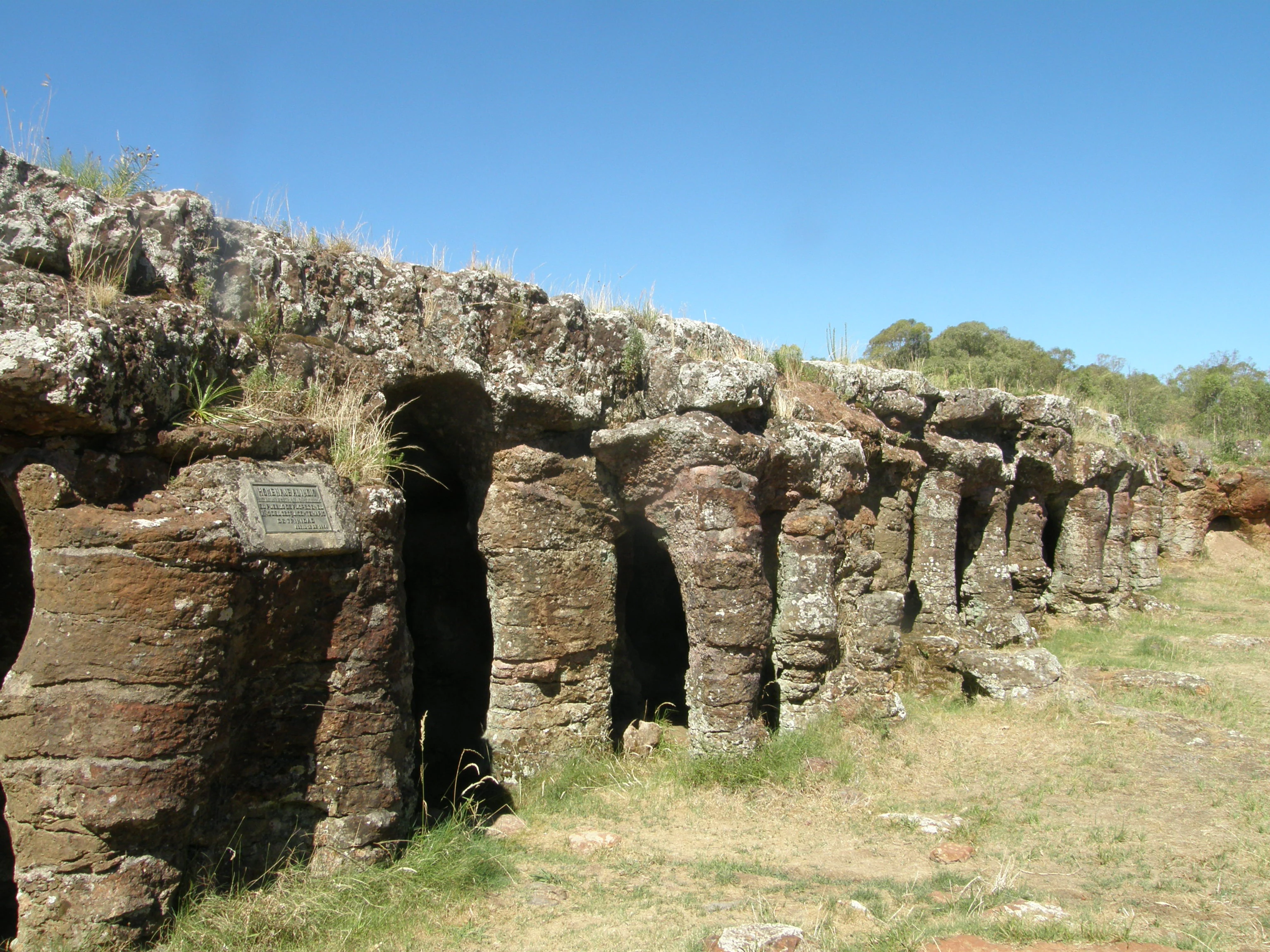
Grutas del Palacio is best known for a single, striking geological attraction: a labyrinthine cavern-like structure whose roof is a ferrified sandstone shell resting on dozens of columnar supports roughly two meters tall, sculpted by erosion over tens of thousands of years. The site is also recognized for anchoring Uruguay's entry into the international geopark movement, becoming the second South American geopark after Araripe in Brazil. The combination of its Cretaceous sandstone origin, Tertiary-age hardening, and column-supported architecture gives the formation a visually distinct, almost monumental appearance that has earned it the comparison to a palace suggested by its name. It is treated both as a natural monument of national importance and as a flagship geosite within the broader Grutas del Palacio Geopark.
Grutas del Palacio history and protected-area timeline
The visible geological history of Grutas del Palacio stretches back to the Late Cretaceous, around 70 million years ago, when the sediments that would become its rocks were first deposited in central Uruguay. The transformation of those loose sands into the ferrified sandstone observed today occurred later, during the early Tertiary, when iron-rich groundwater cemented the deposits into hard rock. Although the precise age of the cavern itself has not been definitively established, it is believed to be at least several tens of thousands of years old, and active studies continue to refine that chronology.
The cultural history of the site is more recent in human terms but layered. Local traditions and indigenous narratives associate the cavern with pre-colonial occupation; it is believed to have served as a dwelling for indigenous groups, and an indigenous legend is tied to the place. No rock paintings have been documented at Grutas del Palacio, distinguishing it from the nearby Chamangá rock art locality in the same region.
Modern scientific engagement began in the early twentieth century, when Dr. Karl Walter, who headed the Geology chair at Uruguay's Faculty of Agronomy from 1909 to 1938, conducted the first systematic geological study of the site's materials. His publications remain a reference for current researchers, and the site has continued to draw scientific and educational interest in subsequent decades.
The most significant modern milestone came on 21 May 2013, when decree N.º 153/013 formally incorporated Grutas del Palacio into Uruguay's National System of Protected Areas (SNAP) as a natural monument. In the same period, it joined the Global Geoparks Network, anchoring the country's first geopark and becoming the second geopark in South America, following the Araripe Geopark in Brazil. This recognition elevated the site from a regionally known geological curiosity to an internationally designated geosite.
Grutas del Palacio landscape and geographic character
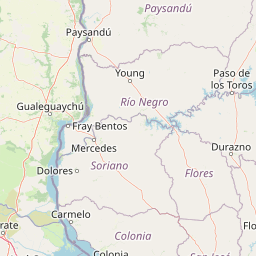
The landscape of Grutas del Palacio is defined by gentle Uruguayan interior countryside, with the reserve itself set within a small area of rolling terrain in the department of Flores. The locality of Marincho provides the human context; the nearest major city is Trinidad, the departmental capital, located about 46 kilometers to the south along the historic alignment of Ruta Nacional N.º 3. Far from Uruguay's coast, the area lies inland in the country's central pastoral belt.
The dominant landscape feature is the cavern itself, which is not a typical cave formed in soluble rock but rather an erosional structure built from sandstone. A hardened cap of ferrified sandstone, a crust of iron-cemented rock, forms a roof over a series of columnar sandstone supports about two meters tall. Erosion has exposed this architecture as a labyrinthine front several meters across, of which only about 40 meters are easily accessible to the public. The result is a visually unusual landform: a natural structure that resembles a vaulted hall supported by pillars, which gave the site its suggestive name.
Grutas del Palacio ecosystems, habitats, and plant life
As a geological natural monument, Grutas del Palacio is primarily managed around the conservation of its sedimentary formations rather than a broad suite of ecosystems. The surrounding terrain falls within Uruguay's central inland landscape of pastoral countryside and low rolling relief, where native grasslands, shrubby vegetation, and patches of woodland intersect with agricultural land use.
The protected-area territory extends beyond the immediate geological feature and includes the Ecoparque Talice (Reserva de Flora y Fauna Dr. Rodolfo Talice), which broadens the site's ecological role into native flora and fauna conservation alongside the geological heritage. Together, these adjacent land uses give the broader geopark territory a mix of geological, grassland, and small-wildlife habitat character, even though the geologically anchored natural monument itself is small and tightly defined.
Grutas del Palacio wildlife and species highlights
The natural monument itself, focused on a single geological feature, does not host a distinctive or well-documented fauna of its own. However, the broader Grutas del Palacio Geopark and the Ecoparque Talice (Reserva de Flora y Fauna Dr. Rodolfo Talice) within its territory extend the site's natural values to include native flora and fauna, providing a context for wildlife observation and environmental education within the geopark setting.
The wider department of Flores and the central Uruguayan countryside surrounding the reserve support typical inland species associated with grasslands, gallery vegetation, and small woodland patches, including both native and rural fauna. Because the protected designation emphasizes geology rather than wildlife, the site is best understood ecologically as a geological reserve embedded in, and complementing, the broader pastoral and native-grassland landscape of central Uruguay.
Grutas del Palacio conservation status and protection priorities
Grutas del Palacio's conservation significance rests equally on its geological character and on its institutional recognition. As a natural monument, it protects a singular erosional landform, a ferrified sandstone crust supported by columnar pillars, that is rare both nationally and regionally. Without formal protection, such a localized geological feature would be vulnerable to extractive activities, infrastructure works, or unregulated tourism pressure. The natural-monument designation provides a formal framework for guarding the site's scientific and scenic values.
The site's importance extends beyond its boundaries through its anchor role in the Grutas del Palacio Geopark. Joining the Global Geoparks Network in conjunction with its 2013 incorporation into the Sistema Nacional de Áreas Protegidas brought international recognition of the site's geoheritage and tied its management into wider geoconservation frameworks. The inclusion of the Ecoparque Talice within the geopark territory links geological conservation with biodiversity and environmental education, broadening the conservation footprint of the site beyond a single rock formation.
In practical terms, the reserve helps safeguard a record of Late Cretaceous sedimentation and early Tertiary iron cementation, processes that illuminate the deep geological history of central Uruguay. It also preserves a cultural-association layer: a place tied to indigenous oral tradition, even in the absence of rock paintings, and a landmark that helped launch Uruguay's modern geopark program.
Grutas del Palacio cultural meaning and human context
Grutas del Palacio carries a meaningful, if modest, cultural dimension tied to the indigenous peoples of Uruguay. Local tradition holds that the cavern served as a dwelling for indigenous inhabitants, and a specific indigenous legend is attached to the place. The site therefore sits within a regional heritage of indigenous use of natural shelters and rock formations in interior Uruguay.
Notably, despite this association, no rock paintings have been documented at Grutas del Palacio, distinguishing it from the nearby Chamangá rock art locality in the same broader region. The site's cultural identity is instead carried primarily by oral tradition and by twentieth-century scientific study, most notably the geological work of Dr. Karl Walter between 1909 and 1938, whose publications are still consulted today and tie the place into Uruguay's academic geoscience history.
Top sights and standout views in Grutas del Palacio
The defining highlight of Grutas del Palacio is the visual and geological singularity of its column-supported sandstone cavern, a ferrified sandstone roof resting on dozens of two-meter-tall sandstone pillars within a compact 45-hectare natural monument. The site also stands out as the anchor of Uruguay's entry into international geopark networks, joining the Global Geoparks Network alongside its 2013 designation as a protected natural monument under decree N.º 153/013.
Complementing these strengths is the site's layered role: a geosite of Cretaceous sedimentary origin, a cultural site associated with indigenous use and legend, and a multi-use protected landscape that includes the Ecoparque Talice within its broader territory. Together, these traits make Grutas del Palacio one of the most distinctive geological reserves in Uruguay and the nucleus of the country's first geopark.
Best time to visit Grutas del Palacio
Grutas del Palacio lies in central Uruguay, where the climate is temperate with four well-defined seasons and relatively mild conditions year-round. Spring and autumn tend to offer comfortable temperatures, softer light on the sandstone formations, and the green countryside typical of Uruguay's pastoral interior, which suits both exploration of the geological site and enjoyment of the wider geopark landscape.
Summer brings warmer weather and longer daylight hours, useful for visiting the geological feature and the on-site interpretation areas, while winter is cooler and can bring shorter days and occasionally wetter ground conditions around the cavern approach. Because the site is primarily a geological and educational reserve rather than a wildlife-focused park, seasonality has more effect on comfort and landscape atmosphere than on visitor access fundamentals. Travelers should plan around mild weather windows for the most rewarding experience of the rock formation and its surrounding countryside.