Why Mooskiefernwald von Dudenhofen stands out
The reserve is best known for protecting one of the rare remaining examples of a lowland moss-pine woodland, a habitat type defined by extensive pine canopy, a distinctive moss-dominated ground layer, and open sandy soils. Within the urbanized Rhine-Main region, this compact woodland supports plant species such as umbellate wintergreen and creeping lady's tresses, along with a notable community of woodland birds. It is also recognized as an important refuge in the Landkreis Offenbach for bird species that depend on open pine forest structure, including woodpeckers, nightjars, and other ground-nesting or cavity-nesting species that have become scarce in more intensively managed landscapes.
Mooskiefernwald von Dudenhofen history and protected-area timeline
The Mooskiefernwald von Dudenhofen was formally designated as a nature reserve in 1999, with the official NSG identification number 1438030. The timing of its protection reflects growing awareness, during the late twentieth century, of the rarity of lowland moss-pine woodland in Hesse and of the pressure being placed on such habitats by urban expansion, infrastructure development, and forestry changes across the Rhine-Main region.
Following designation, the reserve was incorporated into the Natura 2000 network under site code 6019-304, aligning local conservation efforts with European Union-wide habitat and species protection frameworks. Since then, the area has continued to be managed by the lower nature conservation authority of the Landkreis Offenbach, with its primary focus being the preservation of both its pine woodland structure and the rare moss and ground-flora communities that depend on its sandy soils.
Mooskiefernwald von Dudenhofen landscape and geographic character
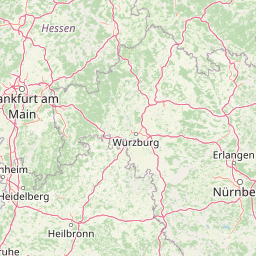
The terrain of Mooskiefernwald von Dudenhofen lies in the gently undulating Rodgau lowlands of southern Hesse, with elevations ranging between roughly 145 and 160 meters above sea level. The reserve is positioned at the eastern edge of the Dudenhofen municipal boundary, directly adjacent to the extensive test facilities of Opel and close to the suburban fabric of Rodgau-Dudenhofen.
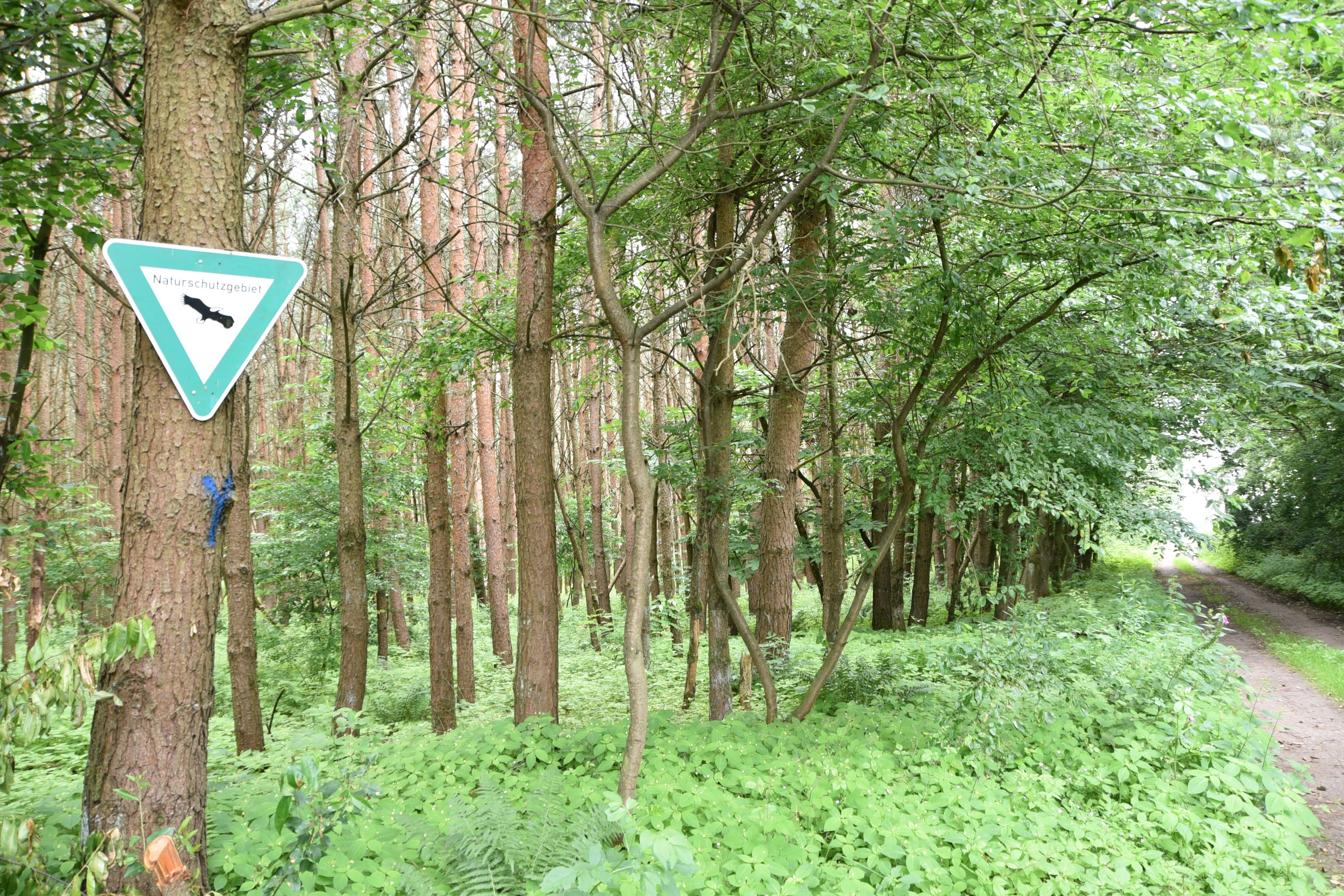
The defining physical feature of the area is its extensive pine forest, which forms large continuous stands across the site. These forests grow on dry, sandy, nutrient-poor soils characteristic of the Rodgau region, a substrate that has historically favored pine-dominated woodland over more demanding broadleaf forest types. Interspersed with the closed forest are open meadow areas that break up the canopy and add structural diversity to the landscape.
Despite its modest elevation and gentle topography, the reserve creates a striking contrast with its surroundings. Bordered by industrial testing grounds and suburban development, the woodland functions as a green island within an otherwise heavily built-up regional environment, while internally it preserves a relatively undisturbed sandy-soil forest landscape.
Mooskiefernwald von Dudenhofen ecosystems, habitats, and plant life
Ecologically, Mooskiefernwald von Dudenhofen represents one of the rare surviving examples of a lowland moss-pine forest community in Hesse. The pine canopy shades a distinctive ground layer dominated by mosses and a small set of specialized understory plants adapted to the dry, acidic, sandy soils of the site. Among the most notable botanical features are the umbellate wintergreen and the creeping lady's tresses, both of which rely on the particular microclimate and soil conditions maintained by the open pine canopy and undisturbed forest floor.
The combination of closed pine stands, light-loving moss vegetation, and open meadow patches creates a mosaic of microhabitats within a relatively small area. This structure supports a community of plants and animals that has become increasingly rare in the surrounding Rhine-Main region, where centuries of settlement, agriculture, and modern development have largely eliminated comparable dry-soil pine woodlands.
The reserve's ecological value is recognized at the European level through its inclusion in the Natura 2000 network under site code 6019-304, a designation reflecting both the rarity of the habitat type and its importance for species that depend on it.
Mooskiefernwald von Dudenhofen wildlife and species highlights
The pine-dominated forest and adjacent meadows of Mooskiefernwald von Dudenhofen support a characteristic community of woodland birds typical of sandy-soil pine forests in central Europe. Among the species recorded as using the reserve as important habitat are the goshawk, the black woodpecker, the European green woodpecker, the common redstart, the Eurasian nightjar, and the Eurasian wryneck, all of which are associated with open or semi-open pine forest structure and have become scarce elsewhere in the region.
The presence of cavity nesters such as the black woodpecker and wryneck, along with ground-nesting species such as the nightjar, indicates that the reserve retains the structural features, including mature trees, deadwood, and open ground, on which these birds depend. The mosaic of meadow and forest also creates edge habitats that broaden the range of nesting and feeding opportunities within the relatively compact area.
Beyond birds, the reserve provides habitat for the broader animal community associated with dry sandy-soil pine woodland, including invertebrates and other fauna adapted to the specific microclimate of moss-pine forest floors.
Mooskiefernwald von Dudenhofen conservation status and protection priorities
The core conservation purpose of Mooskiefernwald von Dudenhofen is the long-term preservation of a lowland moss-pine woodland that has become exceptional within both Hesse and the wider Rhine-Main region. The reserve's designation in 1999 was intended to safeguard the landscape character of the area at a meaningful scale and to protect its rare ground vegetation, particularly the moss layer and sensitive understory species such as wintergreen and creeping lady's tresses.
From a broader perspective, the reserve contributes to the conservation of habitat specialists that depend on dry sandy-soil pine forests, several of which are classified as rare or threatened in regional and national assessments. Inclusion in the Natura 2000 network under site code 6019-304 connects this local effort to European-level biodiversity goals, while the IUCN Category IV classification places the site within the international framework for habitat and species management areas.
Within the Landkreis Offenbach, the reserve complements a network of protected areas focused on wetlands, riverine habitats, gravel pits, and meadows, filling an important niche by representing a dry, sandy-soil woodland ecosystem that is otherwise underrepresented in the regional system of nature reserves.
Top sights and standout views in Mooskiefernwald von Dudenhofen
A rare surviving lowland moss-pine woodland in Hesse, protecting roughly 36 hectares of pine forest and meadow within an otherwise heavily urbanized Rhine-Main setting; designated in 1999 and integrated into the Natura 2000 network; home to a specialized community of woodland birds including goshawk, black and green woodpeckers, common redstart, nightjar, and wryneck; supports notable ground flora such as umbellate wintergreen and creeping lady's tresses on dry sandy soils; and stands out as a representative of dry-soil pine woodland habitat within the broader network of Landkreis Offenbach nature reserves.
Best time to visit Mooskiefernwald von Dudenhofen
Because the reserve's principal values are woodland structure and ground flora, visits during the warmer months, from late spring through early autumn, tend to offer the most active birdlife and the most visible understory vegetation. Late spring and early summer can be particularly favorable for observing breeding woodland birds and flowering ground plants, while autumn brings a quieter atmosphere and the visual change of the pine forest under cooler, damper conditions.
Winter visits are generally less rewarding for casual visitors, given the reduced bird activity and the dormancy of ground flora, though the open pine structure remains accessible. As in any small protected woodland in a lowland region, weather and ground conditions can affect accessibility and the experience of the site at any season.