
Why Naturwald Knetzberge-Böhlgrund stands out
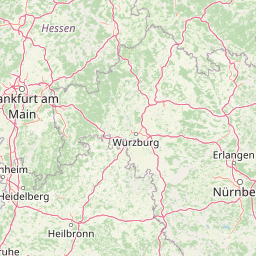
Naturwald Knetzberge-Böhlgrund is best known for its large-scale, unmanaged beech-oak mixed forest in the northern Steigerwald and its important community of saproxylic beetles, including rare primeval-forest relic species and the stag beetle (Lucanus cervus). The reserve is also notable for its exceptionally high volume of deadwood, well above the Bavarian forest average, and for the visible natural regeneration of beech across much of the area. The landscape itself, with steep sandstone slopes, deeply incised stream valleys along the Stöckigsbach and its tributaries, and prominent hilltops such as the Großer Knetzberg and the Ebersberg, gives the reserve a strong scenic identity. Together with adjacent reserves such as Naturwald Wotansborn and Naturwald Kleinengelein, it forms part of one of the most important contiguous broadleaf forest complexes in the Steigerwald.
Naturwald Knetzberge-Böhlgrund history and protected-area timeline
The forest area that today forms Naturwald Knetzberge-Böhlgrund grew out of two pre-existing nature forest reserves, Böhlgrund and Mordgrund, which the Bavarian state had previously set aside from timber production. Böhlgrund, established in 2010, was for a time the largest nature forest reserve outside the Alps and was chosen for protection largely because its steep, marginal terrain made forestry economically impractical. Mordgrund, designated in 2002, contains some of the thickest beech trees in the larger protected landscape.
Prior to these formal designations, many of the smaller forest compartments in the area had already been withdrawn from active management as so-called Class 1 forest, owing to the presence of old near-natural oak and beech stands. The decisive step toward the unified Knetzberge-Böhlgrund reserve came after the 2019 Bavarian citizens' initiative Volksbegehren Artenvielfalt & Naturschönheit in Bayern, in which voters called on the state government to take a substantial share of state forest out of production. In response, the Bavarian government announced the creation of an approximately 1,000-hectare protected forest area in the Steigerwald, and in June 2020 the modern Naturwald Knetzberge-Böhlgrund was officially designated.
Since then, the reserve has been managed exclusively for forest protection and public safety, with periodic forest inventories carried out to monitor timber volume, deadwood, and natural regeneration. Comparisons of inventory data have shown rising deadwood levels and active beech regeneration, while debates over the reserve's role in the larger Steigerwald conservation landscape, including calls for a national park or a re-designation of the nearby Hohe Buchene Wald as a World Heritage beech forest, continue to shape its public profile.
Naturwald Knetzberge-Böhlgrund landscape and geographic character
The reserve occupies the northeastern slopes and valleys of the Steigerwald, a hilly upland of medium elevation in northern Bavaria. Its terrain is shaped by Middle Keuper sedimentary layers that produce an alternation of plateaus, steep forested slopes, and narrow stream valleys cut by the Stöckigsbach and its tributaries, including the Marsbach, Torwiesenbach, Eisenbach, Farnbach, and Schwarzbächlein. The ridges and summits are capped by harder layers such as Lehrberg-Schichten and Blasensandstein, while the lower slopes and valley floors are dominated by softer clay-rich strata of the Gipskeuper.
Several named summits give the landscape a strong relief. The Großer Knetzberg, at 488 meters, is the highest point in the reserve, with the Kleiner Knetzberg (447 m), the Hollacher Berg (409 m), the Trauberg (383 m), and the eastern Ebersberg (450 m) forming a chain of forested hilltops. Towards the south, the ridges of the Euerberg (491 m) and the Beerberg (476 m) close off the area. The lowest point of the reserve lies near Zell am Ebersberg at roughly 269 meters, where the forest opens out toward the Main valley floor.
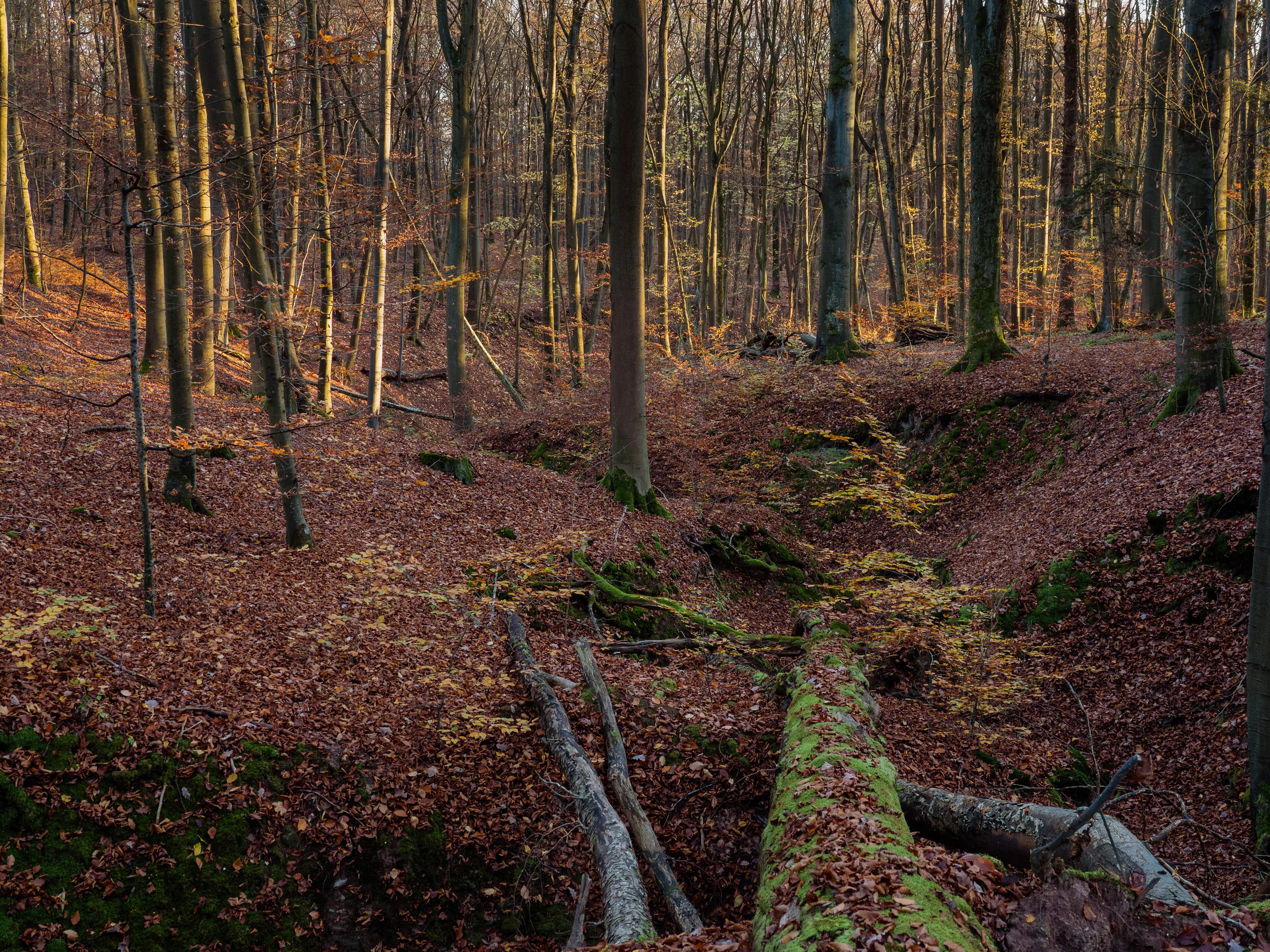
This combination of summit ridges, steep slopes, deeply cut stream valleys, and narrow gorges gives the reserve a strongly three-dimensional character. Local soils vary from fine loams over weathered claystone to sandy substrates on sandstone outcrops, and from well-drained slope soils to waterlogged Stauwasserböden and permanently moist alluvial soils along the streams. The result is a richly textured mosaic of stand conditions that supports a similarly diverse mosaic of forest types, from dry oak-beech woodland on warm southern slopes to moist alder-ash gallery forests in the valley bottoms.
Naturwald Knetzberge-Böhlgrund ecosystems, habitats, and plant life
The reserve is dominated by a heterogeneous beech-oak mixed forest rooted in the varied geology and soils of the northern Steigerwald. The canopy is composed of roughly 38 percent European beech and 26 percent oak, with the remainder made up of other broadleaves such as hornbeam, sycamore maple, small-leaved lime, and wild service tree, plus a small share of conifers including pine, larch, spruce, Douglas fir, and fir. Over half of the stands are more than 100 years old and around 17 percent exceed 160 years, giving the forest an old-growth structural character.
Beneath the canopy, the reserve supports a wide range of Central European forest communities. On the slopes, classic Hainsimsen-Buchenwälder and Waldmeister-Buchenwälder occur, while Galium odoratum-rich oak-hornbeam forests occupy more base-rich sites. Along the streams, alder-ash gallery forests line the Stöckigsbach and its tributaries, and in the cool, humid gorges and around springs, small stands of Schlucht- and Quellwälder add a further structural element. In moist, nutrient-rich valleys and on shaded lower slopes, wild garlic (Bärlauch) dominates the herb layer in spring.
Deadwood is among the most ecologically defining features of the reserve. The total deadwood volume is around 33 m³ per hectare, of which about 19 m³/ha is standing and 14 m³/ha is lying, well above the Bavarian state average of about 21 m³/ha. The mean growing stock is around 342 m³/ha, again exceeding the regional average for the Ebrach Forest District. Natural regeneration is active across roughly 40 percent of the area, especially of beech, while oak currently shows more limited regeneration. Non-native Douglas fir, despite its presence in the canopy, has so far shown negligible regeneration here.
Naturwald Knetzberge-Böhlgrund wildlife and species highlights
The reserve is best known ecologically for its exceptionally rich and well-studied community of saproxylic beetles, the insects that depend on dead and decaying wood. A multi-year oak-ringing project on the Knetzberge documented more than 10,500 beetle individuals and 301 species, equivalent to roughly half of the known saproxylic beetle fauna of the northern Steigerwald. Of these, 22 species had not previously been recorded in the region, 41 are listed as threatened on the German Red List, and nine are so-called primeval-forest relic species whose presence indicates long ecological continuity. Among the species of particular note are the stag beetle (Lucanus cervus), a Habitats Directive Annex species, and rare relic taxa such as the broad-shouldered longhorn beetle (Breitschulterbock), the Bluthalsschnellkäfer, the Buchenmulm-Zwergstutzkäfer, Oxylaemus variolosus, Cerophytum elateroides, Gasterocercus depressirostris, Ipidia binotata, Hesperus rufipennis, and Quedius truncicola, the latter being previously considered extinct and now rediscovered here.
The Große Goldkäfer and the strictly protected Scharlachroter Plattkäfer are also documented. Estimates suggest the Knetzberg hill alone could host up to about 600 saproxylic beetle species over time, an unusually high figure, with bark beetles, wood-boring bark beetles, and oak heartwood beetles dominating while jewel beetles are comparatively scarce. The reserve also falls within the Oberer Steigerwald SPA (Special Protection Area) under the EU Birds Directive, indicating its importance for breeding and migrating forest bird species as well, although detailed bird inventories are not part of the source material.
Beyond beetles, the mosaic of beech and oak forest, deadwood-rich stands, and undisturbed stream valleys provides habitat for a wide range of typical Central European forest fauna, including woodpeckers, owls, bats, and understory-associated small mammals. The combination of old trees, high deadwood volumes, and the presence of natural springs sustains a fungi-, lichen-, and moss-rich understory that in turn supports specialist invertebrates.
Naturwald Knetzberge-Böhlgrund conservation status and protection priorities
Naturwald Knetzberge-Böhlgrund falls within multiple overlapping conservation frameworks. It is part of the European Natura 2000 network through the habitat site Buchenwälder und Wiesentäler des Nordsteigerwalds and the bird protection area Oberer Steigerwald, giving it both Habitats Directive and Birds Directive recognition. Domestically, it is designated under Article 12a of the Bavarian Forestry Act as a Naturwald, in which no commercial forestry or timber harvesting is permitted; only forest protection measures and public safety operations are allowed.
The reserve represents one of Bavaria's first large-scale responses to the 2019 Volksbegehren Artenvielfalt & Naturschönheit in Bayern, which called for ten percent of state forest to be removed from active use. Knetzberge-Böhlgrund is also counted toward Germany's national commitment to bring at least five percent of forest land under natural development without forestry intervention. Although the area is not formally reported to the IUCN and may not meet IUCN wilderness size criteria, it has been identified as a potential candidate area under the German Federal Agency for Nature Conservation's criteria for wilderness zones, due to its location within a larger, contiguous forest landscape on the northeastern Steigerwald.
From a conservation perspective, the reserve is valued primarily for its old-growth structure, its exceptional deadwood resources, and its assemblage of primeval-forest relic species, many of which are red-listed or protected at national and EU level. The continuous monitoring of deadwood, regeneration, and saproxylic beetle communities provides a long-term baseline dataset that feeds directly into broader research on how Central European mixed forests develop when forestry ceases. Conservation organizations such as the Bund Naturschutz and local national park associations consider the reserve an important step toward a potential future Steigerwald National Park and a possible UNESCO World Heritage beech forest nomination centered on the nearby Hohe Buchene Wald.
Naturwald Knetzberge-Böhlgrund cultural meaning and human context
Beyond its natural values, the forest carries a rich cultural and archaeological heritage. Bronze Age hilltop settlements and enclosing walls have been identified on both the Großer Knetzberg and the Kleiner Knetzberg; the larger of the two is thought to have functioned as a regional religious center and is one of the most important Urnfield-period sites in the area, while the smaller fortification likely overlooked a Main valley trade route. Six Hallstatt-period burial mounds are located in the Mordgrund nature forest reserve, and the Hügelgräber bei Zell am Ebersberg add further prehistoric burial evidence within the protected landscape.
Medieval period remains include the so-called Heidenschloss in the valley of the Böhlbach, known as the findspot of 12th-century chess pieces, and the Burgruine Ebersberg, originally built as a watchtower for mounted messengers and later used as the seat of officials of the Bishop of Bamberg before its destruction in the German Peasants' War. The Burgstall am Trauberg, between the Hollacher Berg and Trauberg, marks another former fortification, while the medieval Burgstall Ebersberg near the old burial ground provides a final layer of medieval landscape history.
Five designated archaeological monuments (Bodendenkmäler) are recorded within the boundaries of the reserve, and a small tree-trail (Baumlehrpfad) running from the community forest at Eschenau to the historical farmstead of Neuhaus allows visitors to encounter both the natural and the cultural layers of the landscape. The reserve thus sits within a long continuum of human use, from prehistoric hilltop ritual and burial landscapes through medieval castles, transport routes, and forestry, all of which now lie within an actively regrowing natural forest.
Top sights and standout views in Naturwald Knetzberge-Böhlgrund
A nearly 850-hectare contiguous beech-oak natural forest in the northern Steigerwald, established in 2020 as one of Bavaria's largest such reserves, linking the earlier Böhlgrund and Mordgrund reserves and contributing directly to Bavaria's and Germany's targets for unmanaged forest.
Ecologically, the reserve stands out for its old-growth age structure, high deadwood volumes of around 33 m³/ha, active natural regeneration of beech across large parts of the area, and an outstanding saproxylic beetle fauna that includes stag beetle, primeval-forest relic species, and a beetle previously thought to be extinct in Germany.
Culturally, the landscape preserves a striking archaeological overlay, from Bronze Age hilltop enclosures and Hallstatt burial mounds to the medieval Heidenschloss and the Burgruine Ebersberg, all now embedded within a forest that is once again allowed to develop largely without human interference.
Best time to visit Naturwald Knetzberge-Böhlgrund
As a quiet natural forest landscape rather than a developed visitor park, Knetzberge-Böhlgrund is best appreciated at a pace suited to walking and quiet observation. Late spring, when the forest floor of the moist valleys and shaded slopes is carpeted with wild garlic and other geophytes, and early autumn, when fall colors highlight the mosaic of beech, oak, and other broadleaf species along the ridges and stream valleys, are particularly rewarding periods for visits. The reserve is signed along the long-distance Steigerwald-Panoramaweg and the Schlangenweg, and a tree-trail (Baumlehrpfad) between Eschenau and Neuhaus offers a short, themed introduction to the forest at any time of the open hiking season. Winter visits, while sometimes hindered by snow and frost, reveal the reserve's deadwood-rich structure, its steep gorges, and the long ridge profiles of the Knetzberge in stark relief.