Dolina Potoku Rudno Nature Reserve history and protected-area timeline
The reserve was formally established in 2001, as recorded in the official journal of the Małopolskie Voivodeship (Dz. Urz. Woj. Małopolskiego z 2001 r. Nr. 4, poz. 16). Its creation formalized the protection of an already recognized ecologically and geologically valuable section of the Rudno Stream valley within the larger Orlej Forest.
Although the reserve itself is relatively recent, the protected landscape it forms part of has older roots. The Orlej Forest has long functioned as a recognizable local forest complex, and its integration into the Rudniański Landscape Park gives the reserve a broader landscape protection framework surrounding its core area. The legal designation as a partial protection reserve (ochrona częściowa) reflects a management approach that balances conservation with the continuation of certain traditional uses.
Dolina Potoku Rudno Nature Reserve ecosystems, habitats, and plant life
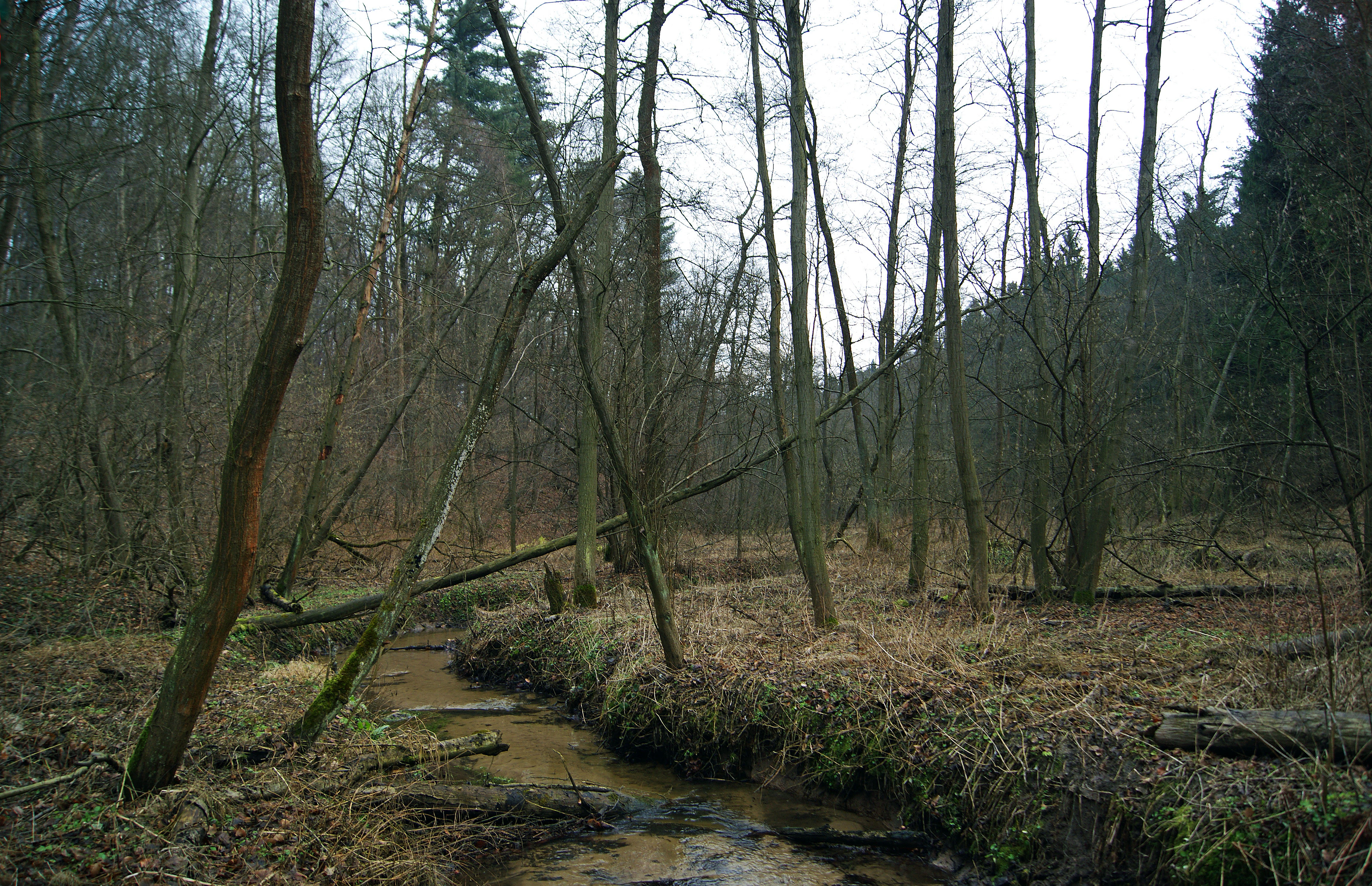
The nature of the reserve is defined primarily by the valley-bottom alder forests that line the Rudno Stream. Łęg olszowy, riparian alder woodland, occupies the wetter zones directly influenced by the stream, while ols, true alder swamp forest, develops where waterlogging is more persistent and soils become peat-influenced. Together these two habitat types create a near-natural floodplain forest mosaic that is increasingly rare in the heavily settled Kraków region.
Away from the stream, the slopes are covered by upland mixed forest typical of the Garb Tenczyński area, grading into drier woodland communities on higher ground. The transition between the moist stream forest and the drier upland forest gives the reserve a clear ecological gradient compressed into a narrow valley.
A botanical highlight of the reserve is the presence of giant horsetail (Equisetum telmateia, referred to in Polish as skrzyp olbrzymi). Its stands in the Rudno valley are noted as a recognizable curiosity and contribute to the site’s scientific and conservation interest. The combination of stream, swamp-edge forest, and specialized plant populations gives the reserve a disproportionate ecological weight relative to its modest size.
Dolina Potoku Rudno Nature Reserve conservation status and protection priorities
The conservation value of Dolina Potoku Rudno rests on three main pillars. The first is the preservation of near-natural alder floodplain and swamp forest communities, łęg olszowy and ols, which are uncommon habitat types in the regional landscape and have been reduced or degraded by drainage and agricultural conversion elsewhere in the Kraków-Częstochowa Upland.
The second pillar is the protection of the hydrological system of the Rudno Stream itself, including the steep valley sections where the watercourse has cut into forest slopes. Maintaining this corridor supports both the forest communities and species that depend on stream margins and wet woodland.
The third pillar is the in-situ conservation of the old porphyry quarry exposures at the Orlej site, which preserve geological features of regional significance. Designated as a partial protection reserve within the broader Rudniański Landscape Park, the site benefits from a layered protection framework that combines strict reserve status in the core zone with landscape-level management in the buffer zone.