
Mori Atlas logo
Wildlife reserveTafi Atome Monkey Sanctuary

Mapping the ecological boundaries and traditional conservation landscapes of this unique West African forest sanctuary.

Tafi Atome Monkey Sanctuary: A Protected Sacred Grove and Wildlife Reserve in Ghana's Volta Region

The Tafi Atome Monkey Sanctuary represents a vital intersection of community-led conservation and natural heritage in the Volta Region of Ghana. As a designated wildlife reserve, this sacred grove preserves a mature tropical forest canopy that serves as a permanent refuge for mona and patas monkey populations. Beyond the primates, the sanctuary offers a documented look at how traditional local protection has maintained an ecological island within the broader rural landscape of southeastern Ghana.

sacred grovecommunity conservationecotourismmona monkeypatas monkeytropical forest

Tafi Atome Monkey Sanctuary

Wildlife reserve

Park overview

Structured park overview, official facts, and landscape profile for Tafi Atome Monkey Sanctuary

Tafi Atome Monkey Sanctuary park facts, protected area profile, and essential visitor context

Review the core facts for Tafi Atome Monkey Sanctuary, including designation, size, terrain, visitor scale, habitats, and operating context in one park-focused overview.

About Tafi Atome Monkey Sanctuary

Tafi Atome Monkey Sanctuary is a small but carefully protected piece of the Volta Region's remaining tropical forest, anchored on the traditional village of Tafi Atome. Rather than being a large, government-managed national park in the conventional sense, it is a community-based protected site shaped by local cultural values and supported by outside partnerships. Its most recognizable feature is the daily presence of mona monkeys in the forest canopy and along the ground beneath it, allowing visitors to see West African primates at relatively close range in a semiwild setting.

The sanctuary sits within the broader forested belt of the Volta Region, an area historically rich in trees, birds, and small forest mammals but increasingly under pressure from agriculture and fuelwood use. By establishing a traditional sacred grove as the anchor of the reserve, the community effectively declared that portion of forest off-limits to logging and large-scale clearing. That decision set the stage for the formal conservation project that began in the early 1990s and continues to define the site today.

Visitors typically approach the sanctuary through the village itself, walking past homes, small farms, and community spaces before entering the shaded grove. The forest interior is what gives the sanctuary its particular character: a canopy of mature trees, a quieter understory, and the constant movement of monkeys between branches. Together with associated birdlife and butterflies, this combination of cultural context, primate presence, and intact forest atmosphere is what makes Tafi Atome a distinctive protected area within Ghana's conservation landscape.

Quick facts and research context for Tafi Atome Monkey Sanctuary

Tafi Atome Monkey Sanctuary is a community-managed sacred-grove reserve in the Volta Region of Ghana, centered on the village of Tafi Atome and the surrounding tropical forest.

It is roughly 230 kilometers northeast of Accra and about 43 kilometers south of Hohoe, with the nearby town of Kpando serving as the closest urban reference point. The site was established in 1993 as a Peace Corps-assisted ecotourism initiative, and it is notable for protecting two species of African monkeys, mona monkeys and patas monkeys, within a forest that also supports diverse bird and butterfly populations.

Protection and recognition

Examining terrestrial protected area boundaries and international recognition

Tafi Atome Monkey Sanctuary Protection Status and Conservation Context

Tafi Atome Monkey Sanctuary holds a documented terrestrial protection status within the global conservation network. Structured environmental records outline the management scope and official recognition details associated with the protected landscape.

Protection details

Protection scope
Terrestrial
Transboundary protection
No
Park context

Deeper park guide and search-rich context for Tafi Atome Monkey Sanctuary

Tafi Atome Monkey Sanctuary history, landscape, wildlife, and travel context

Explore Tafi Atome Monkey Sanctuary through its history, landscape character, ecosystems, wildlife, conservation priorities, cultural context, and seasonal travel timing in a structured park guide built for atlas discovery and search intent.

Why Tafi Atome Monkey Sanctuary stands out

The sanctuary is best known for its population of mona monkeys that live freely within a sacred forest grove and approach visitors on footpaths through the reserve. It is also known for patas monkeys, which share the same wooded habitat and are a less common sight than the more conspicuous mona monkeys. Equally central to the site's identity is the cultural framing of the monkeys as messengers of the gods, a belief held by the Tafi Atome community for generations. Together, the combination of accessible primate viewing, traditional sacred-grove protection, and community-led ecotourism management is what distinguishes Tafi Atome from many other forest reserves in West Africa.

A mona monkey with brown, black, and white fur sitting on a white metal railing with a blurred green forest background.
A mona monkey perched on a railing at Tafi Atome Monkey Sanctuary.

Tafi Atome Monkey Sanctuary history and protected-area timeline

The forest surrounding Tafi Atome has been associated with monkeys for at least two centuries, and throughout that time the local community has regarded the animals as sacred beings believed to be messengers from the gods. This long-standing belief served as a de facto protection mechanism for the grove, shielding it from the woodcutting, charcoal production, and agricultural expansion that affected much of the surrounding landscape.

In 1993, the site was elevated from an informal sacred grove to a formally recognized conservation and ecotourism project. The initiative was developed with the direction of a Peace Corps volunteer working alongside residents of Tafi Atome, and it drew on a coalition of villagers, public institutions, and nongovernmental organizations. By 1996, broader efforts were underway to protect the forest and its monkeys while also offering guided tours for visitors, which gave the community a direct economic stake in keeping the grove intact.

These combined efforts produced tangible ecological results, with the resident monkey population growing and the forest itself preserved along with its many species of birds and butterflies. In November 2020, the sanctuary underwent a substantial upgrade of its visitor infrastructure, including a new reception area, modern washroom facilities, three visitor pavilions, improved fencing using wire mesh and bamboo, repainting of existing structures, a car park, and paved ground surfaces.

Tafi Atome Monkey Sanctuary landscape and geographic character

The physical setting of Tafi Atome Monkey Sanctuary is a patch of mature tropical forest embedded in the rural landscape of the Volta Region of Ghana. The terrain is gently rolling rather than dramatic, with a closed canopy of broadleaf trees shading a relatively open forest floor. Walking tracks lead visitors beneath this canopy, where the height of the trees and the dappled light shape much of the visual character of the grove.

Beyond the protected grove itself, the surrounding landscape is a mosaic of small farms, village plots, and secondary growth typical of rural southeastern Ghana. The forest stands out clearly against this patchwork, both because of its intact canopy and because the community has kept it free from clearing. Even though the sanctuary is relatively compact in size, the contrast between the dense grove and the more open countryside around it gives visitors a strong sense of entering a distinct ecological space.
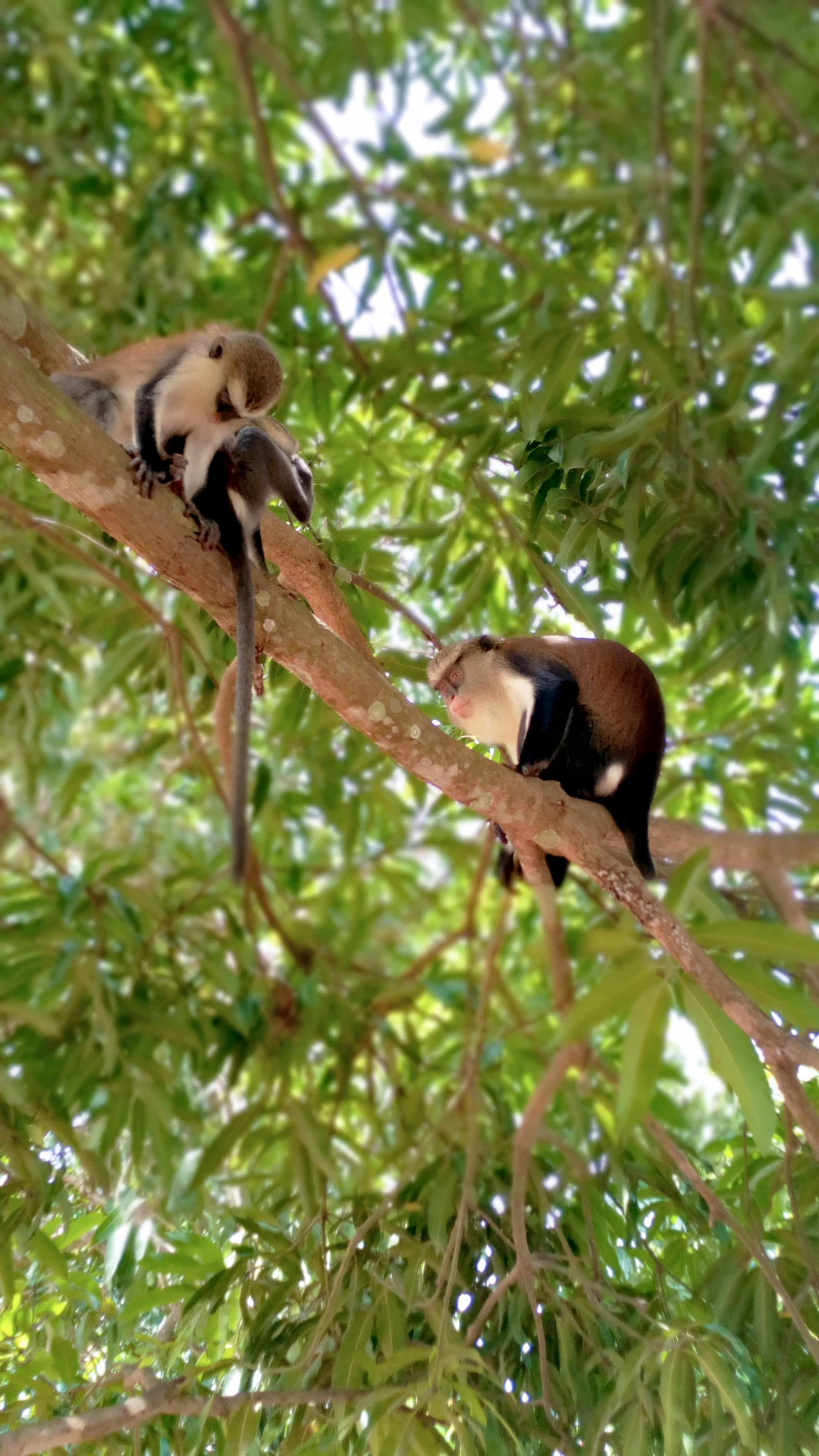
Two Mona monkeys perched on different branches of a leafy green tree, seen from below.
Mona monkeys resting in the canopy at Tafi Atome Monkey Sanctuary.

Tafi Atome Monkey Sanctuary ecosystems, habitats, and plant life

The sanctuary's ecological value is rooted in its surviving fragment of tropical forest, which functions as both a primate refuge and a general biodiversity hotspot within a region where continuous forest cover is increasingly rare. Mature trees form the structural backbone of the grove, providing the canopy that supports monkeys, birds, and insects alike, while the shaded understory creates relatively stable microclimatic conditions for smaller forest species.

In addition to the two primate species that define the site, the grove is recognized for its diversity of birds and butterflies, which benefit from the same protection extended to the monkeys. The combination of intact canopy, restricted human use, and community stewardship has allowed these smaller but ecologically meaningful groups to persist alongside the more charismatic primates. As a result, the sanctuary functions less as a single-species reserve and more as a small, multi-habitat refuge within an otherwise heavily used rural landscape.
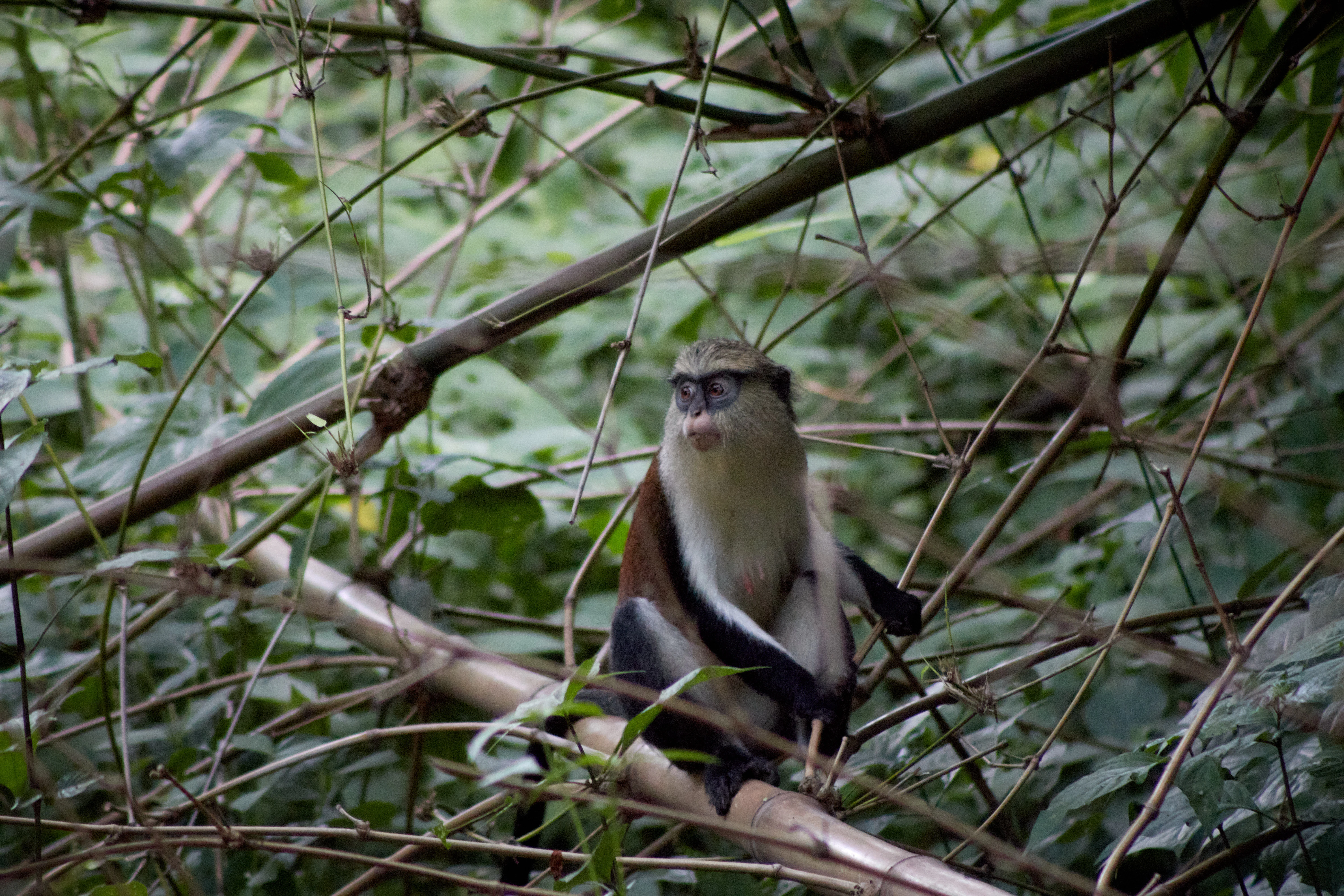
A small monkey with distinct white facial markings and dark fur perched on a bamboo branch surrounded by dense green forest vegetation.
A mona monkey perched in the foliage at Tafi Atome Monkey Sanctuary.

Tafi Atome Monkey Sanctuary wildlife and species highlights

The most visible wildlife at Tafi Atome is the mona monkey, the species that gives the sanctuary its identity and its name. Mona monkeys are highly social primates that forage in the canopy and frequently descend nearer to ground level, which is why they are so commonly seen by visitors along the sanctuary's walking paths. Their tolerance of human presence, combined with the community's traditional reverence for them, has allowed the population to grow in step with the broader conservation effort.

A second primate species, the patas monkey, also inhabits the grove, though it tends to be less frequently observed than the mona monkey. Together, the two species give the sanctuary one of its more unusual features: the chance to see two different African monkey genera sharing the same small protected forest.

The grove also supports a notably rich community of forest birds, drawn to the mature trees and the relative quiet of the protected area, as well as a variety of butterfly species that thrive in shaded tropical forest understory. While smaller mammals, reptiles, and insects are part of the broader forest fauna, it is this combination of primates, birds, and butterflies that most visitors associate with the wildlife experience at Tafi Atome.
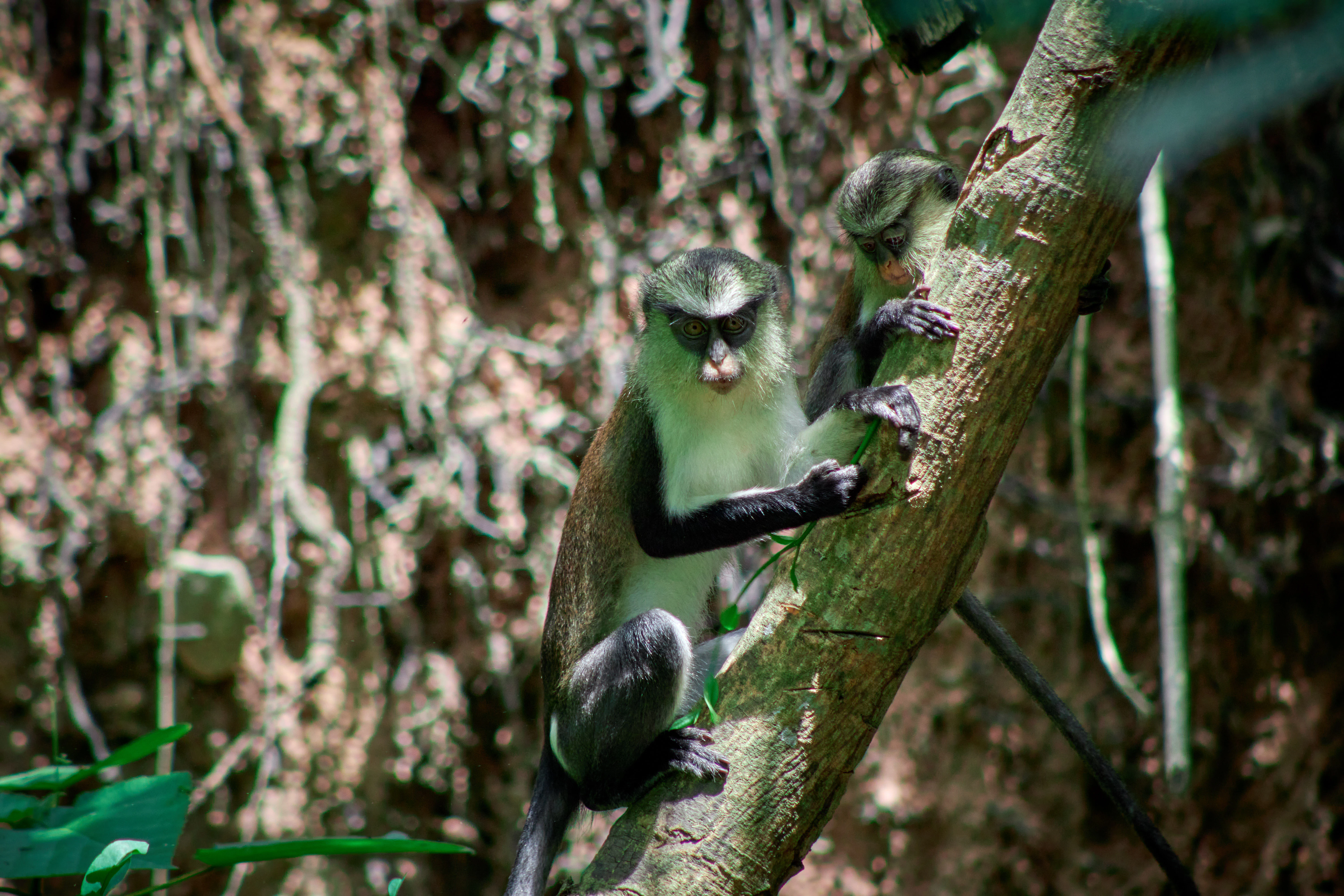
A mona monkey with a white chest and dark face climbing a tree branch in a dense forest setting.
A mona monkey perched on a tree branch at the Tafi Atome Monkey Sanctuary.

Tafi Atome Monkey Sanctuary conservation status and protection priorities

Tafi Atome Monkey Sanctuary is a textbook example of community-based conservation rooted in traditional cultural values. The site's foundational protection mechanism is not a legal designation imposed from outside but a long-standing local belief that the monkeys are sacred messengers of the gods, which historically discouraged hunting and forest clearing around the village. That cultural baseline provided a foundation on which formal conservation activities could later be built.

The 1993 establishment of the sanctuary transformed this informal protection into a structured project, supported by a Peace Corps volunteer, the village itself, public institutions, and nongovernmental organizations. By linking conservation directly to ecotourism, the project created a tangible economic incentive for the community to maintain the forest and its resident primates, an approach that has been credited with both expanding the monkey population and preserving the broader habitat.

The forest is also recognized as a sacred natural site, a category of protected landscape where cultural and spiritual values reinforce ecological protection. As such, the sanctuary aligns with international guidance, including frameworks such as the IUCN and UNESCO Sacred Natural Site Guidelines for Protected Area Managers, which emphasize tools for monitoring plants and animals, building community capacity, and strengthening cultural values as integral parts of conservation practice. The 2020 infrastructure upgrade further reflects an ongoing commitment to maintaining and improving the site as a viable long-term conservation and ecotourism destination.

Tafi Atome Monkey Sanctuary cultural meaning and human context

At the heart of the sanctuary's identity is the traditional Tafi Atome belief that mona monkeys, and the broader monkey population of the grove, are messengers sent by the gods. This spiritual framing has shaped the relationship between villagers and the surrounding forest for generations, effectively setting the monkeys apart from ordinary wildlife and embedding them into local cosmology.

Because the sacred status of the monkeys predates formal conservation, the modern sanctuary is in many ways a continuation of older cultural practice rather than a break from it. The community's role in managing visitors, guiding tours, and protecting the grove reflects this continuity, and the economic benefits of ecotourism now flow back into the same village that has long been the cultural guardian of the monkeys.

Visitors to the sanctuary therefore encounter not just a forest reserve but a layered cultural landscape, where traditional belief, contemporary ecotourism, and outside institutional partnerships have come together to keep the grove intact.

Top sights and standout views in Tafi Atome Monkey Sanctuary

Tafi Atome Monkey Sanctuary stands out for combining up-close primate encounters, intact tropical forest scenery, and a strong community-managed conservation model within a single compact site. The opportunity to walk through a sacred grove and observe mona monkeys, and sometimes patas monkeys, in the forest canopy is the sanctuary's signature experience and the reason it draws visitors to this part of the Volta Region.

Equally distinctive is the sanctuary's status as a sacred natural site, where traditional beliefs about the monkeys have shaped protection for centuries and continue to anchor modern ecotourism practice. Combined with its rich bird and butterfly populations and its upgraded 2020 visitor facilities, these features make Tafi Atome a meaningful destination for travelers interested in West African primates, community conservation, and culturally rooted protected landscapes.

Best time to visit Tafi Atome Monkey Sanctuary

The sanctuary is a year-round tropical forest site, and the largely evergreen canopy means visitors will encounter shaded walking conditions and active monkey populations throughout most seasons. The dry season, typically running from roughly late autumn through early spring in regional climatic terms, is generally the most comfortable time to walk the forest trails, when paths are firmer and the weather is less likely to interrupt outdoor time in the grove.

The wetter months bring heavier rains and more humid forest conditions, but they also tend to keep the forest particularly lush and may support higher insect and butterfly activity. Because the monkeys are resident and protected year-round, wildlife viewing is essentially a permanent feature of the site rather than a narrowly seasonal one; visitors who prefer easier walking and cooler temperatures will generally find the drier months most comfortable, while those interested in peak forest lushness may favor the wet season.
Monthly climate preview

Long-term representative monthly temperature and precipitation data for Tafi Atome Monkey Sanctuary

Tafi Atome Monkey Sanctuary Climate Normals and Annual Weather Rhythm

Temperature and precipitation records for Tafi Atome Monkey Sanctuary illustrate measured annual climate patterns across representative coordinates in the Volta Region. Detailed monthly statistical breakdowns provide deeper insight into long-term temperature ranges and precipitation rhythms across the protected area.
Annual mean26 °C
24 °C28 °C
Jan26°
Feb28°
Mar27°
Apr27°
May26°
Jun25°
Jul24°
Aug24°
Sep25°
Oct25°
Nov26°
Dec26°
Warmest month
February

27.5 °C

Coolest month
August

24.2 °C

Wettest month
September

6.4 mm/day

Driest month
December

0.4 mm/day

Park location guide

Geography guide, regional context, and park location map for Tafi Atome Monkey Sanctuary

Tafi Atome Monkey Sanctuary park geography, regions, and map view in Ghana

Understand where Tafi Atome Monkey Sanctuary sits in Ghana through a broader geographic reading of the surrounding landscape, nearby location context, and its mapped position within the national park landscape.

How Tafi Atome Monkey Sanctuary fits into Ghana

Ghana, officially the Republic of Ghana, is a West African nation spanning approximately 240,000 km² along the Gulf of Guinea. It achieved independence from Britain in 1957, becoming the first Sub-Saharan colony to do so, and transitioned to a republic in 1960. The country has a population of over 35 million, with Accra as its capital and largest city. Ghana features diverse ecosystems from coastal savannas to tropical rainforests and is linguistically and ethnically rich, with English as the official language.

Wider geography shaping Tafi Atome Monkey Sanctuary in Ghana

Ghana is located in West Africa along the Gulf of Guinea and Atlantic Ocean to its south. It borders Côte d'Ivoire to the west, Burkina Faso to the north, and Togo to the east. The country spans diverse ecologies including coastal savannas and tropical rainforests.

Map view of Tafi Atome Monkey Sanctuary

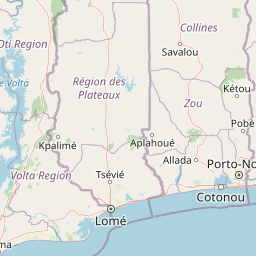
Use this park location map to pinpoint Tafi Atome Monkey Sanctuary in Ghana, understand its exact geographic position, and read its mapped placement within the surrounding landscape more clearly.

Pigeon | © OpenStreetMap contributors

Location context for Tafi Atome Monkey Sanctuary

Volta Region

Visualizing the tropical forest canopy, habitats, and protected terrain of Ghana

Tafi Atome Monkey Sanctuary Photos and Sacred Forest Landscapes

Visual documentation captures the closed canopy, walking tracks, and natural habitats of Tafi Atome Monkey Sanctuary. Exploring these protected area views reveals the dense sacred grove and its surrounding rural terrain.

A mona monkey with brown, black, and white fur sitting on a white metal railing with a blurred green forest background.

A Mona monkey with light colored chest and dark limbs perches on a vertical wooden fence post with green leaves in the background.

Two Mona monkeys perched on different branches of a leafy green tree, seen from below.

A small monkey with distinct white facial markings and dark fur perched on a bamboo branch surrounded by dense green forest vegetation.

A mona monkey with a white chest and dark face climbing a tree branch in a dense forest setting.

A Mona monkey sitting on red earth with a small infant monkey clinging to its chest.

Park atlas

Compare nearby regional reserves and connected tropical forest landscapes in Ghana

Exploring Parks Near Tafi Atome Monkey Sanctuary and Surrounding Protected Areas

Visitors exploring Tafi Atome Monkey Sanctuary can continue browsing other regional reserves and protected areas located throughout the surrounding Volta Region. Comparing adjacent forest habitats and community-managed conservation sites provides a broader geographic perspective on West African wildlife sanctuaries.
Wildlife reserveVolta Region
About 48 km away#1 closest

South

Kalakpa Game Production Reserve: Atlas Overview of Protected Terrain in Ghana

Ecological mosaic landscape in the Volta Region

Kalakpa Game Production Reserve represents a diverse protected area where Borassus and Combretum woodlands meet semi-deciduous gallery forests. Situated on the foothills of the Togo Mountains, this reserve provides essential habitat in the forest-savanna transition of southeastern Ghana, defined by its rugged rocky hills and seasonal valley streams.

Area
320 km²
Established
1975
IUCN
VI
Relief
Upland
National parkBono East Region
About 93 km away#2 closest

Northwest

Digya National Park: Ghana's Oldest National Park, Bordering Lake Volta

Explore its unique geography and mapped protected boundaries.

Digya National Park is a significant protected area in Ghana, renowned as the nation's oldest, established in 1900 and gazetted as a national park in 1971. Occupying 3,743 square kilometers in the Bono East Region, it is distinctively bordered on three sides by the vast Lake Volta, creating an unparalleled terrestrial-aquatic habitat interface. This national park represents a key point in Ghana's geographic atlas, situated in a transitional zone between forest and savanna ecosystems, and is a vital hub for wildlife conservation and the study of its unique landscape character.

Area
3,743 km²
Established
1971
IUCN
II
Relief
Lowland
A watercolor painting showing a soft, impressionistic landscape of Keta Lagoon, featuring patches of green vegetation, yellow grasses, and calm water against a light, airy background.
Protected areaVolta Region
About 123 km away#3 closest

Southeast

Keta Lagoon Protected Area: Coastal Wetland Geography and Regional Landscape Mapping

A vital ecological and cultural landscape in Ghana's Volta Region

Keta Lagoon represents a primary coastal wetland system in eastern Ghana. Spanning the coastline between sandy barriers and inland floodplains, this protected area features a unique mosaic of mangroves, tidal flats, and islands. Its role as a major waterbird habitat and the center of Anlo-Ewe cultural life makes it a significant site for understanding West African coastal geography and environmental conservation.

Area
1,200 km²
Established
1992
Relief
Lowland
Climate
Tropical
A horizontal watercolor painting depicting a winding river flowing through a lush green landscape with distant hills under a light sky.
Biosphere reserveBenin
About 137 km away#4 closest

East

Mono Transboundary Biosphere Reserve: Mapped Protected Landscapes and Regional Geography

Coastal river deltas, wetlands, and savanna transition zones

The Mono Transboundary Biosphere Reserve preserves a critical intersection of freshwater river systems and marine coastal environments. Stretching along the border of Benin and Togo, this protected area includes expansive mangroves, lagoons, and floodplains that transition into inland savanna. The geography of the reserve reflects a dynamic interface between land and water, encompassing a range of natural terrain that supports both ecological conservation and integrated regional land use.

Area
3,462.85 km²
Established
2017
Relief
Lowland
Climate
Tropical
Wildlife reserveGreater Accra Region
About 144 km away#5 closest

South

Sakumo Ramsar Site Wildlife Reserve: Geographic and Protected Landscape Overview

Coastal lagoon and savanna wetland within the Greater Accra Region

Located along the southern coast of Ghana, the Sakumo Ramsar Site functions as a unique wildlife reserve where a seasonally shifting lagoon meets freshwater marshes and coastal savanna. This map-focused profile examines the ecological boundaries and terrain features of this significant wetland, which serves as a vital sanctuary for migratory birds despite its position within the dense urban fabric of the Accra-Tema metropolitan area.

Area
14 km²
Established
1992
Relief
Lowland
Climate
Tropical
A horizontal watercolor painting showing a winding river flowing through a lush marshy landscape with distant hills in the background.
Nature reserveGreater Accra Region
About 165 km away#6 closest

Southwest

Densu Delta Ramsar Site: Coastal Wetland Geography in the Greater Accra Region

Protected nature reserve, lagoon network, and tidal marshland

Located at the mouth of the Densu River, this Ramsar site features an interconnected system of mangroves, salt pans, and shallow lagoons. The protected area serves as an essential coastal buffer and bird habitat, showcasing the complex interplay between riverine freshwater and the marine environment of the Gulf of Guinea.

Area
58.93 km²
Established
1992
Water
Water-dominated
National parkOti Region
About 169 km away#7 closest

North

Kyabobo National Park: Ghana's Highland National Park with Mount Dzebobo and Forest-Savanna Transition

Explore mountainous terrain, park boundaries, and regional geography in Oti Region.

Kyabobo National Park is a significant protected landscape in Ghana's Oti Region, celebrated for its mountainous topography and the commanding presence of Mount Dzebobo. This national park, established in 1993, safeguards a critical ecological transition zone featuring diverse habitats from dense forests to open tree savanna. Its unique geography and protected status make it a vital site for understanding regional conservation and atlas-based landscape exploration in West Africa, offering insights into varied terrain and ecosystems.

Area
360 km²
Established
1993
IUCN
II
Relief
Mountain
Protected areaOuémé
About 177 km away#8 closest

East

Basse vallée de l'Ouémé, lagune de Porto-Novo, lac Nokoué: Benin Wetland and Protected Area

Geographic analysis of a major West African riverine and lagoon system

Spanning the lower reaches of the Ouémé River, this protected wetland area in southern Benin integrates complex fluvial and coastal landscapes. The territory includes Lake Nokoué and the Porto-Novo lagoon, creating a vital hydrological basin that supports seasonal floodplains, mangrove fringes, and significant ecological connectivity. Examine the mapped boundaries and natural terrain of this unique West African environmental corridor.

Area
916 km²
Relief
Lowland
Climate
Tropical
Access
Access unknown

Common questions about visiting, size, designation, and location context for Tafi Atome Monkey Sanctuary

Tafi Atome Monkey Sanctuary FAQs for park facts, access, geography, and protected area context

Find quick answers about Tafi Atome Monkey Sanctuary, including protected-area facts, park geography, trail and visitor context, and how the park fits into its surrounding country and regional landscape.
MoriAtlas Explorer

Continue Your Protected Areas Search Across the Global Atlas

Deepen your exploration by continuing the structured search for national parks and protected areas worldwide. Utilize the comprehensive filtering capabilities to compare different conservation landscapes and refine your understanding of global park geography. Discover more about the distribution and characteristics of protected natural areas.

Global natural geography