Why Tyagarah Nature Reserve stands out
The reserve is most famous for two distinct things: a high-quality and easily accessible land-based vantage point for the annual humpback whale migration along Australia's east coast, and a remarkable concentration of threatened plant species and endangered coastal ecological communities packed into a relatively compact coastal reserve. It also became well known as the site of Tyagarah Beach, a long-standing clothing-optional beach with deep cultural significance for naturist and LGBTQIA+ communities in the Byron Shire. That combination of marine megafauna spectacle, fragile coastal habitat, and a layered social history gives Tyagarah an unusually broad identity for a relatively small reserve.
Tyagarah Nature Reserve history and protected-area timeline
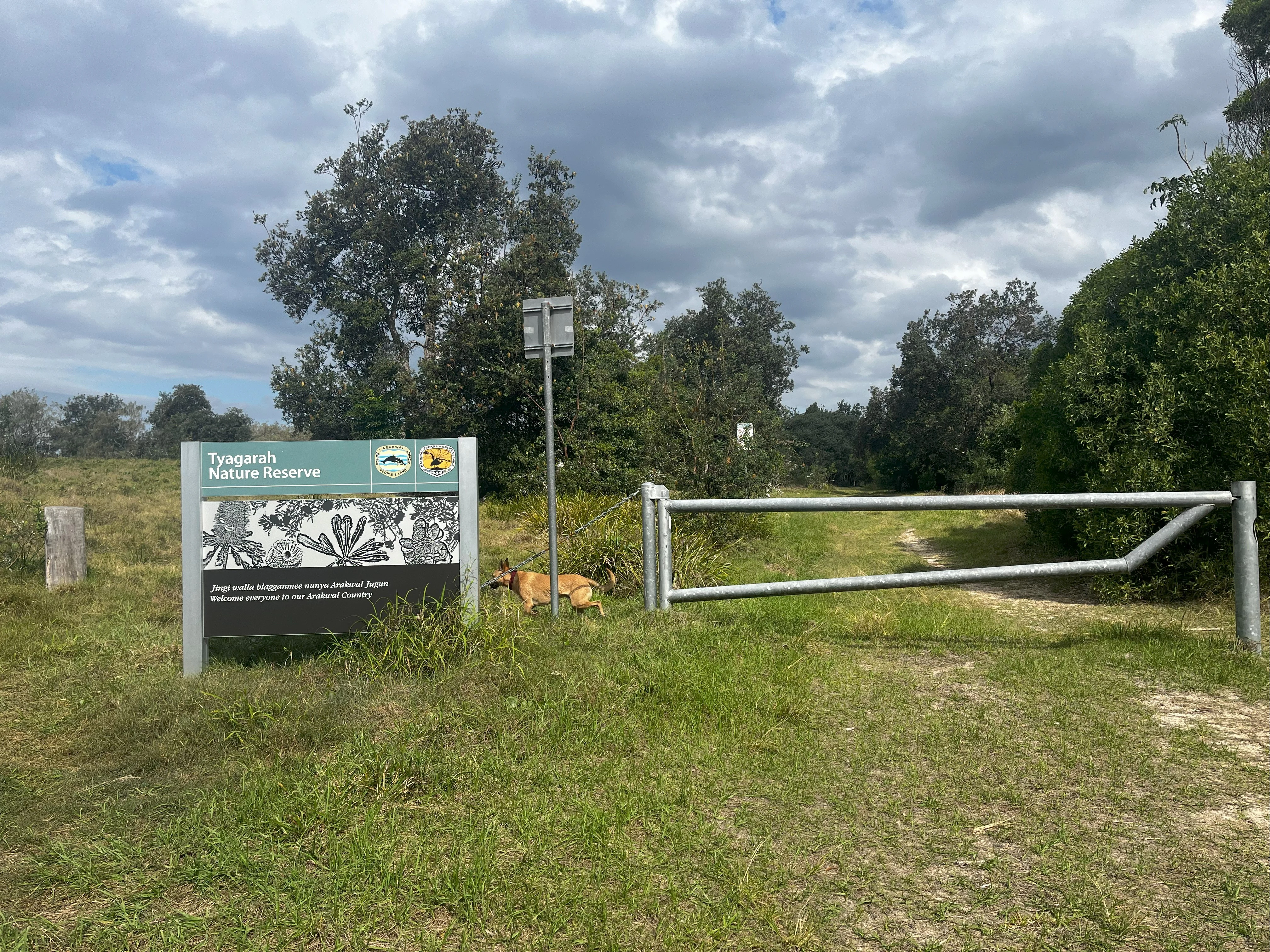
The lands of the Tyagarah Nature Reserve have a much deeper Indigenous history than their formal reserve status suggests. The beach and dune systems, estuarine flats, and open grassy hinterland were used and managed for generations by the Bundjalung people. Within that broader cultural region, the Arakwal people hold a particular connection to the area around Cape Byron and the Tyagarah coastline, which they consider spiritually significant. The Bundjalung word 'Targourah', meaning open grass country or camping ground, reflects this long-standing human relationship with the landscape.
In colonial and modern records, Tyagarah Beach appears as early as 1902, when a man was reportedly arrested and imprisoned for swimming there naked, an early written indication that the beach was already being used informally without clothing long before any formal recognition of that practice. For much of the twentieth century the beach remained a remote, lightly visited stretch of coast used by locals, naturists, and free-spirited travellers drawn to the broader Byron Bay countercultural scene.
In 1998, the Byron Shire formally designated Tyagarah Beach as a clothing-optional beach, formalising a practice that had existed informally for decades. The designation attracted a regular community of naturists and LGBTQIA+ visitors, who came to see the beach as a sanctuary symbolising freedom and belonging. The reserve's modern legal protection and ecological significance were also recognised and expanded across the late twentieth and early twenty-first centuries, including the documentation of multiple endangered ecological communities and threatened plant species on its lands.
From 2018 onward, the clothing-optional status of Tyagarah Beach became contested. Protests such as those under the banner 'Nude Not Lewd' argued against what some residents and commentators described as a broader shift toward conservative attitudes in the region. This debate culminated on 30 August 2024, when the Byron Shire removed the clothing-optional designation from the beach following complaints about inappropriate behaviour. No alternative beach within the reserve was given the same status, marking a significant change in the social character of one of Australia's most recognisable naturist beaches.
Tyagarah Nature Reserve landscape and geographic character
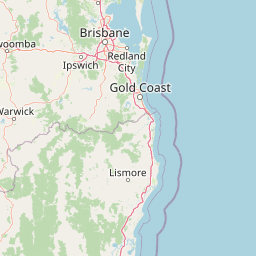
Tyagarah Nature Reserve spans a representative stretch of the NSW far-north coast, defined by an unbroken arc of sandy beach backed by a layered system of dunes, swamplands, and low coastal forest. The reserve's shoreline runs for roughly seven kilometres along the Pacific, sitting just north of the Byron Bay headland and south of the Brunswick River estuary. This stretch of coast remains largely free of residential development and seawalls, allowing the beach profile, dune line, and frontal vegetation to maintain more or less natural dynamics.
Behind the beach, a mosaic of terrestrial habitats unfolds across the reserve's full 875 hectares. Old frontal dunes give way to more stable hind-dune scrublands, which in turn transition into low-lying wetland areas fed by minor creeks and tidal influence near the Brunswick River end of the reserve. These coastal swamplands and estuarine fringes are among the most ecologically significant parts of the reserve, supporting the coastal saltmarsh communities that are listed as endangered. Further inland, the vegetation shifts into swamp sclerophyll forest, a damp eucalypt-dominated woodland that thrives on transitional soils between wetland and dry land.
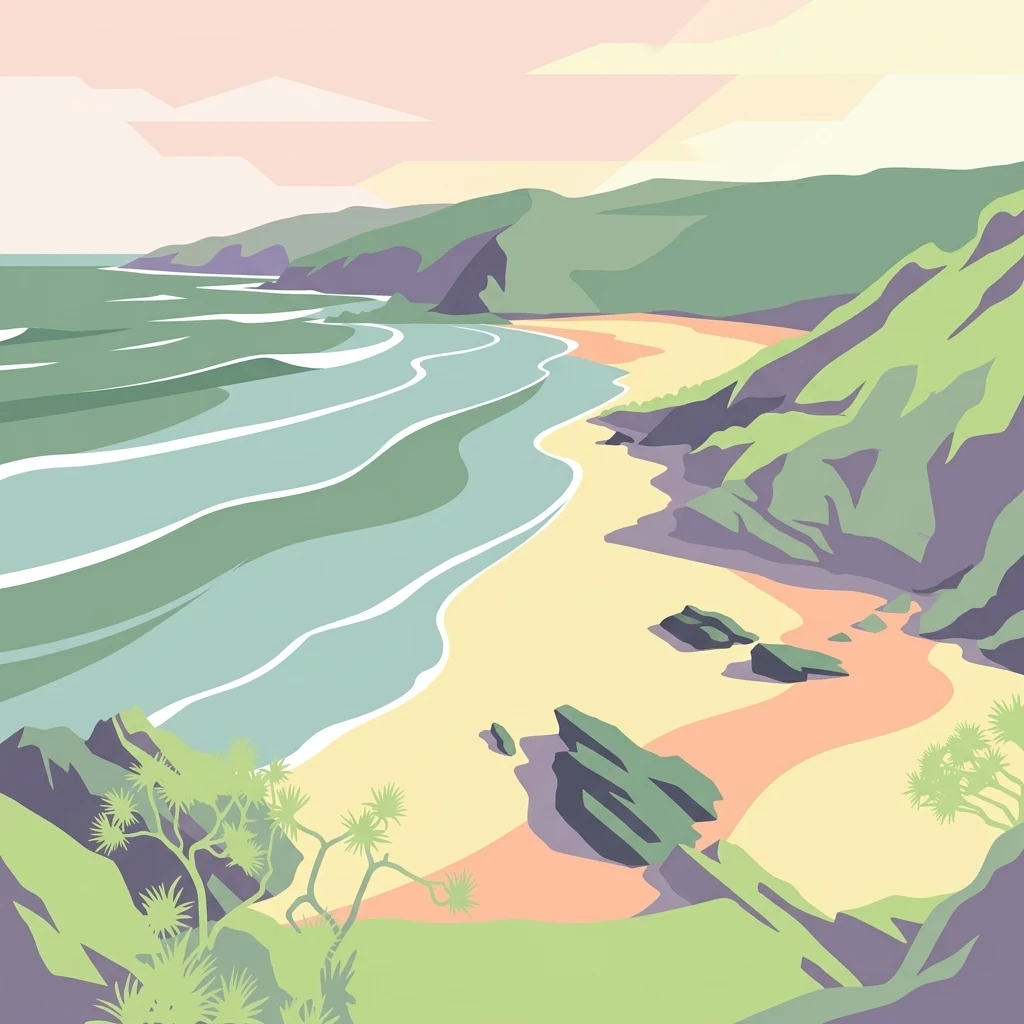
The combination of elements gives Tyagarah its distinctive scenic character: a sweeping ocean horizon on one side, a wall of scrambling wind-formed dunes in the middle distance, and a backdrop of paperbark-fringed swampland and forested ridgelines. From elevated sections of the reserve, viewers can take in long arcs of coast and, in season, the offshore silhouettes of humpback whales travelling through the migration corridor, a flat, oceanic view that distinguishes Tyagarah from the more enclosed hinterland reserves of the Northern Rivers.
Tyagarah Nature Reserve ecosystems, habitats, and plant life
Ecologically, Tyagarah Nature Reserve functions as a compact laboratory of the NSW north coast's coastal ecosystems. Although it is modest in size at 875 hectares, it captures a remarkable range of vegetation types across a short distance, including beach strand, fore-dune heath, hind-dune scrub, coastal swampland, estuarine saltmarsh, and swamp sclerophyll forest. This transition across habitats inside a single reserve is one of its defining ecological qualities.
The reserve protects at least six endangered ecological communities recognised under New South Wales and Commonwealth environmental frameworks. Among them, coastal saltmarsh stands out as a particularly threatened vegetation type across eastern Australia, restricted to narrow tidal margins at the Brunswick River end of the reserve. Swamp sclerophyll forest, another listed community, occupies transitional zones where freshwater influences mix with the coastal setting. Together, these communities support a disproportionately high level of botanical diversity relative to the reserve's footprint.
The mosaic of habitats also provides continuity of vegetation cover between the heavily developed Byron Bay urban area and the more rural lands around Brunswick Heads. This continuity matters because many of the threatened species found inside the reserve depend on intact patches of native vegetation connecting coastal and inland habitat. The reserve therefore functions as both a refuge and a stepping-stone within the broader ecological corridor of the Cape Byron hinterland.
Tyagarah Nature Reserve wildlife and species highlights
Tyagarah's most visible and celebrated wildlife story is the annual passage of humpback whales along the east Australian migration corridor. Each year, large numbers of humpback whales travel north from Antarctic feeding grounds toward calving areas around the Great Barrier Reef, and return south in spring with their newborn calves. The reserve's open beaches, lack of major headland obstructions, and clear sightlines to the ocean make it a favoured land-based vantage point. Mothers with calves, often travelling slowly and close to shore in spring, are particularly commonly seen from Tyagarah Beach.
Beyond the marine megafauna, the reserve's flora is among the most botanically notable features of its wildlife profile. Roughly 33 threatened plant species are recorded as occurring or likely to occur within the reserve. These include the stinking cryptocarya, a small rainforest tree with a distinctive aroma; the red lilly pilly, a coastal rainforest species; and the green-leaved rose walnut, another rainforest tree of conservation concern. Together they reflect the reserve's role in preserving lowland coastal rainforest and sclerophyll flora that has been heavily reduced elsewhere in the region.
The reserve's wetland and forest habitats also support a wide range of birdlife typical of NSW coastal reserves, including shorebirds along the beach and estuarine margins, honeyeaters and lorikeets in the flowering heath and forest edges, and more secretive wetland species within the swamp sclerophyll forest and saltmarsh zones. Estuarine sections are additionally habitat for fish, crustaceans, and other marine invertebrates that underpin shorebird feeding during migration seasons.
Tyagarah Nature Reserve conservation status and protection priorities
Tyagarah Nature Reserve is one of the most ecologically significant reserves in the Byron Shire because it preserves multiple threatened ecological communities in essentially their natural state within a region that has experienced heavy coastal development. The protection of coastal saltmarsh and swamp sclerophyll forest within the reserve is especially important, as both of these communities have declined substantially elsewhere along the NSW coast due to urbanisation, drainage, and grazing pressure. By keeping these communities intact and connected to the beach and dune systems, Tyagarah contributes to the regional survival of vegetation types that no longer have many secure homes.
The reserve's role in protecting threatened plant species is also disproportionate to its size. With around 33 threatened plant species recorded, including rainfall-dependent rainforest trees such as the stinking cryptocarya, red lilly pilly, and green-leaved rose walnut, the reserve effectively functions as a conservation refuge for flora that has been heavily reduced elsewhere in lowland eastern Australia. The mosaic of habitats also supports the ecological processes, fire regimes, and hydrological patterns on which these species depend.
In a broader sense, Tyagarah is a key component of the protected-area network that buffers the Byron Bay region. By holding seven kilometres of undeveloped coastline and a continuous corridor of native vegetation between Byron Bay and Brunswick Heads, the reserve reduces habitat fragmentation, supports wildlife movement, and maintains water quality in the Brunswick River estuary. Its conservation value is therefore both site-specific, in terms of its ecological communities and species, and landscape-scale, in terms of how it anchors the ecological character of the Cape Byron coastline.
Tyagarah Nature Reserve cultural meaning and human context
The cultural landscape of Tyagarah Nature Reserve is shaped primarily by the long-standing Indigenous custodianship of the Bundjalung people, with a particular connection held by the Arakwal, whose traditional lands include the Cape Byron area and extend along the Tyagarah coast. For the Arakwal, the reserve holds strong spiritual and cultural significance, intersecting with dreaming tracks, traditional use sites, and continuing cultural responsibilities along the shoreline and estuarine flats.
The name 'Tyagarah' itself reflects this deep Indigenous heritage, derived from the Yugambeh–Bundjalung word 'Targourah', meaning 'open grass country' or 'camping ground'. The phrase captures how the landscape was understood and used: as an open, habitable stretch of coast suited to gathering, camping, and movement between resource areas. The persistence of the Bundjalung place name on the modern reserve is a direct continuation of Indigenous toponymy in a region where many European-era names have displaced older names.
In more recent decades, the reserve has also developed a distinctive non-Indigenous cultural layer. From the late twentieth century onward, Tyagarah Beach became a recognised clothing-optional beach and a sanctuary for naturists and LGBTQIA+ communities, representing an inclusive and countercultural strand of the Byron Shire's identity. The 2024 removal of the clothing-optional designation, following years of debate and protest, marked a turning point in the beach's social history and is part of the ongoing story of how the reserve's multiple cultural meanings (Indigenous, naturist, and conservation-oriented) coexist and sometimes collide.
Top sights and standout views in Tyagarah Nature Reserve
Tyagarah Nature Reserve concentrates several of eastern Australia's most distinctive coastal experiences into one relatively small, accessible site. Among its strongest points of distinction are the seven kilometres of largely undeveloped beach between Byron Bay and Brunswick Heads, the endangered coastal saltmarsh and swamp sclerophyll forest communities found within its 875 hectares, and the roughly 33 threatened plant species recorded across its mosaic of habitats.
A standout experience is watching humpback whales, especially mothers and calves, from the reserve's shoreline during the spring southern migration, often regarded as one of the most reliable land-based whale watching opportunities on the NSW coast. Equally notable is the cultural depth of the site, from Bundjalung and Arakwal custodianship and the Yugambeh–Bundjalung origin of the name itself to the reserve's later role as a long-standing naturist and LGBTQIA+ sanctuary. These layered natural and cultural identities are what set Tyagarah apart from more uniformly nature-focused coastal reserves in the region.
Best time to visit Tyagarah Nature Reserve
The most rewarding time to visit Tyagarah Nature Reserve for many visitors is during the austral spring months, when humpback whales are actively moving south along the coast toward Antarctic waters. Mothers and calves in particular tend to swim close to shore during this part of the migration, often producing some of the most memorable sightings from the reserve's beaches. Spring also coincides with milder temperatures and lower humidity than the peak of summer, making beach walking and dune exploration more comfortable.
Late summer and early autumn bring warmer ocean conditions and a different ecological character, with flowering shrubs in the dune heath and sclerophyll forest attracting honeyeaters, lorikeets, and other nectar-feeding birds. Winter visits tend to be quieter and cooler, with clearer ocean visibility but reduced whale activity; cooler months can still be rewarding for botanists and birdwatchers interested in lowland rainforest and swamp sclerophyll species. Many of the reserve's threatened plant features and ecological communities are best appreciated when vegetation is actively growing, so visits in the warmer half of the year often reveal more of the reserve's botanical richness.