
Why Velká Klajdovka stands out
Velká Klajdovka is best known for its exceptionally rich thermophilic flora and fauna concentrated on the warm southeastern slopes of Hády hill. The reserve is particularly notable for its steppe grasslands, dry oak woodland, and forest-steppe mosaics that harbor rare orchids, butterflies, spiders, reptiles, and songbirds typical of southern Moravian dry habitats. The site is also recognized for its entomological significance. Despite its very small size, it supports an unusually large number of rare insect species, especially moths, butterflies, and orthopterans, making it an important reference locality for studies of warm-loving fauna in urban-adjacent landscapes.
Velká Klajdovka history and protected-area timeline
The Hády slopes have been the focus of scientific attention since the 19th century, when they became one of the most important sites for the study of warm-loving flora and fauna in central Moravia. Velká Klajdovka, as part of the southern slope of Hády, has shared in this long tradition of botanical and zoological research, particularly regarding steppe and forest-steppe communities.
Until the mid-20th century, the area that today forms the protected site was largely open grassland, maintained by traditional land use that prevented woody species from dominating the slope. After this period, shrubs and trees rapidly colonized the terrain, dramatically reducing the extent of non-forest vegetation within what is now the reserve. This vegetation shift prompted conservation concerns and contributed to the decision to formalize the site's protection.
The area was officially declared a protected natural monument in 1988, by decision of the National Committee of the City of Brno. Since that designation, it has been managed as a small-scale conservation area focused on preserving its steppe, scrub, and warm-loving woodland communities, as well as the rare species that depend on them.
Velká Klajdovka landscape and geographic character
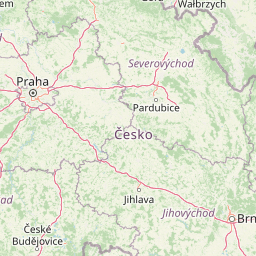
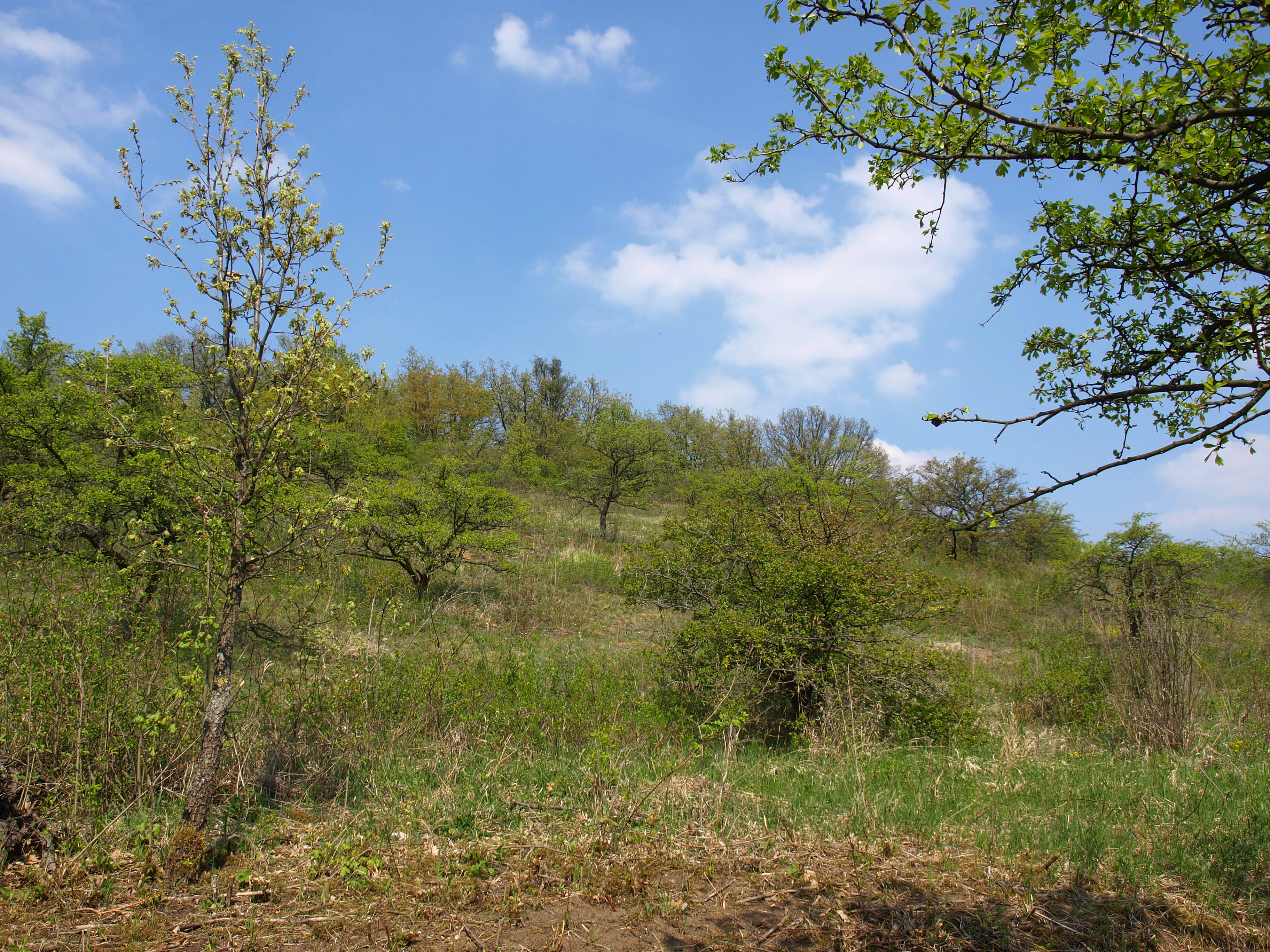
Velká Klajdovka occupies the southeastern slope of Hády hill, a steep, sun-exposed face that drops away from the limestone ridge above. The topography is characterized by inclined terrain, exposed rock outcrops in places, and a sharp thermal contrast between south-facing slopes, which are among the warmest in the Brno area, and adjacent cooler microclimates on shaded aspects.
The site's landscape is shaped less by dramatic relief than by the subtle interplay of geology, soil, and exposure. In the upper part of the reserve, Devonian limestone dominates, producing thin, skeletal rendzina soils that favor drought-adapted vegetation. Lower down, the bedrock shifts to granodiorite of the Brno massif, generating more acidic substrates. Although the geological boundary is not always obvious on the surface, it influences plant distribution and contributes to the unusual ecological complexity of the area.
Human influence is also visible in the landscape. Large quarry spoil heaps have been deposited in parts of the western section, partially reshaping the terrain. Nevertheless, the overall impression remains that of a dry, steppe-like hillside with a mosaic of open meadow patches, low shrubs, scattered trees, and woodland edges, all enclosed within an urban-adjacent setting.
Velká Klajdovka ecosystems, habitats, and plant life
The nature of Velká Klajdovka is defined by its concentration of thermophilic, or warmth-loving, plant and animal communities that are otherwise rare in the region. The reserve harbors a remarkable mixture of dry grasslands, low scrub, woodland-edge habitats, and warm oak woodland, all compressed into a very small area. This mosaic creates unusually sharp ecological transitions, where calcareous and acidic plant communities are found within meters of one another.
The woodland component is dominated by pubescent oak and sessile oak, accompanied by hornbeam, field maple, small-leaved lime, and wild service tree. Black locust, a non-native species, is also present. Beneath and between these trees, a dense shrub layer of Cornelian cherry, hazel, dogwood, blackthorn, spindle, hawthorn, and wild rose creates structural diversity typical of forest-steppe ecotones. The herb layer includes a striking array of steppe and dry-grassland specialists, among them several orchid species and other protected thermophilic flowering plants.
Overall, Velká Klajdovka functions as a small-scale ecological island within the urban matrix, where relict steppe species survive alongside woodland taxa. Its ecological value lies less in size than in the intact vertical and horizontal structure of vegetation types it maintains, and in the unusually high species richness per unit area that characterizes warm, south-facing Moravian hillsides.
Velká Klajdovka wildlife and species highlights
Wildlife at Velká Klajdovka reflects the open, steppe-like character of the site, with a strong emphasis on warm-loving invertebrates, reptiles, and small woodland birds. The reserve is especially noted for its entomological diversity, supporting an unusually rich assemblage of moths, butterflies, orthopterans, and spiders for its size.
Among reptiles, the smooth snake and the green lizard are considered notable returns to the Hády area, having been regarded as locally extinct in earlier decades. The slow worm and the sand lizard are also recorded. Reptiles are particularly associated with the warmer southern slopes, where bare ground and scrub create favorable basking and shelter conditions. A family of European badgers maintains several setts in the clay-rich sediments in the central part of the reserve.
The birdlife is typical of warm, semi-open habitats and the edges of deciduous woodland. Species documented at the site include the Eurasian wryneck, the European golden oriole, the spotted flycatcher, the red-backed shrike, and the Syrian woodpecker, the last being a regionally rare species. The combination of open steppe patches, shrubs, and oak woodland provides nesting and foraging opportunities for a broad mix of species within a very small area, reinforcing the reserve's importance for urban-edge biodiversity conservation.
Velká Klajdovka conservation status and protection priorities
The conservation value of Velká Klajdovka rests on its role as a refuge for thermophilic plant and insect communities that have largely disappeared from the agricultural and urban landscapes surrounding Brno. By securing a representative cross-section of steppe, forest-steppe, and warm oak woodland habitats, the reserve helps maintain genetic reservoirs and reference populations of species that are nationally rare or threatened.
The site's protection also carries scientific significance. The Hády slopes, including Velká Klajdovka, have been documented since the 19th century, and the reserve continues to serve as an outdoor laboratory for studying the dynamics of warm, dry habitats, vegetation succession, and the recolonization of previously open landscapes by shrubs and trees. Active management, including the maintenance of small open meadow patches within the dense scrub, is considered essential for preserving the character of the protected area.
At a broader scale, Velká Klajdovka is part of a network of small protected sites that together safeguard the natural heritage of the Hády massif. Its IUCN Category IV designation as a habitat/species management area reflects its primarily species- and habitat-oriented conservation purpose, and its proximity to the city of Brno underscores the importance of maintaining such refugia even within densely populated landscapes.
Top sights and standout views in Velká Klajdovka
Velká Klajdovka stands out as a compact but exceptionally species-rich steppe and forest-steppe reserve on the outskirts of Brno. Its strongest points of interest include the juxtaposition of calcareous and acidic substrates, the presence of rare orchids and steppe wildflowers, and an unusually rich entomological fauna for a site of its size.
The reserve also offers a distinctive combination of botanical, zoological, and geological interest. Visitors and researchers encounter thermophilic oak woodland, open steppe patches, woodland edges, reptile-rich sunny slopes, and a layered cultural history of land use stretching back to the 19th century, all within a few hectares on the southern flank of one of Brno's most iconic hills.
Best time to visit Velká Klajdovka
Late spring and early summer are the most rewarding periods to experience the steppe and dry-meadow communities of Velká Klajdovka, when thermophilic wildflowers and orchids are in bloom and insects are most active along the warm southern slopes. The exposed terrain becomes very hot in mid-summer, so visits in early morning or late afternoon are most pleasant.
Autumn brings crisp, clear views across the Brno landscape, while winter offers a more austere but structurally interesting perspective on the woodland and scrub mosaic. Because the reserve is small and located in an urban setting, everyday visits outside the peak tourist season tend to be quieter and more conducive to observation of birds and reptiles.