
Why Vlčice Natural Monument stands out
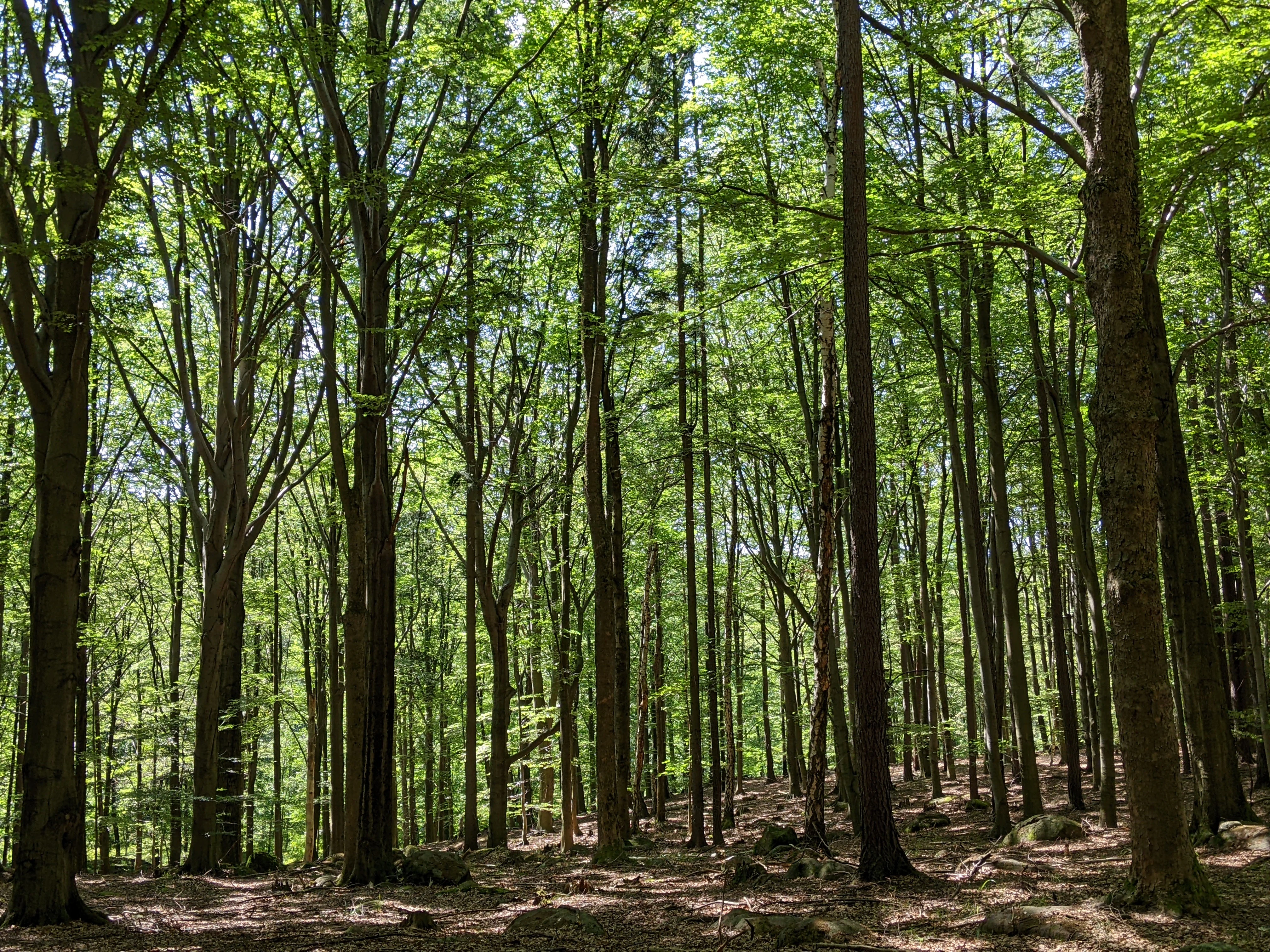
The protected site is best known for being a surviving fragment of an old-growth acidophilic beech forest, rich in veteran trees, standing and lying deadwood, and the rare species that depend on these structural features. It is particularly notable as habitat for the stock dove, boreal owl, and red-breasted flycatcher, all of which are among the most threatened forest birds of central Europe. Equally important is the site's rich assemblage of saproxylic beetles, including several red-listed species documented during a 2018 survey. Together, these elements mark Vlčice as a high-value reference locality for natural beech forest dynamics in the Šluknov Hills, and as a rare, well-preserved example of what much of the surrounding Czech landscape once looked like under minimal direct management.
Vlčice Natural Monument history and protected-area timeline
Vlčice has no long history as a formally protected reserve; its significance is recent in administrative terms. The site was designated as a Czech natural monument (přírodní památka), a category used for smaller protected areas focused on ecologically valuable natural features, by the Regional Authority of the Ústecký Region, with effect from 12 February 2022.
The designation followed ecological surveys that documented the exceptional structural quality of the beech stand and its importance for several rare forest species. A 2018 survey in particular recorded a substantial community of saproxylic fungi and beetles, including several red-listed species, and confirmed that the area hosted nesting populations of threatened forest birds. These findings underpinned the conservation case that led to formal protection.
The monument is not managed as a tourist attraction but as a strictly conserved ecological site. There is no preceding protected-area designation for this exact territory; the 2022 declaration is the first formal recognition of Vlčice as a protected natural area.
Vlčice Natural Monument landscape and geographic character
The landscape of Vlčice is shaped by the rolling upland terrain of the Šluknov Hills, specifically the Šenovská pahorkatina subunit. The protected area lies on the northern slope of hill Vlčice, between roughly 398 and 504 meters in elevation, occupying a mid-slope hillside rather than a valley floor or a steep scarp. The relief is moderate, with smoothed contours typical of crystalline-rock uplands and no dramatic cliffs, gorges, or rock formations.
The geological base is granodiorite of the Lusatian Massif, a hard crystalline rock that weathers slowly and produces acidic, nutrient-poor soils. Surface soils here are skeletal cambisols, thin and stony, well suited to acidophilic vegetation rather than richer deciduous or mixed communities. This geological backdrop is the principal reason why the site supports an acidophilic beech forest rather than a more fertility-demanding woodland type.
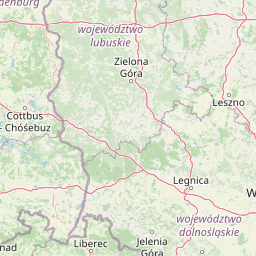
At the broader scale, the protected area forms part of the wooded borderland between the Šluknov Hills and the Saxon landscape to the north. The forest cover in this region is extensive but heavily modified in most places by forestry; the Vlčice fragment therefore stands out as a comparatively unmodified rise within a wider, working-forest matrix.
Vlčice Natural Monument ecosystems, habitats, and plant life
Ecologically, Vlčice is defined by its acidophilic beech forest, a vegetation type associated with acidic substrates and a relatively species-poor but structurally distinctive community. In the herb layer, characteristic plants of acidophilic beech forests dominate in much of the site, while the eastern portion also shows elements of more nutrient-rich, floristically diverse beech woodland (květnatá bučina). This east-west variation reflects subtle differences in soil chemistry and moisture across the slope.
The herb layer includes species such as Prenanthes purpurea, Avenella flexuosa, Poa nemoralis, Carex brizoides, Calamagrostis villosa, Festuca altissima, Paris quadrifolia, Dentaria bulbifera, Circaea alpina, Gymnocarpium dryopteris, Carex remota, Carex sylvatica, Impatiens noli-tangere, Digitalis purpurea, Melica uniflora, and Galeobdolon montanum. Together these form a fairly typical central European acidophilic beech understory, with plants adapted to shaded, acidic, leaf-litter-covered soils.
Deadwood and veteran trees are a defining ecological feature of the site. A 2018 fungal survey recorded several indicators of high natural value, including Ceriporiopsis gilvescens, Ischnoderma resinosum, and Inonotus cuticularis, all fungi associated with old-growth beech forests and the presence of substantial amounts of decaying wood. This wood-rich habitat is the foundation for the rich saproxylic beetle community documented at the site, and it underpins the area's importance for forest-interior biodiversity.
Vlčice Natural Monument wildlife and species highlights
The wildlife significance of Vlčice lies less in conspicuous large mammals than in its rich communities of forest birds, saproxylic beetles, and fungi that depend on old-growth beech forest conditions. The site and its immediate surroundings support notable breeding populations of several rare and threatened bird species, including the red-breasted flycatcher (Ficedula parva), the stock dove (Columba oenas), the boreal owl (Aegolius funereus), the Eurasian honey buzzard (Pernis apivorus), the northern goshawk (Accipiter gentilis), the spotted nutcracker (Nucifraga caryocatactes), and the common raven (Corvus corax). Additional species observed in or near the area include the black stork (Ciconia nigra), the red kite (Milvus milvus), the grey-headed woodpecker (Picus canus), the spotted flycatcher (Muscicapa striata), and the Eurasian eagle-owl (Bubo bubo).
The saproxylic beetle fauna is similarly distinctive. A 2018 survey recorded 64 beetle species, several of which are red-listed, including Lymexylon navale, Corticeus unicolor, two species of Mycetochara, Synchita undata, Agriotes pallidulus, Selatosomus cruciatus, the rare deadwood-dependent Hylis cariniceps, Conopalpus testaceus, and Pediacus depressus. The presence of these species reflects the site's abundant deadwood and its long, largely undisturbed continuity as beech forest.
Birds of prey and cavity-nesting species are particularly well represented, indicating a mature forest structure with sufficient old trees to support nesting hollows. The combination of rare cavity-nesters, a rich saproxylic beetle fauna, and indicator fungi makes Vlčice an important reference site for the fauna of central European beech forests.
Vlčice Natural Monument conservation status and protection priorities
The central conservation objective at Vlčice is the protection of an acidophilic beech forest ecosystem and the rare species it supports. The site was specifically designated for its documented populations of strongly threatened birds, including the stock dove, boreal owl, and red-breasted flycatcher, and for the rare saproxylic beetle Hylis cariniceps. These species are indicators of high natural-value forest and are threatened when mature beech stands are converted to more intensive forestry.
The protection regime seeks to allow the forest to develop naturally, with a conservation target of a self-evolving woodland of at least around twelve hectares encompassing all developmental stages of the tree species present. In practice, this means retaining veteran trees, allowing natural regeneration, and preserving deadwood in all states of decay. The site is therefore managed against the prevailing intensive forest use of the surrounding landscape, setting it aside as a reference for natural forest dynamics.
In the broader national context, Vlčice adds to the network of small protected forest areas in the Czech Republic that collectively preserve fragments of the country's natural beech forest heritage. Although small individually, these sites are ecologically important because each represents an island of habitat continuity for species that cannot survive in heavily worked commercial forest.
Top sights and standout views in Vlčice Natural Monument
Vlčice stands out as a small but ecologically rich fragment of old acidophilic beech forest in the Šluknov Hills, recognized for its dense populations of rare forest birds and a thriving saproxylic beetle community. A 2018 survey documented dozens of beetle species, several of them red-listed, as well as indicator fungi that mark the woodland as a high-natural-value beech forest.
The site's strength lies in the combination of structural factors that are increasingly rare in central European forests: abundant veteran trees, large amounts of standing and fallen deadwood, and minimal direct management. These are the conditions on which the protected species depend, and they give Vlčice its particular identity as a conservation site.
Best time to visit Vlčice Natural Monument
Vlčice is a strictly protected natural monument rather than a visitor attraction, and meaningful visits are limited to careful observation from the forest edge or along nearby paths. The most rewarding periods for experiencing the forest are late spring and early summer, when the herb layer is at its most diverse and breeding birds are most active, and autumn, when the fungal community becomes more conspicuous and the beech canopy shifts color.