Why Altyn Dala Nature Reserve stands out
Altyn Dala is best known as one of the most important protected landscapes for the Betpak-Dala population of the saiga antelope, an iconic and highly threatened steppe species whose vast migratory routes cross northern Kazakhstan. The reserve secures key habitats and seasonal ranges along the Turgay and Uly-Zhylyanshyk river corridors as well as the lake-rich Sarykopa area. It is also recognized for its role as a landscape-scale refuge for intact steppe and semi-desert ecosystems, with its three-cluster structure preserving sand-dune massifs, brackish lake systems, floodplain meadows, and desertified steppe in a single protected framework. The reserve has additionally become prominent for the ongoing reintroduction of the kulan, supporting efforts to restore the historical completeness of Central Kazakhstan's steppe fauna.
Altyn Dala Nature Reserve history and protected-area timeline
Altyn Dala Nature Reserve was established on 27 November 2012 by a special resolution of the Government of Kazakhstan, as part of a broader national effort to strengthen the protection of the country's natural heritage, particularly the remaining strongholds of the Betpak-Dala saiga antelope population. The reserve absorbed the territory of the former Sarykopa zakaznik, an earlier protected designation whose upgrading was required by the UNESCO World Heritage Committee during deliberations on the Saryarka serial nomination covering the steppes and lakes of northern Kazakhstan.
The Sarykopa zakaznik had originally been considered as one of the components of the Saryarka World Heritage nomination. Although it was ultimately withdrawn from the nomination in favor of other sites, the World Heritage Committee recognized in 2008 that Saryarka met natural criteria ix and x and specifically encouraged Kazakhstan to expand the serial property by incorporating the Sarykopa area at a higher protection status, alongside additional portions of the Korgalzhyn Reserve.
In 2017, Altyn Dala was chosen as the site for a major kulan reintroduction program aimed at restoring a viable population of Asiatic wild ass in central Kazakhstan and re-establishing the historical species composition of the steppe ecosystem. The program began with a translocation of ten kulans from Altyn-Emel National Park to a dedicated acclimation enclosure within the reserve, followed in November 2019 by additional animals from the Barsakelmes Reserve. In late September 2024, the program pioneered a new long-distance land transport technique for kulans in Kazakhstan, moving 24 animals over 50 hours across 2,139 kilometers using purpose-built group containers designed in line with South African ungulate transport experience.
Altyn Dala Nature Reserve landscape and geographic character
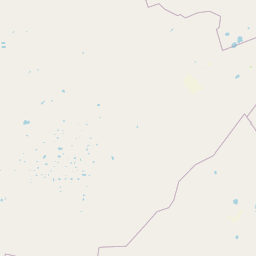
The landscape of Altyn Dala is defined by its enormous, gently rolling steppe plains, sprinkled with patches of sand, saline lake systems, and river corridors. The reserve lies in the Turgay Basin region of northern Kazakhstan, where the relief is a flattening plain with absolute elevations generally between 120 and 200 meters in the western and central portions of the territory, rising gradually eastward toward the Zhylyanshikturme upland, where absolute elevations reach approximately 200 to 300 meters. This subtle topography shapes how water, vegetation, and wildlife are distributed across the protected area.
The Sarykopa cluster in the west is anchored by a system of brackish lakes that act as oases within the surrounding steppe, providing crucial water sources and habitat for migratory waterbirds and an essential watering and crossing area for saiga. The Tosynkum cluster spans the Tosynkum sand massif, a body of dune and sandy terrain where vegetation patterns shift with soil moisture, combined with a stretch of the left bank of the Turgay River, whose floodplain adds riverine meadows and riparian habitats to the reserve's mosaic.
The Uly-Zhylyanshyk cluster, which dominates roughly 70 percent of the reserve's area, extends across a vast semi-desert plateau and along a significant portion of the Uly-Zhylyanshyk River. Here, the landscape becomes progressively more arid, with wide expanses of desertified steppe interrupted by the green ribbon of the river valley. Across all three clusters, the visual impression is one of horizon-stretching openness, with the lack of dense vertical relief placing emphasis on texture, light, and seasonal color shifts in the grasses and herbs.
Altyn Dala Nature Reserve ecosystems, habitats, and plant life
Altyn Dala safeguards a transition between steppe, semi-desert, desert, meadow, and wetland ecosystems that is increasingly rare across Eurasia. Across the three clusters, the protected habitats fall into a broad ecological gradient, from the wetter lake margins and floodplains of Sarykopa and the Turgay River to the more arid sand-dune vegetation of Tosynkum and the open semi-desert steppe of Uly-Zhylyanshyk.
Steppe and semi-desert vegetation dominates the reserve, accounting for roughly 400,000 hectares of its area. These ecosystems include feathergrass and other typical Central Kazakh steppe species, while the sandy Tosynkum section supports more drought-adapted plant communities. The meadows, floodplain wetlands, and the brackish lakes around Sarykopa contribute a sharp ecological contrast, supporting aquatic plants, reeds, and wetland-associated wildlife that cannot persist in the drier sections of the reserve.
The mosaic of these habitats within a single large protected area makes Altyn Dala ecologically significant beyond its scale. The reserve protects not only individual species but also the ecological processes that depend on multi-habitat connectivity, especially the seasonal movements of large ungulates between dry summer ranges and the more reliable winter and calving habitats along rivers and lakes. This ecological coherence is precisely what made the site attractive for both saiga conservation and the kulan reintroduction program.
Altyn Dala Nature Reserve wildlife and species highlights
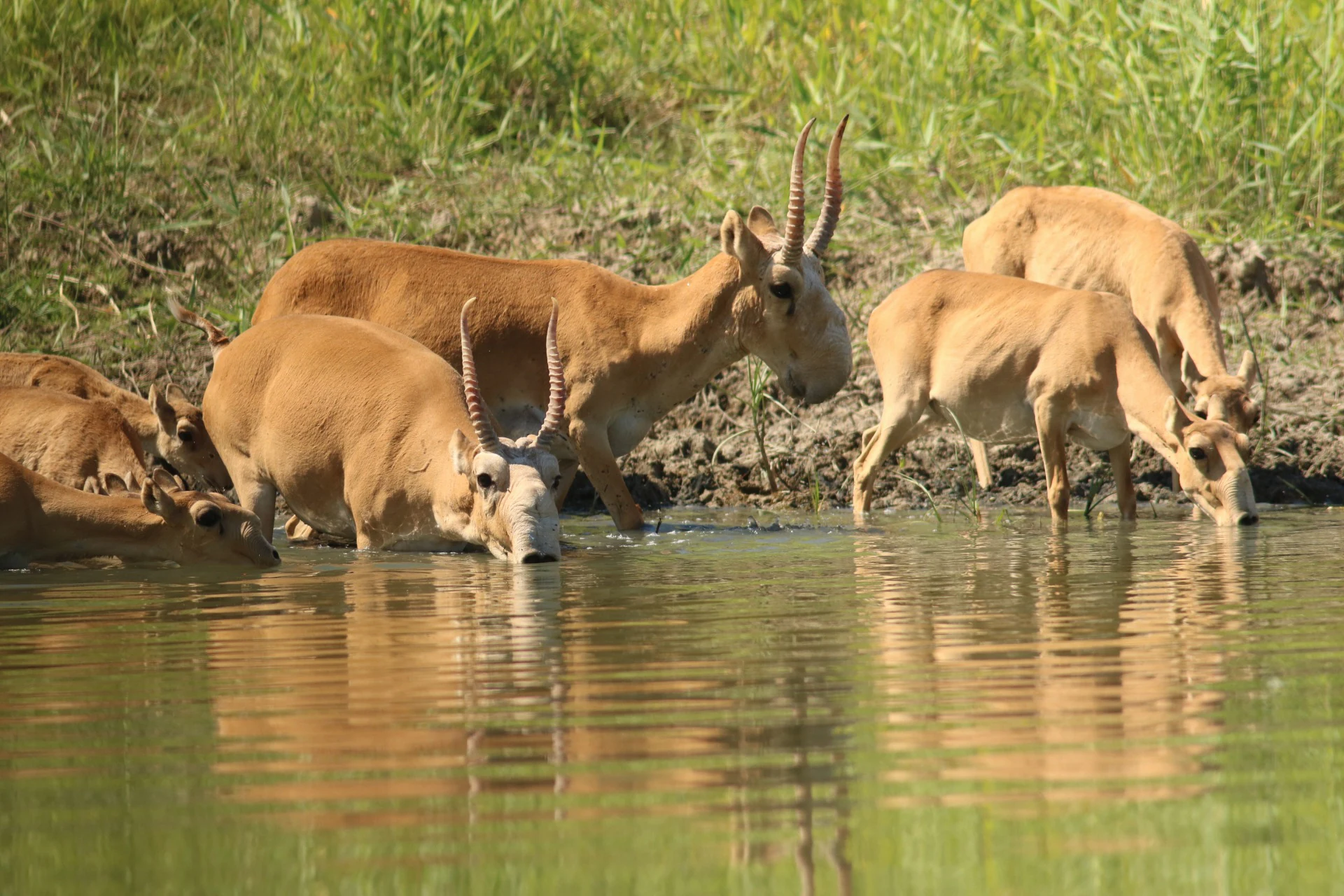
The wildlife significance of Altyn Dala is anchored by its role as a stronghold for the Betpak-Dala population of the saiga antelope, one of the most emblematic and threatened large mammals of the Eurasian steppe. The reserve was specifically created to safeguard the species' habitats, breeding grounds, and migration routes, and the image of saigas coming to water at sites within the reserve has become closely associated with the protected area's identity.
Alongside saiga, the reserve supports a wide variety of steppe-adapted bird species, particularly around the Sarykopa lake system, where migratory and breeding waterbirds concentrate. The combination of lakes, floodplain, sand-dune, and semi-desert habitats creates niches for diverse predator and small mammal communities typical of the Kazakh steppe, though the recorded source material most explicitly highlights saiga and the reintroduced kulan.
The reintroduced population of the Asiatic wild ass, the kulan, is a defining wildlife feature of contemporary Altyn Dala. Since 2017, kulans translocated from Altyn-Emel National Park and the Barsakelmes Reserve have been acclimated within fenced enclosures, monitored with satellite collars, and progressively released into the reserve. The reintroduction program has already documented births, range expansion, and the development of group behavior, including incidents of males joining existing herds, representing an important milestone for steppe wildlife restoration in Kazakhstan.
Altyn Dala Nature Reserve conservation status and protection priorities
Altyn Dala is classified by IUCN as Category VI, recognizing it as a protected area for the sustainable use of natural resources. Functionally, however, it operates as a critical refuge where protection and active restoration coincide. The reserve was established in 2012 specifically to protect the natural heritage of Kazakhstan, with the conservation of saiga habitats, calving grounds, and migration corridors as its core mission.
At a broader scale, Altyn Dala contributes to the international conservation network surrounding the Saryarka steppes and lakes of northern Kazakhstan. The earlier Sarykopa zakaznik, whose territory is now absorbed into the reserve, was part of Kazakhstan's serial UNESCO World Heritage nomination, and the World Heritage Committee explicitly recommended in 2008 that this area be incorporated into the Saryarka property at a higher protection status, highlighting its conservation significance.
In addition to passive habitat protection, Altyn Dala serves as an active reintroduction site for the kulan, an ecological restoration initiative that has attracted cooperation from the Norwegian Institute for Nature Research, the Frankfurt Zoological Society, the Nuremberg Zoo, and the Royal Society for the Protection of Birds. The reserve's role in recovering historical steppe fauna, its long-term ungulate translocation methodology, and its function as a multi-cluster landscape refuge together make it one of Kazakhstan's most strategically important conservation assets for steppe and semi-desert ecosystems.
Altyn Dala Nature Reserve cultural meaning and human context
The cultural context of Altyn Dala is closely tied to the wider human heritage of the Kazakh steppe, where pastoral traditions have long coexisted with the rhythms of large ungulate migrations. The reserve sits in the Amangeldi and Dzhangeldi districts, areas where rural land use, livestock grazing, and traditional steppe livelihoods remain part of the regional identity. The reserve itself is managed by national authorities within the framework of Kazakhstan's natural protected-area system, marking a deliberate national commitment to preserving the country's open landscapes alongside its pastoral heritage.
The name Altyn Dala itself, from the Kazakh word for "golden steppe," reflects the cultural resonance of these grasslands in Kazakh identity, while the reserve's design, three separate clusters protecting lake systems, sand dunes, and semi-desert plains, mirrors an understanding of the steppe as a landscape of seasonal contrasts and resources that has shaped local communities for generations.
Top sights and standout views in Altyn Dala Nature Reserve
Altyn Dala's strongest points of distinction are its vastness, its role in safeguarding one of the last great saiga migration systems, and its pioneering kulan reintroduction work. The reserve's three-cluster design links a brackish lake system, a sand-dune massif along the Turgay River, and the semi-desert steppe of Uly-Zhylyanshyk into a single, large protected landscape that mirrors the ecological gradients of the broader Kazakh steppe.
Equally notable is the reserve's position within Kazakhstan's wider conservation architecture, particularly its historical connection to the Saryarka UNESCO World Heritage nomination and the World Heritage Committee's 2008 recommendation to expand protection at Sarykopa, and its ongoing international partnerships with Norwegian, German, and British conservation organizations supporting long-term ungulate reintroduction.
Best time to visit Altyn Dala Nature Reserve
As an IUCN Category VI reserve with a conservation and research mandate rather than a tourism-oriented national park, access to Altyn Dala is generally limited, and most visitors are researchers, conservation staff, or partners of the management organization. For those interested in understanding the landscape ecologically, late spring and early summer typically offer the most favorable conditions, when steppe vegetation is at its greenest, the Sarykopa lake system supports breeding and migratory waterbirds, and large ungulates such as saiga are concentrated near water sources and during calving periods. Late summer and early autumn bring warmer golden-hued steppe conditions and the continued herd movement typical of saiga seasonal ecology. Winter visits, while logistically demanding, can showcase the open steppe under snow, a phase of considerable ecological importance for both saiga and reintroduced kulans.