Why Biotopo Monte Brione stands out
Biotopo Monte Brione is best known for hosting a Mediterranean ecosystem enclave deep inside an otherwise Alpine region. Its holm oak and deciduous mixed forests, olive groves, Phoenician juniper, rockrose, mastic, myrtle, and other thermophilic plants flourish on warm, sun-exposed limestone cliffs that descend toward Lake Garda. The biotope is also widely recognized for its birdlife. Several typically southern European bird species reach their northern distributional limits here, while raptors such as the peregrine falcon nest on the cliffs and the short-toed snake eagle patrols the slopes. The presence of rare invertebrates such as the longhorn beetle Rosalia alpina and the oak cerambycid Cerambyx cerdo further strengthens the biotope's profile as a small but ecologically rich Mediterranean island in the southern Alps.
Biotopo Monte Brione history and protected-area timeline
The protected area was formally established in 1992 through a provincial decree (decreto del presidente della giunta provinciale), making it one of many local biotopes created in Trentino during the 1990s as part of an effort to safeguard small but ecologically sensitive areas. Soon after its foundation, in 1995, the site was incorporated into the Natura 2000 network, the European Union's coordinated framework for biodiversity conservation, under the designation IT3120075.
In 2013, management of the biotope was transferred to the Parco fluviale della Sarca, a river park dedicated to the protection of the Sarca river system. This integration linked the conservation of Monte Brione's terrestrial habitats with broader river ecosystem management, strengthening the protection of the lake-shore and inland corridor between the Brione ridge and the lake.
Biotopo Monte Brione landscape and geographic character
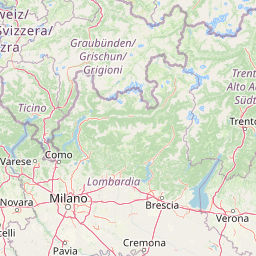
Monte Brione is a compact, steep-sided hill that juts out toward the northern tip of Lake Garda, separating the small harbor of Torbole from the larger town of Riva del Garda. The terrain is characterized by sudden changes in elevation, with exposed limestone cliffs facing the lake and more gently wooded slopes and terraces on the inland side. The proximity of deep water, vertical rock faces, and sheltered inland pockets creates a strong gradient of microclimates within a very small area.
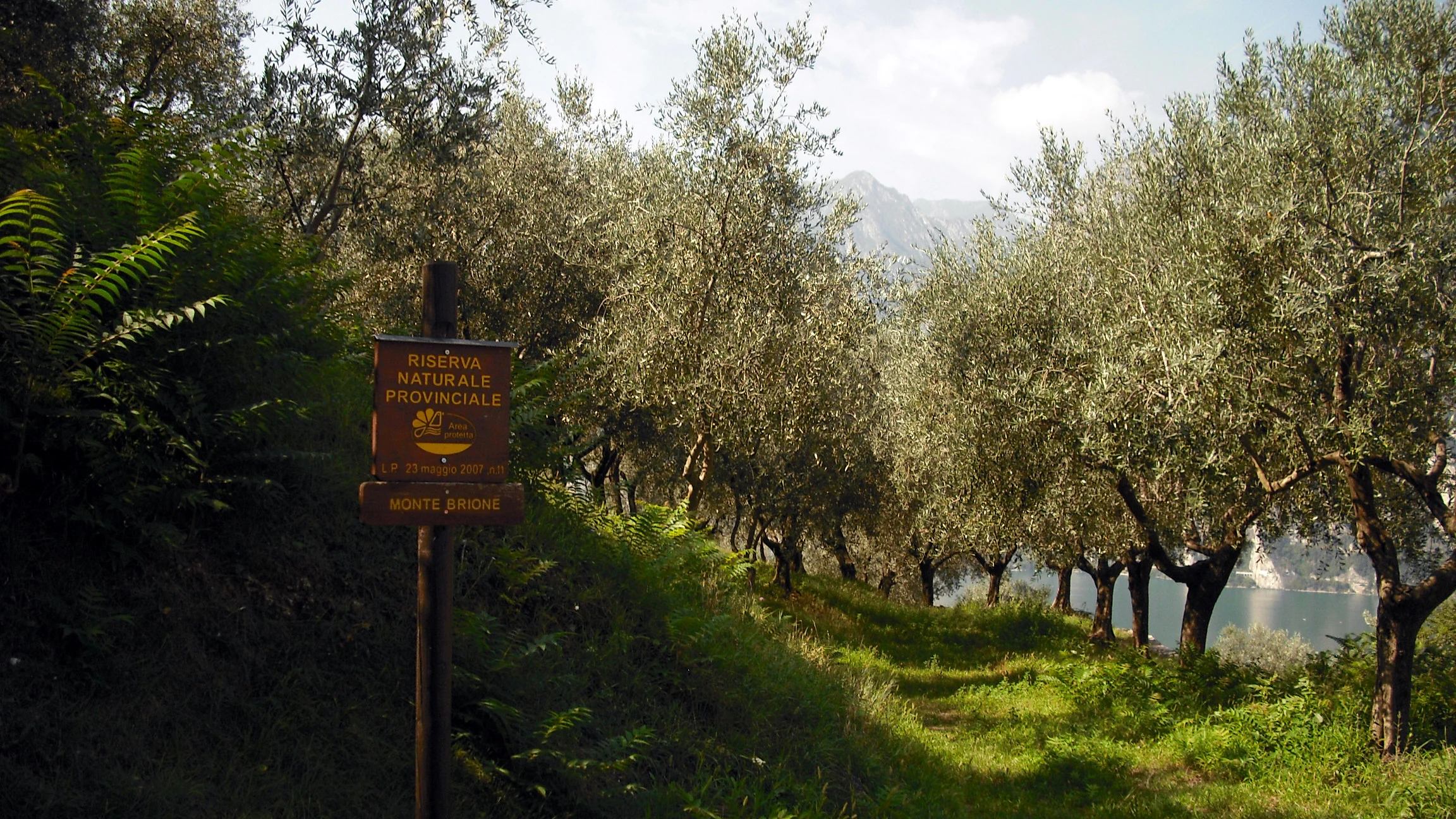
The biotope's physical setting combines dry, sun-baked limestone outcrops with dense maquis, abandoned terraced olive groves, mixed broadleaf woodlands, and mosaic patches of shrubs and herbaceous vegetation. Rocky screes and cliff ledges interrupt the woodland, while occasional flatter areas support dry grassland. The contrast between the bright, reflective surface of the lake below and the rough Mediterranean vegetation clinging to the cliffs above is one of the defining visual signatures of the area.
Biotopo Monte Brione ecosystems, habitats, and plant life
Ecologically, Biotopo Monte Brione is best understood as a Mediterranean outpost embedded within an Alpine region. Forest cover is dominated by sclerophyllous evergreen species, especially holm oak, alongside deciduous broadleaves such as hop hornbeam and other thermophilic trees. Extensive abandoned olive groves on the slopes, with their characteristic gnarled trees, contribute to the Mediterranean character of the site.
The shrub layer includes numerous typical Mediterranean species, including rosemary, Phoenician juniper, Montpellier cistus, mastic, tree heath, spiny broom, and myrtle. The herbaceous layer features several species of wild orchid, occasional rare plants such as phillyrea and butcher's broom, and dry-loving grasses and forbs adapted to rocky soils. Together, these plant communities form a Mediterranean maquis pattern that is unusually well developed for the latitude.
Biotopo Monte Brione wildlife and species highlights
The biotope supports a rich and unusual bird community for the region. Its cliffs and rocky outcrops provide nesting habitat for typically southern species that are otherwise absent from most of Trentino, including the blue rock thrush and the common rock thrush, while low shrubby areas host species such as the Sardinian warbler. Among woodland birds, the great spotted woodpecker, crag martin, hoopoe, rock pigeon, Eurasian nightjar, rock sparrow, yellowhammer, common cuckoo, and ring ouzel are all associated with the biotope's forests and cliffs.
Raptors are an important presence on Monte Brione. The peregrine falcon nests on cliffs and outcrops overlooking the lake, the lanner falcon, short-toed snake eagle, European honey buzzard, black kite, and common kestrel hunt across the slopes, and smaller owls such as the little owl, barn owl, and tawny owl occupy cavities and wooded areas. Among mammals, several bat species are notable; colonies of Schreiber's bent-winged bat have been documented on the summit. Common mammals include wild boar, roe deer, red fox, beech marten, red squirrel, hedgehog, European mole, bank vole, yellow-necked mouse, and garden dormouse. The Etruscan shrew, an extremely rare species in Trentino, has been recorded here and at the nearby Marocche di Dro. Among reptiles, the green whip snake, asp viper, and grass snake are found in sunny clearings and rocky areas. The invertebrate fauna includes the threatened oak longhorn beetle (Cerambyx cerdo) and the alpine longhorn beetle (Rosalia alpina), both associated with mature deciduous and oak woodland.
Biotopo Monte Brione conservation status and protection priorities
The conservation significance of Biotopo Monte Brione lies in its role as a refuge for Mediterranean biodiversity far north of the species' typical distributions. Its woodland, shrubland, and cliff habitats form an ecological island that supports plant and animal communities otherwise very rare in the Alpine region. Recognition through Natura 2000 has underlined the European importance of the site's habitats and species, particularly for thermophilic woodland, Mediterranean shrubland, and cliff-breeding birds of prey.
Inclusion in the Parco fluviale della Sarca in 2013 expanded the scope of management, allowing conservation measures to be coordinated across a wider landscape that includes the lake shore, the river, and the slopes of Monte Brione. The protected area's small size, its position amid developed and frequented lake-shore zones, and its sensitivity to disturbance make it a valuable example of how compact protected areas can preserve high natural value even in a heavily visited region.
Top sights and standout views in Biotopo Monte Brione
Biotopo Monte Brione combines three distinctive traits in a small footprint: a clear Mediterranean character expressed through flora and habitat pattern, an unusually southern-influenced bird community for an Alpine province, and a dramatic lakeside setting on the upper Lake Garda. The presence of rare invertebrates such as Rosalia alpina and Cerambyx cerdo in mature deciduous and holm oak woodland reinforces its scientific interest, while abandoned olive groves, holm oak forest, and Phoenician juniper shrubland give it a strongly Mediterranean visual identity. The cliffs overlooking the lake, occupied by nesting peregrine falcons and other raptors, add a striking scenic dimension to the site.
Best time to visit Biotopo Monte Brione
Spring and early summer are typically the most rewarding periods to visit Biotopo Monte Brione, when Mediterranean shrubs and wildflowers are in bloom and bird activity, including that of migrant and nesting species, is at its peak. The mild microclimate around Lake Garda also makes the cooler months suitable for walking and birdwatching, while autumn offers a quieter atmosphere and warmer-toned vegetation. Summers are warm and sunny but can be busier due to general tourism around the Lake Garda area.