

Mori Atlas logo
Nature reserveDąbrowa Świetlista Nature Reserve

A rare thermophilic oak forest reserve within the Wysoczyzna Kłodawska region of Łódź Voivodeship

Dąbrowa Świetlista Nature Reserve: Exploring Protected Lowland Forest Landscapes in Poland

(Rezerwat przyrody Dąbrowa Świetlista)

Dąbrowa Świetlista Nature Reserve preserves a distinct light-filled oak forest community that stands as a vital ecological anchor within the agricultural matrix of central Poland. Covering nearly 40 hectares in the Łódź Voivodeship, this protected area serves as an important site for floristic diversity and habitat conservation, featuring a unique mosaic of plant species. The reserve, recognized for its specialized thermophilic canopy, offers a clear perspective on the remnant lowland deciduous forests of the region.

thermpophilic oak forestlowland forest reserveNatura 2000 siteprotected woodlandPoland nature reservedeciduous forest
A flat vector-style illustration of a mountain valley scene with a prominent monolith rock formation, a waterfall, a river, and surrounding trees under a soft-toned sky.

Dąbrowa Świetlista Nature Reserve

Nature reserve

Park overview

Structured park overview, official facts, and landscape profile for Dąbrowa Świetlista Nature Reserve

Dąbrowa Świetlista Nature Reserve park facts, protected area profile, and essential visitor context

Review the core facts for Dąbrowa Świetlista Nature Reserve, including designation, size, terrain, visitor scale, habitats, and operating context in one park-focused overview.

About Dąbrowa Świetlista Nature Reserve

Dąbrowa Świetlista Nature Reserve is a protected lowland forest in central Poland, situated in the Łódź Voivodeship near the village of Perna in the gmina Nowe Ostrowy. Although modest in size, it holds considerable botanical importance because it preserves a near-natural stand of thermophilic oak woodland, a forest type more commonly associated with warmer parts of continental Europe than with lowland central Poland.

The reserve falls within the Wysoczyzna Kłodawska mesoregion, a terrain shaped by older glacial activity that left behind gently undulating lowlands. The reserve itself sits at roughly 52 degrees north and 19 degrees east, in a landscape where agricultural land surrounds small forest fragments. Within that context, the reserve functions as a refugium for oak woodland vegetation that has largely disappeared from the surrounding countryside.

Ecologically, the reserve is classified as a phytocoenotic reserve of forest communities and, more broadly, as a biocenotic and physico-cenotic reserve protecting natural and seminatural biocenoses. Its protected object is the świetlista dąbrowa community, classified within the reserve system as belonging to lowland forests and, more specifically, to the subtype of lowland forests. Alongside the oak-dominated woodland, small patches of an edge community (zbiorowisko okrajkowe) occur within the reserve.

Beyond its national designation, the area is part of the European Natura 2000 network as a Special Area of Conservation under the name "Dąbrowa Świetlista w Pernie." This dual recognition, both as a national Polish nature reserve and as a European habitat site, reflects the site's broader relevance for conserving a forest type of considerable biogeographic interest.

Quick facts and research context for Dąbrowa Świetlista Nature Reserve

Dąbrowa Świetlista is a forest nature reserve (rezerwat leśny) located in the Łódź Voivodeship of central Poland, in the administrative district of Kutno County and the gmina Nowe Ostrowy. It lies within the Wysoczyzna Kłodawska mesoregion, a lowland area shaped by glacial and post-glacial processes.

The reserve was created in 1990 by order of the Minister for Environmental Protection, Natural Resources, and Forestry, and since 2008 it has additionally been protected as part of the Natura 2000 network under the designation PLH100002. Its primary purpose is the conservation of a thermophilic oak forest with a rich accompanying flora.

Protection and recognition

Terrestrial conservation frameworks and designated management scope

Dąbrowa Świetlista Nature Reserve Protection Status and Governance Data

Documented protection records outline the terrestrial conservation framework established for Dąbrowa Świetlista Nature Reserve. Verified designation details and administrative boundaries provide clear context for ongoing habitat stewardship.

Protection details

Protection scope
Terrestrial
Transboundary protection
No
Park context

Deeper park guide and search-rich context for Dąbrowa Świetlista Nature Reserve

Dąbrowa Świetlista Nature Reserve history, landscape, wildlife, and travel context

Explore Dąbrowa Świetlista Nature Reserve through its history, landscape character, ecosystems, wildlife, conservation priorities, cultural context, and seasonal travel timing in a structured park guide built for atlas discovery and search intent.

Why Dąbrowa Świetlista Nature Reserve stands out

The reserve is best known for protecting a representative example of świetlista dąbrowa, a thermophilic, light-loving oak community that is botanically unusual in this part of Poland. The site draws attention because of its diverse herb layer, where plants belonging to very different syntaxonomic groups coexist within a single canopy. It is also valued for the presence of protected and regionally rare vascular plants and bryophytes, as well as for its landscape and aesthetic quality as a seminatural lowland woodland.
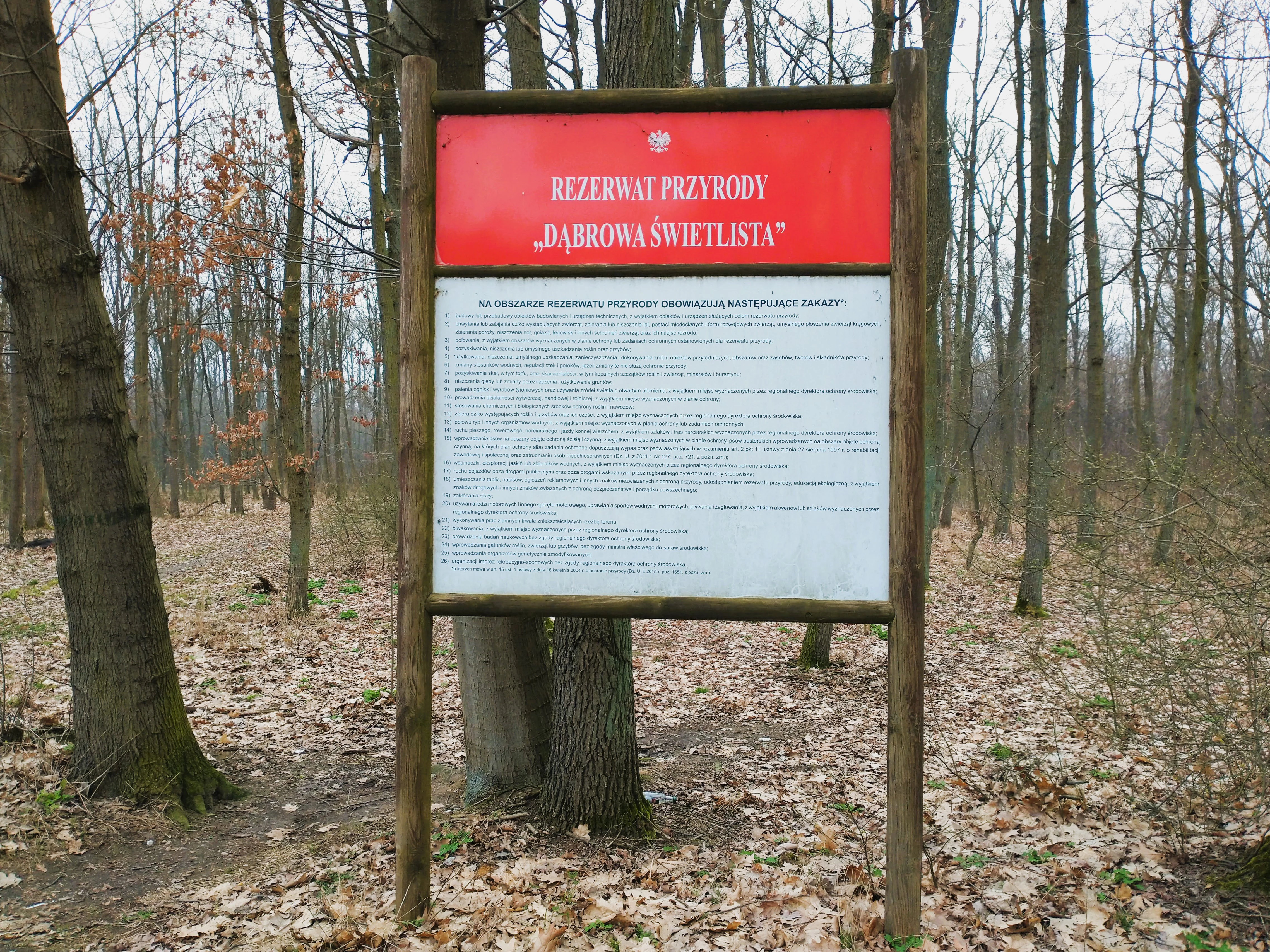
A rectangular information sign standing on two wooden posts in a forest setting. The sign has a red header with the text REZERWAT PRZYRODY DĄBROWA ŚWIETLISTA and a large white lower section containing detailed regulations and park rules in Polish text.
Information sign at the entrance of Dąbrowa Świetlista Nature Reserve.

Dąbrowa Świetlista Nature Reserve history and protected-area timeline

The reserve was established in 1990 by an order of the Minister for Environmental Protection, Natural Resources, and Forestry, issued on 25 June 1990 and published in the Polish official gazette Monitor Polski (1990, no. 31, item 248). Its creation was motivated by the desire to safeguard a natural thermophilic oak forest community with a rich accompanying flora in the Perna forest district.

In 1998, botanical surveys expanded the documented flora of the reserve, identifying a range of species that are considered regionally uncommon. In 2008, the reserve gained an additional layer of protection through inclusion in the Natura 2000 network as Special Area of Conservation PLH100002 "Dąbrowa Świetlista w Pernie," recognising the European value of its forest habitats.

Dąbrowa Świetlista Nature Reserve landscape and geographic character

The reserve lies within the Wysoczyzna Kłodawska, a gently undulating lowland region of central Poland formed through glacial and postglacial processes. Topographically this is a flat to rolling terrain, characteristic of the agricultural heartland of the Łódź Voivodeship. The reserve is approached from the voivodeship road 581, which gives access to a typical lowland countryside where fields and meadows alternate with small tracts of woodland.

Within this surrounding matrix, the reserve stands out as a compact forest island, dominated by oak. The canopy tends to be relatively open and light, giving the woodland the airy character that the term świetlista, meaning "light" or "luminous," implies. The combination of open, sunlit canopy and varied herb layer creates a habitat that feels visually distinct from the denser, more uniform lowland forests typical of the region.

Dąbrowa Świetlista Nature Reserve ecosystems, habitats, and plant life

The defining ecological feature of the reserve is the occurrence of świetlista dąbrowa, a thermophilic oak forest community in a near-natural state. This forest type is characterised by a relatively open oak canopy that allows substantial light to reach the forest floor, supporting a remarkably diverse understory.

A distinctive trait of this community at Dąbrowa Świetlista is the multi-species herb layer, in which representatives of very different syntaxonomic groups grow together. Small patches of edge community (zbiorowisko okrajkowe) add further ecological variety to the otherwise oak-dominated woodland. Together these features give the reserve both high phytocoenotic and high floristic value, and the overall setting also contributes to its landscape and aesthetic significance.

Dąbrowa Świetlista Nature Reserve wildlife and species highlights

The available source material focuses on the botanical, rather than faunal, character of the reserve. As a lowland oak forest with a varied herb layer and well-developed structural diversity, the site provides typical habitat for woodland bird species and forest-floor invertebrates associated with thermophilic oak communities in central Poland, but specific fauna inventories are not documented in the provided sources.

The reserve's most clearly documented biological value lies in its flora, including protected and regionally rare vascular plants and mosses. This botanical richness in turn supports the wider forest ecosystem that depends on light-filled oak woodland habitats.

Dąbrowa Świetlista Nature Reserve conservation status and protection priorities

The primary conservation goal of the reserve, as set out in its founding order, is to preserve the natural community of świetlista dąbrowa along with its rich flora. By targeting not just a single species but an entire forest community, the designation belongs to a category of habitat-level protection that is significant for maintaining representative examples of less common woodland types in central Poland.

The reserve's conservation profile was strengthened in 2008 when it was incorporated into the Natura 2000 network as Special Area of Conservation PLH100002 "Dąbrowa Świetlista w Pernie." This European designation confirms the site's relevance for protecting valuable forest habitats at a continental scale, in addition to its national Polish protection. Together, the two layers of formal protection highlight the reserve's broader importance for conserving thermophilic oak woodland habitats in a region where such communities are scarce.

Dąbrowa Świetlista Nature Reserve cultural meaning and human context

The reserve is located in a traditionally agricultural part of the Łódź Voivodeship, where woodland fragments such as this one have long coexisted with cultivated fields and rural settlements. The village of Perna gives its name to both the surrounding forest district and the Natura 2000 designation, reflecting how protected natural areas in this part of Poland are closely tied to the local land-use history of the surrounding villages and the forestry traditions of the region.

Top sights and standout views in Dąbrowa Świetlista Nature Reserve

The reserve's principal distinction is its preservation of a well-developed thermophilic oak forest community unusual for central Poland. A particularly noteworthy feature is the diverse herb layer, which combines species from several different syntaxonomic groups within a single open oak canopy, supported by small patches of edge woodland that further enrich the habitat mosaic.

Equally notable is the site's dual protection status, as both a Polish nature reserve and a Natura 2000 Special Area of Conservation, which together underscore the importance of this compact lowland woodland fragment for habitat conservation.

Best time to visit Dąbrowa Świetlista Nature Reserve

The reserve is a protected natural area without developed visitor infrastructure, and source material does not provide operational seasonal guidance. As a lowland oak forest in central Poland, it shares the broader seasonal rhythm of deciduous woodland in the region: spring brings flowering of the herb layer, including species such as primrose and lily of the valley; early summer shows the forest at its most freshly leafed and lush; and late summer and autumn, when the broadleaf canopy lightens, best displays the "luminous" open character that gives the community its name.
Monthly climate preview

Long-term representative point measurements tracking monthly averages and precipitation

Dąbrowa Świetlista Nature Reserve Climate Normals and Annual Temperature Rhythm

Representative coordinates record measured monthly temperature swings from sub-zero winter lows to warm summer maximums alongside consistent daily precipitation. Reviewing the complete twelve-month climatology profile provides deeper insight into the protected area baseline environmental rhythm.
Annual mean8 °C
-3 °C20 °C
Jan-3°
Feb-2°
Mar
Apr
May14°
Jun18°
Jul20°
Aug20°
Sep14°
Oct
Nov
Dec-1°
Warmest month
July

20 °C

Coolest month
January

-3.2 °C

Wettest month
July

2.6 mm/day

Driest month
March

1.3 mm/day

Park location guide

Geography guide, regional context, and park location map for Dąbrowa Świetlista Nature Reserve

Dąbrowa Świetlista Nature Reserve park geography, regions, and map view in Poland

Understand where Dąbrowa Świetlista Nature Reserve sits in Poland through a broader geographic reading of the surrounding landscape, nearby location context, and its mapped position within the national park landscape.

How Dąbrowa Świetlista Nature Reserve fits into Poland

Poland, officially the Republic of Poland, is a Central European country spanning from the Baltic Sea in the north to the Carpathian Mountains in the south. It borders Germany, Czech Republic, Slovakia, Ukraine, Belarus, Lithuania, and Kaliningrad Oblast. The country has a temperate climate, diverse landscapes, and is known for its rich history, cultural heritage, and strong economic position within the EU.

Wider geography shaping Dąbrowa Świetlista Nature Reserve in Poland

Poland occupies 312,696 km2 in Central Europe, extending from the Baltic Sea coast in the north to the Sudetes and Carpathian Mountains in the south. It borders Germany to the west, Czech Republic and Slovakia to the south, Ukraine and Belarus to the east, and Lithuania and Kaliningrad Oblast to the northeast. The landscape includes lowland plains, uplands, and mountain ranges.

Map view of Dąbrowa Świetlista Nature Reserve

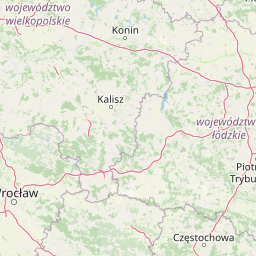
Use this park location map to pinpoint Dąbrowa Świetlista Nature Reserve in Poland, understand its exact geographic position, and read its mapped placement within the surrounding landscape more clearly.

Pigeon | © OpenStreetMap contributors

Location context for Dąbrowa Świetlista Nature Reserve

Łódź Voivodeship

Visualizing the thermophilic oak forest canopy and rare lowland habitats

Dąbrowa Świetlista Nature Reserve Landscape Photography and Protected Area Scenery

Visual records illustrate the distinctive open canopy and diverse herb layers that define the protected woodland environment. Examining these field photographs helps researchers understand the ecological structure of this central Polish forest reserve.

A rectangular information sign standing on two wooden posts in a forest setting. The sign has a red header with the text REZERWAT PRZYRODY DĄBROWA ŚWIETLISTA and a large white lower section containing detailed regulations and park rules in Polish text.

A dirt path leads through a deciduous forest with bare trees and leaf covered ground in early spring.

Park atlas

Compare nearby lowland forests and protected woodland reserves across central Poland

Other Parks Near Dąbrowa Świetlista Nature Reserve: Explore Regional Protected Areas

Browse protected areas and forested landscapes situated near Dąbrowa Świetlista Nature Reserve to compare regional lowland ecosystems. Expanding the geographic view helps connect individual botanical reserves with broader woodland conservation networks across the surrounding terrain.
Nature reserveMazowieckie
About 21 km away#1 closest

Northeast

Rezerwat przyrody Drzewce: Protected Oak-Hornbeam Woodland in the Kutno Plain

Geographic overview of a nature reserve in Mazowieckie, Poland

Located in the Mazowieckie region, Rezerwat przyrody Drzewce provides a conserved sample of oak-hornbeam forest. This nature reserve sits within the ancient Skrwa Lewa River valley, offering a look at the lowland mixed forest communities that historically characterized the Kutno Plain before widespread agricultural development.

Area
0.617 km²
Established
1988
Relief
Lowland
Climate
Temperate
Nature reserveMazowieckie
About 26 km away#2 closest

East

Jezioro Szczawińskie Nature Reserve: Mapped Wetland Landscapes in Mazowieckie, Poland

A vital bird sanctuary and lowland lake protected area.

Jezioro Szczawińskie features a rich mosaic of lake waters, marshes, and wet pastures. This protected area represents a unique zonal habitat in the Mazowieckie lowlands, offering significant insights into wetland geography, avian nesting environments, and the importance of shelterbelt corridors within an agricultural region.

Area
1.379 km²
Established
2009
Relief
Lowland
Scope
Terrestrial
Protected landscapeMasovian Voivodeship
About 44 km away#3 closest

Northeast

Brudzeński Park Krajobrazowy: Protected Landscape and River Valley Geography

Natural landforms of the Masovian Voivodeship, Poland.

Spanning the administrative communes of Brudzeń Duży and Stara Biała, this protected landscape is defined by the lower course of the Skrwa Prawa river. The area is characterized by steep escarpments, ravine systems, and the postglacial lakes of the Karwosiecko-Cholewicka channel. This map-based profile covers the diverse ecological features, including ancient oak-hornbeam forests and protected slope grasslands, providing a structural view of the region.

Area
31.71 km²
Established
1988
Relief
Upland
Climate
Temperate
Protected landscapeMasovian Voivodeship
About 46 km away#4 closest

Northeast

Jar rzeki Brzeźnicy Protected Landscape: Valley Geography and Habitat Mosaic in Płock

A vital riparian green corridor in the Masovian Voivodeship

Located in Płock, Jar rzeki Brzeźnicy protects a distinct ravine ecosystem carved by the Brzeźnica stream. The site encompasses a rich layering of sandy river bars, deciduous gallery forests, old orchards, and dry meadows, creating a dense natural corridor that serves as a critical refuge for rare mammals and breeding birds.

Area
1.5 km²
Established
2002
Relief
Upland
Climate
Temperate
Nature reserveLodzkie Voivodeship
About 53 km away#5 closest

South

Rezerwat przyrody Jodły Oleśnickie: Protected Nature Reserve in Lodzkie Voivodeship

Geography, forest structure, and range-edge ecology

Located within the quiet terrain of the Łaska Highland, Rezerwat przyrody Jodły Oleśnickie is a specialized forest reserve. It is defined by its scientific value as a protected sanctuary for silver fir trees growing at the geographic limit of their species range, offering insight into the development of multi-layered forest communities in lowland central Poland.

Area
0.117 km²
Established
1962
Relief
Lowland
Climate
Temperate
A horizontal watercolor painting showing a soft, stylized landscape of rolling hills, grassy meadows, and clusters of trees under a bright, open sky.
Protected landscapeŁódź Voivodeship
About 57 km away#6 closest

Southeast

Park Krajobrazowy Wzniesień Łódzkich: Geographic Overview of Central Poland's Uplands

Mapped protected landscape featuring glacial relief and forest ecosystems

Gain insights into the physical character of Park Krajobrazowy Wzniesień Łódzkich, an area defined by its striking northern edge and deep river valleys. This protected landscape preserves significant glacial erratics, a central watershed, and diverse forest cover that contrasts with the surrounding Polish plains.

Area
115.8 km²
Established
1996
Relief
Upland
Climate
Temperate
Watercolor painting of a meandering river landscape with gentle hills, light green foliage in the foreground, and soft washes of color.
Protected landscapeLodz Voivodeship
About 59 km away#7 closest

East

Bolimowski Park Krajobrazowy: Geography of a Central Polish Protected Landscape Area

Rawka River valley mapping and Puszcza Bolimowska forest terrain

Bolimowski Park Krajobrazowy encompasses a unique mosaic of postglacial plains and riverine ecosystems in central Poland. The area is defined by the Rawka River, which forms a network of meanders, oxbow lakes, and terraces, while surrounding forests retain historical links to the vast primeval woods of Puszcza Bolimowska. This protected territory offers a significant habitat for diverse wildlife, including moose and beaver, within a landscape characterized by its shifting transition between deep forest, wet meadows, and light oak groves.

Area
205.123 km²
Established
1986
Relief
Lowland
Climate
Temperate
Protected areaLodzkie Voivodeship
About 67 km away#8 closest

Southeast

Polany Puszczy Bolimowskiej: Protected Meadow Enclaves within the Lodzkie Voivodeship Landscape

Mapped meadow clearings and wetland habitat geography

Polany Puszczy Bolimowskiej serves as a critical protected area in central Poland, encompassing a series of connected meadow clearings within the Bolimów Forest. This site preserves rare Molinion wet meadows and tall herb floodplains, offering a distinct study of how open habitats persist in a forest-dominated matrix.

Area
1.341 km²
Relief
Lowland
Water
Minor water

Common questions about visiting, size, designation, and location context for Dąbrowa Świetlista Nature Reserve

Dąbrowa Świetlista Nature Reserve FAQs for park facts, access, geography, and protected area context

Find quick answers about Dąbrowa Świetlista Nature Reserve, including protected-area facts, park geography, trail and visitor context, and how the park fits into its surrounding country and regional landscape.
MoriAtlas Explorer

Continue Your Protected Areas Search Across the Global Atlas

Deepen your exploration by continuing the structured search for national parks and protected areas worldwide. Utilize the comprehensive filtering capabilities to compare different conservation landscapes and refine your understanding of global park geography. Discover more about the distribution and characteristics of protected natural areas.

Global natural geography