Why Diabla Góra Nature Reserve stands out
Diabla Góra Nature Reserve is best known for protecting an isolated forested hill crowned with sandstone rock outcrops (wychodnie skał piaskowcowych) in the middle of a largely agricultural region. The combination of exposed sandstone geology, woodland cover, and a clearly visible rise in the terrain gives the site a distinctive profile that stands out within the otherwise flat surroundings of the Pilica basin. The reserve is also recognized for its ecological value at the regional level, particularly as habitat for the smooth snake (gniewosz plamisty), a reptile listed in the Polish Red Book of Animals. Together with its position as the starting point of important hiking routes through the Opoczno Hills, these qualities define the reserve's identity.
Diabla Góra Nature Reserve history and protected-area timeline
Diabla Góra Nature Reserve was established on 29 December 1987 by order of the Polish Ministry of Environmental Protection and Natural Resources. The founding act, formalized in the official legal gazette (Monitor Polski, 1988, No. 5, item 47), listed the reserve's area as 159.00 hectares; the current official surface is recorded as 161.19 hectares.
The rationale for protecting the site combined natural and historical considerations. The reserve was created to preserve a forested, isolated hill with sandstone rock outcrops, and the hill is also remembered as a location of partisan battles during the Second World War. This dual historical-ecological motivation has shaped the reserve's identity since its inception.
A formal conservation plan for the reserve was approved in 2011, with later amendments. Under this plan, the area is subject to active protection (ochrona czynna), meaning that ongoing management interventions are part of the reserve's conservation regime.
Diabla Góra Nature Reserve landscape and geographic character
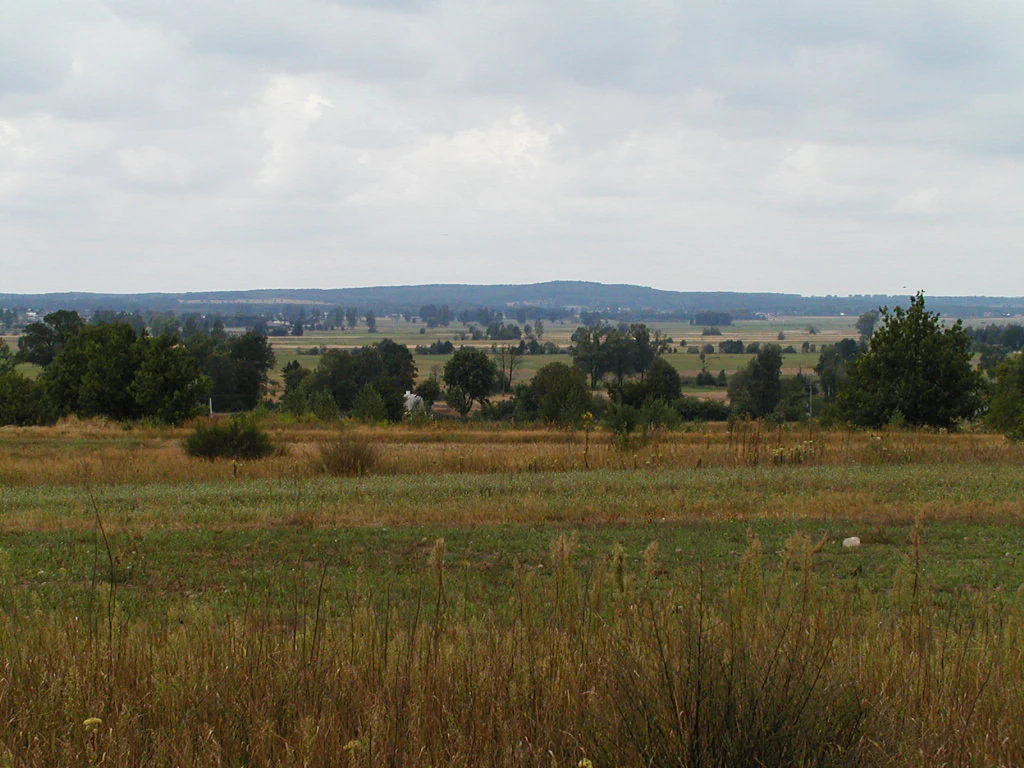
The defining landscape feature of Diabla Góra Nature Reserve is an isolated forested hill rising above the lowlands of the Opoczno region. The hill, also named Diabla Góra, belongs to the Wzgórza Opoczyńskie mesoregion, where scattered uplands break up what is otherwise a fairly flat landscape typical of central Poland.
At and near the summit of the hill, sandstone rocks appear as natural outcrops (wychodnie), exposing geological structure that is normally hidden beneath soil or glacial deposits in this part of the country. These rock exposures, combined with the slope of the hill and its continuous forest cover, give the site a distinctive visual profile that is recognizable from a considerable distance across the surrounding farmland.
The broader landscape context is shaped by the Pilica river system. The reserve lies within the Piliczański Protected Landscape Area, and the Pilica River Recreational Trail passes through the hill, linking Diabla Góra to other landscape units along the river.
Diabla Góra Nature Reserve ecosystems, habitats, and plant life
Ecologically, Diabla Góra is dominated by pine forest with an admixture of oak. This relatively simple tree composition nevertheless supports a small but ecologically interesting mosaic of forest communities.
Botanists and foresters have distinguished three main plant communities within the reserve. Acidophilous oak forest represents more natural woodland conditions on the hill's soils, while fresh mixed pine forest (bór mieszany świeży) covers other parts of the slope. Fresh suboceanic pine forest (bór sosnowy świeży) occurs especially on former agricultural land that has been converted back to woodland, illustrating the active ecological transition that has shaped parts of the reserve.
The combination of sandstone outcrops, slopes of varying exposure, and a mix of older forest and recovering post-agricultural stands gives the reserve a varied microhabitat pattern that supports both common woodland species and more specialized flora and fauna.
Diabla Góra Nature Reserve wildlife and species highlights
Wildlife interest at Diabla Góra centers on species tied to the reserve's forest and dry, rocky microhabitats. Reptiles in particular find suitable conditions among the sandstone outcrops and along forest edges.
The most notable species recorded in the reserve is the smooth snake (gniewosz plamisty), Coronella austriaca, a rare and protected reptile in Poland that is listed in the Polish Red Book of Animals. The presence of this snake is one of the principal ecological justifications for active conservation management at the site and contributes significantly to the reserve's regional natural value.
Diabla Góra Nature Reserve conservation status and protection priorities
Diabla Góra Nature Reserve exists primarily to maintain an isolated hill landscape, including its forested surface and exposed sandstone rocks, that would otherwise be vulnerable to changes in land use. By protecting both the geological exposure and the surrounding woodland from forestry intensification, agricultural conversion, or development, the reserve safeguards a feature that is unusual at the regional scale.
The reserve sits inside the Piliczański Protected Landscape Area (Piliczański Obszar Chronionego Krajobrazu), a broader designation that surrounds it with additional landscape-level protection. This layered protection, combined with the reserve's own legal status as a rezerwat krajobrazowy, situates Diabla Góra within a continuum of conservation measures across central Poland.
Under the 2011 conservation plan, the reserve is managed through active protection (ochrona czynna), allowing specific interventions such as habitat restoration or targeted management measures. The plan also accommodates the site's historical importance, recognizing Diabla Góra as a Second World War partisan battlefield. Ecologically, the reserve's role in protecting the smooth snake underscores its contribution to the conservation of rare reptile species in the Łódź region and beyond.
Diabla Góra Nature Reserve cultural meaning and human context
Beyond its natural and geological significance, Diabla Góra holds a notable, though somber, place in the modern history of central Poland. The hill was a site of partisan battles during the Second World War, and this wartime past is explicitly cited among the reasons for establishing the reserve in 1987.
The reserve thus combines natural landmark status with a historical memorial dimension: the very terrain that is now protected for its ecology and landscape is also preserved as a reminder of the partisan struggle that took place across the Polish countryside during the war.
The hill is also embedded in contemporary local culture through recreation. Hiking and walking routes use Diabla Góra as a key node: the red hiking trail to Łączna begins at the reserve, and the Pilica River Recreational Trail crosses the hill, making it a recognizable destination within the regional tradition of outdoor exploration in the Opoczno Hills.
Top sights and standout views in Diabla Góra Nature Reserve
A standout feature of Diabla Góra Nature Reserve is the combination of geomorphological, ecological, and historical value concentrated in a single small site. Its sandstone outcrops on a forested hilltop are rare in the lowland geography of central Poland, and they underpin both the reserve's scenic identity and its ecological diversity.
Equally important is the reserve's value as habitat for protected species, especially the smooth snake, and its role as a landmark within the Piliczański Protected Landscape Area. The hill's wartime past, its position at the head of regional hiking trails, and its clearly visible profile on the horizon together give Diabla Góra a distinctive, multi-layered identity that goes beyond a simple forest reserve.
Best time to visit Diabla Góra Nature Reserve
Diabla Góra is a wooded landscape reserve where seasonal conditions matter mainly for how the terrain and its surroundings can be experienced. Spring brings fresh green foliage and active woodland life, while late spring and early summer tend to be the most productive periods for observing reptiles such as the smooth snake, which depends on warmer temperatures and exposed rocky microhabitats.
Late summer and early autumn offer favorable hiking conditions, with mild weather, stable ground, and good visibility from and toward the hill, which is a recognizable feature on the regional horizon. Winter visits are possible, but snow and cold can make the rocky outcrops and slopes more difficult to traverse, while the bare deciduous trees make the hill's profile even more visible from a distance. As with any small landscape reserve, visitors should focus on marked trails to avoid disturbing protected habitats.