
Mori Atlas logo
Park guides

Review seasonal travel information for the marine environments and masonry structures.

Expert Guides and Planning Resources for Dry Tortugas National Park in Monroe County

Access focused resource materials regarding Dry Tortugas National Park, a remote chain of coral islands and marine ecosystems situated at the western edge of the Florida Keys. This collection provides structural support for evaluating seasonal planning and understanding the environmental context of these isolated, water-dominant protected lands.

Related tags

Marine protected areaCoral reefsBird nesting coloniesHistoric fortressShipwrecks

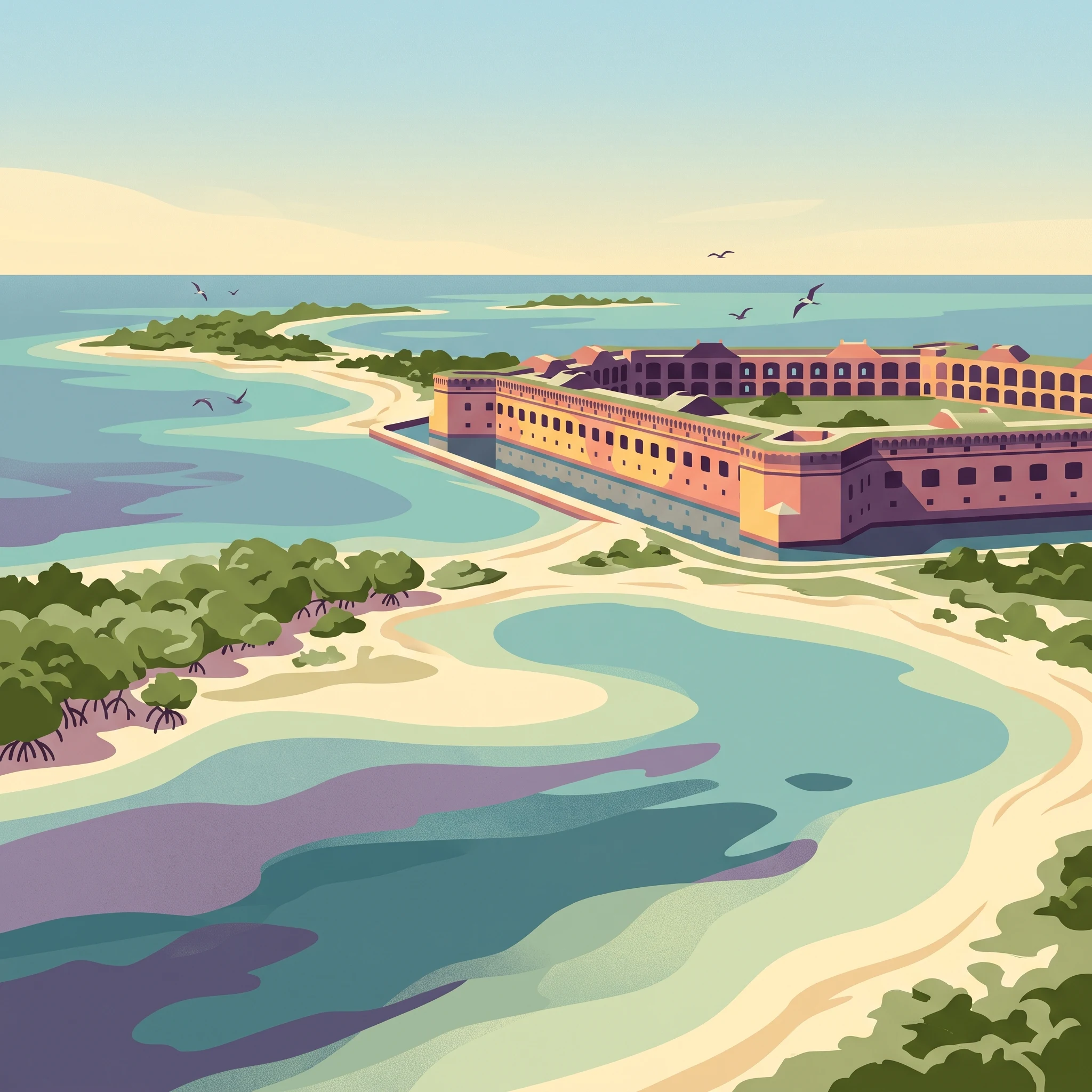
Remote coral archipelago with the Western Hemisphere's largest brick fortress and the United States' only nesting colonies of several tropical bird species

Dry Tortugas National Park

Dry Tortugas National Park occupies a unique position in the American protected area system as a place where pristine tropical marine ecosystems coexist with profound historical artifacts spanning five centuries of maritime activity. The park sits at the terminus of the Florida Keys archipelago, projecting into the Gulf of Mexico in a configuration of low, sandy coral islands surrounded by productive reef systems. This isolation has paradoxically contributed to both ecological significance and historical preservation, as the difficulty of access has limited development and disturbance while creating natural hazards that generated numerous shipwrecks. The park's 64,701 acres encompass not only the seven named islands totaling roughly 144 acres of land but also extensive shallow reef systems, seagrass beds, and deep water environments that support remarkable biodiversity. Fort Jefferson dominates Garden Key, an unfinished massive coastal fortress that represents one of the most ambitious 19th-century American engineering projects and serves as thepark's most visible cultural landmark. The marine environment surrounding the islands contains reef formations representing the western extension of an arcuate chain of Pleistocene reef and oolitic limestone islands, with excellent examples of Holocene carbonate-sand deposits between the Tortugas and Key West. This combination of natural and cultural resources, both exceptionally preserved due to the park's remoteness, creates a destination unlike any other in the national park system.

Location
United States of America
Park type
National park
Established
1935
Area
261.8 km²
Highest point
3 m
Dry Tortugas National Park Atlas
MoriAtlas Explorer

Continue Exploring Dry Tortugas National Park's Protected Landscape and Geography

Deepen your understanding of Dry Tortugas National Park by exploring its specific geographic context and protected area identity within Monroe County. This atlas-driven approach allows for detailed examination of its mapped boundaries and natural landscape, providing critical insights beyond simple park facts. Continue your discovery of this unique U.S. National Park's regional setting and mapped terrain.

Global natural geography