Mori Atlas logo
National parkDry Tortugas National Park

Explore the atlas of Dry Tortugas National Park's geographic identity and protected boundaries.

Dry Tortugas National Park: A Mapped Protected Landscape in Monroe County, Florida

Delve into the protected landscape of Dry Tortugas National Park, a designated U.S. National Park situated within Monroe County. This atlas-focused exploration reveals the park's mapped boundaries and its distinct geographic context, offering a unique perspective on its place within the natural terrain. Understand the core identity of this protected area through its defined landscape and regional setting, providing essential insights for geographic discovery.

Marine protected areaCoral reefsBird nesting coloniesHistoric fortressShipwrecksFlorida Keys

Dry Tortugas National Park

National park

Park overview

Structured park overview, official facts, and landscape profile for Dry Tortugas National Park

Dry Tortugas National Park park facts, protected area profile, and essential visitor context
Review the core facts for Dry Tortugas National Park, including designation, size, terrain, visitor scale, habitats, and operating context in one park-focused overview.

About Dry Tortugas National Park

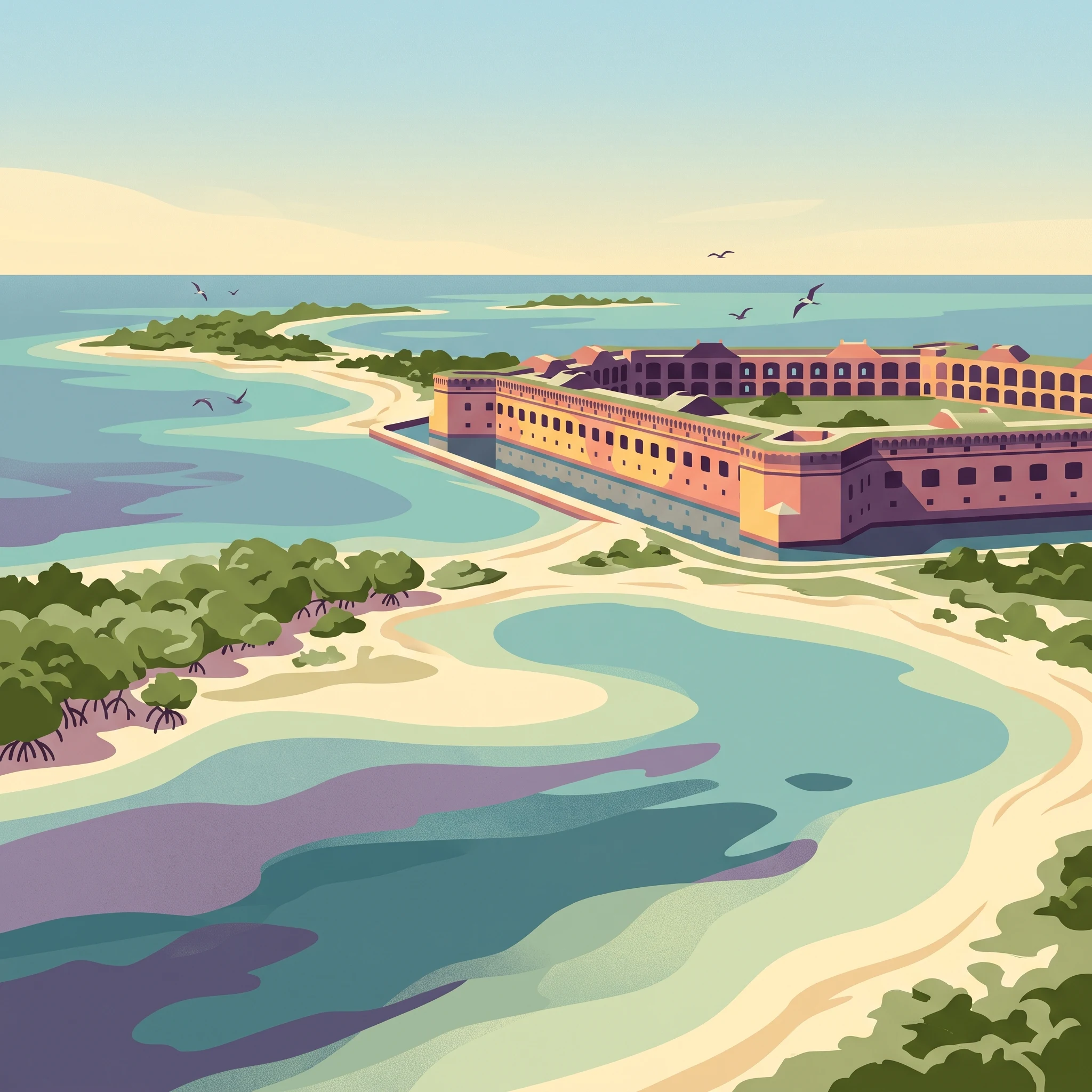
Dry Tortugas National Park occupies a unique position in the American protected area system as a place where pristine tropical marine ecosystems coexist with profound historical artifacts spanning five centuries of maritime activity. The park sits at the terminus of the Florida Keys archipelago, projecting into the Gulf of Mexico in a configuration of low, sandy coral islands surrounded by productive reef systems. This isolation has paradoxically contributed to both ecological significance and historical preservation, as the difficulty of access has limited development and disturbance while creating natural hazards that generated numerous shipwrecks. The park's 64,701 acres encompass not only the seven named islands totaling roughly 144 acres of land but also extensive shallow reef systems, seagrass beds, and deep water environments that support remarkable biodiversity. Fort Jefferson dominates Garden Key, an unfinished massive coastal fortress that represents one of the most ambitious 19th-century American engineering projects and serves as thepark's most visible cultural landmark. The marine environment surrounding the islands contains reef formations representing the western extension of an arcuate chain of Pleistocene reef and oolitic limestone islands, with excellent examples of Holocene carbonate-sand deposits between the Tortugas and Key West. This combination of natural and cultural resources, both exceptionally preserved due to the park's remoteness, creates a destination unlike any other in the national park system.

Quick facts and research context for Dry Tortugas National Park

Dry Tortugas National Park spans approximately 64,701 acres in Monroe County, Florida, making it one of the most water-dominated national parks in the United States. The seven islands within the park total only about 144 acres of land, with Loggerhead Key being the largest at 64 acres and the highest in elevation at just 10 feet above sea level. The park is part of the Everglades and Dry Tortugas Biosphere Reserve, designated by UNESCO in 1976 under its Man and the Biosphere Programme. Access is exclusively by boat or seaplane from Key West, with primitive camping limited to eight sites on Garden Key near Fort Jefferson. The park contains significant historic resources including the massive unfinished coastal fortress built between 1847 and 1860 and numerous shipwrecks from the 17th century onward, including artifacts from the 1622 Spanish treasure fleet.

Park context

Deeper park guide and search-rich context for Dry Tortugas National Park

Dry Tortugas National Park history, landscape, wildlife, and travel context
Explore Dry Tortugas National Park through its history, landscape character, ecosystems, wildlife, conservation priorities, cultural context, and seasonal travel timing in a structured park guide built for atlas discovery and search intent.

Why Dry Tortugas National Park stands out

Dry Tortugas National Park is especially known for its extraordinarily diverse marine environments and significant bird nesting colonies found nowhere else in the contiguous United States. The coral reefs here are the least disturbed of all Florida Keys reefs, supporting abundant sea life in waters that remain largely unaffected by development. The archipelago hosts the only nesting colonies of sooty terns, brown noddies, magnificent frigatebirds, and masked boobies in the continental United States, making it a singular destination for birdwatchers. Above water, the park preserves Fort Jefferson, a massive coastal fortress constructed of more than 16 million bricks that stands as the largest masonry structure in the Western Hemisphere. The surrounding waters contain a high concentration of historically significant shipwrecks dating from the 17th century to the present, including the famous 1622 Spanish treasure fleet wreck Nuestra Señora de Atocha, whose recovered treasure cache was valued at an estimated $450 million.

Dry Tortugas National Park history and protected-area timeline

The human history of the Dry Tortugas spans more than 500 years, beginning with the first European contact by Juan Ponce de León on June 21, 1513, who named the islands "Tortugas" after capturing approximately 160 sea turtles there. The descriptor "Dry" was added due to the absence of surface fresh water on the islands, creating one of the oldest surviving European place-names in the United States. Following American acquisition of Florida in 1819, the strategic importance of the Tortugas for controlling the Straits of Florida and Gulf of Mexico prompted construction of Fort Jefferson beginning in 1847, built largely with enslaved laborers hired from their owners in Key West. The fortress reached approximately half completion by 1860 and served as a Union stronghold throughout the Civil War, later functioning as a prison where Dr. Samuel Mudd was held for his involvement in the Lincoln assassination conspiracy. During the 1880s, the U.S. Navy established a base with coaling and wireless stations, and from 1903 until 1939, the Carnegie Institution operated a renowned marine biology laboratory on Loggerhead Key that became the best-equipped marine biological station in the tropical world. The park was originally established as Fort Jefferson National Monument by President Franklin D. Roosevelt on January 4, 1935, under the Antiquities Act, then expanded in 1983 and redesignated as Dry Tortugas National Park by Congress on October 26, 1992.

Dry Tortugas National Park landscape and geographic character

The physical landscape of Dry Tortugas National Park is fundamentally defined by its marine setting, with over 99 percent of the protected area consisting of water surrounding a small cluster of low coral islands at the western terminus of the Florida Keys. The seven major islands are Loggerhead Key, Garden Key, Bush Key, Long Key, Hospital Key, Middle Key, and East Key, collectively representing the westernmost extent of the Florida Keys archipelago while several reefs and submarine banks continue westward beyond the park boundaries. These islands are irregular and low-lying, with thin growths of mangroves and various vegetation on the larger keys while the smallest contain only small patches of grass or no plant life at all. Loggerhead Key, the largest island at 64 acres and 10 feet in elevation, contains the 151-foot-tall Dry Tortugas lighthouse. The islands are dynamic landforms that change in size and shape as water levels fluctuate and hurricane impacts alter the coastline, with some smaller islands having disappeared and reappeared multiple times over the past two centuries. Below the water surface, the seafloor features excellent examples of Holocene carbonate-sand deposits composed mainly of disarticulated Halimeda plates, with a 39-foot-thick deposit known as "the quicksand" existing between the Tortugas and Key West. The underlying geology represents the surface expression of the 3.7-mile-thick southern Florida carbonate platform that has been accumulating sediments since the Early Cretaceous.

Dry Tortugas National Park ecosystems, habitats, and plant life

The Dry Tortugas archipelago supports a borderline subtropical-tropical ecosystem that hosts species not normally breeding in and not commonly found anywhere else within the continental United States. The marine environment contains coral reef formations representing the least disturbed reefs in the Florida Keys, though a severe cold wave in January 1977 devastated 96 percent of shallow-water branching coral, transforming once-extensive formations into rubble fields that have since been colonized by patch reef organisms. The islands themselves are characterized by tropical savanna conditions with an annual precipitation of about 38 inches, making the Dry Tortugas the driest place in Florida despite the surrounding marine environment. The sandy soils drain quickly and the intense sun creates drought-like conditions on land, limiting terrestrial vegetation to sparse mangrove growth and small patches of grasses. The surrounding waters support diverse fish populations, marine invertebrates, and sea life that thrive among the reef structures and seagrass beds. A 46-square-mile research natural area in the northern and western portions of the park, designated in 2007, prohibits any taking of marine life and anchoring of vessels, providing additional protection for the underwater environment.

Dry Tortugas National Park wildlife and species highlights

Dry Tortugas National Park supports remarkable wildlife populations, particularly in its avian fauna and marine life. The park has documented 299 bird species, of which eight species regularly nest within the park boundaries, including some that nest nowhere else in the contiguous United States. Sooty terns, brown noddies, magnificent frigatebirds, and masked boobies all maintain their only U.S. nesting colonies here, while brown pelicans, roseate terns, bridled terns, and mourning doves also nest in the park. Bush Key serves as a significant tern rookery and is closed to visitors from February through September to protect nesting sooty terns and brown noddies. The surrounding waters support abundant marine life including numerous fish species, coral organisms, and invertebrates that inhabit the reef systems. The park's position along migratory bird routes makes spring migration particularly notable, with dozens of species potentially passing through in a single day and birdwatchers often recording more than 100 species during peak April visits. Invasive species including lionfish have been found in park waters, prompting ongoing management efforts, and an active program has successfully removed invasive Casuarina trees and agave from Loggerhead Key.

Dry Tortugas National Park conservation status and protection priorities

Dry Tortugas National Park plays a critical conservation role as part of the larger Everglades and Dry Tortugas Biosphere Reserve, established by UNESCO in 1976 under its Man and the Biosphere Programme. The park's coral reefs represent the most undisturbed reef systems in the Florida Keys, providing valuable reference ecosystems for understanding pre-development marine conditions. A significant conservation achievement came in 2007 with the designation of a 46-square-mile research natural area in the northern and western portions of the park, where no marine life may be taken and vessels must use designated mooring buoys rather than anchoring. This protection extends to the submerged cultural resources including shipwrecks that are preserved as archaeological sites. About 54 percent of the park remains open for fishing, balancing resource protection with sustainable use. The park is bordered by the Florida Keys National Marine Sanctuary on the east, south, and west, with the Tortugas Ecological Reserve adjacent to the northwest, creating a layered conservation framework that extends protection beyond park boundaries. Ongoing invasive species management addresses both terrestrial plants and marine invaders like lionfish that threaten native ecosystems.

Dry Tortugas National Park cultural meaning and human context

The cultural landscape of Dry Tortugas National Park encompasses more than five centuries of human interaction with these remote islands, beginning with indigenous peoples who likely visited for fishing and turtle harvesting before European arrival. The Spanish colonial period left lasting names and the legacy of treasure fleet shipwrecks, while the 19th-century American period produced the monumental Fort Jefferson fortress and associated communities of enslaved laborers, prisoners, and military personnel. The enslaved laborers who built Fort Jefferson between 1847 and 1860 were hired from their owners in Key West, representing a significant chapter in the history of African American labor in Florida. During the Civil War, Fort Jefferson held Union prisoners including Dr. Samuel Mudd, and after the Emancipation Proclamation, freed African Americans enlisted in the Union Army with the 82nd Colored Infantry stationed at the fort. The Carnegie Institution's marine biology laboratory from 1903 to 1939 brought international researchers to Loggerhead Key and established the islands as a significant site in the history of American marine science. The park continues to serve as a landing location for Cuban immigrants arriving in homebuilt boats, adding a contemporary dimension to the islands' long history as a place of transit and arrival.

Top sights and standout views in Dry Tortugas National Park

The most compelling highlights of Dry Tortugas National Park include the unparalleled nesting bird colonies of sooty terns, brown noddies, magnificent frigatebirds, and masked boobies that exist nowhere else in the continental United States, creating a singular wildlife observation opportunity. Fort Jefferson itself stands as an architectural marvel, the largest brick masonry structure in the Western Hemisphere with more than 16 million bricks forming an unfinished coastal fortress that dominates Garden Key. The surrounding waters contain the least disturbed coral reefs in the Florida Keys, supporting exceptional snorkeling and scuba diving experiences among diverse marine life. The historical shipwrecks, particularly those from the 1622 Spanish treasure fleet including the Nuestra Señora de Atocha, represent both archaeological significance and the romantic allure of sunken treasure. The park's extreme remoteness and accessibility only by boat or seaplane contribute to its distinctive character as a wilderness destination requiring advance planning and self-sufficiency. Birdwatching during spring migration offers extraordinary opportunities, with peak activity in April potentially yielding more than 100 species in a single day within the historic fortress walls.

Best time to visit Dry Tortugas National Park

The optimal time to visit Dry Tortugas National Park depends on interests, with different seasons offering distinct advantages for various activities. For birdwatching, spring migration from late March through early May represents the peak season, particularly April when dozens of migratory warbler species pass through and daily bird lists can exceed 100 species, with many birds landing in the protected courtyard of Fort Jefferson where they can be observed at close range. The dry season extending from November through April offers generally more stable weather conditions with lower precipitation and reduced hurricane risk, though the park remains vulnerable to tropical systems even outside the official hurricane season. Summer months from May through October coincide with the rainy season and peak hurricane activity, though this period also brings warmer water temperatures favorable for snorkeling and diving. The park's tropical savanna climate maintains relatively warm temperatures year-round, with summer highs around 91 degrees Fahrenheit and winter lows around 65 degrees, and no recorded frost or freeze in the islands' history. Visitors should note that Bush Key is closed from February through September to protect nesting terns, which may affect those specifically seeking to observe breeding bird colonies.
Park location guide

Geography guide, regional context, and park location map for Dry Tortugas National Park

Dry Tortugas National Park park geography, regions, and map view in United States of America
Understand where Dry Tortugas National Park sits in United States of America through a broader geographic reading of the surrounding landscape, nearby location context, and its mapped position within the national park landscape.

How Dry Tortugas National Park fits into United States of America

The United States of America is a federal presidential republic and one of the world's largest countries by area and population. It consists of 50 states across a vast territory spanning multiple time zones, with its capital in Washington, D.C. and largest city in New York City. The nation has a diverse economy, influential political system, and significant cultural and military presence globally.

Wider geography shaping Dry Tortugas National Park in United States of America

The United States occupies a vast territory in North America, bordered by Canada to the north and Mexico to the south. The 48 contiguous states stretch from the Atlantic to the Pacific Ocean, while Alaska occupies the northwestern region and Hawaii is an archipelago in the Pacific. The country encompasses diverse terrain including the Rocky Mountains, Appalachian Mountains, Great Plains, and extensive river systems.

Map view of Dry Tortugas National Park

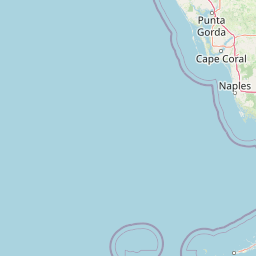
Use this park location map to pinpoint Dry Tortugas National Park in United States of America, understand its exact geographic position, and read its mapped placement within the surrounding landscape more clearly.

Pigeon | © OpenStreetMap contributors

Location context for Dry Tortugas National Park

FloridaMonroe County
Park atlas

Explore the broader regional geography and connected protected landscapes surrounding the remote Florida Keys.

Discover Nearby National Parks and Protected Areas around Dry Tortugas National Park
After exploring Dry Tortugas National Park, browse other national parks and protected areas across the Florida Keys and Gulf of Mexico, comparing diverse marine and island ecosystems. This atlas view offers geographic context, revealing patterns of conservation and regional park distribution beyond the remote archipelago.
National parkFlorida

Everglades National Park: Protected Landscape Identity and Regional Geographic Context

Explore its unique natural terrain and mapped boundaries.

Understand Everglades National Park as a distinct protected landscape with significant geographic features within Florida. This page offers an atlas-driven view of its protected area, detailing its mapped boundaries and the surrounding regional natural terrain. Discover the core identity of this national park through its landscape and geographic setting, providing context for broader atlas exploration.

Area
6,106.61 km²
Established
1947
IUCN
II
Visitors
1.2M annual
National parkMiami-Dade County

Biscayne National Park: Mapped Protected Area and Coastal Landscape

Explore its protected status and geographic setting in Miami-Dade County.

Biscayne National Park represents a significant protected area managed as a U.S. National Park, safeguarding extensive coastal and marine environments. This page offers detailed insight into the park's geographic placement within Miami-Dade County, Florida, focusing on its mapped boundaries and the unique landscape it encompasses. Understand its ecological importance and its distinct contribution to the atlas of protected lands.

Area
700 km²
Established
1980
IUCN
V
Visitors
701K annual
National parkAndros

Blue Holes National Park: A National Park for Detailed Geographic and Landscape Exploration

Explore mapped boundaries and regional terrain context.

Delve into the specifics of Blue Holes National Park, a designated national park offering rich opportunities for geographic discovery. This entry provides structured information focused on its protected landscape identity, mapped outlines, and its contribution to the regional geography of Andros, Bahamas. Understand the park's unique setting through detailed map context and atlas-driven insights.

Area
162 km²
Established
2002
IUCN
II
Relief
Mixed relief
National parkGrand Bahama

Lucayan National Park: National Park Geography and Mapped Landscape Exploration

Discover protected area boundaries on Grand Bahama.

Lucayan National Park stands as a distinct national park entity within the geography of Grand Bahama. This page provides a focused atlas-style exploration of the park's protected landscape, detailing its mapped area and contributing to a structured understanding of its regional context. Delve into the geographic specifics that define Lucayan National Park as a key element of the Bahamas' protected lands, suitable for detailed map-based discovery and analysis.

Area
7.84 km²
Established
1982
IUCN
II
Climate
Tropical
National parkBahamas

West Side National Park National Park: Extensive Protected Landscape in the Bahamas

Mapped marine and mangrove ecosystems, plus pine forest terrain

Delve into the geographical identity of West Side National Park, a protected national park in the Bahamas renowned for its vast scale and diverse ecosystems. This landscape features significant Caribbean pine forests transitioning into extensive, intact mangrove systems along its coastlines, integrating directly with vital marine habitats. As one of the largest protected areas in the Caribbean, its ecological representation from land to sea offers a unique atlas perspective on Bahamian natural heritage and conservation.

Area
6,070 km²
Established
2002
IUCN
II
Relief
Mixed relief
National parkBahamas

North and South Marine Parks National Park: Geographic Atlas and Protected Landscape in the Bahamas

Mapping Bahamian protected marine geography and its national park boundaries.

Delve into the atlas-view of North and South Marine Parks, a key national park in the Bahamas. This page details the park's specific geographic features and its protected landscape identity within the island nation. Understand its placement and significance as a protected marine area contributing to the regional geography.

Area
20 km²
Established
2002
IUCN
II
Climate
Tropical
National parkAndros

Crab Replenishment Reserve National Park: Explore Andros Protected Landscape Boundaries

Mapped geography and regional park context

Investigate Crab Replenishment Reserve National Park, a significant protected landscape located in the Andros region. This page provides detailed atlas-style information, focusing on the park's mapped boundaries and its specific geographic setting. Understand how this national park contributes to the regional protected area network and its overall landscape identity for atlas-driven exploration.

Area
16 km²
Established
2002
IUCN
II
Relief
Lowland
National parkBahamas

Walker's Cay National Park: Bahamas National Park Featuring a Premier Barrier Reef Ecosystem

Explore mapped underwater geography and marine protected boundaries.

Walker's Cay National Park is a vital marine protected area located in the Bahamas, safeguarding approximately 3,840 acres of coastal and ocean waters. Its most distinguishing feature is the expansive barrier reef, a complex underwater geography teeming with diverse marine species that draws attention for diving and snorkeling. This park serves as a crucial element within the atlas of Bahamian protected lands, offering structured insights into marine conservation and the mapped distribution of critical reef habitats.

Area
16 km²
Established
2002
IUCN
II
Relief
Lowland

Common questions about visiting, size, designation, and location context for Dry Tortugas National Park

Dry Tortugas National Park FAQs for park facts, access, geography, and protected area context
Find quick answers about Dry Tortugas National Park, including protected-area facts, park geography, trail and visitor context, and how the park fits into its surrounding country and regional landscape.
MoriAtlas Explorer

Continue Your Protected Areas Search Across the Global Atlas

Deepen your exploration by continuing the structured search for national parks and protected areas worldwide. Utilize the comprehensive filtering capabilities to compare different conservation landscapes and refine your understanding of global park geography. Discover more about the distribution and characteristics of protected natural areas.

Global natural geography