Why Biscayne National Park stands out
Biscayne National Park is best known for its exceptional marine environments and coral reef systems. The park protects a remarkable concentration of marine biodiversity, including more than 200 species of fish, hard corals, sea turtles, manatees, and endangered species such as the smalltooth sawfish and Schaus' swallowtail butterfly. The offshore coral reefs have been the site of numerous shipwrecks dating from Spanish colonial times through the 20th century, and the park maintains the Maritime Heritage Trail, the only underwater archaeological trail in the National Park Service system. The park's mangrove forests represent the longest stretch on Florida's east coast and serve as critical nurseries for marine life. Elliott Key, the park's largest island, offers one of the few opportunities to experience the tropical hardwood forests of the Florida Keys on land.
Biscayne National Park history and protected-area timeline
The human history of Biscayne National Park spans thousands of years, beginning with indigenous peoples who inhabited the region when ocean levels were lower and the bay was largely dry land. The Glades culture was present in the area around 2,500 years before the present, followed by the Tequesta people who occupied the islands and shoreline from roughly 4,000 years ago until Spanish contact in the 16th century. Spanish explorer Juan Ponce de León arrived in 1513, and the bay subsequently became part of Spanish Florida. The reefs proved treacherous for Spanish treasure fleets, with more than 40 documented shipwrecks within present park boundaries from the 16th through the 20th centuries. In the 19th and early 20th centuries, the islands were farmed for key limes and pineapples, though the rocky soil and hurricanes made agriculture difficult. The islands became exclusive retreats for wealthy Miamians in the early 20th century, with the Cocolobo Cay Club attracting four U.S. presidents and other notable figures. During the Cold War, Elliott Key served as a training ground for Cuban exiles preparing for missions against Fidel Castro's government. In the 1960s, development pressures prompted proposals for industrial facilities including a deepwater seaport and oil refinery. Environmental opposition led to the designation of Biscayne National Monument in 1968, which was expanded and redesignated as a national park in 1980. The park's establishment preserved the area's remarkable marine environments and historic sites against development pressures.
Biscayne National Park landscape and geographic character
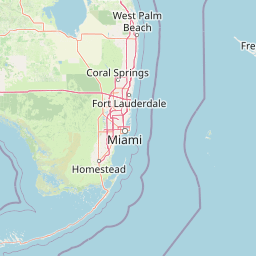
Biscayne National Park encompasses a distinctive coastal landscape shaped by geological processes spanning tens of thousands of years. The park comprises three primary landscape components: the mainland shoreline and mangrove swamps, the chain of 42 coral limestone islands known as the northern Florida Keys, and the submerged environments of Biscayne Bay and the Atlantic Ocean. The Florida Keys represent a unique geological transition, distinguished from barrier islands by the coral limestone that extends to the surface under thin topsoil. Key Largo Limestone, underlying Elliott Key and the southern keys, formed as a fossilized coral reef during the Sangamonian Stage approximately 75,000 to 125,000 years ago. Miami Limestone, forming the ridges on the western mainland, was deposited in turbulent lagoon waters and later consolidated by fresh water during a glacial period. Biscayne Bay itself is a shallow semi-enclosed lagoon averaging 10 feet in depth, lying between the oolitic Miami Limestone ridges to the west and the coral-based Key Largo limestone to the east. The bay's eastern boundary reaches the ten-fathom line where the Florida Reef rises from the ocean floor. The islands within the park shift from barrier island characteristics in the north, with more sandy composition, to true coral rock platforms in the south, with rocky beaches on Elliott Key and Old Rhodes Key contrasting with the sandy beaches of Sands Key.
Biscayne National Park ecosystems, habitats, and plant life
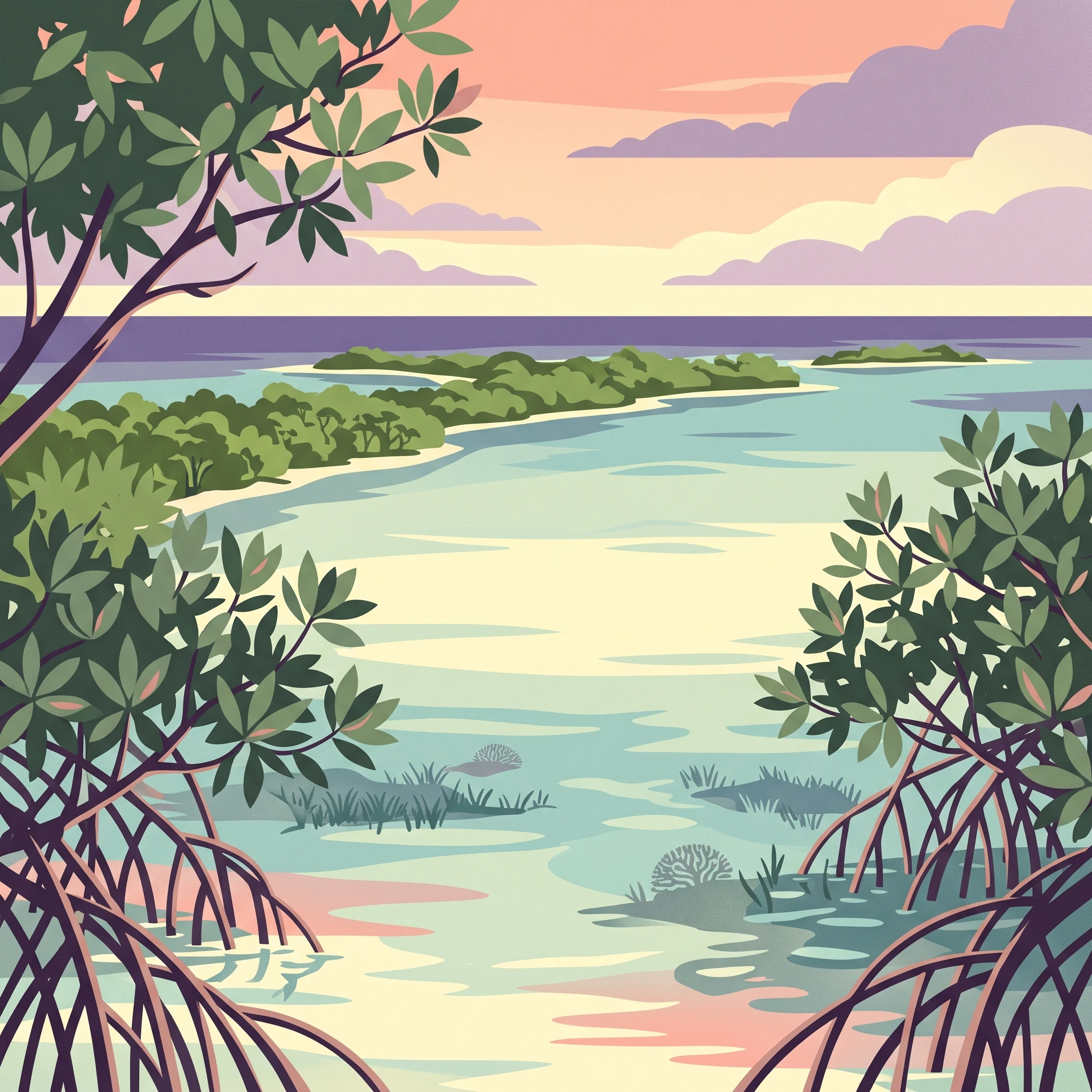
Biscayne National Park protects four distinct ecosystems that create remarkable ecological diversity within a relatively compact area. The mangrove swamp ecosystem dominates the mainland shoreline and fringes all the islands, with red mangrove, black mangrove, and white mangrove forming a complex transitional zone between land and water. These mangrove forests represent the longest continuous stretch on Florida's east coast and serve as critical nurseries for fish, molluscs, and crustaceans, with the sheltered waters within the mangrove thickets providing essential habitat for larval and juvenile marine organisms. The shallow lagoon waters of Biscayne Bay support extensive seagrass meadows dominated by turtlegrass, shoal grass, and manatee grass, covering roughly 75 percent of the central bay floor. The coral limestone keys support subtropical vegetation including hardwood forests of gumbo limbo, mahogany, ironwood, torchwood, and satinleaf, as well as rare plant species such as the semaphore prickly-pear cactus and Sargent's cherry palm. The offshore coral reef ecosystem contains more than 200 species of fish and hundreds of species of hard and soft corals, sponges, and sea anemones. The park lies at the convergence of Nearctic and Neotropical realms, enabling visitors to observe species not found elsewhere in North America.
Biscayne National Park wildlife and species highlights
Biscayne National Park supports exceptional marine and terrestrial wildlife within its diverse habitats. The park's waters harbor more than 200 species of fish, while the mangrove forests and seagrass meadows provide critical habitat for juvenile fish, crustaceans, and molluscs. Marine mammals include a year-round population of common bottlenose dolphins and seasonal visitors such as West Indian manatees, which frequent the quiet bay waters. Offshore waters may occasionally host endangered whales including North Atlantic right whales, humpback whales, sperm whales, fin whales, and sei whales. Sixteen endangered species have been documented within the park, including Schaus' swallowtail butterflies, smalltooth sawfish, green sea turtles, hawksbill sea turtles, and the threatened American crocodile. Sea turtles, primarily loggerheads, nest on island beaches with active park staff assistance to protect nests from predation. The park supports approximately 200 species of birds, with the keys and bay providing important resting areas for migratory birds traveling between North America and the Caribbean. Notable bird species include brown pelicans, magnificent frigatebirds, bald eagles, ospreys, and a variety of warblers during migration. The islands support terrestrial wildlife including marsh rabbits, raccoons, and various reptiles including occasional crocodiles and rattlesnakes.
Biscayne National Park conservation status and protection priorities
Biscayne National Park represents a critical conservation priority for marine ecosystems in the southeastern United States. The park protects the northernmost region of the Florida Reef, one of the largest coral reef systems in the world, and preserves essential habitat for 16 endangered species. The park's mangrove forests serve as carbon sequestration environments estimated to have two to three times the carbon-capturing ability of terrestrial forests, while providing nurseries for the marine life of southeast Florida. The park faces significant conservation challenges including water quality issues from altered freshwater flow due to canal construction, seagrass damage from vessel groundings, and impacts from invasive species including lionfish, green iguanas, and Brazilian pepper. Climate change poses additional threats, with projected sea level rise potentially eliminating much of the park's terrestrial area within two centuries. The park works actively on sea turtle nest protection, having reduced nest predation from 100 percent to near zero through intensive management. The Maritime Heritage Trail provides underwater archaeological interpretation while protecting historic shipwrecks as cultural resources.
Biscayne National Park cultural meaning and human context
The cultural landscape of Biscayne National Park reflects thousands of years of human interaction with this coastal environment. Indigenous peoples including the Glades culture and later the Tequesta inhabited the region for millennia, leaving behind shell middens and artifacts that document their presence. The bay's name derives either from a shipwrecked Basque sailor known as a Biscaino or from an allusion to the Bay of Biscay in Spain. Spanish colonial history is inscribed in the more than 40 shipwrecks on the park's reefs from the 16th through 20th centuries. The islands served as exclusive retreats in the early 20th century, with the Cocolobo Cay Club hosting U.S. presidents and wealthy industrialists. The Cold War-era use of Elliott Key as a training ground for Cuban exile infiltrators adds a layer of recent geopolitical history. Stiltsville, the unique community of stilted shacks established in the 1930s in northern Biscayne Bay, was incorporated into the park in 1985. The park's establishment reflects the successful efforts of early environmentalists who opposed industrial development in the 1960s, leading to the designation that preserved this remarkable marine environment.
Top sights and standout views in Biscayne National Park
Biscayne National Park offers exceptional underwater experiences centered on its coral reef systems and marine environments. The Maritime Heritage Trail provides ranger-led snorkeling and scuba diving access to historic shipwrecks including the Arratoon Apcar, Erl King, Alicia, Lugano, and Mandalay. Elliott Key, the park's largest island, features hiking trails through tropical hardwood forests and campground facilities accessible by boat. The Boca Chita Key area includes an ornamental lighthouse and is the most-visited island in the park. The park's exceptional marine biodiversity enables observation of sea turtles, manatees, dolphins, and more than 200 fish species. The mangrove forests provide critical habitat for wildlife and offer kayaking opportunities through sheltered waterways. Birdwatching is particularly productive during migration seasons when the keys serve as rest stops for trans-Caribbean journeys. The Dante Fascell Visitor Center offers exhibits and glass-bottom boat tours for visitors without their own boats.
Best time to visit Biscayne National Park
Biscayne National Park can be visited year-round, though seasons significantly affect the experience. The dry season from November through April offers more comfortable temperatures averaging 66 to 76 degrees Fahrenheit and lower rainfall, making this the most popular time for visitors. Winter months are particularly popular for camping on the islands, when mosquitoes are less troublesome than during the wet season. The wet season from May through October brings higher temperatures and greater rainfall, roughly coinciding with Atlantic hurricane season. While summer heat and humidity increase, this period offers the opportunity to experience the park's full tropical atmosphere. Visitors should be aware that the park is accessible only by boat, and the Columbus Day weekend has been cited as the most dangerous weekend of the year due to high boating activity. Snorkeling and diving conditions are generally best when water is calmer, typically during the winter months.