Why Ellergronn Nature Reserve stands out
Ellergronn is best known for the way its industrial past has been absorbed back into nature. Underground ironstone galleries of the former Mines Cockerill gradually collapsed, letting the surface sink into funnel-shaped hollows that filled with water and became the reserve's ponds, the largest being the Liégeois-Weier. A former limestone quarry waste heap has, in turn, matured into a patch of dry grassland, giving the reserve an unusual blend of woodland, open water, and semi-open calcareous habitats on a small footprint.
Ellergronn Nature Reserve history and protected-area timeline
The landscape that is now Ellergronn Nature Reserve was shaped by two overlapping phases of mineral extraction tied to the industrial rise of southern Luxembourg. The underlying ironstone, known as Minett ore, was deposited in a Jurassic-era sea roughly 160 to 180 million years ago and later lithified into the sedimentary layers that gave the Minett region its name and economic importance.
In the Ellergronn area the ironstone was not extracted from open pits, as was common elsewhere in the region, but was won underground in galleries and shafts belonging to the Cockerill mining operation, situated directly beside the French border south of Esch-sur-Alzette. Many of those old galleries have since subsided, and the gradual sinking of the surface above them produced the characteristic collapse craters, some of which filled with water to form the reserve's ponds.
On top of the iron-bearing layers, a substantial limestone formation was quarried for stone in a separate pit close to the border. The cut stone was hauled by small rail-borne wagons (buggies) to storage yards and onward to the cement works at Esch. Material cleared from the quarry was tipped beside the old track, and over time that deposit developed into a tract of dry grassland that is now part of the protected site.
The area itself received formal nature protection status on 19 March 1988, recognizing roughly 110 hectares as a Zone of National Interest. A nature trail was established in 1991 by the forestry administration in cooperation with the town of Esch-sur-Alzette, and fifteen interpretive panels were installed to explain the site's intertwined natural and industrial story to visitors.
Ellergronn Nature Reserve landscape and geographic character
Ellergronn's terrain is a small-scale palimpsest of geological and industrial activity. The reserve sits on Jurassic-age ironstone sediments, but its modern surface is shaped less by natural erosion than by the slow aftermath of underground mining and quarrying.
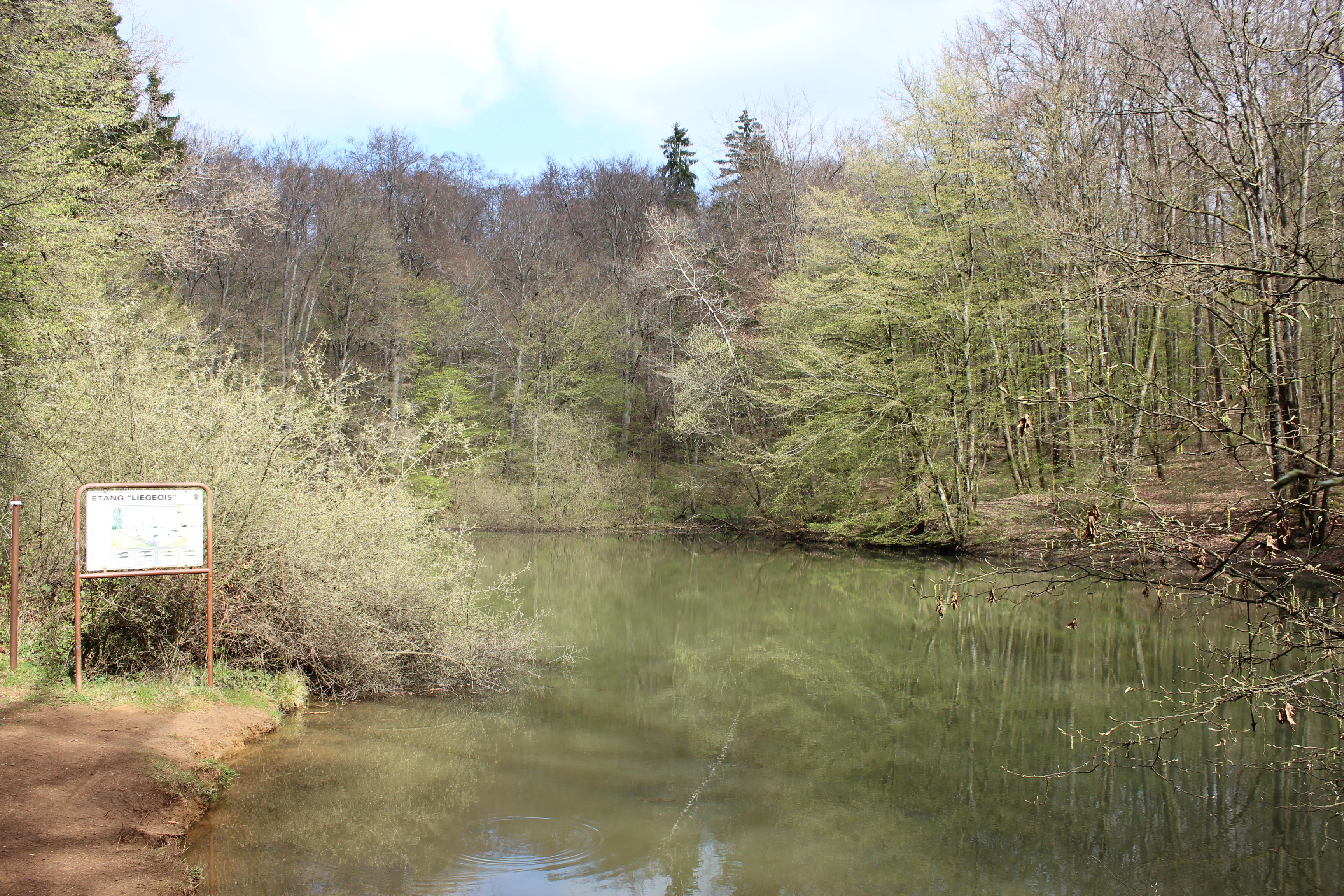
The most distinctive landforms are the collapse craters. Where the galleries of the former Cockerill mines have caved in, the ground has subsided into rounded, almost funnel-like depressions, several of which now hold permanent water. The biggest of these, the Liégeois-Weier, reaches depths of more than ten metres and sits as a dark, still pool within the surrounding woodland; smaller ponds repeat the same pattern at lower depths through the forest.
Alongside these watery hollows, the reserve carries the traces of old limestone quarrying near the French border. Excavation left a worked face of calcareous rock, while a neighbouring spoil mound, originally laid down as waste beside a narrow-gauge track, has matured into a piece of dry grassland where thin soils and lime-rich substrate define a very different habitat from the woodland around it.
Woodland still dominates the wider reserve, linking the ponds, the dry grassland, and the quarry edge into a single mosaic; the roughly three-kilometre nature trail is designed to pass through all of these zones in turn.
Ellergronn Nature Reserve ecosystems, habitats, and plant life
The habitat mosaic of Ellergronn is unusually concentrated given its size, because industrial disturbance has produced a mixture of conditions that would normally be spread across a much larger area. The dominant cover is deciduous forest, growing on the ironstone-derived soils above the old Minett layers. Under the canopy, dead wood, leaf litter, and sheltered microclimates support a rich forest-floor fauna and a range of invertebrates.
The most striking habitats, however, are the open ones. The collapse ponds and their fringing vegetation behave as small wetland patches embedded in woodland, while the old limestone quarry face and the adjacent dry-grassland mound together create open, calcareous conditions. This contrast between shaded wet hollows and bright, thin-soil dry grassland gives Ellergronn a diverse ecological profile in a compact footprint.
The 1991 nature trail with its fifteen stations was explicitly designed to expose these transitions, walking visitors from pond edges into forest and out again across drier, more open ground, so that the ecological story of the reserve can be read directly from the landscape.
Ellergronn Nature Reserve wildlife and species highlights
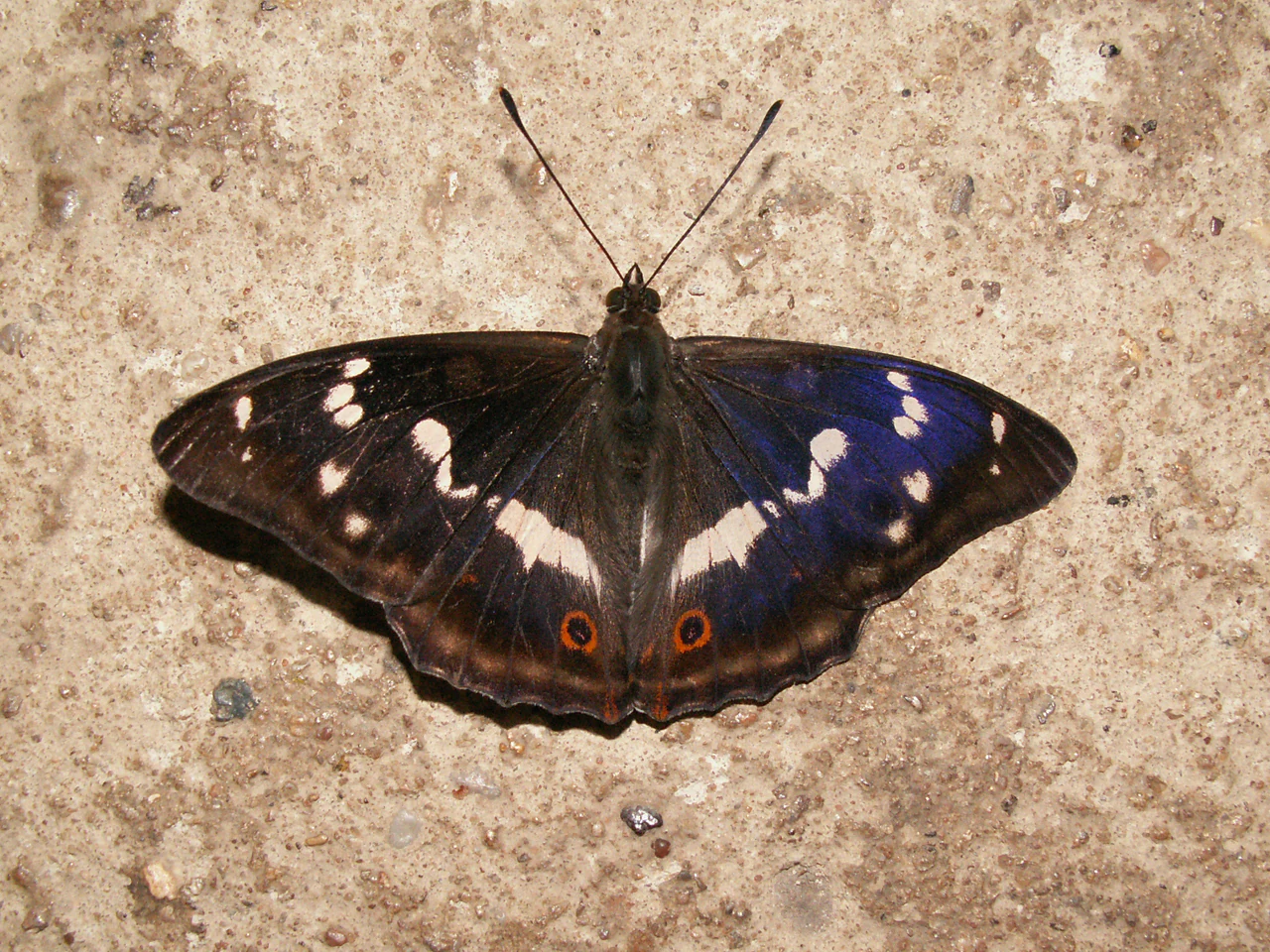
Among the protected species recorded at Ellergronn, the large or purple emperor butterfly (Apatura iris) is one of the most notable. It is a woodland-dependent butterfly associated with mature deciduous forest and willow stands near water, a habitat profile that matches the reserve's pond-fringed woodland.
The slow worm (Anguis fragilis), a legless lizard rather than a snake, is also listed among the reserve's protected fauna. Its presence is a good indicator of the kind of warm, sheltered, structurally varied ground cover found along woodland edges, grassland margins, and old quarry workings.
Beyond these named species, the reserve's combination of ponds, forest, and dry grassland provides habitat for a broader community of amphibians, invertebrates, and small woodland vertebrates associated with the mix of wet and dry conditions created by the former mining landscape.
Ellergronn Nature Reserve conservation status and protection priorities
Ellergronn was placed under formal protection on 19 March 1988 and is classified as a Zone of National Interest within Luxembourg's nature conservation system. This designation covers roughly 110 hectares of forest, ponds, and former industrial land in the commune of Esch-sur-Alzette.
Its conservation value lies particularly in the combination of habitats that mining has accidentally renewed. Quarrying and underground ironstone extraction created collapse pools and calcareous dry grassland that now sit alongside mature deciduous woodland, supporting protected species such as the purple emperor butterfly and the slow worm in close proximity.
The reserve is actively managed in cooperation with the city of Esch-sur-Alzette. The 1991 educational trail, with fifteen interpretive panels along a three-kilometre loop, anchors both the conservation message and the public engagement around the site, and the visitor centre at the start of the trail serves as the main point of contact for orientation and information.
Ellergronn Nature Reserve cultural meaning and human context
Ellergronn sits within the Minett region of southern Luxembourg, whose identity was built over more than a century around the extraction and processing of Minett ironstone. For generations this steel-and-mining belt shaped the economy, demography, and urban culture of towns like Esch-sur-Alzette. The Cockerill mining complex beside the reserve was a key part of that industrial heritage.
Because much of the surrounding extractive industry has wound down, the reserve also carries a strong post-industrial memory. Local signage and trail panels frame the site not only as a natural refuge but as a landscape that has been read and reinterpreted after the mines, turning former workings into a shared place of nature, geological education, and regional memory.
Top sights and standout views in Ellergronn Nature Reserve
The Liégeois-Weier pond, more than ten metres deep and lying within collapse terrain from the former Cockerill mines, is the reserve's single most distinctive feature and the centrepiece of its nature trail. The mosaic of woodland, collapse pools, and calcareous dry grassland on a site of roughly 110 hectares gives Ellergronn an unusually compressed ecological variety, supported by protected species such as the purple emperor butterfly and the slow worm. The 1991 three-kilometre educational loop, with fifteen interpretive stations and a dedicated visitor centre, ties the natural and industrial stories of the Minett region into a single easy walking experience.
Best time to visit Ellergronn Nature Reserve
Spring and early summer are well suited to appreciating Ellergronn's mix of habitats, when woodland ground flora is at its richest and conditions around the ponds and dry grassland are most biologically active; these months also coincide with the flight period of woodland butterflies such as the purple emperor, a species of particular interest at the site. Late spring through summer likewise showcases the dry grassland areas in their most herbaceous and insect-rich state. Visits in any mild season benefit from the reserve's compact three-kilometre trail network, which reliably shows the contrast between shaded forest and open former-quarry ground.