Why Faulbruch bei Erzhausen stands out
Faulbruch bei Erzhausen is best known for preserving a fragmented but ecologically distinctive combination of submontane mat-grass pastures on silicate soil and calcareous Molinia caerulea wet meadows, soils that are rare in the surrounding lowlands of southern Hesse. The reserve is also recognized for retaining traces of the original black alder fen woodland (Bruchwald) that once dominated the wetland, set against a landscape otherwise dominated by agricultural and urban land use. Beyond the habitat mosaic, the site is valued as a small-scale refuge for wetland-dependent flora such as mat grass (Nardus stricta), purple moor-grass (Molinia caerulea), grey willow (Salix cinerea), and black alder (Alnus glutinosa), along with characteristic wetland fauna including the Jersey tiger moth (Euplagia quadripunctaria).
Faulbruch bei Erzhausen history and protected-area timeline
The name of the site reveals a long history of human association with the wetland. Historical forms of the name appear in records from 1497 ("Im faulen bruch"), 1658 ("im fauhl Bruch"), 1767 ("im faulen Bruch"), and the 19th century ("Das Faulbruch"), with the name continuing in use through the 20th and 21st centuries. The German elements both describe unproductive, swampy ground: "Faul" derives from Old High German fûl and Middle High German vûl, meaning rotten or decayed, while "Bruch" from Old High German bruoch refers to boggy moorland and swampy meadow soil. The name thus reflects centuries of local recognition of the area as a distinctive wet, poorly drained zone.
Until modern drainage efforts gradually altered the water balance, the Faulbruch is believed to have been a near-pure black alder and grey willow fen woodland, sustained by high, base-rich groundwater slowly moving through the substrate. Over time, partial drainage converted much of the original alder carr into a mixed wetland forest interspersed with forest meadows and wet grassland.
The area's modern conservation history began on 2 August 2001, when it was formally designated as a nature reserve (Naturschutzgebiet) under the identifier 1432028 through a regulatory ordinance. The designation covered 65.75 hectares and aimed to secure the remaining habitat mosaic for long-term protection. A southeastern portion of the reserve was subsequently recognized within the European Natura 2000 network as the Fauna-Flora-Habitat site Faulbruch von Erzhausen (DE-6017-306), covering approximately 15.2 hectares and integrating the reserve into broader European conservation planning for these habitat types.
Faulbruch bei Erzhausen landscape and geographic character
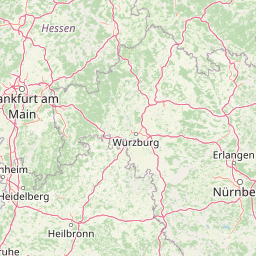
The Faulbruch occupies a low-lying position in the southern Hessian landscape at around 50 degrees north and just under 9 degrees east, set on soils with a high, slowly moving groundwater table. The terrain is flat to gently undulating and is shaped primarily by hydrology rather than dramatic relief. The reserve sits at about 65 meters elevation and is crossed by local transportation corridors that help define its boundaries.
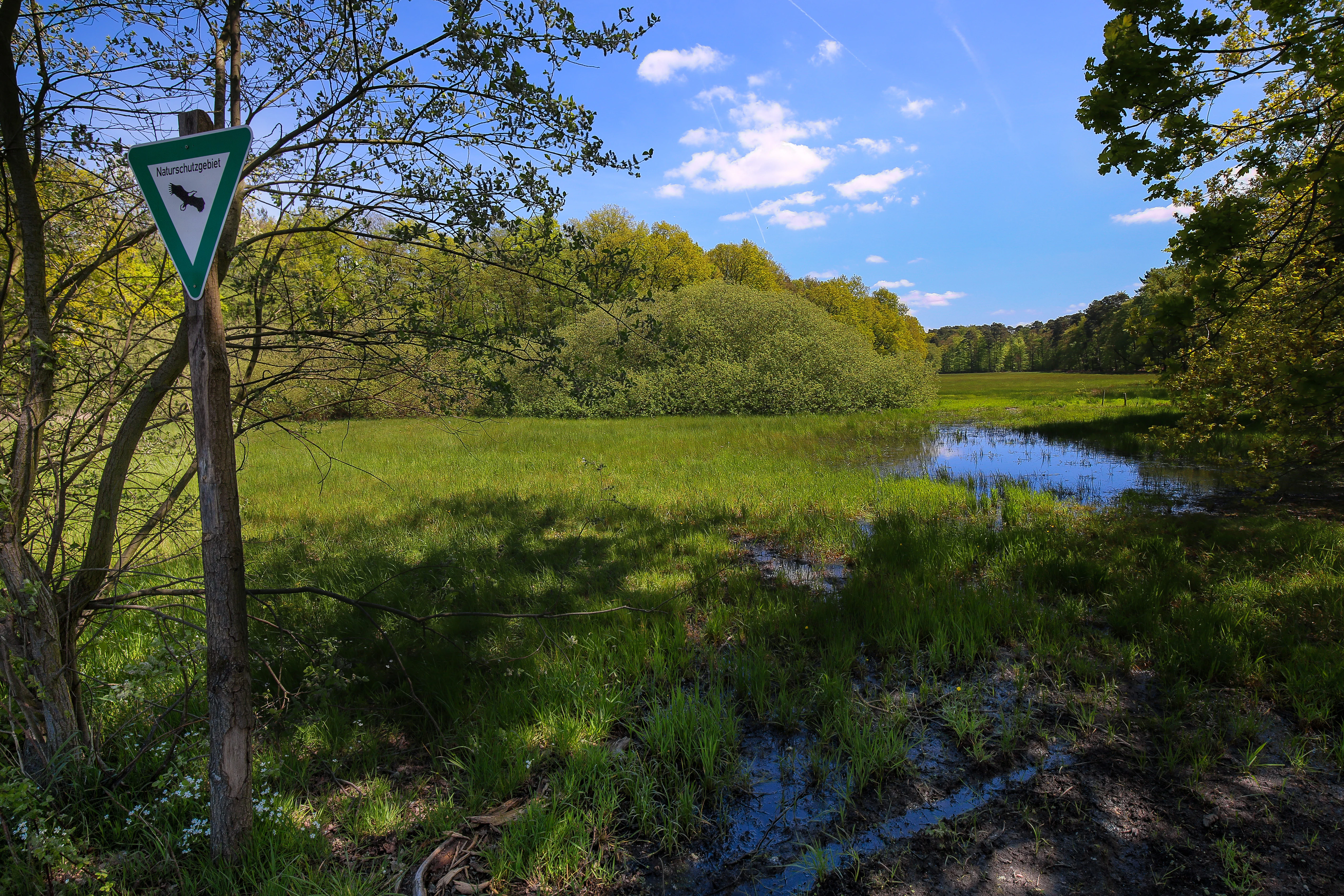
The most striking physical feature of the area is its soil and water system. A thick layer of fen-peat (Bruchwaldtorf or Bruchwaldfehn), built up from wood and cone residues, lies beneath parts of the reserve. In spring, before the vegetation period begins, the combination of high groundwater and runoff produces prolonged flooding and surface saturation across large parts of the site. Later in the year, near-surface drying becomes an important ecological factor, supporting nitrogen mineralization and oxygen supply that allow regeneration of the shallow-rooted black alder.
Above the wetland substrate, the reserve presents a visually varied mosaic of forest stands, wet meadows, reed beds, and small temporary pools, with the railway embankment and Kreisstraße 167 providing clear anthropogenic edges. The interplay between saturated low-lying areas and neighboring drier forest patches gives the reserve its distinctive landscape character.
Faulbruch bei Erzhausen ecosystems, habitats, and plant life
Ecologically, the Faulbruch is anchored by two rare and contrasting grassland habitats that occur side by side: a submontane Borstgrasweide on silicate soils, and Molinia caerulea Pfeifengraswiesen on calcareous, peaty, and clayey-silty soils. These habitats are of high conservation interest because they reflect a transitional submontane character uncommon in the surrounding lowlands.
Where the original hydrology persists, the woodland takes the form of alder carr (Bruchwald) dominated by black alder (Alnus glutinosa) and grey willow (Salix cinerea), belonging to the Alnetea glutinosae community. In the understory of these wet woodlands, the high water table suppresses typical broadleaf forest species and encourages the establishment of swamp plants normally associated with wet meadows and reed beds. The thick fen-peat horizon contains preserved wood and cone fragments, reflecting the long history of organic accumulation in the wetland.
A century of partial drainage has shifted parts of the reserve toward plant communities generally associated with drier or more disturbed conditions. Recent vegetation surveys classify the reserve as a mosaic dominated by acidophilic beech forest, mixed stands that include coniferous plantings, and fragmented open wetlands. Wet grassland, Molinion meadows, reed beds, wet braches, tall-herb vegetation, and small patches of mat-grass turf each contribute to the ecological texture of the site, while the network of forest tracks and small drainage channels influences how these habitats interconnect.
Faulbruch bei Erzhausen wildlife and species highlights
The wildlife interest of the Faulbruch is closely tied to its mosaic of wetland, woodland, and meadow habitats. The reserve's species inventory reflects the importance of small, structurally varied protected areas for maintaining invertebrate and plant diversity in heavily developed regions.
Among the most notable fauna documented for the site is the Jersey tiger moth (Euplagia quadripunctaria), a striking day-flying moth whose presence in the reserve is recognized as regionally significant. Historical records also document the dusky large blue butterfly (Maculinea nausithous), a highly specialized species tied to wet meadows with great burnet (Sanguisorba officinalis) host plants, as having been present in the Faulbruch until 2001, illustrating both the conservation value of the site and the vulnerability of meadow specialists to drainage and land-use change.
The wet woodland, reed beds, and small temporary pools provide habitat for a broader community of wetland-associated invertebrates, amphibians, and birds typical of southern Hessian lowland wetlands, although detailed species lists are limited. The continued importance of the reserve for such wildlife lies in its combination of structurally varied habitats within a small footprint.
Faulbruch bei Erzhausen conservation status and protection priorities
Faulbruch bei Erzhausen is a small but strategically placed contribution to nature conservation in southern Hesse, where the surrounding landscape has been transformed by urban expansion, transport infrastructure, and intensive agriculture. The 2001 designation of the 65.75-hectare reserve secured the legal protection of a habitat mosaic that would otherwise be highly vulnerable to further drainage, intensification, or land conversion.
A southeastern portion of the reserve has been integrated into the European Natura 2000 network as the Fauna-Flora-Habitat site Faulbruch von Erzhausen (DE-6017-306), covering about 15.2 hectares. This dual designation reflects the high conservation value of the area's mat-grass pastures, Molinia wet meadows, and wet woodland for European habitat types that have become scarce across much of central Europe.
Conservation management challenges at the site are typical of small lowland wetland reserves: partial drainage continues to affect parts of the area, leading to gradual loss of the most valuable wet habitats. The presence of mixed forest stands of limited timber value, alongside planted conifers, suggests that balancing hydrological restoration with the maintenance of existing open habitats will be central to the site's long-term conservation strategy. The reserve's profile as a habitat for specialized species such as Maculinea nausithous underscores the high stakes of maintaining appropriate management practices.
Faulbruch bei Erzhausen cultural meaning and human context
The cultural context of the Faulbruch is rooted in the long-standing relationship between local communities and the unproductive, swampy ground that defines the site. The continuity of the name from the late 15th century through to the present day reflects recognition of the area as a distinctive and economically marginal piece of land within the agrarian landscape south of Darmstadt, where wet, peaty soils were traditionally avoided for cultivation and instead used as pasture, woodland, or rough grazing.
The reserve fits into the broader pattern of southern Hessian nature protection, sitting within both the Darmstadt-Dieburg and Offenbach administrative regions. Its historical woodland meadows (Waldwiesen), including the named Bauerswiese, Sauwiese, and Faulbruchwiese, preserve traces of traditional open-land systems embedded within the forested wetland. Modern protection designations in 2001 and subsequent Natura 2000 recognition brought this long-standing cultural landscape into a new framework of ecological conservation rather than economic land use.
Top sights and standout views in Faulbruch bei Erzhausen
The reserve's standout quality is its compact combination of three habitat types rarely found together in such close proximity at this latitude: submontane mat-grass pasture on silicate soils, calcareous Molinia wet meadows, and remnant black alder fen woodland. This habitat triumvirate, sustained by the area's distinctive groundwater hydrology, sets the Faulbruch apart from the majority of surrounding lowland sites in southern Hesse.
Further standout features include the reserve's role in the European Natura 2000 network through the Faulbruch von Erzhausen FFH site, its designation as a state-level nature reserve in 2001, and its function as a refuge for specialized wetland species such as Euplagia quadripunctaria in a landscape dominated by transport corridors and settlement.
Best time to visit Faulbruch bei Erzhausen
The Faulbruch is a low-lying wetland reserve whose character shifts strongly with the seasons. In early spring, before the vegetation period is fully underway, the high groundwater table combined with snowmelt and rainfall produces prolonged surface flooding and saturation across much of the site, a dynamic that is central to the area's ecological identity. As the year progresses, surface drying allows the soils to aerate, supporting the growth of mat-grass pastures and Molinia meadows.
For visitors interested in experiencing the habitat mosaic and the seasonal hydrological cycle, late spring through early autumn generally offers the most accessible combinations of flowering meadows, drier forest paths, and active invertebrate life. Winter and early spring visits can reveal the saturated character of the landscape but require appropriate footwear and tolerance for wet conditions on forest tracks.