
Why Kelsbaach Nature Reserve stands out
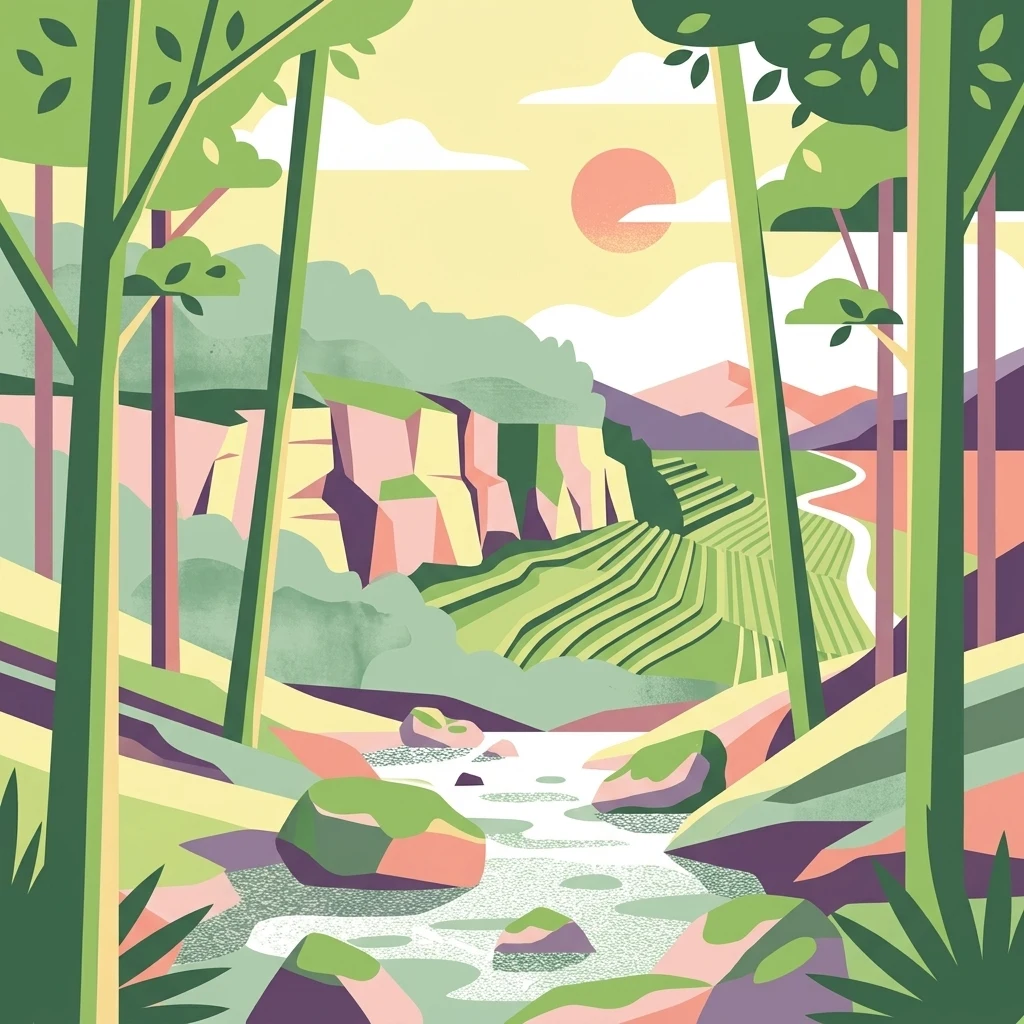
Kelsbaach is best known for its combination of calcareous and dolomitic geology, including the marked rock walls above the Moselle vineyards formed by the Trochite and Ceratite layers of the Luxembourg Muschelkalk. The reserve's plateau is celebrated for its nutrient-poor, lime-rich dry grasslands that support rare wild orchids, including military orchid, lizard orchid, and man orchid. Equally distinctive is the dramatic environmental contrast within the reserve itself. Above the vineyards, sun-warmed dolomite cliffs host heat-loving species such as wall lizards and drought-adapted plants like white stonecrop and rusty-back fern. Below, the narrow Kelsbaach gorge forms a cool, mossy, humid microclimate where moisture-loving trees and stream-dwelling birds thrive. This juxtaposition of hot dry cliff and cool shaded ravine, within a short distance, gives the reserve a striking ecological signature along the Luxembourg Moselle.
Kelsbaach Nature Reserve history and protected-area timeline
The natural and cultural history of the Kelsbaach area stretches back millennia. The underlying geology reveals an ancient marine past, with limestone and dolomite formed from layers of marine life that were later transformed chemically into the dolomite cliffs visible today along the Moselle.
Human use of the area is equally long-lived. The dolomite of the Ceratite layer was quarried and mined for centuries, and well into the 20th century the rock was extracted for use as building stone, fertilizer, milling flour, and cement. Transport of the heavy stone to the Moselle was originally carried out by a small rail system and later a cable railway down to the riverbank. A labyrinth-like gallery from these former workings can still be visited near the entrance of the Kelsbaach gorge.
The unstable geology of the valley, with hard limestone and dolomite of the Upper Muschelkalk resting on the impermeable, slippery marl of the Middle Muschelkalk, has repeatedly caused major landslides. In prehistoric times, a massive slide formed the broad Longkaul depression on the plateau above Wellbierg. A more recent and very large event occurred in December 1964, when roughly a million cubic metres of soil and rock began to slide across a 250-metre-wide front between the Kelsbaach and the Deisermillen, ultimately destroying the historic mill complex that had stood on the Moselle road. The Deisermillen system had been fed by eight springs that once powered four separate mills along the stream's descent to the river.
The area formally became a protected nature reserve on 3 August 1998, through a Grand Ducal regulation covering approximately 75.45 hectares. In 2002, the Forestry Administration, together with the Commune of Grevenmacher, established a 4 km 'Wine and Nature' discovery trail, formalising public access and interpretation of the reserve's geology, biodiversity, and two-thousand-year viticultural history associated with Grevenmacher.
Kelsbaach Nature Reserve landscape and geographic character
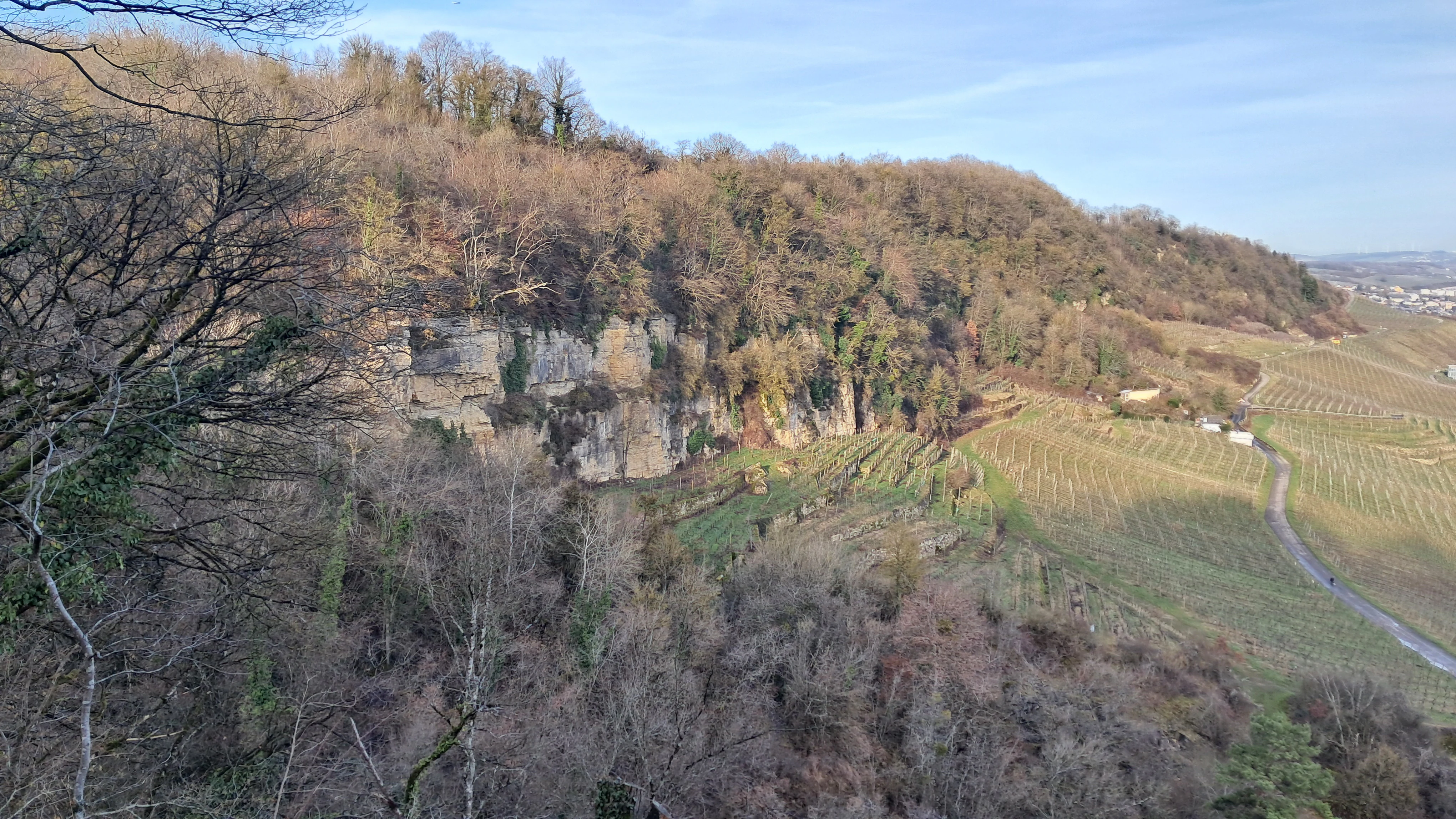
The landscape of the Kelsbaach reserve is defined by an unusually compressed vertical and ecological gradient along the Luxembourg Moselle. From the river, the vineyards climb up the slope in a series of man-made terraces until they reach the base of a striking limestone wall, the Trochite layer, which forms a clear geological horizon across the hillside. Above this wall, the younger Ceratite layer sets the upper slope and plateau, and it is here that the reserve's most distinctive rocky terrain begins.
Much of the plateau and upper slope is built on dolomite, a rock transformed from the original marine Ceratite limestone through natural chemical change. This dolomite gives the area its dry, rocky character and supports both the dramatic white rock faces and the sparse, arid grasslands on the upper plateau. The surface heat is intense in summer, and cracks, ledges, and rocky crevices shape every habitat visible on the slope.
The most visually striking feature of the reserve is the Kelsbaach gorge itself. The stream has cut a narrow, steep, shaded ravine into the hillside, producing a cool, moist, almost cave-like atmosphere that contrasts sharply with the hot, exposed rock above. In winter and after heavy rains, the Kelsbaach tumbles into this gorge as a small waterfall, while in late summer the stream can shrink to almost nothing. The result is a small but dramatic canyon, set right above the famous vineyard terraces of the Moselle valley and offering one of the most concentrated landscape contrasts in Luxembourg's wine country.
Kelsbaach Nature Reserve ecosystems, habitats, and plant life
Ecologically, the Kelsbaach reserve is best understood as a mosaic of three strongly contrasting habitat types packed into a small area. Each habitat reflects the underlying geology, exposure, and water regime of its specific location on the slope above the Moselle.
On the sun-exposed dolomite cliffs and rocky slopes, conditions are hot and dry. Here, habitats are dominated by drought-adapted plants, scattered shrubs, and reptiles specialised for warm rock faces. The microclimate of these rocks allows species more typical of Mediterranean environments to thrive in the heart of Luxembourg. Stone walls and terraces along the Wellbierg vineyards provide similar conditions, supporting additional heat-loving flora and fauna in small artificial habitats.
The Kelsbaach gorge is the ecological opposite of the cliffs above it. Inside the narrow ravine, the air is cool, damp, and shaded. Mosses and humidity-loving plants colonise the rocks and soil, and the canopy is dominated by moisture-loving deciduous trees such as sycamore maple, wych elm, and large-leaved lime. The original calcareous beech forest that once occupied the slope above the cliffs has been largely altered by human activity into a mixed woodland with hazel and field maple; nevertheless, fragments of these lime-rich woodlands still influence the area's character.
The plateau grasslands above the cliff form perhaps the most ecologically distinctive habitat in the reserve. These nutrient-poor, calcareous dry grasslands, populated with low herbs and characteristic steppe-like species, support several protected wild orchids. Together, these grassland, cliff, and gorge habitats make the reserve a textbook example of how a small area can combine geological variety with strong ecological contrasts.
Kelsbaach Nature Reserve wildlife and species highlights
The wildlife profile of Kelsbaach reflects the reserve's strong contrast between dry, exposed rock habitats and the cool, sheltered Kelsbaach gorge. Different groups of animals dominate each of these worlds, and the reserve is notable for the unusual presence of more southerly species in a Luxembourgish setting.
On the warm dolomite cliffs and old vineyard walls, the most visible species is the common wall lizard, a heat-loving reptile that hunts insects among the rocks and is agile enough to scale even vertical stone surfaces. The dry, sun-baked rock faces also support a community of drought-adapted invertebrates, including the butterfly fauna typical of calcareous grasslands and dry slopes.
The Kelsbaach gorge supports a very different set of species. The clear, fast-flowing, and rocky sections of the stream provide hunting habitat for the white-throated dipper, a stream-dwelling songbird that searches for insect larvae and small aquatic invertebrates among the stones. The grey wagtail is also regularly present along the watercourse, feeding along the edges of the stream in the shaded, mossy environment. Amphibians and moisture-loving invertebrates also benefit from the persistent humidity of the gorge.
On the dry plateau grasslands, the rich wildflower communities, particularly of orchids, attract a wide range of pollinators, especially butterflies, which are drawn to the nectar of rare orchid species such as military orchid, lizard orchid, and man orchid. The combination of dry grassland, rocky cliff, shaded gorge, and vineyard edge gives the reserve an unusually diverse fauna for its small size, but the wildlife story is fundamentally one of two very different microclimates sitting on top of one another.
Kelsbaach Nature Reserve conservation status and protection priorities
Kelsbaach has been formally protected as a nature reserve of national interest since 3 August 1998, under Grand Ducal regulation covering roughly 75.45 hectares. The decision to protect the area reflects both the high ecological value of its habitats and the fragility of the dry calcareous grasslands and cliff ecosystems that depend on very specific site conditions.
From a conservation perspective, the reserve's most important contribution is the preservation of nutrient-poor, calcareous dry grasslands on limestone and dolomite. These habitats are exceptionally rich in plant species, including several protected wild orchids, but they are also vulnerable: they depend on low nutrient levels and traditionally open conditions, and they can easily be lost if the land is fertilised, afforested, or abandoned without management.
Equally important is the protection of the geological-climatic mosaic itself. The contrast between hot dry dolomite cliffs and a cool shaded stream gorge supports a genuinely rare combination of Mediterranean-like and central European species in a single small site. Protecting both the rocky outcrops and the watercourse ensures that specialised cliff species, stream wildlife, and grassland flora can continue to coexist. The surrounding cultural landscape, including old stone walls and vineyard terraces, is also recognised as an important habitat in its own right, providing additional niches for the reserve's reptiles and drought-adapted plants.
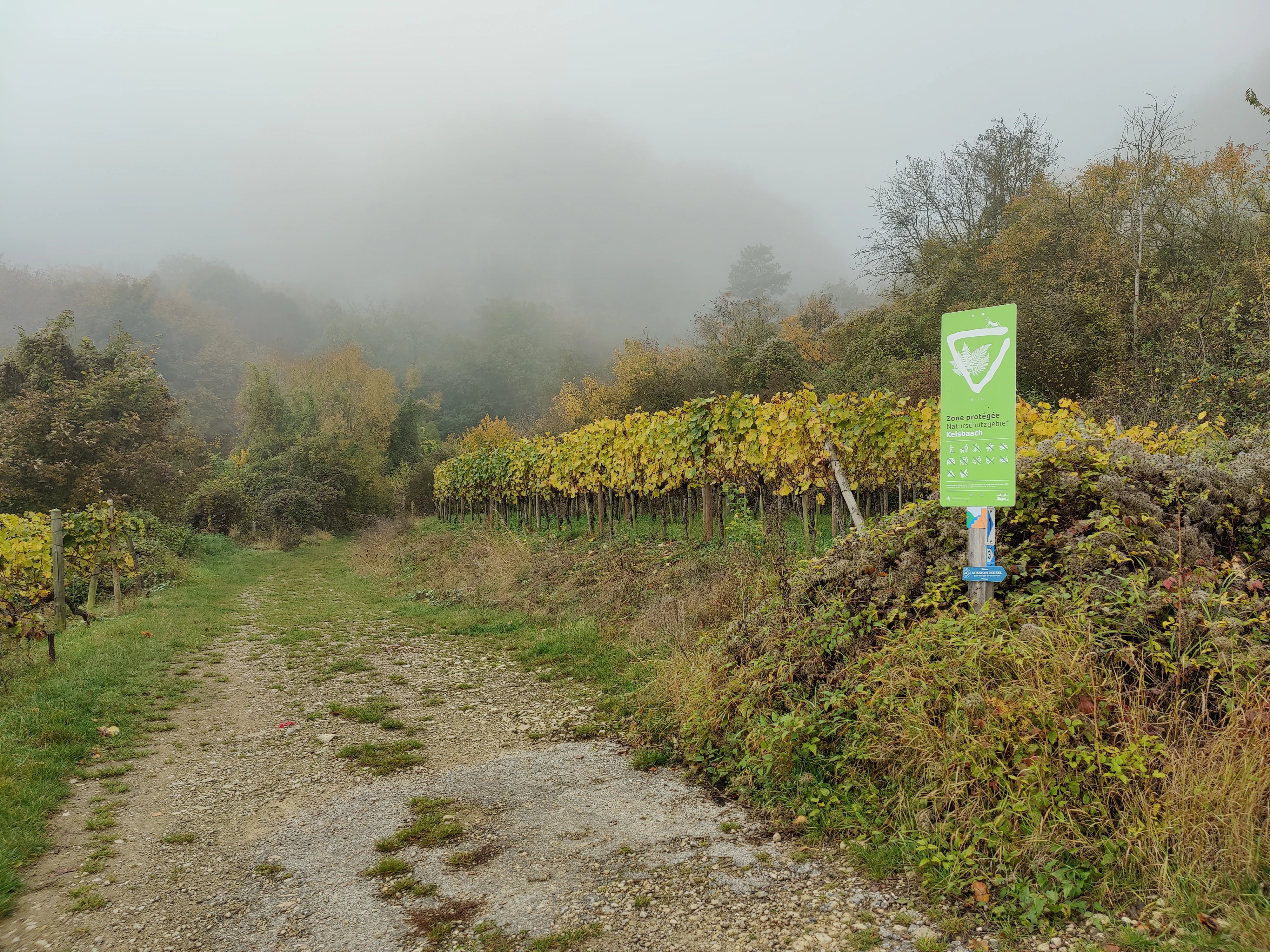
The 2002 establishment of the 4 km Wine and Nature discovery trail reflects the fact that conservation here is closely linked with public access and education. By channeling visitors along an established route and providing interpretive stations, the management aims to balance the area's scientific and ecological value with its cultural heritage and recreational use along the Luxembourg Moselle.
Kelsbaach Nature Reserve cultural meaning and human context
Kelsbaach sits within one of the oldest and most intensely cultivated wine regions in Luxembourg, and the protected area reflects thousands of years of human shaping of the landscape. The Moselle vineyards between Grevenmacher and Machtum have been worked for around two millennia, and the dry stone terraces climbing up the slope from the river are themselves a recognised cultural and ecological feature, providing habitat for heat-loving species such as wall lizards and rare ferns.
The reserve also preserves evidence of older extractive industries. The dolomite of the upper Ceratite layer was historically mined and quarried for use as building stone, fertiliser, flour, and cement. The transport of this heavy material was supported first by a small rail line and later by a cable railway descending to the Moselle. A labyrinth-like gallery from this mining past can still be visited at the entrance to the Kelsbaach gorge, making the area a working link between natural and industrial heritage.
Equally important is the history associated with the Deisermillen. Eight springs along the Kelsbaach once fed a system of four mills arranged in sequence: a limestone and oil mill, an oak bark mill, and a tanning mill along the Moselle road. The 1964 landslide destroyed this complex, and its disappearance is part of the reserve's living memory. The 2002 discovery trail deliberately integrates these cultural layers, weaving together viticulture, mining, milling, and nature into a single narrative of the Luxembourg Moselle landscape.
Top sights and standout views in Kelsbaach Nature Reserve
The reserve's defining quality is the tight concentration, within just over 75 hectares, of three sharply contrasting habitats: sun-baked dolomite cliffs, a cool mossy stream gorge, and species-rich calcareous dry grasslands on the plateau. Combined with a strongly expressive geology of limestone and dolomite, this creates one of the most compact and varied ecological sites along Luxembourg's Moselle.
Visitors and conservation interest focus on several standout features: rare wild orchids in the plateau grasslands, heat-loving reptiles and drought-adapted plants on the cliffs and old vineyard walls, white-throated dippers and grey wagtails along the Kelsbaach stream, and visible traces of 2,000 years of human history in quarrying, milling, and wine-growing. The 4 km Wine and Nature discovery trail links these features in a single accessible circuit starting from Grevenmacher, Machtum, or the Deisermillen site.
Best time to visit Kelsbaach Nature Reserve
Spring is widely the most rewarding season to experience the Kelsbaach reserve, when the dry grasslands on the plateau come into flower and the wild orchids, including military orchid, lizard orchid, and man orchid, are at their most visible. This is also when temperatures on the exposed dolomite cliffs are warm enough to be lively without being oppressive, and reptiles such as the common wall lizard are most active and easiest to observe.
Summer brings the driest conditions in the reserve. The dolomite rocks and vineyard walls are at their hottest, supporting heat-loving species, but the Kelsbaach stream itself may shrink to almost nothing, and waterfalls along the gorge only appear during heavy rainfall. Autumn is generally a calmer season, with softer light on the Moselle vineyards and the rock walls, and stable conditions for walking the discovery trail. Winter, after rain or snowmelt, is the best time to witness the Kelsbaach in its most dramatic form, when it cascades into the gorge as a seasonal waterfall.