Why Krielower See Nature Reserve stands out
Krielower See is especially known for its near-verlandet, or largely silted-up, glacial lake set within a connected chain of wetland habitats that link Lake Plessow with the Havel. The reserve is recognized as an important refuge for wetland birds such as common cranes and spotted crakes, as well as for amphibians, otters, and rare mollusks. Its combination of a former open lake, peat cuttings, reed beds, mires, and wet meadows makes it a textbook example of a renaturating Brandenburg lowland wetland complex.
Krielower See Nature Reserve history and protected-area timeline
The Krielower See itself is a relic of glacial landscape formation during the Pleistocene, when ice tongues and meltwater carved out the shallow basin in which it lies. In historical times the open water was known as the Krielower See, while the increasingly marshy surroundings were referred to as the Krielower Luch. Over the centuries, the lake gradually filled in, and peat cutting in places further altered its character, until it became the almost fully overgrown wetland seen today.
Formal conservation came much later. The Brandenburg Minister for Agriculture, Environmental Protection and Spatial Planning designated the area as the Naturschutzgebiet Krielower See on 31 August 2004, under Section 21 in conjunction with Section 19 of the Brandenburg Nature Conservation Act. The designation also aligned the area with European nature protection frameworks, and the site is now listed as a Fauna-Flora-Habitat (FFH) site under the designation DE 3543-301, part of the Natura 2000 network. Subsequent restoration work focused on the surrounding Krielower meadows aimed to re-flood formerly drained grasslands and to support traditional grazing practices, including the use of water buffalo for landscape management in areas made too wet for machinery.
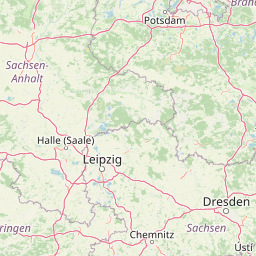
Krielower See Nature Reserve landscape and geographic character
The landscape of the reserve is defined by a flat, low-lying glacial terrain typical of central Brandenburg. Its central landform is the former lake basin of the Krielower See, now an almost completely silted-up waterbody within a wider moor channel. The historic open water has been replaced by a mosaic of reed beds, sedge marshes, wet meadows, willow scrub, and alder carr, framed by the older Pleistocene sand formations of the Phöbener Berge to the east, where the Wachtelberg rises to about 83.7 meters and the Haakberg to about 87.9 meters above sea level.
Once these ice age deposits formed the western edge of a large sand island between the Havel and the Plessow lakes. North and south of the Krielower See, the Torfgraben, a seasonally water-bearing former peat cutting, provides a narrow linear connection toward the Großer Plessower See and the Havel. The combination of glacial lake basin, peat cuttings, glacial sand uplands, and floodplain zones gives the reserve a layered, ecologically diverse topography despite its modest elevation differences. Today the area reads visually as a wide, open wetland landscape interrupted by patches of wet woodland and bordered by farmland and the Berlin to Magdeburg railway corridor to the south.
Krielower See Nature Reserve ecosystems, habitats, and plant life
Ecologically, the reserve centers on a dynamic gradient from open water to fully terrestrial wetland. The remnant eutrophic lake carries water vegetation characteristic of the Magnopotamion and Hydrocharition vegetation types, including pondweed communities and floating aquatic plant associations. Surrounding peat cuttings support specialized stonewort (Armleuchteralgen) communities, while the larger wetland matrix is composed of reed communities, large sedge marshes (Großseggenriede), floodplain grasslands (Flutrasen), Molinia meadows on calcareous substrates, and wet tall-herb communities.
Willow scrub and alder carr (Erlenbruch) occupy the wetter transitions, particularly along former drainage channels and the edges of the old lake basin. These habitats correspond to officially listed natural habitat types of community interest under Germany's federal nature conservation act. The management goal is to preserve, restore, and develop the area as a key segment of the regional biotope network between the Kleiner Plessower See and the Havel, allowing water, nutrients, and species to move between these larger wetland systems.
Krielower See Nature Reserve wildlife and species highlights
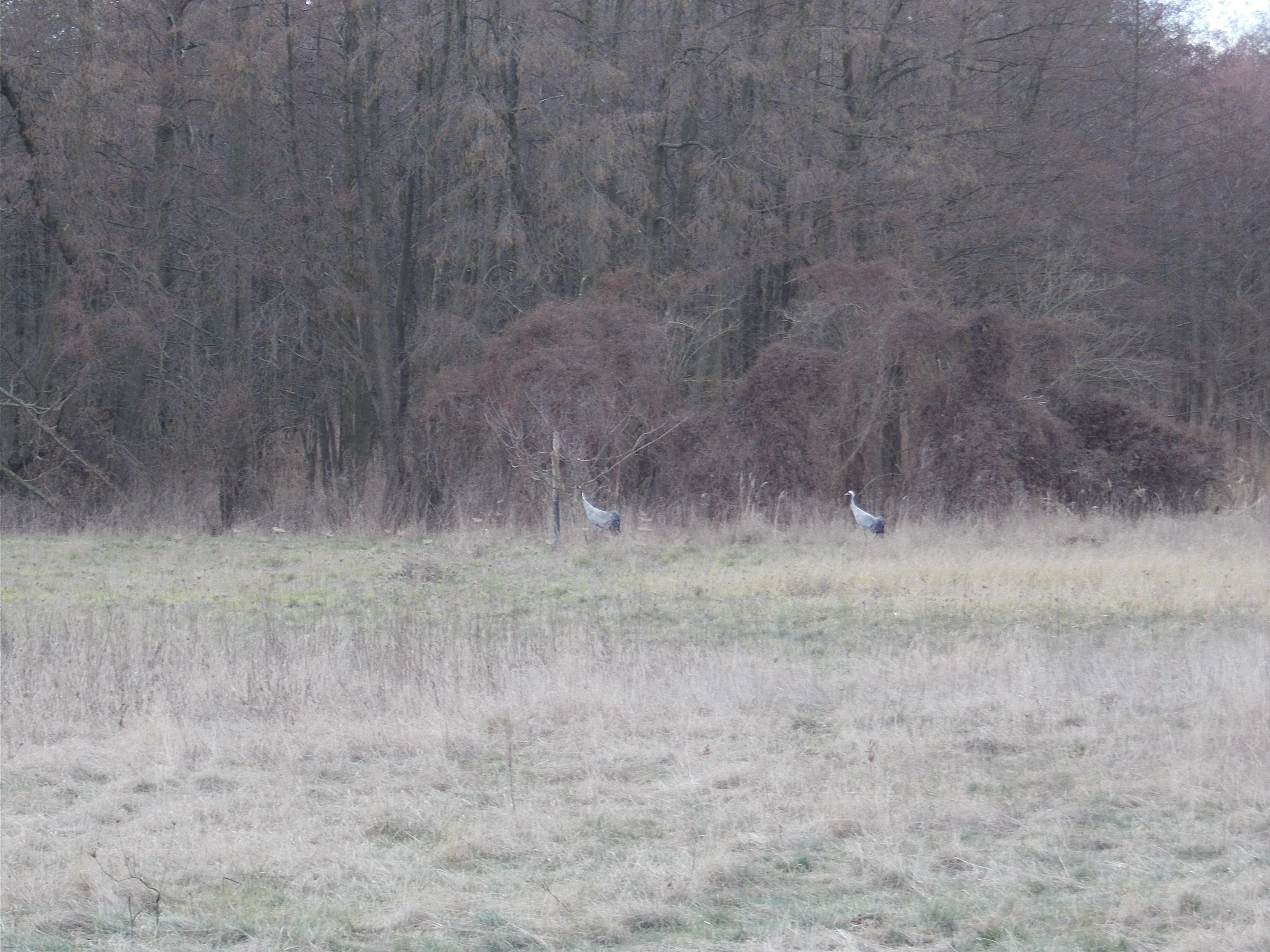
Krielower See is recognized as a habitat and retreat area, as well as a potential source for renewed expansion, for a wide range of protected and ecologically important species. Common cranes (Grus grus) are especially visible along the edge of the alder carr, as captured in the area's iconic imagery. The reserve also supports a rich community of marshland and wetland birds including spotted crake (Porzana porzana), corncrake (Crex crex), common snipe (Gallinago gallinago), and garganey (Anas querquedula).
Among herptiles, the reserve hosts the natterjack toad-adjacent species complex including the garlic toad (Pelobates fuscus) and moor frog (Rana arvalis), along with the grass snake (Natrix natrix). Mammals include the Eurasian otter (Lutra lutra), while the European beaver (Castor fiber) plays an especially significant ecological role by damming drainage channels and rewetting former dry grasslands. The invertebrate fauna is notable for rare snails such as the small discoid snail Anisus vorticulus and the two Vertigo species, Vertigo moulinsiana and Vertigo angustior, which are listed as species of community interest. In addition, water buffalo introduced to the area help maintain open wet grassland habitats that can no longer be managed mechanically.
Krielower See Nature Reserve conservation status and protection priorities
The reserve is designated under Brandenburg state law and integrated into the European Natura 2000 network as a Fauna-Flora-Habitat site. Its primary conservation objective is to preserve and develop the area as a functioning segment of the regional biotope network linking the Havel floodplain and the Plessow lake chain. This includes maintaining and restoring open water, peat-cutting ponds, reed beds, wet meadows, tall-herb vegetation, willow scrub, and alder marsh.
A second objective involves protecting habitats for species of community interest, particularly common crane, spotted crake, corncrake, common snipe, garganey, grass snake, garlic toad, moor frog, otter, and rare mollusk species. Long-term faunistic and floristic monitoring is carried out by NABU conservation area caretakers, with records reported to the Naturgucker observation portal, supporting evidence-based management. Restoration of the Krielower meadows, sparked in part by the arrival of beavers that have raised water tables and made mechanical management impossible, has shifted management toward grazing-based conservation using hardy livestock such as water buffalo.
Krielower See Nature Reserve cultural meaning and human context
The Krielower See lies within a long-settled rural landscape of Brandenburg, interspersed among the historic villages of Krielow, Schmergow, Kemnitz, and Phöben. These villages, like much of the surrounding Havelland, have traditionally depended on agriculture, particularly on the extensive pastures and meadows of the Havel floodplain. The transformation of the lake basin from open water to wetland and the loss of usable dry pastureland reflects broader regional patterns of land-use change in Brandenburg after the second half of the twentieth century.
Elements of cultural identity remain visible in the area's topography, the legacy of peat cutting that shaped parts of the wetland, and in the continued practice of traditional livestock grazing. The introduction of water buffalo to maintain wet meadows adds a distinctive contemporary farming element tied directly to the reserve's conservation strategy.
Top sights and standout views in Krielower See Nature Reserve
Krielower See stands out for its combination of a former glacial lake now functioning as a near-natural wetland, a key ecological link between the Plessow lakes and the Havel, and a remarkable diversity of protected species within a relatively compact 155-hectare area. The visible presence of cranes along the alder carr edge, the visible and ecological impact of beaver activity, and the use of water buffalo as conservation grazers give the reserve a distinctive identity that combines glacial landscape history with active, habitat-driven conservation.
Best time to visit Krielower See Nature Reserve
Visit timing at Krielower See is shaped primarily by seasonal wetland dynamics and wildlife activity rather than by structured visitor programming. Spring is often the most rewarding season, when rising water levels, fresh growth in the reed beds and wet meadows, and the arrival and display of cranes and other marshland birds are most visible. Early morning and dusk tend to offer the best chances of observing wetland birdlife and large mammals such as the otter or beaver.
Summer brings lush growth across reed beds, sedge marshes, and wet tall-herb communities, when insect activity peaks and frog and toad populations are most audible. Autumn can deliver rich color and movement across the landscape as migratory birds pass through and cranes prepare for departure. Winter tends to be quieter and colder, with frozen or partially frozen wetland surfaces and minimal bird song.