
Why Lago d'Ampola stands out
Lago d'Ampola is best known for being a compact but ecologically rich Alpine wetland biotope, where glacial lake, reedbed, marsh, and montane forest coexist in a single protected area. It stands out for its lily-covered open water, thriving reedbed vegetation, and the wide range of birdlife supported around the basin, from reed-nesting ducks and rails to birds of prey and woodland passerines. The site is also notable for its transformation from a former inert-waste landfill into a renaturalized protected area, and for its ongoing importance for large mammals such as bears, wolves, and possibly lynx, which have returned to the broader Ampola and Ledro valleys.
Lago d'Ampola history and protected-area timeline
The lake's origins trace back to the last major glaciation, the Würm, ending roughly eighteen thousand years ago. During this period a massive moraine blocked the eastern end of what is now the Val di Ledro, creating an enormous proglacial lake that stretched from Molina di Ledro up toward the Ampola pass.
As the glaciers retreated and the original basin partially silted up with material carried by side streams, this large lake split in two. The larger remnant became Lago di Ledro, while the much smaller Lago d'Ampola was left in the upper part of the valley. Over time, sediment accumulation drove the small lake toward the natural silting-up process typical of glacial basins.
A second, more recent chapter began in the 1970s, when the area around the lake was used as a landfill for inert construction waste. Following agreements with the province of Trento under regional law, the municipalities initiated a renaturalization project that continues to shape the site today. Where waste heaps once stood, vegetation has gradually recovered, and native trees, shrubs, and flowers have been planted. The former tourist hut was converted before 1995 into a visitor center dedicated to wetland education. The formal establishment of the biotope in 1990 marked the consolidation of these restoration efforts into an institutional protection framework.
Lago d'Ampola landscape and geographic character
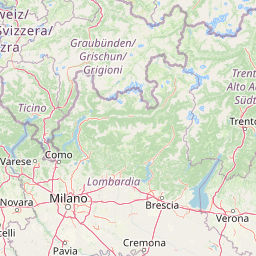
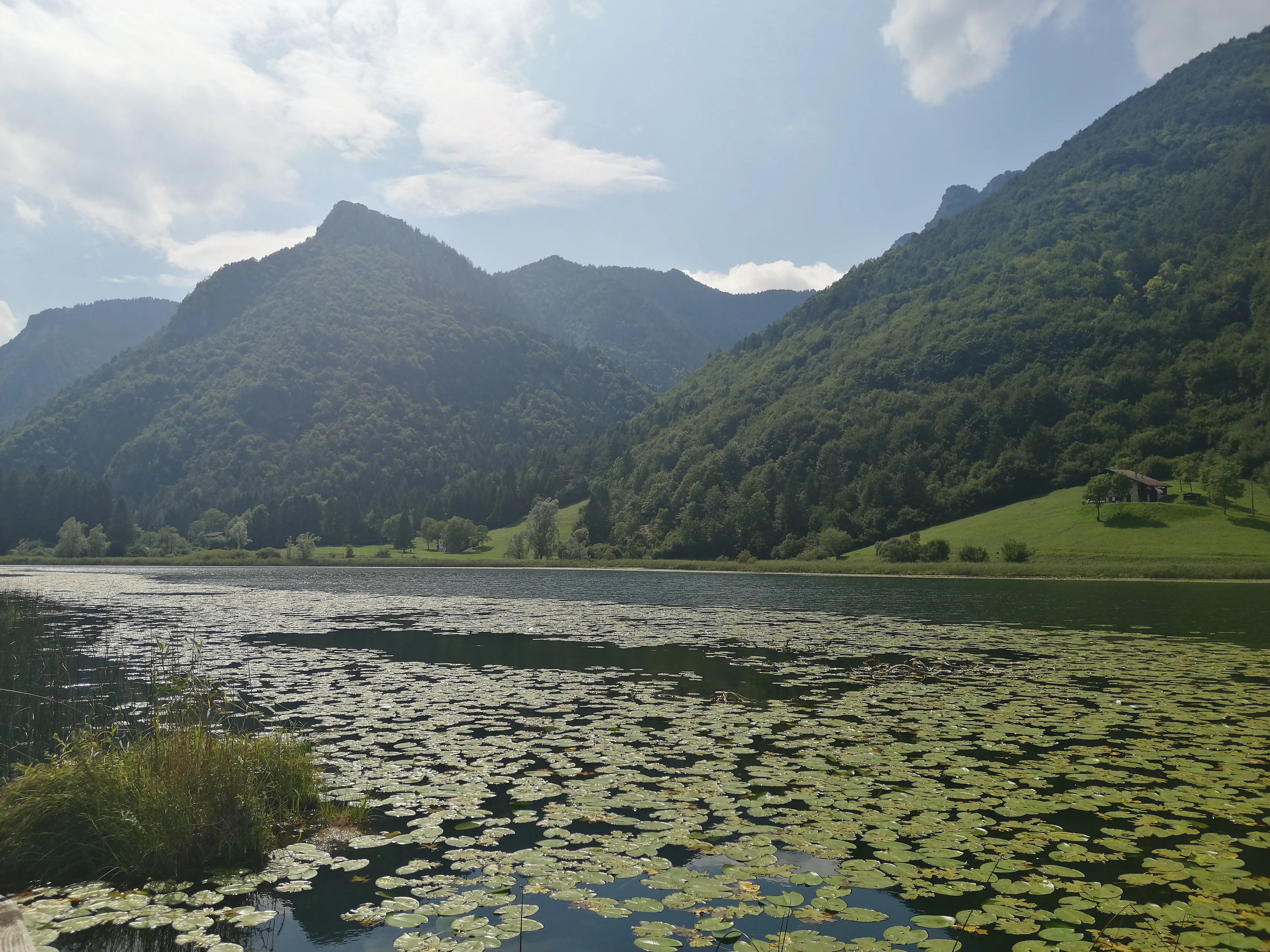
The landscape of Lago d'Ampola is defined by the contrast between a tiny glacial lake basin and the steep, forested slopes that frame it. The Ampola valley opens between higher Alpine terrain to the north and the moraine-controlled basin that also holds Lago di Ledro to the south, producing a sheltered, trough-like setting typical of formerly glaciated valleys.
Around the shore, three concentric vegetation zones give the area a layered appearance. A belt of sedge marsh (cariceto) lies closest to the water, followed by a band of tall reeds and associated marsh plants (canneto), and then the open water surface (bacino idrico), which in summer is dotted with white and yellow water lilies. Beyond these wetland rings, woodland of spruce, beech, and Scots pine climbs the slopes, with a rich shrub layer beneath.
The terrain preserves clear traces of its glacial inheritance, including the lateral and terminal moraines that once held back the original larger lake. Small artificial hills from the former landfill period still interrupt the land surface, although they have been progressively absorbed by the returning vegetation, providing a visible reminder of the site's more recent history.
Lago d'Ampola ecosystems, habitats, and plant life
Ecologically, Lago d'Ampola is a textbook example of a small Alpine wetland complex. The lake itself is shallow and nutrient-rich enough to support beds of white water lily, yellow water lily, and the fringed water nymph, while the surrounding marshland is dominated by common reed, flowering rush, yellow flag iris, and lily of the valley in the wetter zones.
The drier ground and slopes carry montane forest dominated by Norway spruce, with beech, Scots pine, hornbeam, smoke tree, hazel, and hawthorn contributing to a diverse shrub and mid-story layer. Honeysuckle appears in scattered patches, adding further diversity to the undergrowth. This combination of aquatic, marsh, and forest habitats creates a gradient of moisture and light conditions that supports a particularly wide range of species within a small area.
The biotope is also distinctive in being a deliberately restored ecosystem. After decades of use as an inert-waste dump, the site has been progressively recovered through planting, regrading, and passive regeneration, so that the vegetation seen today is in part the product of active ecological management. This blend of natural processes and restoration work gives the biotope a unique character among protected areas in Trentino.
Lago d'Ampola wildlife and species highlights
The fauna of Lago d'Ampola reflects the diversity of its habitats. The lake and reedbeds host an abundant community of aquatic invertebrates, including dragonflies and beetles, which in turn support populations of fish such as tench, eel, common carp, pike, European perch, common nase, and the European minnow. These smaller fish attract a wide range of predators, including the marsh harrier, little egret, great crested grebe, common kingfisher, white-throated dipper, and mixed heronries of grey and purple herons.
Within the reeds nest and feed typical marsh birds such as the mallard, common moorhen, gadwall, little grebe, Eurasian coot, bearded reedling, and water rail, with common snipe suspected as a recent breeder. The surrounding woodland hosts a characteristic high-altitude avifauna including meadow pipit, Alpine accentor, goldcrest, yellowhammer, northern wheatear, Eurasian nuthatch, great spotted woodpecker, sparrowhawk, northern goshawk, barn owl, little owl, boreal owl, and tawny owl, with possible sightings of the western capercaillie on remote slopes.
Mammals are also well represented. Red deer, roe deer, wild boar, red fox, stoat, European badger, least weasel, common shrew, beech marten, red squirrel, edible dormouse, hare, and yellow-necked mice are all documented. Brown bears have returned, with regular incursions into the valley, and a small wolf pack has been roaming between Val d'Ampola and Val di Ledro, with a first confirmed litter in 2024. There are many sightings and photographic records of the Eurasian lynx, and at least one adult wildcat has been confirmed by camera traps on the slopes above the lake. Bats include three breeding colonies of Daubenton's bat in cliff areas and a recently discovered colony of lesser horseshoe bat in a spruce stand. Amphibians such as the fire salamander, common frog, common toad, and smooth newt are widespread and migrate to the lake in spring to breed.
Lago d'Ampola conservation status and protection priorities
The principal conservation framework around Lago d'Ampola is the designation of the area as a biotope under provincial law in 1990, with the official EUAP code EUAP0482 and management by the Autonomous Province of Trento. The protected area covers around 24 hectares of terrestrial habitat surrounding the lake and captures the full wetland-to-forest gradient.
Its conservation value lies in the unusually complete representation of an Alpine lake ecosystem within a small area, including open water, aquatic vegetation, reedbed, marsh, woodland, and rock habitats. The site supports breeding populations and seasonal visitors that would otherwise be vulnerable to habitat loss in the more heavily developed valleys of Trentino.
Restoration history is an essential part of its conservation story. The transformation from a former landfill for inert materials into a functioning wetland biotope demonstrates the potential for active recovery of damaged sites. Ongoing management focuses on habitat preservation, monitoring of returning large carnivores such as bears, wolves, and lynx, and public education through the visitor center that emphasizes the air–water interface as a key zone of biological activity.
Lago d'Ampola cultural meaning and human context
The Ampola valley carries both natural and human traces. The glacial shaping of the landscape is read today through the moraines still visible on the valley sides, while the presence of Forte d'Ampola in the broader area links the valley to the historical military heritage of Trentino.
The most recent cultural chapter is the deliberate reclamation of the site from landfill use into a renaturalized protected landscape, reflecting a broader regional turn toward ecological recovery that has characterized conservation policy in the province of Trento in recent decades. The visitor center's emphasis on wetland education also embeds the site in a local tradition of nature interpretation aimed at schools, residents, and tourists visiting the Ledro area.
Top sights and standout views in Lago d'Ampola
Lago d'Ampola offers a striking combination of geological history, ecological richness, and active conservation within a very compact area. The visible moraines and the clear layered structure of the wetland make the glacial story of the valley tangible, while the lily-covered open water, dense reedbeds, and montane forest create a continuously shifting visual experience around the lake.
The site is also distinguished by the return of charismatic large mammals to its valley system, including brown bears, a resident wolf pack, and a growing number of lynx sightings, alongside exceptionally diverse birdlife across marsh and forest. For visitors interested in wetlands, birdwatching, glacial landscapes, or the recovery of damaged ecosystems, Lago d'Ampola provides a compact but complete reference point within the Trentino Alps.
Best time to visit Lago d'Ampola
Seasonal character at Lago d'Ampola is shaped by the contrast between the wetland and the surrounding forest. In spring, amphibian activity peaks in and around the lake as frogs, toads, and newts migrate from wooded clearings and meadows to the water to breed, while the first reedbed birds begin nesting. This is often the most dynamic period for wetland wildlife and is well suited to visitors interested in amphibians, dragonflies, and early-season birdlife.
Summer brings the classic image of the lake, with full reedbeds, blooming water lilies on the open surface, and the richest diversity of dragonflies, beetles, and reed-nesting birds. Woodland bird song is at its height, and longer days make it easier to combine the visitor center, the lakeshore paths, and observation of marsh species. Autumn turns attention to the surrounding forest, with ripening fruits, rutting deer in the broader valley, and migratory birds passing through the wetland.