Central Europe's largest freshwater lake and Hungary's defining inland water
Lake Balaton
Lake Balaton is the largest lake in Central Europe and the defining natural landmark of western Hungary. It occupies a tectonic depression formed within the broader Transdanubian basin, resting on Mesozoic sedimentary rocks that connect it geologically to the Alpine formations to the west. The lake is approximately 77 kilometers long and averages only a few meters in depth, with its deepest point, often called the Tihany well, lying near the Tihany strait where the peninsula narrows the basin. This extreme shallowness shapes nearly every aspect of the lake's behavior, from the rapid warming of its waters in summer to the way wind produces steep, short waves. The Tihany Peninsula effectively divides the lake into a larger western basin and a smaller, narrower eastern basin.
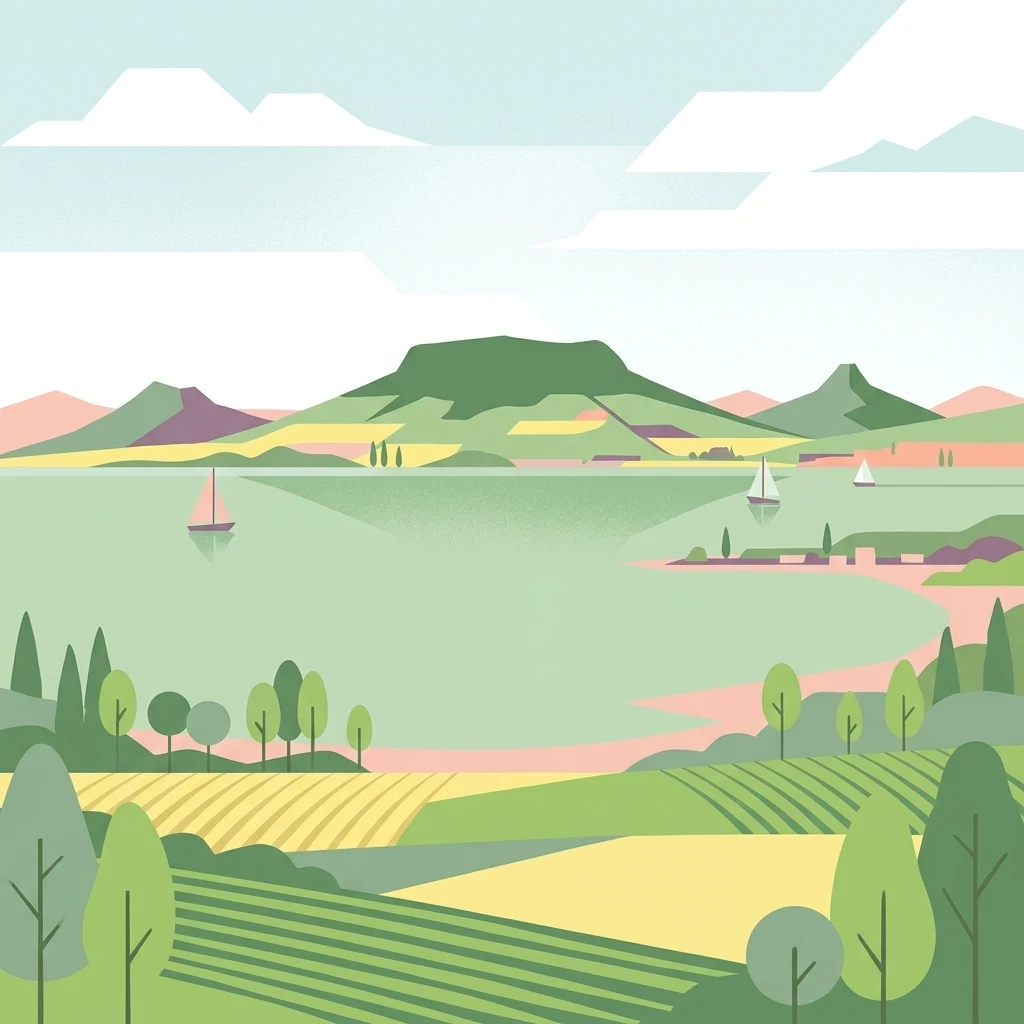
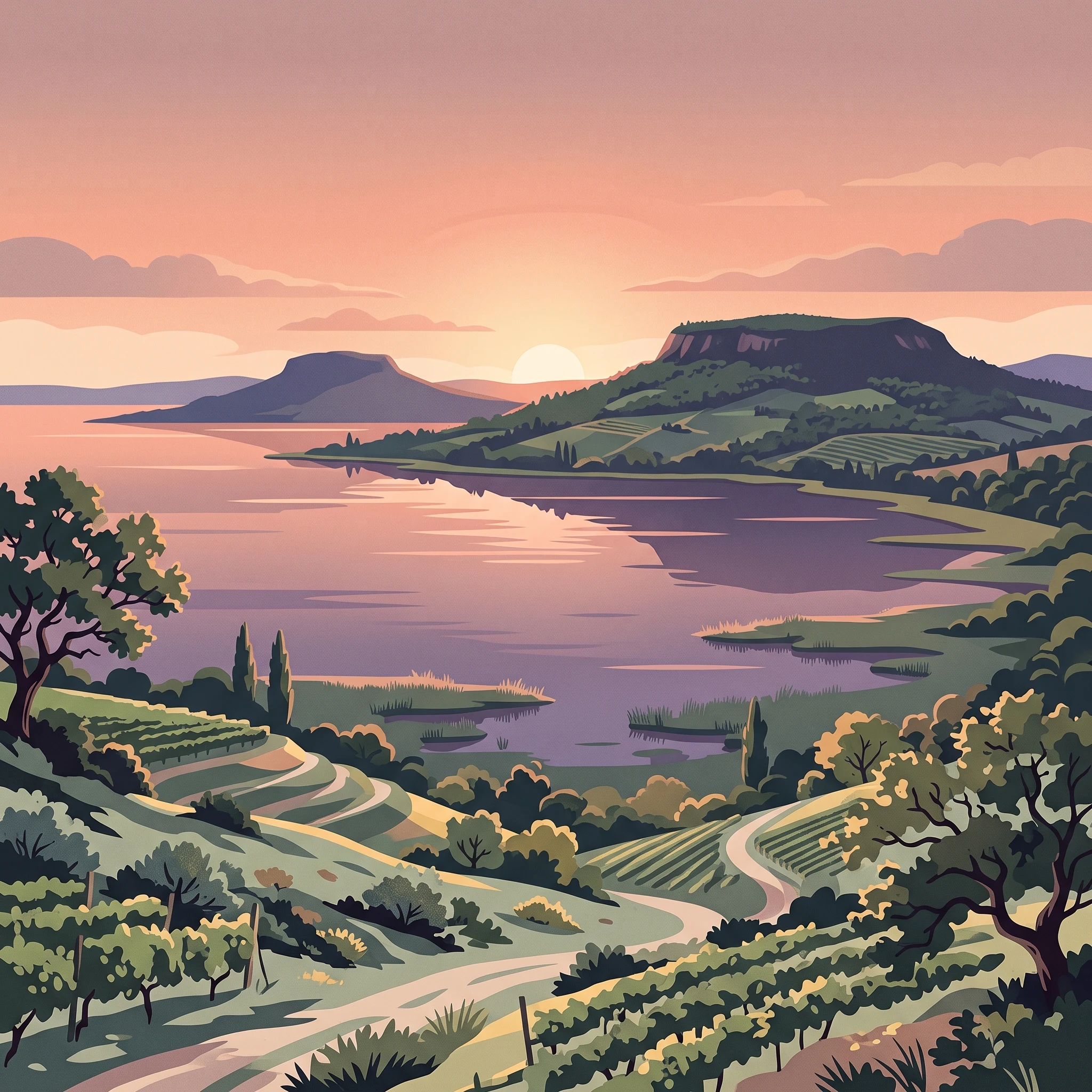
The surrounding landscape is sharply asymmetrical. To the north rises the Balaton-felvidék, a foothill belt of the Bakony Mountains composed of volcanic remnants, basalt flows, and forested ridges. These hills include the famous witness mountains, buttes such as Badacsony, Szigliget, and Gulács, each carrying layers of basalt and tuff above softer sedimentary rock. Their sun-facing slopes have been cultivated with vineyards since Roman times and remain the core of the Badacsony and Balaton-felvidék wine regions. To the south, the land flattens into a sandy plain that was historically a mosaic of marshes and reed-fringed bays before nineteenth-century water management lowered the lake's level and opened the area to agriculture and, later, large-scale resort development. The Tihany Peninsula itself is a geological showcase, exposing fossil-bearing sediments, geothermal features, and the iconic geyser cones that give Tihany its distinctive silhouette.
Balaton is also a deeply protected natural system. The lake is listed as a Ramsar wetland and forms part of a wider protected framework that includes the Balaton-felvidéki National Park on the northern shore and the Bakony-Balaton UNESCO Global Geopark across the broader hills. Beyond formal protection, the lake functions as a critical inland habitat for waterbirds, fish, and aquatic vegetation. Reedbeds fringe large sections of the shore, particularly along the quieter northern coast, while the open water hosts one of Europe's most significant waterbird populations outside the great lowland wetlands. Research carried out at the Balaton Limnological Research Institute in Tihany has shaped modern understanding of the ecology of shallow eutrophic lakes and continues to guide restoration efforts against algae blooms and invasive species.
Culturally, the lake operates on multiple scales. It is a working agricultural and fishing environment, with vineyards on the hills, fish populations in the water, and reed harvesting along the margins. It is also a national leisure landscape, where Hungarian families have spent summer holidays for over a century, first at the aristocratic resorts of Balatonfüred and Hévíz in the late nineteenth century, then as mass middle-class and working-class tourism expanded with the railways and later with state-organized holidays. Literature, painting, music, and film have repeatedly used Balaton as a setting, from Jókai's novels and Krúdy's short stories to twentieth-century painters and contemporary pop songs, embedding the lake in Hungarian cultural identity as unmistakably as the Danube.