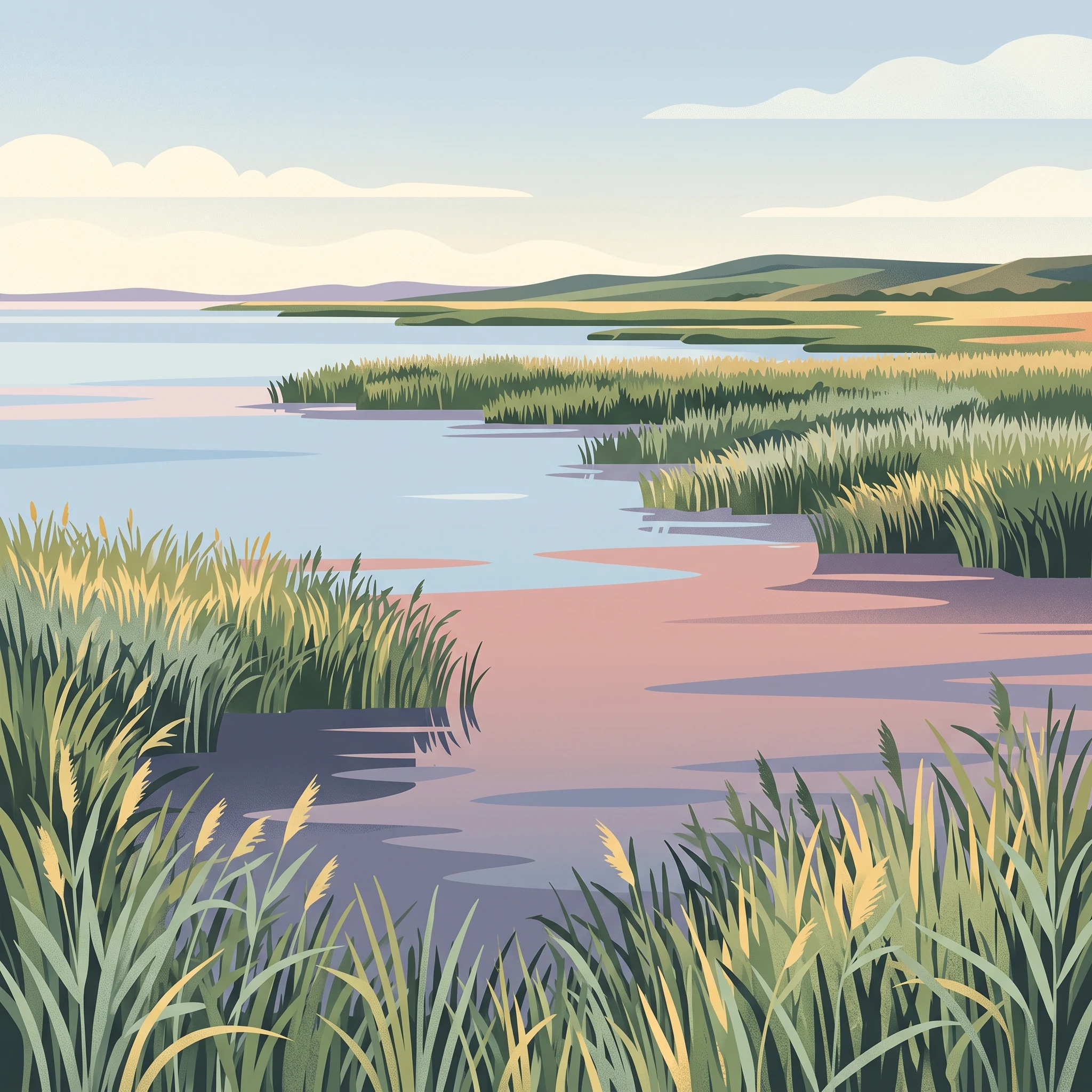
A shallow, saline steppe lake straddling Austria and Hungary, ringed by Europe's second-largest continuous reed belt.
Lake Neusiedl
Lake Neusiedl is a defining geographic feature of the Austro-Hungrian borderland, lying in the climatic and ecological transition zone where the eastern Alps meet the Pannonian Plain. The lake sits in the Little Hungarian Plain (Kisalföld), framed by the Leitha Mountains to the northwest, the Sopron Mountains to the south, and the flat Parndorf Plateau and Seewinkel to the east. Politically, roughly three quarters of its surface lies in Burgenland, Austria, with the remainder in Hungary, while its drainage basin extends across both countries.
As a steppe lake, Lake Neusiedl is exceptionally shallow, on average around one meter deep, and never exceeds about 1.8 meters. Its water is mildly saline, with sodium carbonate (locally called "Zick"), sodium sulfate, magnesium sulfate, and sodium chloride contributed by groundwater interaction with ancient marine sediments. Because the lake has no natural outflow, water levels have fluctuated dramatically through history, with the lake having vanished entirely multiple times in recorded centuries and been documented as growing far larger in wet periods.
The reserve system built around the lake is unusually mature. The Austrian Neusiedler See-Seewinkel National Park was formally recognized as an IUCN Category II protected area in 1993, and the Hungarian Fertő-Hanság National Park holds the larger cross-border share of the protected landscape. UNESCO inscribed the Fertő/Neusiedlersee Cultural Landscape on the World Heritage List in 2001, and the lake and its surroundings are also designated under the Ramsar Convention on Wetlands, with two separate Ramsar sites bearing on the cross-border area.
For visitors and residents, Lake Neusiedl serves as both a working agricultural landscape and a recreational hub. Wines from the surrounding region, sailing and windsurfing on its open waters, the cycling path encircling the lake, and the cultural attractions of towns such as Rust, Fertőd, and Fertőrákos all contribute to its identity. The lake remains, however, environmentally fragile, with concerns over water loss driven by reduced precipitation, reed encroachment, and rising temperatures shaping current management debates.