
Why Lauternsee bei Klein-Auheim stands out
The reserve is best known for its Flachmoor, a flat, low-nutrient bog habitat that supports a specialized assemblage of sedges, cottongrass, marsh violet, and marsh cinquefoil. It is also notable as a refuge for bog- and wet-woodland-dependent fauna, including snipe, woodcock, green and lesser spotted woodpeckers, grass snakes, and several amphibian species such as alpine and smooth newts. The combination of a relict river terrace and intact bog vegetation distinguishes it among the smaller protected areas around Hanau.
Lauternsee bei Klein-Auheim history and protected-area timeline
The reserve was formally established as a Naturschutzgebiet in 1987, placing it under long-term legal protection within the Hessian nature conservation framework. It is registered in the national protected areas database under the identifier 1435046 and in the World Database on Protected Areas entry 164407. Its designation reflected recognition of the Flachmoor and its surrounding wet woodland as a habitat of regional importance within the Hanau area, where industrial development and infrastructure along the Main had significantly reduced the extent of natural wetland communities.
Lauternsee bei Klein-Auheim landscape and geographic character
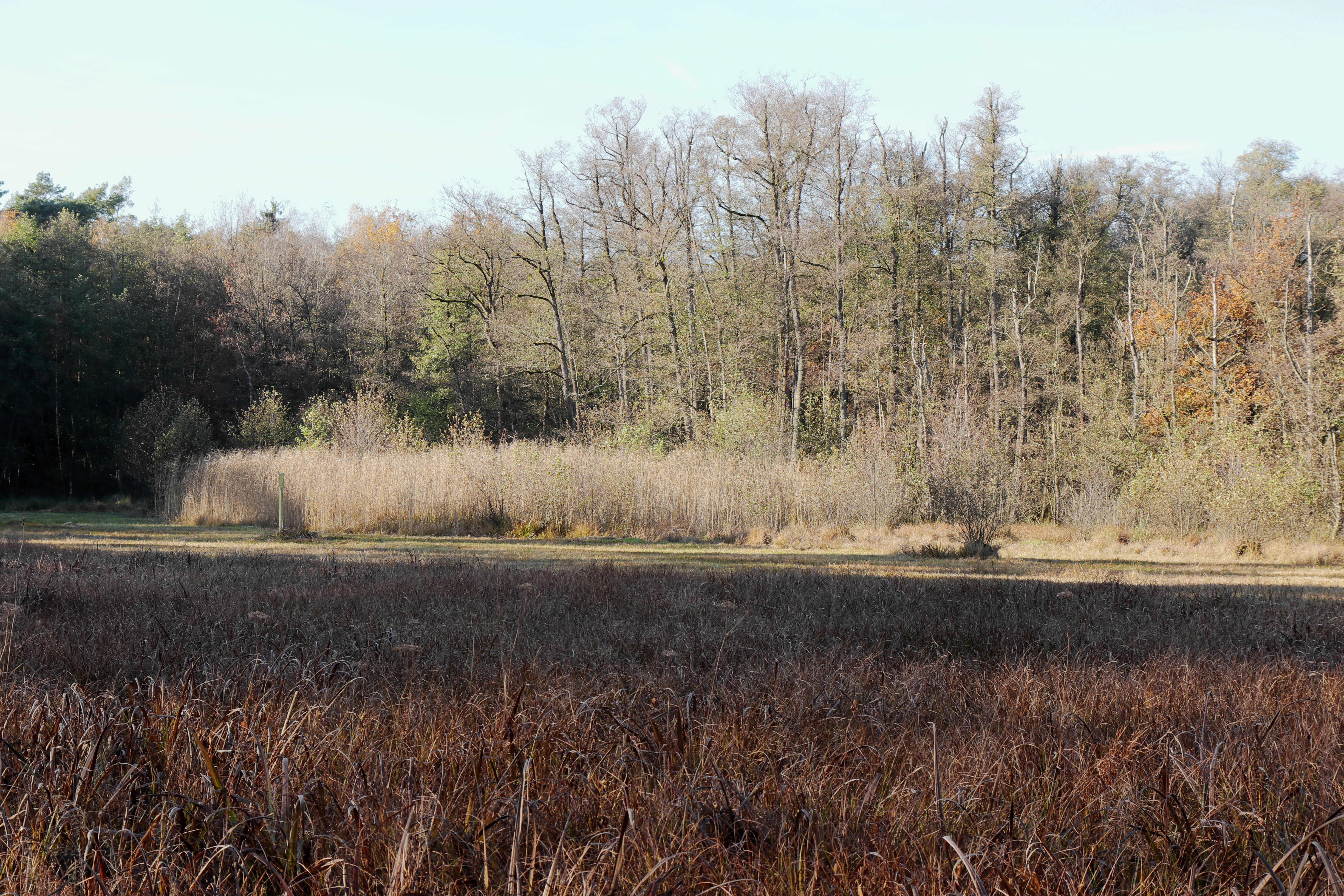
The landscape of Lauternsee bei Klein-Auheim is dominated by forest, with the open bog forming a small but conspicuous interruption in the woodland canopy. The reserve occupies a Hochterrasse of the Main, the elevated, relatively flat bench of land that marks an abandoned, higher-lying bed of the river. Because the terrace sits slightly above the present floodplain, water emerges at the surface in places where the old channel once ran, creating the saturated conditions that define the bog.
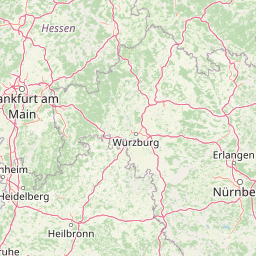
Visually, the area reads as a quiet, shaded patch of mixed deciduous woodland with a clearing of low, dense marsh vegetation at its core. The terrain is gentle and level, without dramatic relief, and the contrast between dark forest floor and pale sedge tussocks gives the site its particular character. To the east lies the B45 federal highway and the lower-lying modern Main valley, while the broader Hanau suburban and industrial landscape frames the forest on multiple sides.
Lauternsee bei Klein-Auheim ecosystems, habitats, and plant life
Ecologically, the reserve is defined by the Flachmoor at its center, a nutrient-poor, groundwater-influenced wetland dominated by sedges and other marsh plants. Characteristic species include tufted sedge, yellow sedge, bottle sedge, bladder sedge, marsh cinquefoil, narrow-leaved cottongrass, marsh pennywort, milk parsley, and marsh violet. These plants form a closely knit vegetation layer that holds moisture, stabilizes the peat-forming substrate, and provides the structural base for the invertebrate community.
Surrounding the bog is a wet-influenced deciduous forest that transitions gradually into drier upland woodland on the higher parts of the terrace. The interplay between open bog, damp woodland margin, and drier forest creates the habitat mosaic that supports the site's biodiversity. This combination of vegetation types is uncommon in the immediate Hanau area, where most remaining woodland is on drier ground and most open land is either farmed or built up.
Lauternsee bei Klein-Auheim wildlife and species highlights
The wildlife of Lauternsee bei Klein-Auheim closely reflects its wetland focus. Common snipe and Eurasian woodcock use the boggy ground and adjacent wet woodland, while green woodpecker and lesser spotted woodpecker are associated with the surrounding forest. The spotted flycatcher contributes to the birdlife of the more open wooded margins.
Reptiles are represented by the sand lizard, and the grass snake is a typical wetland predator here. Amphibians are particularly important: alpine newt, smooth newt, common toad, edible frog, and common frog all depend on the bog's shallow water and damp margins for breeding. Invertebrates further enrich the fauna, including the scarce chaser dragonfly, the swallowtail butterfly, and several grasshopper species typical of damp meadows such as the sickle-bearing bush-cricket, the large marsh grasshopper, and the gold grasshopper. Together, these groups mark the reserve as an unusually complete small-scale wetland ecosystem within the lower Main valley.
Lauternsee bei Klein-Auheim conservation status and protection priorities
Conservation significance at Lauternsee bei Klein-Auheim stems primarily from the protection of a Flachmoor, a habitat type that has been lost across much of central Europe through drainage, agricultural intensification, and urban expansion. By safeguarding both the bog vegetation and its hydrological setting on the old Main terrace, the reserve preserves a functioning example of this habitat along with the species that depend on it.
The site also contributes to the wider network of Naturschutzgebiete around Hanau, which together protect a chain of wetland, forest, and meadow fragments along the Main. Within this network, Lauternsee serves as a local refuge for amphibians, wetland birds, and bog-specialist invertebrates, and as a source area for species that may disperse into similar habitat fragments nearby.
Top sights and standout views in Lauternsee bei Klein-Auheim
Lauternsee bei Klein-Auheim combines two visually simple but ecologically powerful elements: a relict high terrace of an ancient Main channel and a flat bog habitat that has survived within a working forest. Its protected status since 1987 ensures the continuation of a sedge-dominated wetland and its associated amphibian, reptile, and invertebrate communities.
The reserve is also distinctive for the density of bog indicators it packs into a small area, from cottongrass and marsh violet to snipe and alpine newt, making it a compact but representative example of lower Main valley wetland ecology.
Best time to visit Lauternsee bei Klein-Auheim
As a quiet forest wetland with sedges, marsh flowers, and amphibian breeding pools, Lauternsee bei Klein-Auheim is at its most expressive in late spring and early summer, when the bog vegetation is in full growth and amphibians are active in the shallow water. Late spring also tends to bring the most bird activity along the wet woodland margins. Autumn offers quieter conditions and the muted colors of the surrounding forest, while winter visits focus on the structure of the bog and the woodland rather than on flowering species.