Mori Atlas logo
Nature reserveRezerwat przyrody Molenda

Examining the ecological significance, forest structure, and regional geography of this central Polish nature reserve.

Rezerwat przyrody Molenda: A Protected Old Growth Forest Landmark in the Lodz Voivodeship

Rezerwat przyrody Molenda preserves a significant expanse of old-growth mixed forest within the Lodz Voivodeship, acting as a crucial ecological enclave for ancient silver fir, European beech, and Norway spruce stands. Spanning 147 hectares, the reserve protects complex oak-hornbeam landscapes that once defined the historical Puszcza Lodzka. This protected area stands as a vital reference site for native forest structure, harboring monumental trees and diverse ground flora rarely encountered across the broader central Polish lowlands.

forest reservemixed forestold-growth treessilver firEuropean beechNorway spruce

Rezerwat przyrody Molenda

Nature reserve

Park overview

Structured park overview, official facts, and landscape profile for Molenda Nature Reserve

Molenda Nature Reserve park facts, protected area profile, and essential visitor context

Review the core facts for Molenda Nature Reserve, including designation, size, terrain, visitor scale, habitats, and operating context in one park-focused overview.

About Molenda Nature Reserve

Molenda Nature Reserve is a forest reserve in central Poland, near the town of Tuszyn in the Łódź region, that fulfills the role of a small but ecologically significant refugium within a once much larger forest landscape. Although today it is a compact protected area of 147.12 hectares, it safeguards a structure and species composition reminiscent of the mixed forests that historically dominated this part of Poland, before centuries of settlement, agriculture, and timber harvesting transformed the regional landscape.

The reserve belongs to the state forest administration through Nadleśnictwo Kolumna in the Rydzyny forest range, and it lies within the Wysoczyzna Bełchatowska mesoregion. Its current protection plan, introduced in 2013 and revised in 2015, establishes the reserve as an actively managed protected area, meaning that conservation interventions are applied to maintain its specific forest character.

Visitors encounter a forest of considerable age and size: many of the oaks, firs, and pines outlast any neighboring stands in the region. The dominant community is a subcontinental oak-hornbeam forest, while species such as silver fir and European beech, which are normally more characteristic of mountain and southern Polish forests, appear here at the limits of their natural distribution. This unique mix gives Molenda both scientific and conservation importance, while trails crossing the reserve invite visitors to walk through a landscape that retains traces of the much greater forest that once covered the area.

Quick facts and research context for Molenda Nature Reserve

Molenda Nature Reserve is a forested protected area in the Łódź Voivodeship of central Poland, administered by Nadleśnictwo Kolumna within the Rydzyny forest district. It was established on 14 September 1959 and covers 147.12 hectares of mixed deciduous and coniferous woodland.

The reserve preserves a fragment of the old Puszcza Łódzka, featuring stands of silver fir, beech, spruce, oak, and pine that include trees more than 150 years old. It falls within the Wysoczyzna Bełchatowska mesoregion and is presently managed under active conservation, with its current protection plan adopted in 2013 and amended in 2015.

Protection and recognition

Documented protection scope and international recognition records for Rezerwat przyrody Molenda

Rezerwat przyrody Molenda Protection Status and Territorial Designation Data

Terrestrial protection records and management frameworks outline the formal status established for Rezerwat przyrody Molenda. Structured designation details provide clear reference data regarding conservation oversight and protected area parameters.

Protection details

Protection scope
Terrestrial
Transboundary protection
No
Park context

Deeper park guide and search-rich context for Molenda Nature Reserve

Molenda Nature Reserve history, landscape, wildlife, and travel context

Explore Molenda Nature Reserve through its history, landscape character, ecosystems, wildlife, conservation priorities, cultural context, and seasonal travel timing in a structured park guide built for atlas discovery and search intent.

Why Molenda Nature Reserve stands out

Molenda is recognized above all for its power to protect old-growth mixed forest on the western reaches of historical Puszcza Łódzka, especially the silver fir and beech stands growing near the limits of their natural European range. Many of the firs rise above 40 meters, giving the reserve an unusually monumental standing tree component for lowland central Poland. The reserve is also distinguished by its combination of ancient trees, a diverse structure typical of subcontinental oak-hornbeam forest (grąd), and a remarkably rich herb-layer with several protected plant species.
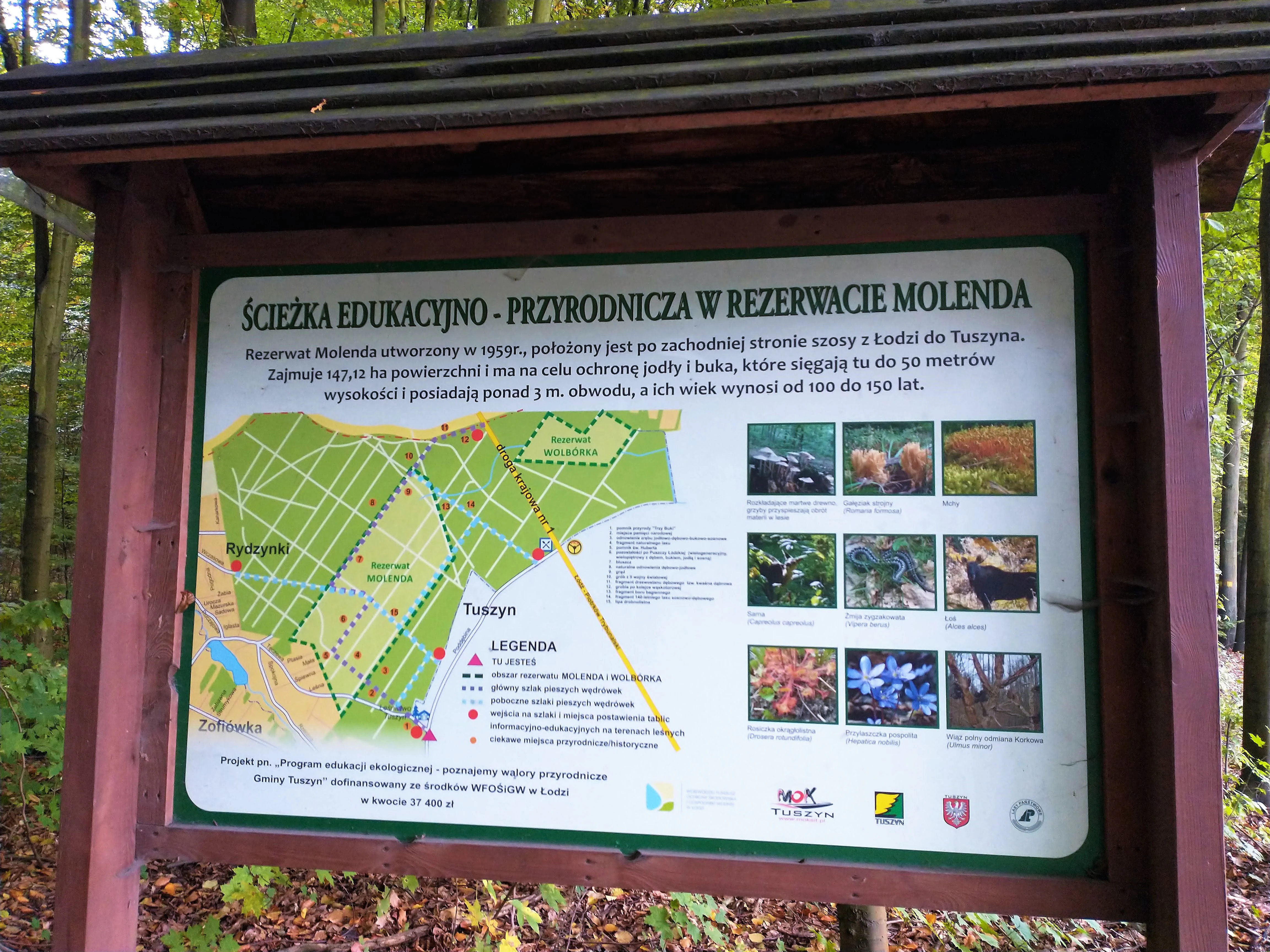
A brown wooden-framed information sign with a map, photos of flora and fauna, and descriptive text about the Molenda Nature Reserve in Polish.
An educational information board at the entrance of the Molenda Nature Reserve.

Molenda Nature Reserve history and protected-area timeline

Molenda Nature Reserve was formally established on 14 September 1959, following a legal notice published in the Polish Monitor. The original founding decree cited a slightly smaller area of 143.00 hectares, while the reserve today covers 147.12 hectares after later adjustments.

The reserve was created specifically to protect a fragment of the historical Puszcza Łódzka, the mixed forest that once stretched across what is now the Łódź region. Its purpose was to preserve a representative sample of forest composition and structure that had already largely disappeared from the surrounding landscape.

In 2013 the reserve received a comprehensive protection plan, later amended in 2015, formalizing active conservation management, mapping out habitat maintenance, and setting the framework under which the forest continues to be managed by the state forest administration today.

Molenda Nature Reserve landscape and geographic character

The reserve lies in the Wysoczyzna Bełchatowska, a relatively flat to gently undulating upland (wysoczyzna) east of Łódź that forms part of the broader central Polish lowlands. Within this setting the reserve is essentially a continuous expanse of mature forest stretching northwest of Tuszyn.

The terrain is typical of lowland Polish forest: gentle relief, no dramatic elevations, with a closed canopy broken by occasional clearings and paths. The forested surface visually dominates the local landscape, contrasting with surrounding agricultural land and the road corridor running southwest toward Łódź.

What gives the landscape of Molenda its special character is the presence of very tall, broad-canopied trees, particularly firs exceeding 40 meters, alongside massive oaks and pines. These ancient specimens lend the reserve a stately, almost primeval atmosphere unusual for lowland southern-central Poland.
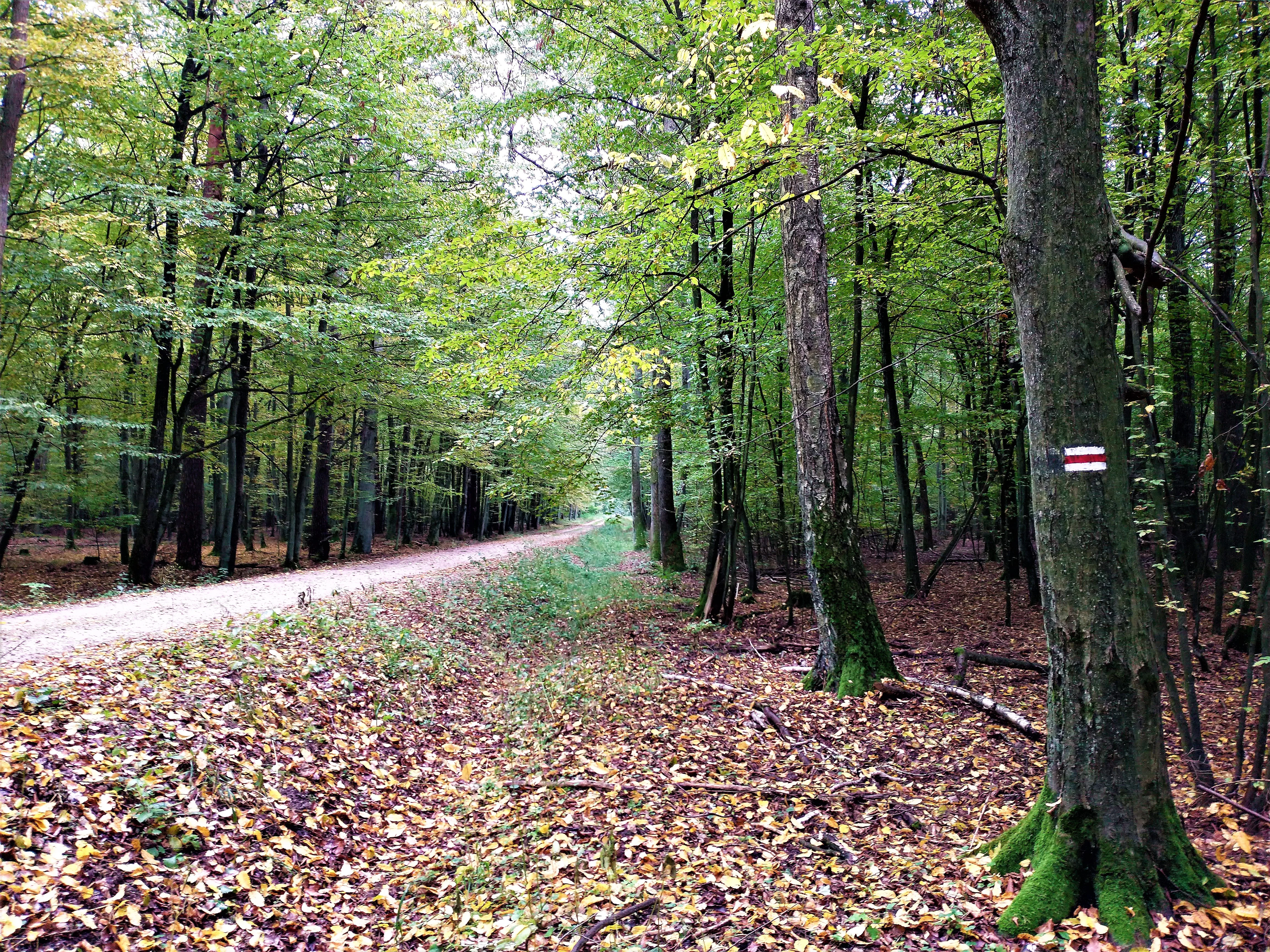
A dirt forest path leads into a dense deciduous forest with trees showing early autumn foliage and a hiking trail marker on a tree trunk in the foreground.
A forest trail through the Molenda Nature Reserve, marked with a red and white hiking blaze.

Molenda Nature Reserve ecosystems, habitats, and plant life

Ecologically, the heart of Molenda is a subcontinental grąd, an oak-hornbeam-type forest community, which covers roughly four-fifths of the reserve's area. This community is one of the classic central European mixed broadleaf forest formations, and the version present at Molenda is exceptional because of its unusual coniferous admixtures.

While oak dominates the canopy and pine appears frequently, the most distinctive elements are fir, beech, and spruce mixed into the stands. These species, often associated with higher elevations or more western parts of Poland, find a marginal natural refuge at Molenda, growing at the edge of their natural range.

Tree-fall gaps, edge zones, and more open patches have allowed numerous additional tree species to enter in small numbers, including hornbeam, birch, larch, and linden, contributing to a complex vertical structure. The combination of age-class diversity, structural layering, and the presence of rare tree species makes the flora composition of Molenda far richer than is typical for forested landscape fragments in central Poland.
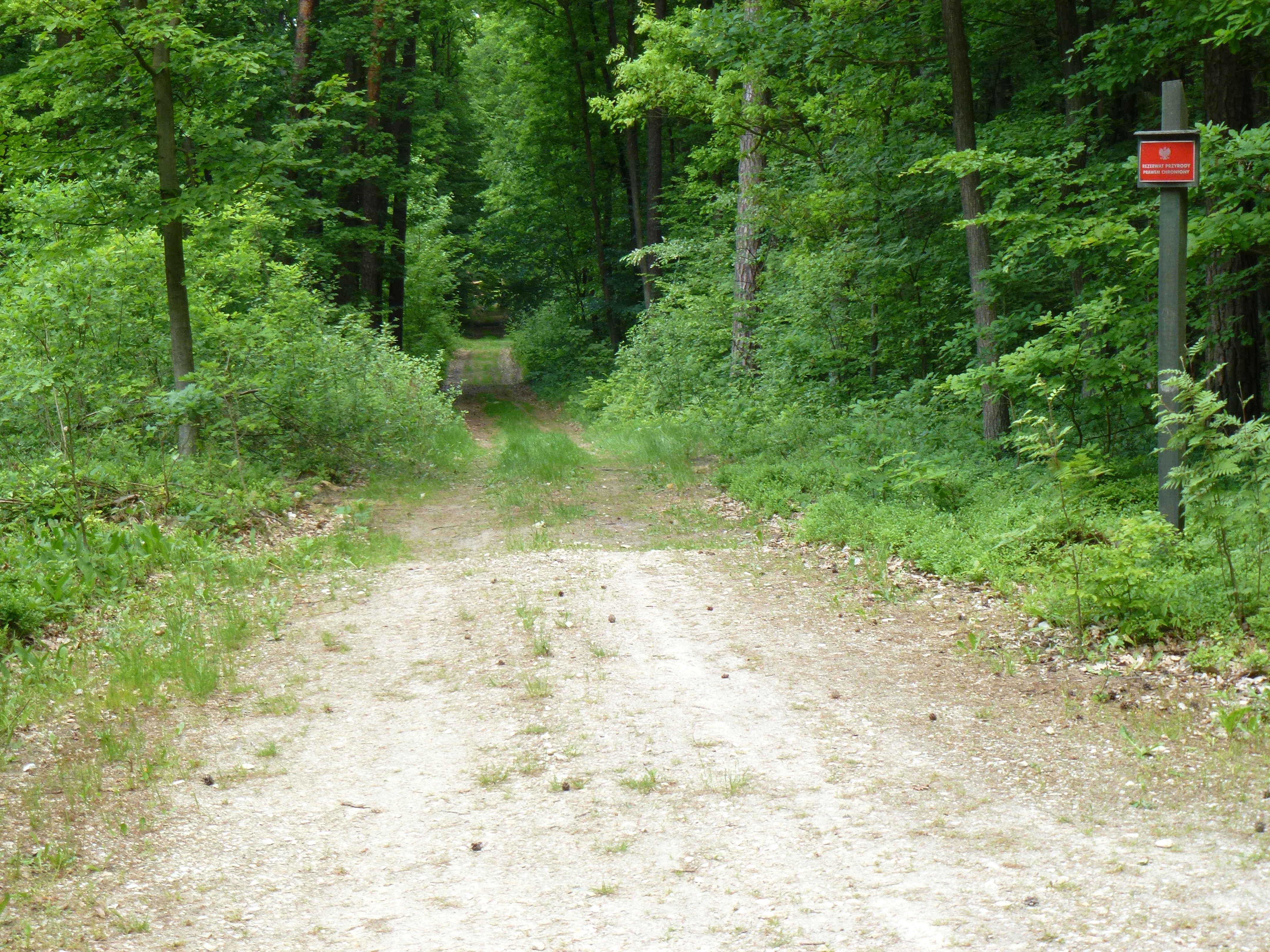
A dirt path leading into a lush green forest, with a small red signage marker on a wooden post visible on the right side.
A narrow dirt path winding into the dense forest of Molenda Nature Reserve.

Molenda Nature Reserve conservation status and protection priorities

Conservation value of Molenda centers on its role as a living memory of the old Puszcza Łódzka and as a refuge for tree species whose natural distributions have shrunk dramatically across central Poland. By protecting mature stands of fir, beech, and spruce alongside centuries-old oaks and pines, the reserve preserves genetic resources and structural characteristics that today are vanishingly rare in the surrounding lowlands.

Because so many firs and oaks exceed 150 years of age, the reserve represents an important long-term ecological archive. Continuities in canopy structure, dead wood, understory development, and microhabitat variety that would be impossible to recreate within human timescales are conserved here.

The reserve's designation under active conservation management, governed by a formal protection plan adopted in 2013 and amended in 2015, reflects an approach in which specific interventions are used to maintain target forest conditions. This makes Molenda both a passive conservation legacy and an active project of forest habitat preservation.

Top sights and standout views in Molenda Nature Reserve

Molenda is a standout forest reserve for the way it preserves old, structurally complex mixed forest in a region where most woodlands have long since given way to farmland. The combination of subcontinental oak-hornbeam forest with rare admixtures of fir, beech, and spruce makes it both a scientific reference site and a memorable place to experience lowland Polish woodland.

The age and stature of the trees themselves form the dramatic signature of the reserve: firs soaring above 40 meters, with oaks and pines stretching well past 150 years. Combined with protected ground flora species like martagon lily and various clubmosses, the reserve offers a layered picture of native forest life rarely encountered this far east and north in central Europe.

Best time to visit Molenda Nature Reserve

Like most lowland central European forest reserves, Molenda is most rewarding during spring and early summer, when the understory flora is in active growth and martagon lilies, clubmosses, and other characteristic herb-layer plant species are at their most visible. Late spring into mid-summer generally offers long daylight hours and the fullest view of canopy and woodland variety. Autumn brings rich seasonal color from broadleaf trees and a meditative atmosphere well suited to exploring the educational trail.
Monthly climate preview

Long-term monthly temperature averages and precipitation measurements for Rezerwat przyrody Molenda

Rezerwat przyrody Molenda Climate Normals and Annual Temperature Rhythm

Representative coordinate records show measured monthly temperature variations and precipitation averages spanning the entire year at Rezerwat przyrody Molenda. Examining the complete twelve-month profile provides a detailed breakdown of long-term climate normals and seasonal weather patterns.
Annual mean8 °C
-3 °C20 °C
Jan-3°
Feb-2°
Mar
Apr
May14°
Jun18°
Jul20°
Aug20°
Sep14°
Oct
Nov
Dec-2°
Warmest month
July

20 °C

Coolest month
January

-3.3 °C

Wettest month
July

2.6 mm/day

Driest month
January

1.3 mm/day

Park location guide

Geography guide, regional context, and park location map for Molenda Nature Reserve

Molenda Nature Reserve park geography, regions, and map view in Poland

Understand where Molenda Nature Reserve sits in Poland through a broader geographic reading of the surrounding landscape, nearby location context, and its mapped position within the national park landscape.

How Molenda Nature Reserve fits into Poland

Poland, officially the Republic of Poland, is a Central European country spanning from the Baltic Sea in the north to the Carpathian Mountains in the south. It borders Germany, Czech Republic, Slovakia, Ukraine, Belarus, Lithuania, and Kaliningrad Oblast. The country has a temperate climate, diverse landscapes, and is known for its rich history, cultural heritage, and strong economic position within the EU.

Wider geography shaping Molenda Nature Reserve in Poland

Poland occupies 312,696 km2 in Central Europe, extending from the Baltic Sea coast in the north to the Sudetes and Carpathian Mountains in the south. It borders Germany to the west, Czech Republic and Slovakia to the south, Ukraine and Belarus to the east, and Lithuania and Kaliningrad Oblast to the northeast. The landscape includes lowland plains, uplands, and mountain ranges.

Map view of Molenda Nature Reserve

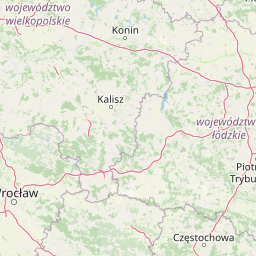
Use this park location map to pinpoint Molenda Nature Reserve in Poland, understand its exact geographic position, and read its mapped placement within the surrounding landscape more clearly.

Pigeon | © OpenStreetMap contributors

Location context for Molenda Nature Reserve

Lodz Voivodeship

Visual exploration of old-growth forest habitats and towering canopy terrain

Rezerwat przyrody Molenda Photos and Landscape Scenery

Visual documentation captures the ancient mixed woodland character and towering silver fir stands of Rezerwat przyrody Molenda. Photographic records reveal the dense lowland forest structure, mature oak specimens, and protected ecological habitats across central Poland.

A brown wooden-framed information sign with a map, photos of flora and fauna, and descriptive text about the Molenda Nature Reserve in Polish.

A weathered stone monument in a forest setting, featuring an engraved stag head emblem and Polish text, surrounded by mossy rocks and trees.

A dirt forest path leads into a dense deciduous forest with trees showing early autumn foliage and a hiking trail marker on a tree trunk in the foreground.

A dirt path leading into a lush green forest, with a small red signage marker on a wooden post visible on the right side.

Park atlas

Compare surrounding forest reserves and regional protected areas across central Poland

Other Parks Near Rezerwat Przyrody Molenda And Regional Protected Landscapes

Browse protected areas near Rezerwat przyrody Molenda to compare neighboring forest enclaves and lowland woodland types. Evaluating adjacent regional geography reveals broader conservation patterns across the central Polish lowlands.
Nature reserveŁódź Voivodeship
About 25 km away#1 closest

Southeast

Rezerwat przyrody Dęby w Meszczach: Protected Oak Forest and Regional Geography

Nature reserve in the Równina Piotrkowska of central Poland.

Located in Łódź Voivodeship, this nature reserve is defined by its ancient pedunculate oaks, some over 250 years old. The site protects a unique blend of oak-hornbeam and mixed coniferous forest communities, serving as an ecologically vital fragment of lowland woodland within an agricultural landscape.

Area
0.392 km²
Established
1989
Relief
Lowland
Climate
Temperate
Protected landscapeLodzkie Voivodeship
About 27 km away#2 closest

Southeast

Sulejowski Park Krajobrazowy: Geography and Protected Landscape Mapping

Central Polish river valley and reservoir terrain

Examine the territorial boundaries and landscape character of Sulejowski Park Krajobrazowy. This protected area integrates riverine corridors, large reservoir habitats, and mixed lowland forests across the Lodzkie Voivodeship, providing a core reference for understanding the ecological geography of the central Pilica valley.

Area
170.26 km²
Established
1994
Relief
Lowland
Climate
Temperate
A horizontal watercolor painting showing a soft, stylized landscape of rolling hills, grassy meadows, and clusters of trees under a bright, open sky.
Protected landscapeŁódź Voivodeship
About 27 km away#3 closest

North

Park Krajobrazowy Wzniesień Łódzkich: Geographic Overview of Central Poland's Uplands

Mapped protected landscape featuring glacial relief and forest ecosystems

Gain insights into the physical character of Park Krajobrazowy Wzniesień Łódzkich, an area defined by its striking northern edge and deep river valleys. This protected landscape preserves significant glacial erratics, a central watershed, and diverse forest cover that contrasts with the surrounding Polish plains.

Area
115.8 km²
Established
1996
Relief
Upland
Climate
Temperate
A minimalist watercolor painting showing stylized evergreen trees, rolling hills, and distant mountains in soft green, pink, and yellow tones against a white background.
Nature reserveLodz Voivodeship
About 28 km away#4 closest

West

Rezerwat przyrody Jodły Łaskie im. Stanisława Kostki Wisińskiego Protected Area Atlas

Mapping forest ecosystems and glacial geography in Lodz Voivodeship.

The Rezerwat przyrody Jodły Łaskie im. Stanisława Kostki Wisińskiego serves as a key reference point for central European lowland forest conservation. This nature reserve protects a rare silver fir stand along with mature oaks and pines, showcasing a complex mosaic of forest community types across its uniquely varied glacial lowland terrain.

Area
0.584 km²
Established
1991
Relief
Lowland
Scope
Terrestrial
Nature reserveLodzkie Voivodeship
About 28 km away#5 closest

Southeast

Rezerwat przyrody Meszcze Nature Reserve: Mapped Protected Landscape and Forest Ecology

Protected fresh mixed forest within the Sulejów Landscape Park context

Rezerwat przyrody Meszcze represents a compact, protected forest block in central Poland. Known for its historical small-leaved lime regeneration, this reserve provides a key case study for forest structure and lowland biodiversity within the Lodzkie Voivodeship, serving as an important part of the Sulejów Landscape Park's protected corridor.

Area
0.353 km²
Established
1959
Relief
Lowland
Scope
Terrestrial
Nature reserveŁódź Voivodeship
About 33 km away#6 closest

East

Rezerwat przyrody Małecz: Protected Nature Reserve and Forest Landscape in Łódź Voivodeship

Floristic reserve and managed coniferous forest geography

Rezerwat przyrody Małecz is a key floristic site in Poland, safeguarding rare Pontic-origin flora and ancient forest stands. This reserve showcases the integration of strict protection zones with moist and dry mixed coniferous forest communities within the Spała Forest District, offering deep insight into regional botanical conservation.

Area
0.092 km²
Established
1987
Relief
Lowland
Climate
Temperate
Nature reserveLodzkie Voivodeship
About 37 km away#7 closest

Northwest

Rezerwat przyrody Jodły Oleśnickie: Protected Nature Reserve in Lodzkie Voivodeship

Geography, forest structure, and range-edge ecology

Located within the quiet terrain of the Łaska Highland, Rezerwat przyrody Jodły Oleśnickie is a specialized forest reserve. It is defined by its scientific value as a protected sanctuary for silver fir trees growing at the geographic limit of their species range, offering insight into the development of multi-layered forest communities in lowland central Poland.

Area
0.117 km²
Established
1962
Relief
Lowland
Climate
Temperate
Nature reserveLodzkie Voivodeship
About 37 km away#8 closest

Northeast

Doliska Nature Reserve: Protected Forest Boundaries and Geographic Landscape Context in Poland

A study in regional forest conservation and woodland ecology

Located in the Lodzkie Voivodeship, Doliska Nature Reserve is a designated phytocenotic forest area established to preserve specific woodland communities. Its primary geographic value lies in the protection of silver fir populations that exist outside their natural distribution range, making this a foundational site for regional conservation history and ecological study in the heart of lowland Poland.

Area
0.033 km²
Established
1954
Relief
Upland
Scope
Terrestrial

Common questions about visiting, size, designation, and location context for Molenda Nature Reserve

Molenda Nature Reserve FAQs for park facts, access, geography, and protected area context

Find quick answers about Molenda Nature Reserve, including protected-area facts, park geography, trail and visitor context, and how the park fits into its surrounding country and regional landscape.
MoriAtlas Explorer

Continue Your Protected Areas Search Across the Global Atlas

Deepen your exploration by continuing the structured search for national parks and protected areas worldwide. Utilize the comprehensive filtering capabilities to compare different conservation landscapes and refine your understanding of global park geography. Discover more about the distribution and characteristics of protected natural areas.

Global natural geography