
Why Monte Grappa stands out
Monte Grappa is best known for two interwoven identities: a pre-Alpine natural massif with Mediterranean and boreal vegetation overlapping in a small geographic space, and one of the most symbolic Great War memorial landscapes in Italy, anchored by a large military ossuary on the summit. The mountain's Mediterranean-meets-alpine ecological mosaic is a defining feature: Mediterranean macchia shrub formations meet conifer forests of silver fir and Norway spruce, beech woodland, and subalpine snow-loving communities, all within a massif that rises directly above the Venetian plain. At the same time, its wartime history has shaped how the summit is experienced today, with crypts, fortifications, galleries, and commemorative monuments forming the cultural backbone of the massif.
Monte Grappa history and protected-area timeline
The geological history of Monte Grappa is tied to the long history of the Alpine orogeny. The massif is composed of marine sediments, originally deposited on the floor of an ancient sea, that were compacted through diagenesis and gradually uplifted as the African and European tectonic plates converged. The result is a mountain built mainly of Jurassic and Cretaceous limestones, including the pale Biancone formation typical of the Venetian Prealps.
The much more recent, and more visible, historical layer of Monte Grappa is the legacy of the First World War. The massif lay on the front between the Italian and Austro-Hungarian armies and saw prolonged fighting, trenching, and fortification building across its ridges, caves, and galleries. After the war, Italy chose Monte Grappa as one of the principal sites at which to commemorate the fallen. The Sacrario Militare del Grappa, designed by the architect Giovanni Greppi with sculptor Giannino Castiglioni, was inaugurated on the summit on 22 September 1935. The structure takes the form of five concentric stepped tiers forming a pyramid, crowned by the chapel of the Madonnina del Grappa, and houses the remains of more than twelve thousand Italian fallen, the great majority unidentified.
Beside the Italian ossuary, a large sector to the north-east holds the burials of roughly ten thousand Austro-Hungarian soldiers, again almost entirely unknown. The summit area was further enriched by commemorative features such as the Via Eroica leading to the Portale di Roma, with fourteen stone markers listing the battle localities, the Galleria Vittorio Emanuele III tunnel system linking the various fortified caverns, the Caserma Milano, converted into a historical museum and documentary screening room, and a bronze statue to the Partisan erected in 1974 near a cave where seven partisans were burned alive by Nazi-fascist forces during the Second World War.
In the post-war period the summit also hosted a military presence, including an Air Force base that served as a radar and missile control point for Italian Nike-Hercules batteries during the Cold War, before being decommissioned and slated for demolition in 2019. In September 2021, the area around Monte Grappa received UNESCO Biosphere Reserve status under the Man and the Biosphere programme, adding an international environmental recognition to the mountain's long memorial and natural history.
Monte Grappa landscape and geographic character
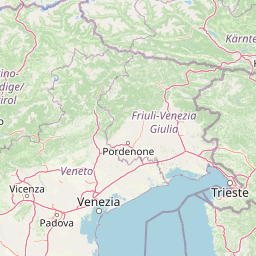
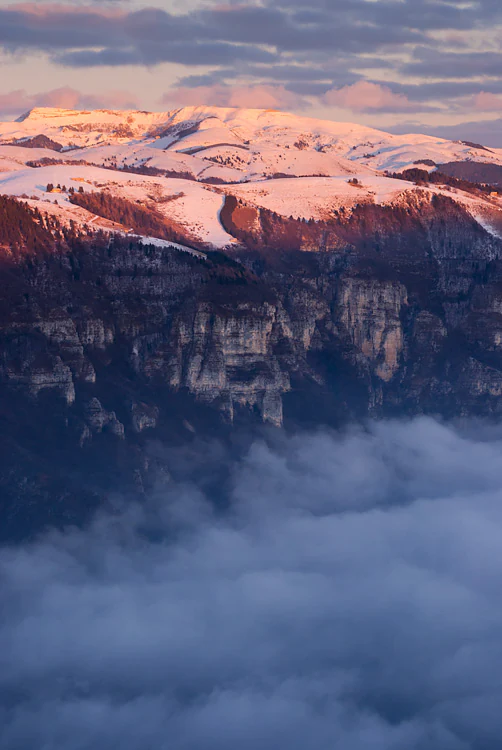
The landscape of Monte Grappa is that of a pre-Alpine massif shaped from marine limestones, standing between the Venetian plain and the deeper Alpine valleys. The summit reaches 1,775 meters and is part of a broader massif with prominent ridges, exposed rocky slopes, karstic surfaces, and abrupt transitions between plateau-like high ground and steep valley flanks. The orographic prominence of the peak is large, lifting the massif dramatically above the surrounding lowlands.
To the south-west, the mountain descends toward the Brenta valley and the inhabited foothills of the Vicenza and Treviso provinces, with the Sanctuary of the Beata Vergine del Covolo at the locality of Frontal visible on the lower slopes. To the east and north, the massif overlooks the Piave valley and the Feltrino, an area already leaning toward the Dolomitic foothills and the Belluno province. The result is a mountain with three distinct geographic sides, each shaped by different valley systems and by the wider pattern of Venetian pre-Alpine geography.
The vegetation pattern mirrors this geographic transition. Lower slopes carry Mediterranean-influenced shrub formations and mixed broadleaf woods, while the upper slopes and summit ridges support conifer forest, beech stands, and subalpine shrub communities. The combination of exposed limestone terrain, narrow snow-collecting hollows, and rapidly changing aspect produces a patchwork of habitats within a relatively compact mountain, and this landscape mosaic is one of the massif's defining visual characteristics.
Monte Grappa ecosystems, habitats, and plant life
Monte Grappa's natural richness stems from its position at the meeting point of Mediterranean and Alpine biogeographic influences. Because the massif rises immediately above the Venetian plain, warm lowland conditions reach unusually high into the mountain, allowing shrubby Mediterranean macchia vegetation to coexist with typical boreal montane forests. This overlap is visible across the massif's slopes, with Mediterranean-type shrub communities giving way, with altitude, to mixed woodland, conifer forest, beech stands, and finally subalpine vegetation in the longest snow-covered zones.
The forests are dominated by silver fir (Abies alba), Norway spruce (Picea abies), and European beech (Fagus sylvatica), with arbustive subalpine communities occupying the higher and more exposed zones. The flora includes a range of characteristic mountain plants: Soldanella montana in melting snow patches, Trollius europaeus (globeflower), Clematis species, and Daphne mezereum (mezereon) in the woodland and shrub layers. The combination of geology, elevation gradient, and climatic variability produces a compact but diverse botanical profile unusual for a single massif of this size.
Faunistically, the massif benefits from the same transitional position. The mosaic of forest, scrub, rocky terrain, and meadow supports ungulates such as roe deer, chamois, mouflon, and red deer, while the cliffs and quieter forested areas host raptors including common buzzard, peregrine falcon, golden eagle, and Eurasian eagle-owl. After an absence of roughly two centuries, the wolf has returned to the Grappa area, marking a significant ecological development, alongside the continued presence of smaller mammals such as red squirrel, red fox, and European badger, and reptiles like the western green lizard and various dragonfly species in the wetter habitats.
Monte Grappa wildlife and species highlights
Monte Grappa supports one of the more diverse mammal communities of the Venetian Prealps. Roe deer, chamois, mouflon, and red deer are present across the forested and rocky terrain, sustained by the massif's mix of woodland, scrub, and open ground. Smaller mammals include the red squirrel, the red fox, and the European badger, while reptiles such as the western green lizard occupy sunny rocky slopes and forest clearings. The return of the wolf after approximately two hundred years of absence is a notable recent ecological development, alongside the presence of the European wildcat and the crested porcupine.
The birdlife is similarly varied. Raptors are well represented and include common buzzard, peregrine falcon, golden eagle, and Eurasian eagle-owl, with the cliff and rocky habitat of the massif providing nesting and hunting opportunities. Wet microhabitats and forest edge support active dragonfly populations, and the varied vegetation layers from macchia shrub to conifer forest allow different species to occupy distinct niches within a relatively small area. The wildlife profile of Monte Grappa is shaped less by the presence of single charismatic species than by the breadth and density of species present across habitats.
Monte Grappa conservation status and protection priorities
Conservation significance is central to the identity of Monte Grappa. In September 2021, the area around the mountain was designated a UNESCO Biosphere Reserve under the Man and the Biosphere programme, recognizing the site for the integration of conservation, research, and sustainable relationship between human communities and the natural environment. This international designation reflects the ecological importance of the massif as a transitional zone between Mediterranean and Alpine biomes.
The massif also lies within the European Natura 2000 network, with designated sites covering representative habitats and species of the Venetian Prealps. Beyond formal designations, the area's long memorial history means that large sectors of the mountain remain in a relatively low-intensity land-use condition, allowing forest and subalpine communities to persist in a fragmented lowland context. Active conservation concerns implicit in the source material include the management of large ungulate populations, the monitoring of returning large carnivores such as the wolf, and the balance between memorial tourism, hiking, and the protection of sensitive habitats across a mountain that is widely visited and deeply symbolically charged.
Monte Grappa cultural meaning and human context
Monte Grappa carries a profound cultural identity tied to Italy's experience of the First World War and to the broader history of the Veneto region. The summit is dominated by the Sacrario Militare del Grappa, inaugurated in 1935, and the surrounding landscape is marked by military ossuary architecture, commemorative monuments, the Via Eroica, the Galleria Vittorio Emanuele III, and the old Caserma Milano now used as a war museum. These features have made the mountain a national place of memory where political, military, and civilian commemorations converge annually.
The cultural layer extends beyond the Great War. A bronze statue to the Partisan, erected in 1974 near the cave in which seven partisans were killed during the Second World War, links the summit memory to the Resistance, while the older presence of the Sanctuary of the Beata Vergine del Covolo on the lower slopes reflects a longer tradition of religious pilgrimage associated with the mountain. The mountain itself is also encountered through local culture and language; in Venetian dialect it is known as Monte Grapa, and the region includes local traditions and place names that connect the massif to surrounding communities.
Top sights and standout views in Monte Grappa
Monte Grappa's standout qualities are its UNESCO Biosphere Reserve status, the Mediterranean-alpine ecological overlap that compresses unusually varied habitats into a single massif, and the concentration of First World War memorial architecture on and around the summit. The Sacrario Militare del Grappa, the Austro-Hungarian burial sector, the Via Eroica, and the Galleria Vittorio Emanuele III together form one of Italy's most complete memorial mountain landscapes.
Ecologically, the mountain is also distinctive for the return of the wolf after about two centuries of absence and for the persistent coexistence of ungulates such as chamois, mouflon, and red deer within easy reach of the Venetian plain. Together, these features make Monte Grappa a mountain of overlapping identities: a Biosphere Reserve, a memorial landscape, a hiking destination, and a biogeographic crossroads in the Venetian Prealps.
Best time to visit Monte Grappa
Monte Grappa's climate is highly variable and strongly influenced by wind exposure, so conditions can change quickly in any season. Summers tend to be dry and breezy, with stable weather best suited to hiking the ridges and visiting the summit memorial complex; autumn and spring bring more abundant precipitation and frequent fog, but also richer landscape colors and more dynamic atmospheric conditions over the massif. Snow is generally modest, averaging sixty to seventy centimeters annually, but can transform the upper slopes in colder winters, and the summit has recorded temperatures ranging from roughly minus eighteen degrees Celsius to over thirty-six, so visitors should expect significant weather variability throughout the year.