
Why Mühlbachtal stands out
The Mühlbachtal is best known for combining a small but ecologically rich nature reserve with a remarkable medieval water management heritage. The hillside water-catchment system built by the nuns of Kloster Rumbeck to feed their fishponds and mills is a rare construction type in Germany, comparable in its engineering to elements recorded at Kloster Maulbronn. Ecologically, the valley is recognized for its near-natural, meandering stream, alder-lined banks, orchid-rich wet meadows, mixed deciduous woodland, and the presence of characteristic valley species such as the kingfisher, the grey wagtail, the white-throated dipper and the wren.
Mühlbachtal history and protected-area timeline
The cultural history of the Mühlbachtal is inseparable from Kloster Rumbeck, the Premonstratensian convent that held the surrounding Waldwiesental through the Middle Ages and the early modern period. The nuns ran intensive forestry, water use and fish-farming operations in the valley, supporting their kitchen through pond-based fish culture and operating at least one glassworks in the woods. A linked network of ponds and dams powered grain mills, oil mills, sawmills and even a small iron forge.
The valley's most distinctive historical feature is a hillside water-catchment system, a network of channels cut along the slopes to collect and divert groundwater and runoff into the valley's ponds and mill channels during dry periods. Such systems are rare in Germany, with the only widely cited parallel found at Kloster Maulbronn. The catchment is now recognized as an archaeological monument and remains legible in the landscape alongside the older dam and charcoal-burning relicts.
After secularization and the transfer of the former Duchy of Westphalia to Prussia, the valley passed into state forest administration, a transition that ended its monastic management regime and shifted it toward forestry. The nature reserve designation, first established in 1998 by the Hochsauerlandkreis district council and renewed under the 2021 landscape plan, marks the most recent chapter in this long history of layered land use.
Mühlbachtal landscape and geographic character
The Mühlbachtal is a short valley segment where the Mühlenbach flows in a clear Sohlental form, a valley whose floor and sides meet broadly rather than through steep, narrow walls. The lower part of the valley opens between the village of Rumbeck and the adjoining forest, with pastures used as cattle grazing giving it a partly open, partly enclosed feel.
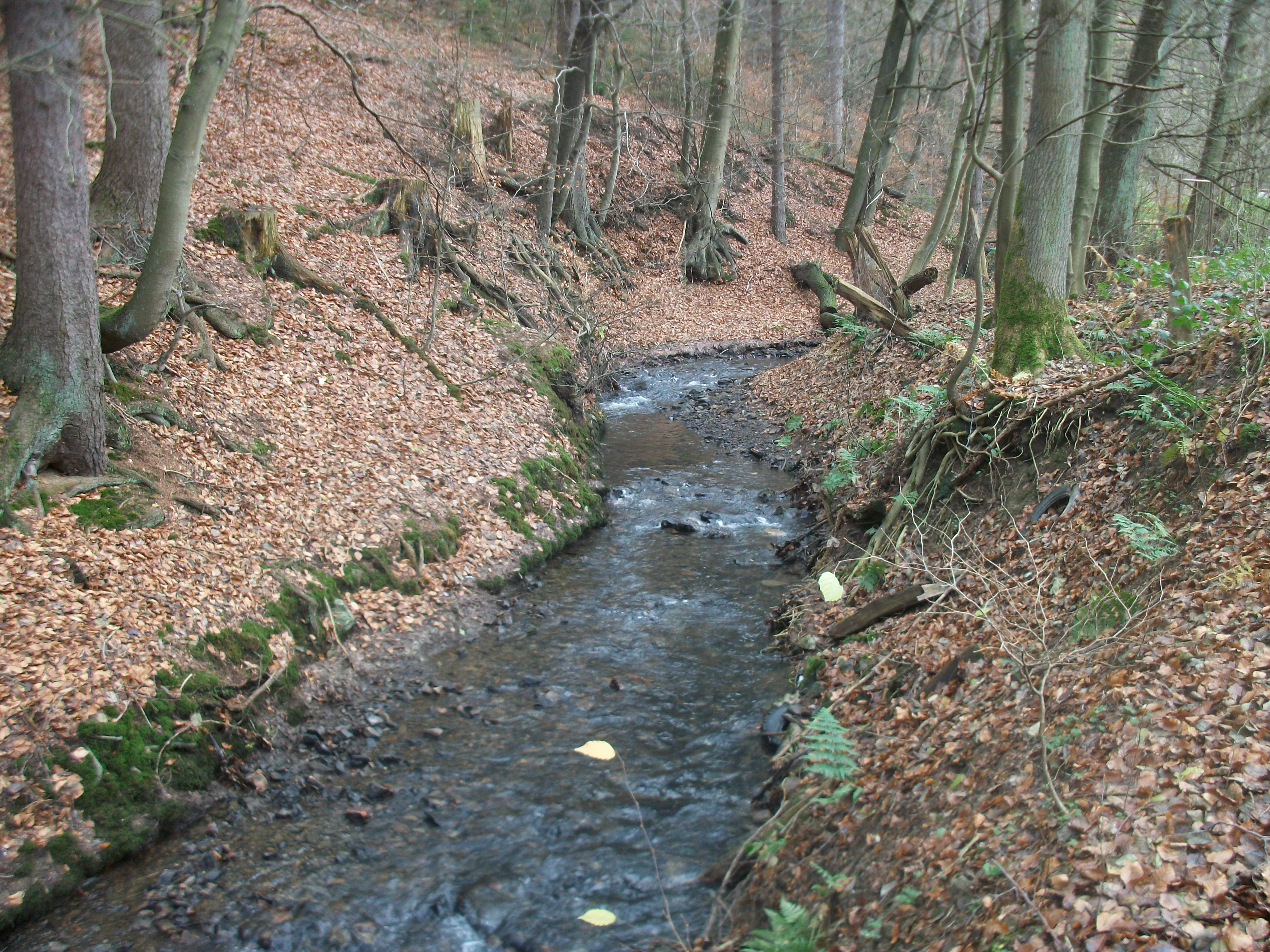
The stream itself defines the visual and physical spine of the valley, meandering along its floor through alder-lined banks. To either side, the valley supports a patchwork of wet meadows, where scrubby greenland fallows dominate the central section, mixed woodland of birch, alder and beech along the edges, and a stand of spruce further south. Small artificial fishponds and a more natural, reed-choked pond introduce standing-water elements into an otherwise stream-led landscape.
The valley's topography is modest rather than dramatic, but it reads clearly as a sequence of small landscape rooms: village edge, open pasture, wooded amphitheater, pond cluster, meadow, brookside. The medieval earthworks from the monastic pond and mill system are still visible in the relief, lending historical depth to what is otherwise a quiet, contained valley landscape.
Mühlbachtal ecosystems, habitats, and plant life
Ecologically, the Mühlbachtal functions as a small but structurally rich valley mosaic. The Mühlenbach is the central ecological axis, running with a near-natural character and hosting a self-reproducing trout population. Its banks are framed by alder, a typical riparian species for Sauerland brooks and one that helps stabilize the moist, nutrient-rich bankside.
Around the stream, the habitats vary quickly over short distances. The middle of the protected stretch is dominated by greenland fallows and wet meadow fragments, with a notably diverse orchid flora on the damper patches. Toward the south, the stream passes through a mixed stand of birch, alder, beech and spruce, reflecting both natural forest tendencies and the long history of forest management in the area. Standing water is provided by several fishponds of more recent, non-natural origin, alongside a small, near-natural pond that has largely silted up with reed growth.
Floristically, more than 160 plant species have been recorded in the area, including several orchid species that give the wet meadow zones particular conservation interest. The combination of free-flowing stream, riparian woodland, wet meadow and small-scale standing water is what gives the valley its ecological coherence, even within a compact protected footprint.
The formal protection statement for the area emphasizes the rarity, distinctive character and beauty of the landscape, and the designation specifically targets the preservation of a structurally rich valley stretch, the orchid-bearing wet meadows, and the integrity of habitat types protected under German federal nature conservation law.
Mühlbachtal wildlife and species highlights
The wildlife profile of the Mühlbachtal reflects its character as a small, structurally diverse valley. The stream is home to a healthy population of brown trout, while the ponds and slow-flowing stretches support rich dragonfly communities, particularly around the reed-fringed pond and along quieter bank margins.
The valley's birdlife is closely tied to its stream and bankside vegetation. The kingfisher, the grey wagtail and the white-throated dipper are regularly recorded along the Mühlenbach, while the wren inhabits the denser scrub and woodland understory. Together these species signal a functioning riparian habitat and a degree of naturalness that is increasingly rare in heavily managed lowland and sub-mountainous landscapes.
Larger mammal species are not specifically highlighted in the available sources, which tend to emphasize the aquatic and meadow-associated fauna. The valley's role for wildlife is therefore less about charismatic large species and more about supporting the smaller, often overlooked communities of stream fish, riparian birds, dragonflies and meadow insects that depend on intact small-scale valley habitats.
Mühlbachtal conservation status and protection priorities
The Mühlbachtal is protected in two nested layers. The lower portion of the valley carries formal nature reserve (Naturschutzgebiet) status, while the broader valley upstream is designated as the Landschaftsschutzgebiet Mühlenbachtal, a landscape protection area covering a wider buffer of pastoral and forested land around Rumbeck. The nature reserve was first established in 1998 under the original Arnsberg landscape plan and was renewed with a revised name and reduced area in 2021.
The stated purpose of the reserve is to protect, maintain and develop a structurally rich, at least partially open valley stretch with near-natural, alder-lined stream sections and adjacent wet meadow habitats. The designation also explicitly aims to preserve the cultural-historical value of the Kloster Rumbeck pond and irrigation system, and to support the coherence of the European Natura 2000 network of protected areas.
Additional management prescriptions link the conservation regime to specific habitat types protected under Germany's federal nature conservation act, and prohibit the use of the valley's still waters for fishing. The protection package positions the Mühlbachtal as both an ecological site, valuable for its orchids, trout and riparian birds, and a cultural-ecological site, where monastic earthworks are themselves treated as integral components of the protected landscape.
Management is also explicitly aimed at gradually converting non-native tree stands into extensive grassland or replacing them with native woodland species, reinforcing the valley's long-term trajectory toward a more natural habitat mosaic.
Mühlbachtal cultural meaning and human context
The Mühlbachtal carries a distinctive cultural imprint from Kloster Rumbeck, whose Premonstratensian nuns shaped the valley through forestry, fish-farming, milling and a sophisticated water-catchment system. The cloister's economic footprint, ponds, dams, mill leats, charcoal platforms and water channels, is still partly legible in the present landscape and is formally recognized as an archaeological monument.
After secularization and the transition to Prussian state forest ownership, the valley's cultural identity shifted from a monastic working landscape to a forested cultural landscape associated with the Arnsberg state forestry tradition. The literary society of Arnsberg, the local heritage association and the state forestry service now jointly maintain the Poesiepfad, a seasonal poetry trail where nature-themed poems are installed along the valley's paths and refreshed four times a year.
The poetry trail has become the most visible contemporary cultural layer on the valley, attracting around fifteen thousand visitors a year and reframing the Mühlbachtal as a place where literature, ecology and the cloister-era earthworks coexist. The result is a landscape whose cultural value is not just historical but actively renewed through seasonal programming.
Top sights and standout views in Mühlbachtal
The Mühlbachtal combines a compact nature reserve with a layered cultural-historical identity, anchored by the surviving engineering of the Premonstratensian nuns of Kloster Rumbeck. Its hillside water-catchment system is a nationally rare feature, paralleled in Germany only at Kloster Maulbronn.
Ecologically, the valley stands out for the density of habitats packed into a small area: meandering trout stream, alder galleries, orchid-rich wet meadows, mixed deciduous woodland, small fishponds and a reed-framed pond. The presence of kingfisher, grey wagtail, white-throated dipper and wren reinforces the conservation value of these habitats.
The valley's seasonal poetry trail adds a distinctive cultural-ecological touchpoint, attracting roughly fifteen thousand visitors annually and turning the old monastic pathways into an active, year-round literary and nature landscape.
Best time to visit Mühlbachtal
The Mühlbachtal's seasonal character is shaped by its deciduous woodland, wet meadows and seasonal programming. Spring is a particularly rewarding period, when the wet meadows come alive with orchids and the streamside vegetation greens up, while the fresh leaf canopy makes the valley feel enclosed and intimate. Summer offers the richest display of dragonflies around the ponds and slow-flowing stream sections, along with the longest daylight hours for walking the trails.
Autumn brings the classic mixed-color display of the Sauerland beech, birch and alder stands, and the poetry trail is rotated to a season-appropriate selection of poems at each change of season. Winter visits offer a quieter, more open reading of the valley, where the bare deciduous cover exposes the medieval earthworks, pond hollows and the meandering course of the Mühlenbach in the landscape.