
Why Na letišti stands out
Na letišti is best known as one of the last known strongholds of the water caltrop (Trapa natans) along the Czech stretch of the Morava River, a species that was the central reason for the area's original designation as a state nature reserve in 1956. The site also stands out for being a textbook example of a regulated-river oxbow that retained enough natural character to support an unusually rich community of aquatic beetles, including a notable overlap between thermophilic and northern faunal elements. Beyond these headline species, the reserve is recognized locally as a surviving fragment of the Morava floodplain wetland system, where shallow water, organic-rich sediments, and reedy margins still come together to create habitat for amphibians, water plants, and rare shoreline flora. Its compact size and urban-adjacent setting also make it a familiar reference point for botanical and zoological surveys of lowland aquatic biodiversity in the Zlín Region.
Na letišti history and protected-area timeline
The protection history of Na letišti dates to the mid-1950s, when the site was first recognized for its botanical importance, particularly the presence of the water caltrop, a species that was already considered critically threatened in the Czech Republic. On July 4, 1956, the area was officially declared a state nature reserve, placing it among the earliest wetland conservation designations in the country.
Water caltrop populations at the site were substantial into the 1980s, with around 300 individuals documented at their peak. Over time, recreational fishing pressure eroded this population and several other floating aquatic species were removed by anglers seeking to keep the water clear for fish. By the late twentieth century, the reserve's status needed to be reconsidered both to acknowledge changes in its characteristic flora and to widen the focus of protection.
On February 6, 1997, the site was reclassified from a state nature reserve to a natural monument, a national designation used in the Czech Republic for smaller areas protected primarily for a particular species, habitat, or geological feature. This change preserved legal protection while refocusing management on the oxbow's broader ecological character. Today the site remains under the stewardship of the Czech Agency for Nature Conservation and Landscape Protection.
Na letišti landscape and geographic character
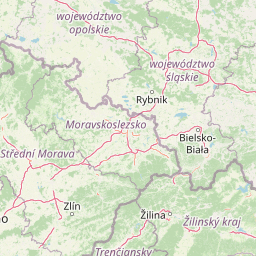
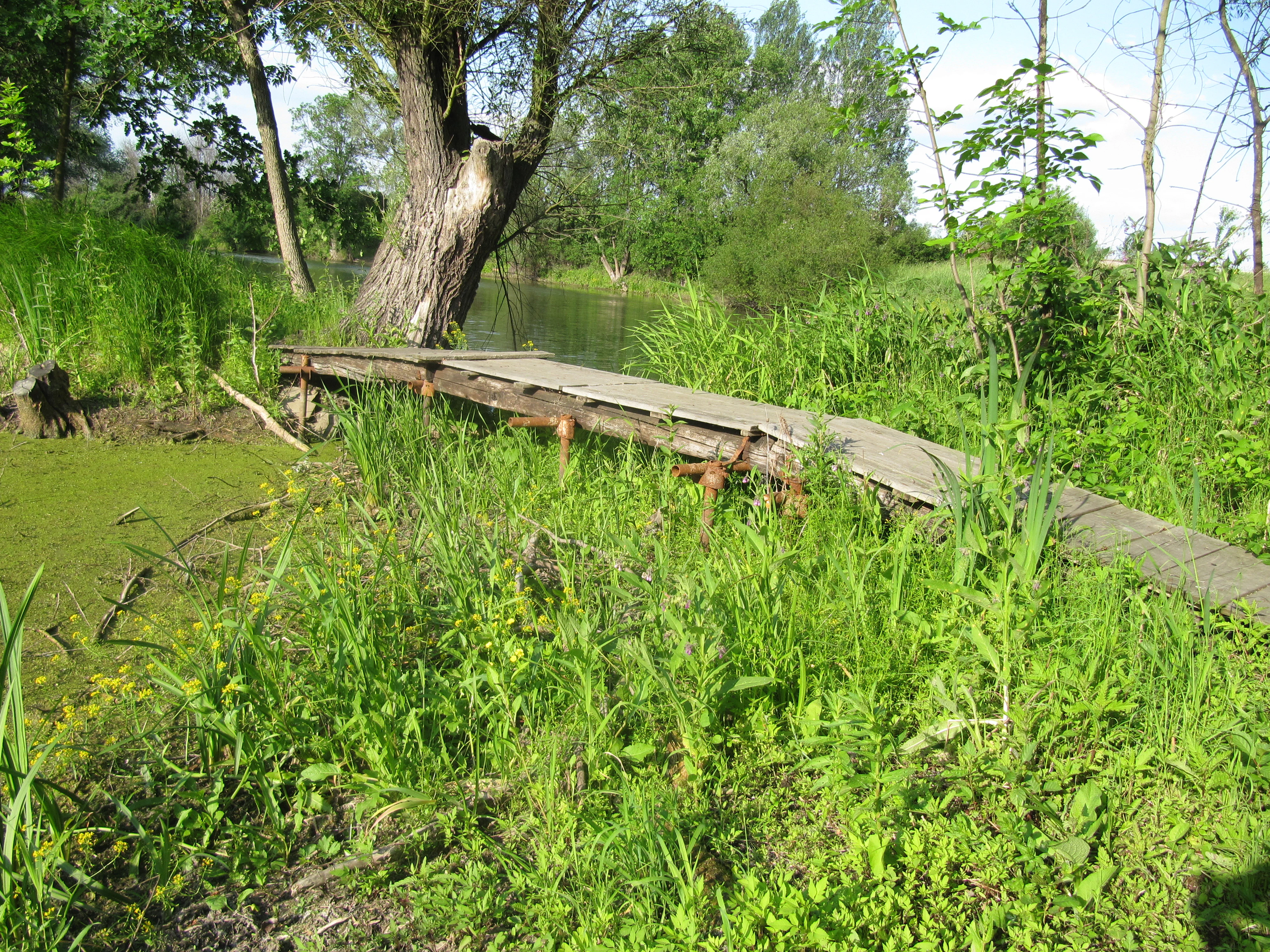
The landscape of Na letišti is defined almost entirely by a former meander of the Morava River that became an isolated oxbow when the river's course was straightened during flood-control regulation works. The result is a small, curved water body with no direct inflow from the active river channel, set within a low-lying portion of the Morava floodplain at roughly 184 meters above sea level. The water surface is bordered by broad belts of reed and emergent vegetation, and behind these, low shrubs and scattered trees create a soft, transitional edge between open water and the surrounding lowland terrain.
The oxbow's floor is covered by a thick layer of mud and decaying organic detritus that has accumulated since the meander was cut off. The still water is classified as poorer alpha-mesosaprobic, indicating moderate nutrient enrichment and a level of organic pollution that supports only certain pollutant-tolerant aquatic communities. Surrounding land use is a mosaic of urban edges, infrastructure associated with Otrokovice, and agricultural plots, which makes the small wetland feel geographically enclosed yet ecologically distinct from its surroundings.
Geomorphologically, Na letišti is a textbook example of a regulated lowland river oxbow, a kind of feature that has become increasingly scarce in central European floodplains as rivers have been channelized for flood control, navigation, and agriculture. Its preservation in an otherwise heavily modified landscape gives the site its visual and ecological character.
Na letišti ecosystems, habitats, and plant life
The nature of Na letišti centers on a quiet but biologically rich lowland aquatic ecosystem. Open water, vegetated shallows, bushy shoreline, and reedy margins come together to form a layered wetland habitat that supports diverse aquatic plants, invertebrates, amphibians, and reptiles in a very compact footprint. The water body is nutrient-rich, with high sediment accumulation, and the surrounding soils reflect both alluvial deposits and organic material washed in from the surrounding floodplain.
Ecologically, the site functions as a refuge for wetland species that have been pushed out of the intensively used surrounding Morava lowlands. Floating and submerged aquatic plants, emergent reed vegetation, and shoreline shrubs together create a gradient of habitats from open water to dry land that is rare in this region. Despite ongoing losses of its most characteristic species, the oxbow still supports a community structure typical of healthy lowland oxbows, with overlapping zones of reed, open water, and shrub-dominated margins.
The site's designation as a natural monument emphasizes not a single charismatic species but the integrity of this small habitat complex. Its continued biological value depends on protecting the water chemistry, shoreline vegetation, and minimal disturbance of the oxbow's hydrology, any of which could shift the balance of the existing community.
Na letišti wildlife and species highlights
The wildlife of Na letišti is dominated by aquatic invertebrates and amphibians that thrive in the still, organically rich waters of the former river meander. A targeted zoological survey of aquatic beetles in 1994 recorded 51 species at the site, an unusually high figure for such a small area and an indication of the habitat's ecological richness. Among these, the community mixes thermophilic lowland species, represented by the water scavenger beetle Hydrochara flavipes, with more northern elements such as Hydaticus modestus. A particularly notable record is the diving beetle Graphoderus austriacus, which is among the rarer aquatic beetle species documented here.
Amphibians are an important component of the reserve's fauna. Surveys have identified the smooth newt, the fire-bellied toad, the common toad, the European green toad, and the edible frog. These species use the oxbow for breeding and the surrounding marshy margins for shelter and foraging, making the wetland a critical local amphibian habitat in an otherwise heavily developed landscape.
Reptiles are represented so far in records by the grass snake, which depends directly on the amphibian-rich waters for prey. Although the site is small, its combination of open water, shallow reedy margins, and bushy shoreline creates enough structural diversity to support a functioning food web from invertebrates up to amphibian- and reptile-hunting predators.
Na letišti conservation status and protection priorities
The conservation significance of Na letišti lies in its role as one of the few surviving oxbow wetlands in the Morava lowlands. While the site is too small to function as a landscape-scale reserve, it preserves a habitat type that has been almost entirely lost elsewhere along the regulated stretches of the Morava River. Because oxbows of this kind act as refuges for aquatic plants, amphibians, and invertebrates, their incremental loss has cumulative consequences for floodplain biodiversity in central Europe.
The original conservation driver for the site was the water caltrop, a critically endangered species in the Czech Republic at the time of designation. Heavy historical disturbance, including the removal of floating plants by anglers, led to the local disappearance of this species and prompted a 1997 reclassification from a state nature reserve to a smaller-scale natural monument. This shift kept the area under protection while broadening the conservation focus from a single species to the integrity of the oxbow habitat as a whole.
Continued conservation value depends on protecting the site's hydrology, shoreline vegetation, and water quality. As a natural monument under the management of the Czech Agency for Nature Conservation and Landscape Protection, Na letišti is part of the national network of small protected sites that together maintain habitat continuity and species refuges in landscapes otherwise dominated by agriculture, industry, and settlement.
Top sights and standout views in Na letišti
Na letišti's strongest qualities include its example of a regulated-river oxbow preserved in an urban-adjacent floodplain, a recorded assemblage of 51 aquatic beetle species, a rich amphibian community that includes the fire-bellied toad and the European green toad, and historically one of the most important Czech habitats for water caltrop. Even after the loss of its headline plant species, the site's combination of open water, reedbeds, and shoreline shrubs continues to provide refuge for wetland species that have largely disappeared from the surrounding landscape.
Best time to visit Na letišti
Na letišti is best appreciated in late spring and early summer, when shallow warming of the oxbow supports peak amphibian breeding activity and the most active period of aquatic plant growth. Early summer visits offer the best chance to observe water beetle diversity along the margins and to see emergent vegetation, including common reed, at full development. Late spring also tends to be a productive period for hearing amphibian calling activity at the site. Autumn can still be rewarding for shoreline flora, though water levels may drop and vegetation may die back. Visitors should keep in mind that this is a small, ecologically sensitive site; observation should focus on the margins and approaches rather than entering the water or disturbing shoreline plants.