
Why Nest Hill Nature Reserve stands out
Nest Hill Nature Reserve is best known for preserving a tract of dry eucalypt woodland on the South Western Slopes of New South Wales, an ecosystem heavily modified across inland Australia. It is recognised for its populations of characteristic box and stringybark eucalypts, including white box, red stringybark, red box and scribbly gum, and for the presence of several woodland bird species listed under the New South Wales Biodiversity Conservation Act. The reserve is also notable as a former state forest that has transitioned into a strict nature reserve, offering insights into the recovery and ongoing pressures of inland temperate woodland systems in a region shaped by historic timber harvesting and grazing.
Nest Hill Nature Reserve history and protected-area timeline
Nest Hill Nature Reserve lies within the broader traditional country of the Wiradjuri people, the large Aboriginal language group of central and southern New South Wales. Detailed historic information about how the reserve's landscapes were used or valued by Aboriginal communities is limited, and the lack of permanent water within the reserve suggests it may not have been a site of sustained traditional occupation. What is known reflects the broader pattern across many inland woodland reserves, where Aboriginal heritage is less visibly recorded than in better-watered or more sheltered landscapes.
European land-use history is far more clearly documented. On 4 May 1917, the area that is now Nest Hill Nature Reserve was gazetted as Pulletop State Forest and placed under the management of the Forestry Commission of New South Wales. Throughout the twentieth century the forest functioned as a working timber resource, with logging and harvesting shaping the structure and composition of the woodland, particularly through the removal of some older trees and changes to understorey density. Past livestock grazing on the site added further pressure to the ground and shrub layers.
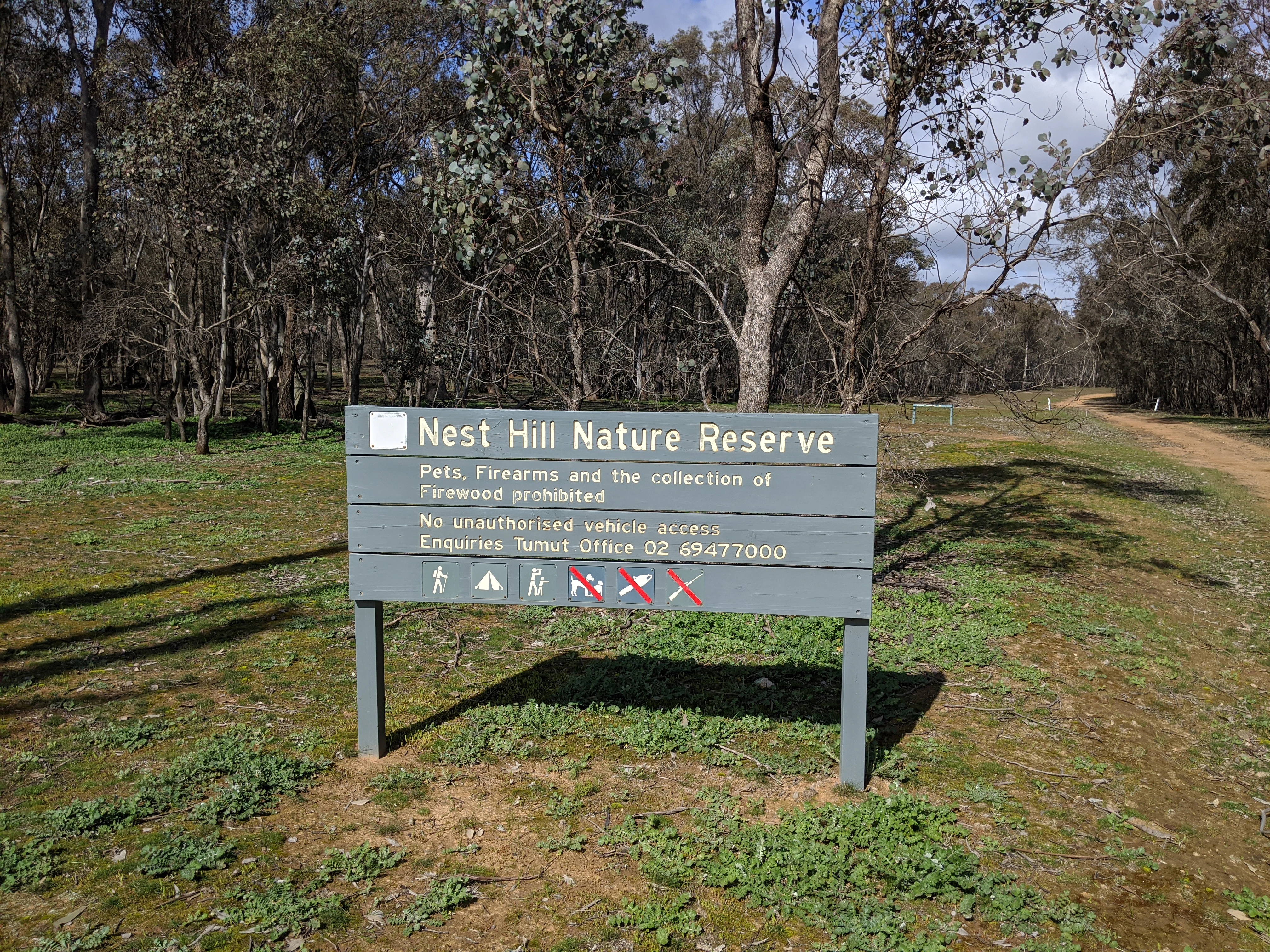
At the end of the twentieth century, a regional re-evaluation of the reserve's conservation values led to its reclassification. On 1 January 2001, Pulletop State Forest was formally gazetted as Nest Hill Nature Reserve, transferring management from the Forestry Commission to what is now the NSW National Parks and Wildlife Service. The transition reflected a wider shift from timber-producing state forests to biodiversity-focused reserves across parts of inland New South Wales. The name 'Nest Hill' itself comes from a prominent local peak located several kilometres to the south, anchoring the reserve in its geographic setting on the South Western Slopes.
Nest Hill Nature Reserve landscape and geographic character
Nest Hill Nature Reserve lies on relatively flat to gently undulating country along County Ridge, contrasting with the more sharply dissected terrain that surrounds it on the South Western Slopes. The reserve sits at the interface between the southern foothills of the inland Great Dividing Range and the wider Riverina-type plains to the west, giving it a transitional landscape character rather than the dramatic relief of nearby hill country.
The topography is subdued, with broad ridges, shallow valleys and gentle slopes defining much of the reserve. There are no significant rivers or permanent creeks running through the area, and the reserve is broadly characterised as dry for most of the year. Surface water tends to appear only after heavy summer storms or during the wetter months of winter, when seasonal pools and ephemeral drainage lines briefly form and then recede.
Vegetation patterning follows the landform closely. Higher, better-drained sections support the most developed eucalypt overstorey, while flatter or more exposed areas tend to have thinner, more open woodland cover. The combination of mild topographic relief, low rainfall seasonality, and a deep-rooted eucalypt canopy gives the landscape its enduring feel of a working inland woodland, even after a century of timber history.
Nest Hill Nature Reserve ecosystems, habitats, and plant life
Nest Hill Nature Reserve protects a representative slice of inland temperate eucalypt woodland, one of the defining vegetation types of southeastern Australia's slopes and plains. The overstorey is shaped by a handful of dominant eucalypts typical of box-stringybark woodland, with white box, red stringybark, red box and scribbly gum forming the main canopy layer. These species together give the reserve its characteristic grey-green foliage and the open, light-filled woodland structure seen across much of the South Western Slopes.
Beneath the canopy, the midstorey and understorey are relatively limited compared with less disturbed woodland in the region. A long history of timber harvesting during the reserve's years as a state forest, combined with historic livestock grazing and ongoing pressure from eastern grey kangaroos, has reduced the density and diversity of shrubs and groundcovers. Despite this, surveys have recorded 119 plant species within the reserve, of which 91 are native and 28 are introduced, indicating that a meaningful native flora persists alongside the disturbance history.
Native groundlayer plants include a recognisable suite of woodland herbs, lilies, orchids and small shrubs. Species such as chocolate lily, twining fringe-lily, bulbine lily and early nancy contribute to seasonal wildflower displays, while native orchids like dusky fingers and the common onion orchid mark the presence of more specialist habitat. Wattles, including box-leaf, silver and woolly wattles, alongside hairy geebung, creamy candles and grass trees, give a sense of the typical floristic mix of inland New South Wales woodland. The overall vegetation structure is functional rather than pristine, reflecting both the reserve's working history and its ongoing capacity for woodland recovery.
Nest Hill Nature Reserve wildlife and species highlights
Wildlife records for Nest Hill Nature Reserve reflect the broader biodiversity profile of inland New South Wales woodland reserves: modest in total numbers but containing several species of genuine conservation interest. Surveys have documented four reptile species, 20 bird species and seven mammal species within the reserve, a diversity that, while not large, is consistent with the habitat type and reserve size.
Birdlife is the most ecologically significant component. Four bird species recorded in the reserve are listed under the New South Wales Biodiversity Conservation Act 2016: the black-chinned honeyeater, brown treecreeper, diamond firetail and speckled warbler. Each of these is a characteristic woodland-dependent species whose distributions have contracted with the loss and degradation of box-stringybark habitat across southeast Australia, making reserves like Nest Hill locally important for their ongoing persistence.
Mammals recorded in the reserve include the eastern grey kangaroo, which continues to influence vegetation structure through grazing, along with several smaller native species typical of woodland environments. Reptile records are limited but include species adapted to dry, open woodland with leaf-litter and log habitat. Introduced pest species, notably the European red fox and European rabbit, are also present, and their management is part of the ongoing challenge of maintaining ecological integrity in such a small, fragmented landscape.
Nest Hill Nature Reserve conservation status and protection priorities
Nest Hill Nature Reserve contributes to conservation of inland temperate eucalypt woodland in inland New South Wales, one of the most heavily cleared and modified vegetation types on the Australian continent. Box-stringybark woodlands like those protected here have lost substantial area since European settlement, with remaining patches increasingly important as refuges for woodland-dependent flora and fauna. Although the reserve covers just 759 hectares and is modest in scale, its protection status gives it a clear role in the regional conservation estate.
Its IUCN Category Ia classification as a strict nature reserve reflects the management intent of prioritising biodiversity conservation over other uses. The presence of four bird species listed under the NSW Biodiversity Conservation Act 2016 underscores the reserve's conservation significance, particularly for woodland birds that have declined across their range. Black-chinned honeyeater, brown treecreeper, diamond firetail and speckled warbler all rely on the kind of habitat structures that the reserve, despite its disturbance history, continues to provide.
Conservation management at Nest Hill must balance the recovery of understorey and groundcover with the realities of past and present pressures. Historic timber harvesting shaped the overstorey, past livestock grazing and continuing kangaroo browsing have limited midstorey regeneration, and introduced predators such as the red fox pose ongoing risks to ground-nesting birds and small mammals. The reserve therefore offers not just a protected site but a working example of how small inland woodland reserves are stewarded for long-term ecological recovery.
Nest Hill Nature Reserve cultural meaning and human context
Nest Hill Nature Reserve lies within the broader traditional country of the Wiradjuri people, one of the largest Aboriginal language groups in New South Wales. Detailed heritage information specific to the reserve is limited, and the absence of permanent water inside its boundaries has been interpreted as suggesting it may not have been a focal site for traditional use.
More broadly, the reserve's cultural landscape is shaped by its twentieth-century identity as Pulletop State Forest, tied to the timber economy and rural livelihoods of the South Western Slopes. The transition from production forest to nature reserve marks a shift in how local communities and land managers have valued this country, from a working forest resource to a place valued primarily for biodiversity and ecological integrity.
Top sights and standout views in Nest Hill Nature Reserve
Nest Hill Nature Reserve stands out for protecting a representative block of South Western Slopes box-stringybark woodland in a landscape long shaped by timber harvesting and grazing. The reserve's overstorey of white box, red stringybark, red box and scribbly gum captures the essence of inland New South Wales temperate woodland, while its understorey still retains a recognisable mix of native lilies, orchids, wattles and grass trees, despite the pressures it has faced.
Its conservation value is reinforced by the presence of several woodland bird species listed under the NSW Biodiversity Conservation Act, and by its status as a strict nature reserve managed primarily for biodiversity outcomes. The reserve's relatively modest size, gentle topography and dry, seasonal character make it an uncomplicated but instructive example of how small inland woodlands are protected and managed in southeastern Australia.
Best time to visit Nest Hill Nature Reserve
The character of a visit to Nest Hill Nature Reserve shifts with the seasons in ways typical of the South Western Slopes. Spring is often the most rewarding period, when cooler nights and warming days bring out native wildflowers, including chocolate lily, bulbine lily, dusky fingers and other groundlayer species alongside the fresh growth of wattles. Bird activity also tends to peak through spring, making it a useful period for observing woodland species.
Summer in this part of inland New South Wales is typically hot and dry, and the reserve reflects that. Vegetation is parched, surface water is largely absent, and the woodland feels exposed and quiet. After heavy summer storms, temporary water can briefly appear in low-lying areas, but the landscape generally returns to a dry state. Autumn offers milder conditions and softer light through the eucalypt canopy, while winter tends to be the wettest part of the year, with cooler temperatures and the most reliable accumulation of moisture in the reserve.