Why Riemeisterfenn stands out
Riemeisterfenn is best known as one of Berlin's last surviving lowland peat bogs, preserving rare marsh and moor species within an urban setting. It represents a rare example of a nutrient-poor, acidic wetland ecosystem that has been actively protected against the influence of Berlin's drinking-water extraction and urban hydrology. The reserve is also notable for the unusual underground Riemeisterfenn waterworks, whose reed-roofed structure was built to blend into the wetland landscape.
Riemeisterfenn history and protected-area timeline
The history of Riemeisterfenn reaches back to the medieval period, when the Margrave sold the village of Crummensee to Kloster Lehnin in 1251. Around the year 1301, the abbey merged the village with Zehlendorf and appointed a Riedmeister to oversee the forests and lakes of the area; over time Riedmeister was shortened to Riemeister, and the lake, and later the fen, took its name from this official.
The modern history of the site is inseparable from the dramatic hydrological changes brought by Berlin's industrial-era growth. Between 1861 and 1910, the population of Berlin quadrupled from about 500,000 to over two million. The subsequent demand for drinking water led to intense groundwater extraction throughout the city. By 1911 the original Riemeister See had effectively fallen dry, and in 1913 the Berliner Wasserwerke began pumping Havel water into the lake chain to keep the wetlands viable. This artificial water supply remains in use.
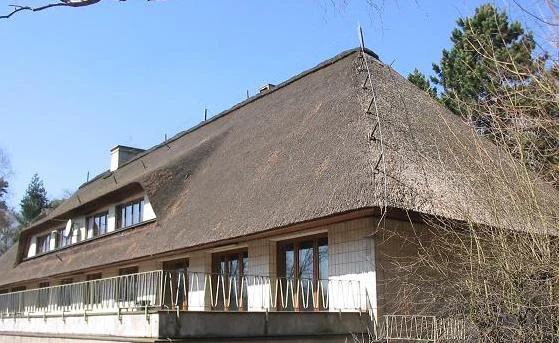
In 1957 a waterworks (Wasserwerk Riemeisterfenn) was built at the southwestern edge of what would later become the nature reserve. Its technical installations were set underground, and the surface buildings were constructed with a deep, prominent reed roof so that the structure would blend into the wetland landscape. Despite contributing only a small fraction of Berlin's total water supply, the plant shaped the modern visibility of the site. It was placed on standby in the 1990s, hosted a restaurant between 2007 and 2012, and then stood empty. On the evening of 7 November 2018, a fire of unknown origin destroyed the entire reed roof of the main building.
Parallel to this hydrological story, ecological protection evolved slowly. Concern for the peatland's flora and fauna was formalized on 4 May 1987, when the Berlin Senate issued a protection ordinance explicitly aimed at preserving the remaining mesotrophic moor pond and alder swamp forest habitat. In 1998, a connection between the fen and the larger chain of lakes, which had formed after a dam break in the 1960s, was sealed by Senate order to shield the nutrient-poor bog vegetation from nutrient-rich lake water. This restoration choice led to the suffocation of a fish population that had developed in the renewed open water, and since then the small lake within the reserve has continued to expand again.
Riemeisterfenn landscape and geographic character
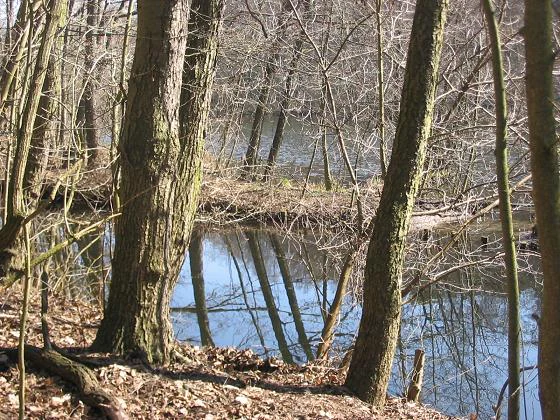
The landscape of Riemeisterfenn is shaped by a low, flat, swampy lowland. Where once the open Riemeister See spread, today a partly silted-in basin remains, with marshy, boggy margins and shallow open water threaded by reed growth. The terrain is flat to gently undulating; the site has no cliffs, peaks or large dunes. Instead, its character is defined by the contrast between dark peat soils, marsh vegetation, floating peat mats and the canalised water that loops through the reserve.
Despite being small, the reserve has clear microtopography. Moist depressions alternate with slightly higher hummocks supporting alder carr and shrubby transitions. The Fennkanal, a narrow artificial canal, conducts water along the northern edge of the site past the protected zone and onward into the Langes Luch reserve and the Grunewaldsee, ensuring that the wetland does not stagnate but also does not flood. The fen feels like a fragment of an older landscape pressed against the dense, modern urban fabric of southwestern Berlin.
Riemeisterfenn ecosystems, habitats, and plant life
Ecologically, Riemeisterfenn represents one of Berlin's rare surviving mesotrophic peatland systems. Its habitats include open water, transitional mires, reed beds, and alder swamp forest (Erlenbruchwald). The peat substrate and acidic, nutrient-poor groundwater define the ecological character of the site, and create the conditions for plant communities that cannot survive in the surrounding, more nutrient-enriched urban environment.
Management efforts focus on keeping the bog's stratification intact, allowing natural terrestrialisation (Verlandung) to proceed without disturbance, and actively removing invasive species such as Prunus serotina (späte Traubenkirsche) and Acer negundo (eschen-Ahorn). The fluctuating wet-dry zones around the alder carr are deliberately maintained to encourage the dynamic successional processes typical of lowland bog margins.
Riemeisterfenn wildlife and species highlights
The reserve is recognised as habitat for a small but ecologically meaningful community of wetland species. Native fish such as pike (Esox lucius), eel and carp were historically present in the open water sections; they disappeared locally when the dam was closed in 1998 to restore bog conditions. Aquatic and marsh plants, including the rare flowering rush Butomus umbellatus (Schwanenblume) and the threatened Anacamptis palustris (Sumpfknabenkraut), are strongly tied to the site's acidic, low-nutrient water and form a core part of its biodiversity value. The wetland's combination of open water, reed beds and alder carr makes it a stopover and breeding area for typical Berlin wetland birds, though the surrounding forest also supports forest-dwelling fauna common to the wider Grunewald.
Riemeisterfenn conservation status and protection priorities
Riemeisterfenn has conservation significance because it preserves one of the very last lowland mesotrophic peatland fragments in Berlin. Its 1987 protection ordinance specifically targets the conservation of moor pond flora and fauna and of alder swamp forest, and provides for the restoration of habitat suitable for these species. Active conservation work includes the suppression of invasive woody species, the maintenance of the natural terrestrialisation process, and the protection of the peat body's stratification.
Equally important is the site's role in demonstrating how a wetland can be sustained within a heavily modified urban hydrological system, since the broader Grunewald depends on pumped Havel water to compensate for centuries of groundwater extraction. Riemeisterfenn thus also serves as a reference point in discussions about Berlin's groundwater management, forestry and ecological balance, even though it is only about 7.2 hectares in size.
Riemeisterfenn cultural meaning and human context
Culturally, Riemeisterfenn is embedded in the rural and recreational heritage of the Zehlendorf area. The fen, the adjacent Riemeisterstraße and the Riemeister-Grundschule all preserve the memory of a medieval Riedmeister appointed to oversee the local forest and water bodies. The area also has a strong late-19th and early-20th-century excursion culture: the famous local inn Onkel Toms Hütte, just across Onkel-Tom-Straße, was a famous Berlin weekend destination, and the nearby U-Bahn station Onkel Toms Hütte carries on that legacy.
Top sights and standout views in Riemeisterfenn
Riemeisterfenn's main highlights include the surviving peat bog itself, one of Berlin's rarest surviving wetland habitats; the Fennkanal, which connects the protected fen with the broader Grunewaldseenkette; the unusual underground waterworks with its landmark reed roof; and the visible tension between a protected bog ecosystem and a heavily urbanised, water-engineered region.
Best time to visit Riemeisterfenn
Late spring through early autumn is the most rewarding period to experience Riemeisterfenn. In late spring and early summer the bog vegetation, including rare species such as the flowering rush, reaches its peak, and the wetland wildlife is most visible. Mild, damp weather emphasises the marshy character of the site; in winter, frozen bog and reed surfaces highlight the open, quiet structure of the fen but limit access and visibility.