
Trip Timing
When is the Best Time to Visit Serengeti National Park?
Determining the best time to visit Serengeti National Park requires balancing your desire to witness the legendary Great Migration against the realities of the park’s seasonal climate shifts. Because the Serengeti spans nearly 15,000 square kilometers of varied savanna, woodland, and riverine habitats, there is no single month that guarantees the same experience across the entire ecosystem. For most travellers, the dry season,typically running from June through October,offers the most reliable conditions for game viewing, as wildlife clusters around permanent water sources and the thinner vegetation makes spotting predators and large herds easier.
Balancing Migration Cycles and Weather
Understanding when to visit hinges on how you prioritize the movement of the roughly 1.5 million wildebeest and 250,000 zebras. These herds are in constant motion, driven by the search for fresh grazing following rainfall. While the dry months offer comfortable temperatures and clear, sunny days with low humidity, they also coincide with higher demand for park services. Conversely, the transition months, marked by the arrival of the short rains in November or the long rains beginning in April, transform the landscape into lush green plains. These periods offer a different allure, characterized by dramatic afternoon thunderstorms, more vibrant birdlife, and the arrival of newborn animals, though roads can become challenging and some areas less accessible due to mud.
Interaction of Landscape and Climate
Your experience in the Serengeti is fundamentally shaped by the interaction between the park’s elevation,averaging around 1,390 meters,and its seasonal weather patterns. The cooling effect of this elevation makes for temperate, pleasant mornings and evenings, even when daytime maximums reach the low 30s (°C) during the sunnier months of September and October. Wind patterns also play a critical role; as you move through the year, the shift in wind direction and speed affects everything from the persistence of dust on game drive routes to the perceived temperature during early morning safaris.
Deciding on your travel dates means accepting inherent trade-offs. Choosing the dry season prioritizes ease of movement and visibility, while opting for the wetter shoulder seasons favors the park's renewal and lower visitor density at the expense of potential rainfall interruptions. Because the ecosystem relies on the unpredictable arrival of rain to trigger migration patterns, the specific timing of the herds’ presence in regions like the Southern Plains or the Northern Grumeti corridor varies annually. Rather than seeking a universally ideal time, focus on which seasonal rhythm aligns with your primary interests,whether that is the high-stakes drama of river crossings or the tranquil beauty of the green season.
Seasonal Visiting Guide
Best Months to Visit Serengeti National Park by Travel Priority
Dry Season: Prioritizing Wildlife Visibility and Migration Dynamics
The dry season, extending from June through October, is the most frequently recommended window for visitors prioritizing reliable wildlife viewing. As the landscape transitions into its arid phase, surface water becomes increasingly scarce, compelling resident and migratory herds to cluster around permanent riverine sources and waterholes. This aggregation makes wildlife spotting significantly more predictable. During this period, the vegetation thins out, offering clearer lines of sight for photographers and safari-goers. However, the trade-off is higher demand for park resources and popular lodges, meaning bookings should be secured well in advance. Late in this season, particularly September and October, temperatures rise and the landscape becomes noticeably dusty, which is a consideration for those sensitive to air quality or heat.
Transition Periods: Balancing Weather and Tourist Density
The "shoulder" months, including November and December (the start of the short rains) and the period from late March through May (the long rains), offer a distinct alternative to the peak dry season. These times often feature a lush, vibrant green landscape that provides a striking aesthetic contrast to the golden plains of the dry months. Birdwatching is particularly rewarding during these phases as migratory species arrive and resident birds become more active. Travelers who choose these windows often encounter fewer vehicles on game drives compared to the peak months of July and August. The compromise, however, is the heightened probability of precipitation. While rain typically arrives in localized, brief bursts rather than continuous downpours, it can make navigating dirt tracks more challenging, and some remote areas may become less accessible for self-drivers.
High-Activity Windows for Specific Wildlife Phenomena
Visitors whose primary goal is witnessing the dramatic river crossings or the rutting season should align their travel with the migration’s specific geographic movements rather than just the general weather pattern. The western corridor is a prime location from late May through August, as the herds congregate and the Grumeti River crossings take center stage. For those focused on the southern plains, the months of January and February represent the calving season. During this time, the landscape is often greener and the plains are filled with the activity of young ungulates, which in turn draws significant predator interest. This period offers a unique experiential layer, but it requires accepting that the timing is highly dependent on the timing of seasonal rainfall patterns, which can fluctuate slightly from year to year.
Climate Averages
Understanding Serengeti National Park Weather and Climate by Month
The Annual Rhythm of Temperature and Rainfall
Serengeti National Park experiences a distinct climate dictated by the movement of the Intertropical Convergence Zone, resulting in a dual-peak precipitation pattern rather than a single winter-summer divide. Understanding these normals requires looking at the inverse relationship between rainfall and temperature. The hottest months, particularly September and October, coincide with the end of the long dry season, where daytime maximums frequently climb into the mid-30s Celsius. Conversely, the arrival of heavier rains in April and November often coincides with a modest cooling effect, as increased cloud cover limits solar radiation.
It is important to note that these figures represent long-term climate normals for a standardized elevation of approximately 1,390 meters. Conditions across the park’s 14,763 square kilometers are not uniform. The vast, low-lying southern plains will feel significantly hotter and drier than the higher-altitude woodlands or the northern riverine zones. Visitors should treat these monthly averages as a baseline for expectations rather than a definitive forecast for any specific week, as year-to-year variation,especially regarding the exact onset of rainfall,remains a hallmark of this savanna ecosystem.
Seasonal Moisture and Atmospheric Comfort
The park’s humidity levels shift in direct response to the rainfall cycles. During the driest months of July and August, when average daily precipitation drops below one millimeter, relative humidity frequently dips to its annual minimums in the mid-40 percent range. This creates a crisp, clear atmosphere that is physically comfortable for long days in safari vehicles. By contrast, the wettest months of March, April, and December see humidity levels climb toward 70 percent. While this is rarely oppressive, it does change the character of the mornings, which can feel damp and heavy before the sun fully clears the horizon.
Wind patterns also play a subtle but material role in visitor comfort. Wind speeds are generally most consistent between May and October, often peaking in July at over 4 meters per second. This breeze serves as a natural tempering mechanism against the midday heat. During the transition months between wet and dry periods, the air can become noticeably still, increasing the perceived intensity of the sun.
Daylight and Thermal Variation
Given its equatorial proximity, the Serengeti does not experience the dramatic fluctuations in daylight length found at higher latitudes. The annual variance remains tight, ranging between approximately 11.87 hours in June to 12.13 hours in December. While this provides a reliable window for daytime wildlife viewing throughout the year, the subtle difference is most relevant for those prioritizing early morning photography, where even a slight variation in sunrise time can influence the optimal departure from camp.
Thermal diurnal shifts remain significant year-round. Regardless of the month, the drop in temperature from a daily high of 30°C or 35°C to an evening low of 12°C–15°C is substantial. This regular night-time cooling is a critical aspect of the park's climate, necessitating layers for early morning game drives and late-night campfire sessions. The consistency of these overnight temperatures ensures that the park avoids extreme, year-round heat, maintaining a relatively temperate environment despite the high daily peaks found in the height of the dry season.
Seasonal dynamics
Understanding Serengeti National Park Weather Patterns and Seasonal Cycles
While the Serengeti’s ecosystem is defined by a continuous, annual cycle of life, the climatic rhythm is best understood through two primary phases: the extended dry period and the dual-peak rainy period. These cycles do not align with a standard four-season northern hemisphere calendar, but rather fluctuate based on moisture availability, which dictates the movement of the Great Migration and the accessibility of different park regions.
The Dry Season: June to October
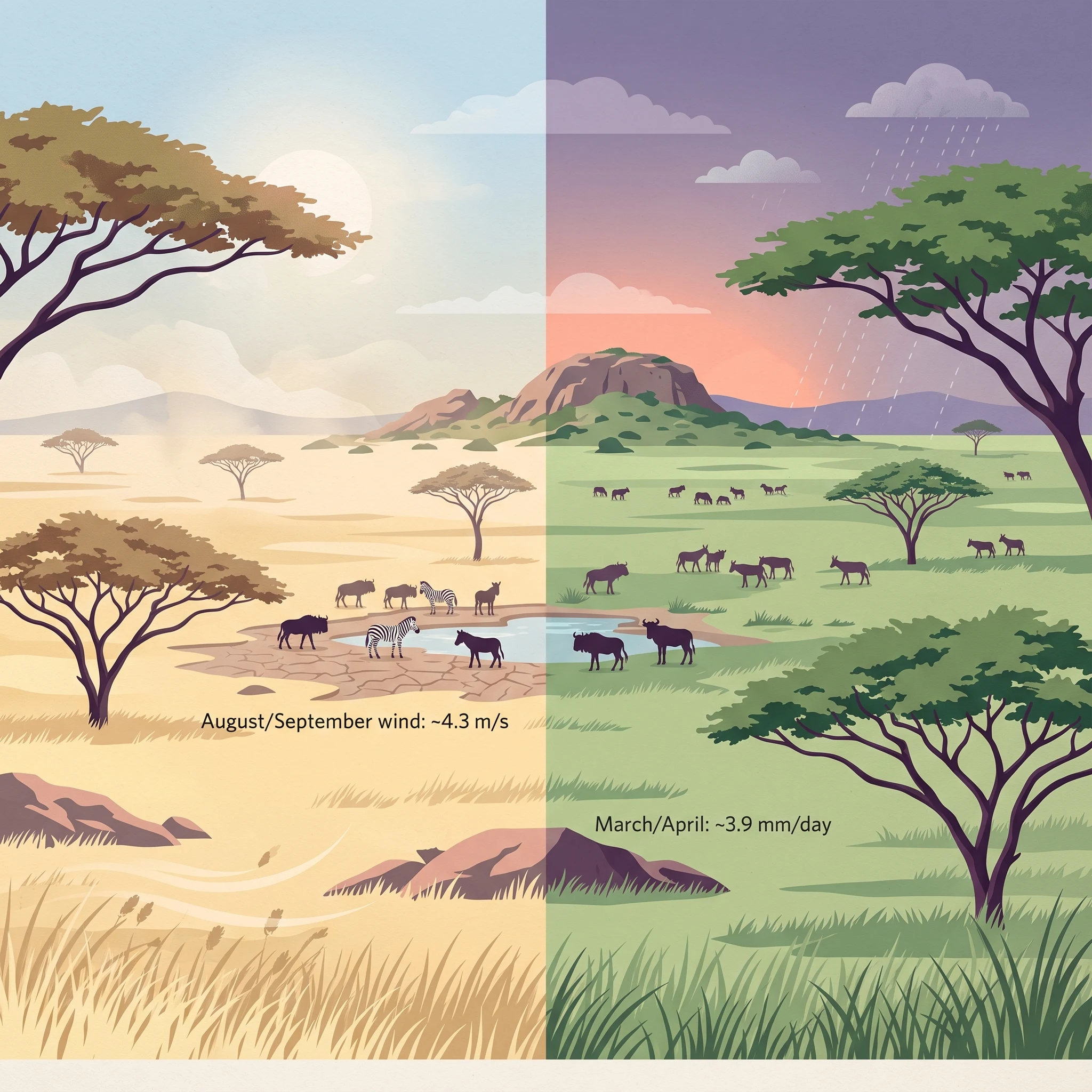
Spanning from June through October, this phase represents the period of lowest rainfall, with monthly precipitation values often dropping well below 2 mm per day, particularly in July and August. This is a time of environmental consolidation. As surface water in the plains evaporates, wildlife is drawn to permanent river systems, such as the Mara and Grumeti, and established waterholes. Travellers should expect the most stable weather during these months, though the trade-off is higher daytime dust levels and cooler nights, as the clear, dry air allows for rapid heat loss after sunset. Wind speeds tend to be highest during the heart of this season, particularly from June to August, which can influence the perceived temperature during early morning game drives.
The Transition and Short Rains: November to December
The onset of the 'short rains' in November marks a distinct shift in the Serengeti’s rhythm. Humidity begins to rise from the 40-50% range characteristic of the dry season to over 60%. This period acts as a bridge; the landscape begins to transition from the golden, parched tones of the dry months to a burgeoning green. While rain is frequent, it is often characterized by short, intense afternoon storms rather than persistent days of deluge. For visitors, this is a time when the park feels 'refreshed,' though it requires flexibility as road conditions can begin to change, becoming softer as moisture returns to the soil.
The Long Rains: March to May
The most significant climatic shift occurs with the 'long rains,' typically peaking in March and April. During this time, precipitation patterns are at their most consistent, with daily averages often exceeding 3 mm. Humidity levels remain elevated, and temperatures are generally more moderate compared to the heat spikes of late dry-season months like September and October. This phase is defined by widespread landscape transformation; the vast, endless plains become lush and verdant, creating a striking visual contrast to the dry months. Access to certain remote tracks can become restricted, and the wildlife, while present, disperses more widely as water becomes available everywhere, challenging the concentration-based viewing of the dry season.
Why Mid-Year Transitions Matter
Months like January and February often act as a secondary dry 'interlude' between the short and long rains, though this can vary significantly year to year. These months are warmer, with average daily highs climbing back toward 33–34°C. Understanding these transitions is essential because they represent the Serengeti’s 'unpredictable' window, where weather patterns are influenced by complex local topography. Rather than viewing the year as a static sequence, travellers should interpret these phases as shifting stages that dictate where wildlife will likely cluster and how one must navigate the park's extensive dirt road network.
Seasonal Experiences
What Visiting Serengeti National Park is Like Throughout the Year
Wildlife Dynamics and Seasonal Movement Patterns
The Serengeti experience is fundamentally dictated by the oscillation of its massive herbivore populations, primarily wildebeest, zebras, and gazelles. From December to May, the southern plains,specifically around Lake Lagarja and the Naabi Hill region,become the focal point of the visitor experience. During this window, the open, nutrient-rich short-grass plains support calving, which in turn draws significant predator activity. Visitors in these months can expect to traverse flatter, accessible terrain, often witnessing the cycle of birth and the subsequent survival strategies of cheetahs and lions hunting in the expansive, unobstructed landscape.
As the long rains transition into the dry season from June through August, the migration moves toward the Western Corridor and the Grumeti River. This period offers a more concentrated and dramatic viewing experience compared to the southern plains. The vegetation here includes riverine forests and gallery woodlands, creating a contrast in both scenery and wildlife behavior. Accessing this area requires navigating different road conditions, and visitors should be prepared for the distinct shift from the open savannah to the more enclosed, bush-heavy environments near the riverbanks.
Habitat Variations and Specialized Experiences
The Serengeti’s landscape creates distinct experiential zones that function differently depending on the time of year. The central region, anchored by the Seronera area, remains a hub for leopard and cheetah sightings throughout the year. Its characteristic granite koppies,rocky outcrops that rise above the plains,serve as essential landmarks for predators. Because these koppies provide elevated vantage points, they offer reliable opportunities for observing lion and leopard behavior, regardless of the seasonal fluctuations that might push the wider herds toward the north or south.
Conversely, the northern Serengeti, particularly near the Mara River and Bologonja Springs, becomes the centerpiece from late dry season through October. This region is structurally different, featuring more rugged, hilly terrain and reliable water sources. This consistency in water availability makes the north a sanctuary for resident species like elephants and buffalo, even when the migratory herds are concentrated elsewhere. For visitors, the northern experience is characterized by dramatic river crossings and a landscape that feels significantly more permanent and forested than the transient southern plains.
The Impact of Rainfall on Exploration
While wildlife activity remains the primary draw, the practicalities of moving through these diverse habitats are tied to the precipitation cycles. During the heavier rainfall months, such as April and May, some remote tracks can become difficult to traverse. Conversely, the height of the dry season, from July to September, turns the park into a dusty, high-visibility environment. This clarity allows for easier spotting of wildlife across long distances but necessitates preparation for significant dust during game drives. The change in vegetation density between the wet and dry cycles directly impacts the ease of identifying camouflage-reliant species, making the late dry season often the most straightforward time for first-time visitors to engage with the park’s primary residents.
Travel Priorities
Optimizing Your Serengeti Safari Based on Specific Visitor Priorities
Prioritizing Clearer Skies and Drier Ground
If your primary travel objective is minimizing rainfall and enjoying consistent, sun-drenched days, the months of July, August, and September offer the most reliable conditions. During this window, precipitation reaches its annual minimum,often falling below 1 mm per day,and relative humidity levels drop to their lowest point of the year, frequently dipping under 45%. The trade-off for this exceptionally dry weather is a significant increase in wind speed, which averages over 4 m/s. While this wind helps keep the perceived temperature comfortable, it can also whip up dust on the unpaved tracks, requiring sturdy 4x4 vehicles and careful planning for camera equipment protection.
Seeking Milder Temperatures for Walking and Comfort
Travellers who prioritize cooler, more temperate days often find the transition months of May and June the most suitable. While temperatures in the Serengeti are moderated by elevation, the mean temperature dips slightly below 22°C during this period, offering a reprieve from the intense heat of the late dry season. This timing is particularly beneficial for those hoping to engage in guided walking activities, where physical exertion makes lower maximum temperatures,often around 30°C to 31°C,more manageable. The compromise here is the landscape; May and June represent the transition away from the long rains, meaning vegetation can still be thick, which occasionally limits visibility compared to the parched, open plains of the peak dry season.
Maximizing Daylight for Extended Exploration
For visitors wanting to maximize their time in the field, daylight hours are relatively consistent due to the park's proximity to the equator, yet subtle shifts occur throughout the year. November, December, and January provide the longest days, extending slightly past 12 hours. This extra daylight is advantageous for those planning to traverse the large distances between regions, such as the drive from the Seronera area to the northern Kogatende sector. However, this period coincides with the arrival of the short rains, which can increase humidity to nearly 70% and occasionally render secondary dirt tracks more challenging to navigate. The added daylight hours provide a buffer for travel time, but the trade-off is a higher probability of localized afternoon showers.
Balancing Animal Density and Predator Activity
If your goal is observing predator-prey dynamics, specifically the interaction between big cats and the migrating herds, timing your visit around the peak dry season months of September and October is arguably the most effective. As water sources diminish, resident and migratory animals cluster around permanent features like the Grumeti River or regional kopjes, creating a natural concentration that predators exploit. The trade-off is that this period is the culmination of the dry season; the landscape is at its most arid, and the high concentration of visitors in accessible areas can necessitate more forward planning for accommodation and vehicle access. Conversely, those willing to visit during the 'short' dry interval of January and February may encounter the calving season on the southern plains, offering a unique opportunity to witness high-intensity predator behavior in a landscape that is still recovering from, or anticipating, seasonal rains.
Access and Logistics
Seasonal Road Conditions and Serengeti Safari Planning
Access to the Serengeti is defined by a reliance on dirt track infrastructure that reacts predictably to the region's rainfall patterns. During the dry season months of June through October, most internal routes remain firm, allowing for reliable transit between the main regional hubs such as Seronera, the Western Corridor, and the northern stretches near the Mara River. As precipitation levels rise during the long rains in April and May, these same tracks can become saturated, significantly increasing travel times and requiring more robust vehicle capabilities. While the main arterial routes are generally maintained to support year-round park operations, the physical condition of secondary game-drive tracks fluctuates based on current local weather. Travellers should always verify the status of specific routes with their chosen safari operator or park authorities before planning transit between remote sectors, as heavy localized rain can temporarily impact accessibility even outside of the primary wet season.
Navigation and Travel Logistics
Most visitors explore the park via 4x4 safari vehicles, which are essential for navigating the terrain. While self-driving is a permitted activity for experienced travellers, it requires high levels of self-sufficiency. Because the park spans nearly 15,000 square kilometers, fuel stops and reliable breakdown support are concentrated in specific areas like Seronera and Lobo. Outside of these points, services are extremely limited. Those choosing to self-drive must ensure their vehicle is mechanically sound, carry adequate fuel reserves, and possess reliable navigation tools, as signal availability and road signage can be inconsistent across the vast plains.
Air Travel and Regional Connectivity
To bypass the long driving distances between major zones, small aircraft provide a common alternative. Several airstrips, including Seronera, Kogatende, Grumeti, and Ndutu, facilitate quick access to specific migratory hotspots. When planning an itinerary, note that weight limits for these small aircraft are typically strict,often restricted to 15 kg in soft-sided bags,to accommodate the smaller cargo holds of bush planes. It is important to confirm luggage policies with your flight provider and safari operator well in advance, as these requirements are non-negotiable for safety and space reasons.
Official Verification of Operations
Operational details such as park gate opening hours, permit costs, and specific area closures are subject to change by the Tanzania National Parks Authority (TANAPA). Never assume that travel times, road access, or facility availability remain static year-over-year. Always verify current entry requirements, vehicle fees, and any restricted zones directly through official government portals or your licensed tour operator before finalizing your travel logistics. Relying on outdated travel blogs or anecdotal accounts can lead to significant planning delays, particularly when crossing into adjacent conservation areas.
Safety and Preparation
Seasonal Weather Hazards and Packing for Serengeti National Park
Adapting to Seasonal Climate Variations
Preparation for the Serengeti is dictated by its distinct rainfall phases and thermal shifts rather than a static packing list. During the dry season months of June through October, when precipitation is minimal, the primary environmental factors are dust and significant diurnal temperature swings. Daytime temperatures frequently climb into the low 30s (°C), yet the lack of humidity causes rapid heat loss after sunset. Travelers should prioritize layered clothing that accommodates sudden transitions between the intensity of midday sun and the chilly, crisp air that follows nightfall. In these months, dust is ubiquitous; protecting camera gear and electronics with sealed, moisture-proof bags is more critical than heavy-duty rain protection.
Conversely, during the wetter windows,the long rains of March through May and the shorter, unpredictable showers of November and December,the landscape transitions. Humidity levels rise, and while temperatures remain moderate, the increased likelihood of mud and saturated vegetation shifts safety priorities. Footwear choices should emphasize grip and durability for potentially slick conditions, and lightweight, moisture-wicking fabrics are essential as heavy, water-logged clothing will not dry efficiently in the park’s humid periods.
Wildlife Safety and Interaction Protocols
Safety within the park is fundamentally linked to respecting wildlife space and adhering to established proximity protocols. Regardless of the time of year, large predators remain active. The fundamental rule of safety is to never leave a vehicle outside of designated areas. While the dry season increases wildlife visibility due to the thinning of vegetation, it also concentrates animals near permanent water sources, which may increase the density of encounters. Always maintain a respectful distance; wildlife is unpredictable, and human presence can induce stress or defensive behaviors.
For those staying in tented camps or mobile lodges, listen closely to staff briefings. These accommodations are often unfenced, allowing wildlife to move freely through the area. Nighttime movement is almost always restricted; when permitted, it must be accompanied by an armed ranger or authorized guide. These measures are in place to ensure both human safety and the protection of the local ecosystem.
Essential Field Considerations
Because the Serengeti covers nearly 15,000 square kilometers, help is rarely immediate. Preparation for any road-based transit involves self-sufficiency. If planning a self-drive safari, confirm that your vehicle is a reliable 4x4 and carry ample water and a basic emergency kit. Navigation can be complex, and relying solely on mobile signal is risky; download offline maps and carry physical backup resources. Before departing, verify current park alerts regarding road closures, bridge conditions, and any active wildlife migration warnings with the Tanzania National Parks Authority (TANAPA) or your authorized tour operator. Always cross-reference climate normals with current forecasts, as localized weather patterns can significantly deviate from long-term trends.
Finalizing Your Plans
How to Choose the Right Time to Visit Serengeti National Park
Choosing the best time for your visit requires reconciling your personal travel objectives with the natural, weather-dependent rhythm of the ecosystem. Because the park is a vast, dynamic environment, there is no single month that serves everyone; instead, your decision should stem from which trade-offs you are most willing to accept. If your priority is maximizing the probability of spotting the Great Migration in specific regions, your window is constrained by the herds' annual movement. If your focus is instead on avoiding peak tourist density or experiencing the landscape during its greener, more temperate phases, you will find better outcomes by looking at the shoulder seasons.
Balancing Wildlife Visibility and Comfort
Your decision framework should start by identifying your primary interest. Travelers who view consistent wildlife visibility and high predator activity as the core requirement often gravitate toward the dry season from June through October. During this period, the receding water sources force animals to cluster, making them more predictable and easier to locate. However, this is also when the park experiences its highest volume of visitors. If you prefer a quieter experience, the transitional months surrounding the long or short rains offer a different trade-off: higher chances of precipitation and more challenging road conditions in exchange for fewer vehicles and a lush, vibrant landscape.
Aligning Seasonal Realities with Expectations
When you finalize your travel window, keep in mind that the climate normals discussed throughout this guide are long-term averages and not guarantees for your specific dates. Unpredictable shifts in rainfall can accelerate or delay the movement of the herds, and weather conditions,such as the significant diurnal temperature swings,remain a factor regardless of the time of year. Your preparations must account for these realities, prioritizing reliable 4x4 transport and flexible planning that allows for local conditions. Before booking, always verify current access status, park gate operations, and permit requirements through official channels, as these can be updated by park authorities independently of seasonal climate patterns. By evaluating these factors,your tolerance for crowds, your specific wildlife goals, and your adaptability to varying road and weather conditions,you can identify the timeframe that best aligns with your own definition of an ideal safari.