Why Steinernes Meer Nature Reserve stands out
Steinernes Meer is best known for its remarkable concentration of glacial erratic boulders, an unusually rich assemblage of large stones deposited by the Saalian glaciation. The site's signature feature, the Butterstein, stands apart as the largest of these boulders and has been linked to prehistoric ritual use, lending the reserve both geological and archaeological significance. The reserve's identity is also shaped by its position within the TERRA.vita geopark landscape, where ancient stones and gently wooded lowland hills together illustrate the deep geological history of northwestern Germany. The combination of dense forest cover, glacial history, and prehistoric association gives the reserve a distinctive profile among German nature reserves, despite its compact size.
Steinernes Meer Nature Reserve history and protected-area timeline
The Steinernes Meer has been protected as a natural monument since 8 November 1924, when the boulder field was first placed under the field and forest police law to safeguard its cluster of glacial erratic boulders from damage or removal.
In 1937, the protection regime was reorganized under the new Reich Nature Conservation Act, and the official effective date of the reserve's ordinance was set to 7 August 1937, which remains the most commonly cited establishment date for the protected area. The handover of legal authority reflected a broader national reorganization of nature protection in Germany at that time.
Responsibility for the reserve today rests with the Osnabrück district as the lower nature protection authority, while the Lower Saxon Agency for Water Management, Coastal Protection, and Nature Conservation (NLWKN) supports its management. The site has thus retained continuous protection across several distinct legal and political eras in German conservation history.
Steinernes Meer Nature Reserve landscape and geographic character
The landscape of Steinernes Meer Nature Reserve is defined by a gently rolling wooded hillside on the northeastern slopes of the Gattberg, a modest elevation within the otherwise flat surroundings of the Osnabrück area. The reserve sits between approximately 128 and 143 meters above sea level, an unusual rise that gives the site a more sheltered and visually enclosed forest character than much of northwestern Germany.
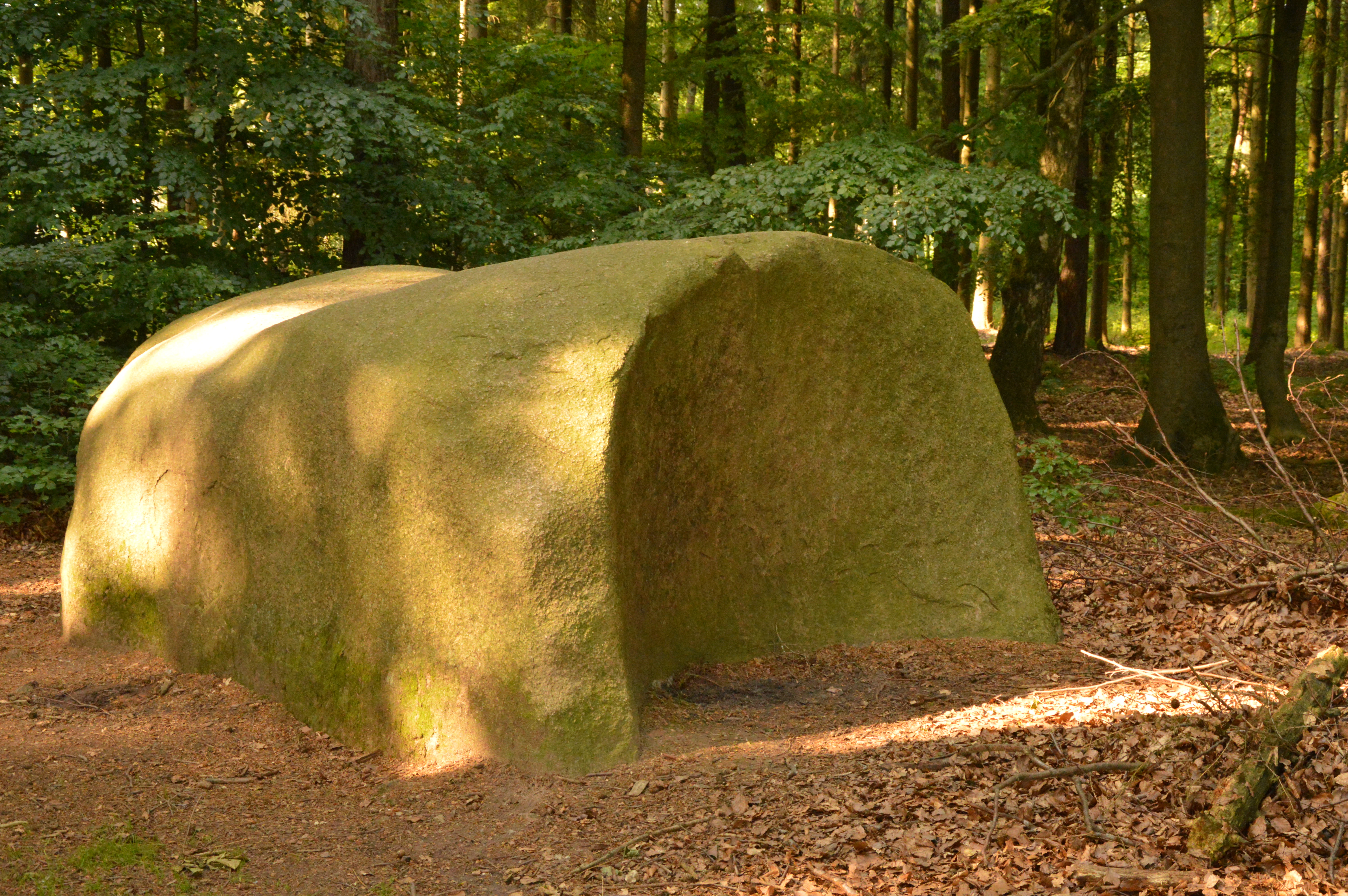
The defining geological feature is the dense scattering of glacial erratic boulders, or findlings. These large stones, transported by Pleistocene ice during the Saalian glaciation, appear together in such numbers that the forest floor takes on the appearance of a stony sea from which the reserve takes its name. Among them, the monumental Butterstein stands slightly apart along the southern edge of the area, its sheer size and isolation giving it a distinctive visual presence that has long drawn visitors to the site.
Overall, the landscape is a striking juxtaposition of dense lowland forest and exposed glacial stone, illustrating how Ice Age processes continue to shape the surface character of this part of Germany long after the ice itself retreated.
Steinernes Meer Nature Reserve ecosystems, habitats, and plant life
The ecological character of the Steinernes Meer is shaped by its wooded lowland setting on the slopes of the Gattberg, dominated by forest cover that surrounds and weaves between the scattered glacial boulders. This forested hillside habitat is typical of the protected forest patches maintained across the Osnabrück district, offering habitat continuity and shelter for woodland species.
The boulder field itself creates additional microhabitats within the forest. Stones of varying size and surface texture provide crevices, shaded surfaces, and small clearings that support mosses, lichens, and other rock-dwelling vegetation, while the intermittent leaf litter and soil pockets between boulders support small-scale plant communities.
While the reserve is small in extent, its integration into the broader TERRA.vita Nature and Geopark means that the site's natural values are understood within a wider regional context of forest preservation and geoconservation across northern Germany.
Steinernes Meer Nature Reserve wildlife and species highlights
Given its compact 12.7 hectare size and dense forest setting, Steinernes Meer is not primarily a destination for high-volume wildlife viewing, but the wooded Gattberg slopes and boulder field together support characteristic woodland fauna typical of Lower Saxony. Forest birds, small mammals, and invertebrates benefit from the structural variety created by trees, leaf litter, and the sheltered spaces around large boulders.
The site's particular value lies more in preserving the physical habitat conditions for these communities than in harboring rare or flagship species. The continuity of forest cover, combined with the protected status of the boulder field, ensures that the microhabitats beneath and around the erratic stones remain undisturbed, supporting the broader woodland ecosystem rather than a single species assemblage.
Steinernes Meer Nature Reserve conservation status and protection priorities
Steinernes Meer Nature Reserve has been protected for its geological and cultural significance for nearly a century, making it an unusually long-standing Lower Saxon conservation site. Its primary conservation value lies in the preservation of a rare in-situ concentration of glacial erratic boulders, geological evidence of the Saalian glaciation that shaped much of northern Europe.
By safeguarding the boulders from removal or disturbance, the reserve protects a tangible record of Pleistocene climate history. Its inclusion within the TERRA.vita Nature and Geopark strengthens this conservation role, embedding the site within a broader regional framework that promotes the protection and public understanding of geological heritage.
Although small, the reserve also contributes to the conservation of contiguous woodland habitat on the Gattberg slopes, demonstrating how even very compact German nature reserves can combine geological, ecological, and cultural protection objectives.
Steinernes Meer Nature Reserve cultural meaning and human context
The cultural identity of Steinernes Meer is inseparable from its glacial landscape and its long association with folklore and prehistoric imagination. The Butterstein, the largest boulder in the field, has been interpreted as a possible prehistoric sacrificial or ritual stone, suggesting that the site held symbolic or ceremonial meaning for communities living in the region in prehistoric times.
The evocative name "Steinernes Meer," or "Stone Sea," itself reflects a long tradition of folk interpretation of dramatic natural features. The reserve, though a formal 20th-century protection entity, stands at the intersection of ancient human imagination and modern geoconservation, with the surrounding region holding many similar traces of prehistoric stone use.
Top sights and standout views in Steinernes Meer Nature Reserve
The Steinernes Meer offers a compact but layered experience centered on one of northern Germany's most accessible concentrations of glacial erratic boulders. Visitors encounter a wooded hillside setting unusual for the Osnabrück area, a forest floor strewn with Ice Age stones, and the dramatic Butterstein, the largest boulder in the field and a possible prehistoric ritual site.
The reserve's long protection history, its geological value as evidence of the Saalian glaciation, and its position within the TERRA.vita geopark give it an importance that goes well beyond its modest 12.7 hectare footprint, making it a small but distinctive destination for those interested in the deep history of the German landscape.
Best time to visit Steinernes Meer Nature Reserve
The reserve can be appreciated year-round thanks to its deciduous and mixed forest setting, but spring and early autumn tend to offer the most comfortable conditions for walking the uneven boulder-strewn terrain. In spring, fresh leaf cover and forest blooms brighten the slope of the Gattberg, while in autumn the seasonal colors contrast strongly with the grey glacial stones.
Winter visits reveal the boulder field most starkly, with bare trees exposing the full scale of the "stone sea," though visitors should expect cooler temperatures on the exposed north-facing slope.