
Why Uhlířský vrch stands out
Uhlířský vrch is best known for being one of the youngest extinct volcanoes in the Czech Republic, whose basaltic bedrock and tuff deposits remain exposed in a small former quarry on the southern slope. That quarry, together with the surrounding volcanic substrate, has been protected since 1966 as a geological natural monument. Equally central to the hill's identity is its Baroque pilgrimage landscape: the Church of the Virgin Mary of Help crowning the summit, approached along a four-row linden avenue planted in the 1760s. The combination of a young, well-preserved volcanic cone with an eighteenth-century religious ensemble and a restored Way of the Cross gives Uhlířský vrch a distinctive character within the Nízký Jeseník highlands.
Uhlířský vrch history and protected-area timeline
The hill's modern history is layered across two intertwined threads: its geological past and its cultivation as a pilgrimage site.
The volcanic foundation of Uhlířský vrch dates back to relatively recent geological activity, which is why the cone is considered one of the youngest extinct volcanoes on Czech territory. This volcanic origin was once actively quarried, especially for tuff on the southern slope, and it was the scientific value of that quarry exposures, with sandy tuffs and embedded volcanic bombs, that led the District National Committee in Bruntál to declare the site a natural monument on 26 April 1966.
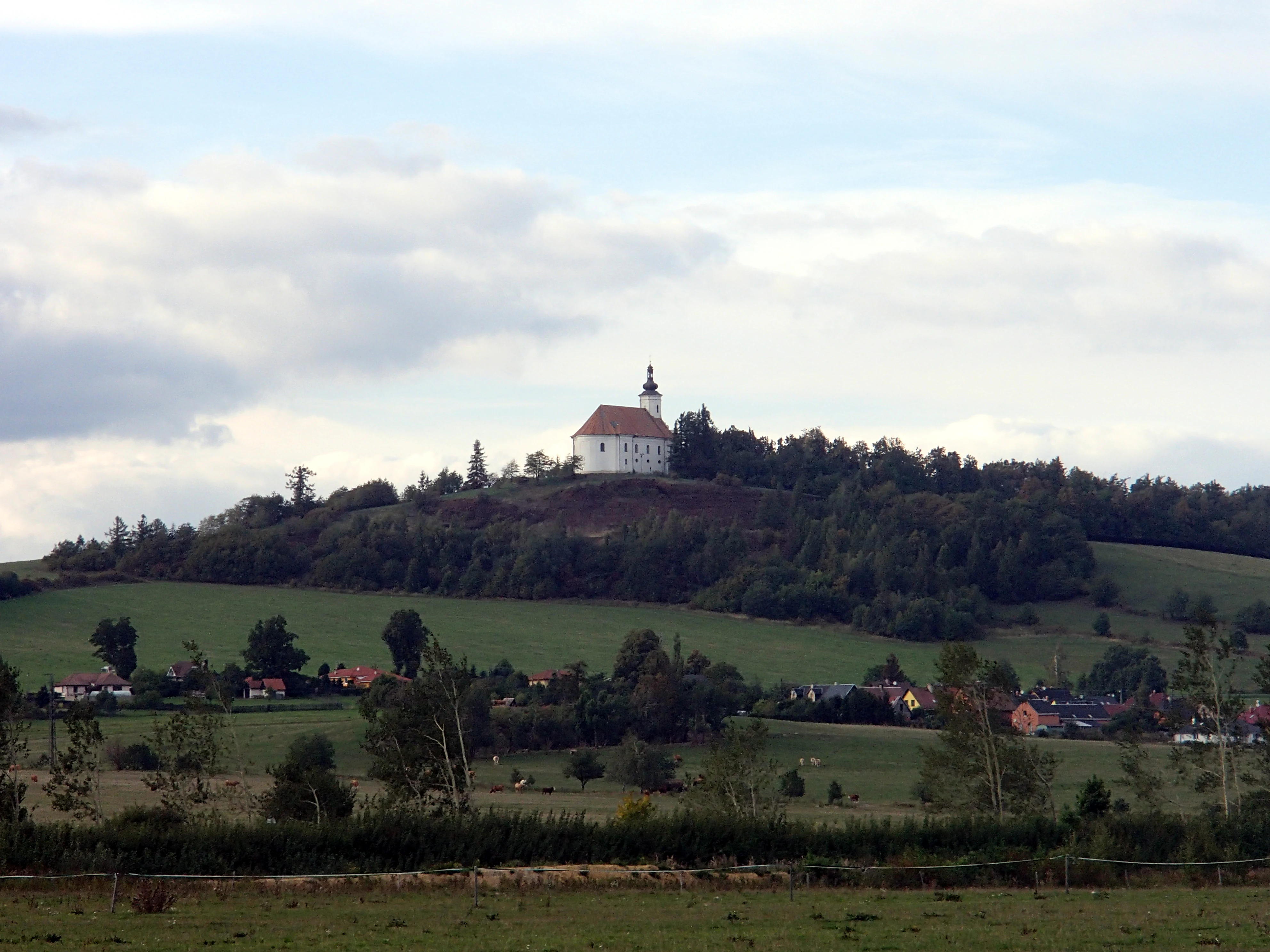
The cultural history began in the mid-seventeenth century, when Oswald of Liechtenstein, a regional commander of a religious order, had a wooden pilgrimage chapel erected on the summit in 1653 as a far-visible symbol of Catholic triumph over Protestantism in the Silesian lands. By the mid-eighteenth century that modest chapel had been replaced by the present single-nave Baroque church of the Virgin Mary of Help, built between 1755 and 1765 to a design by the Krnov-based architect Jiří Friedrich Gans.
The site's careful landscape design took shape in the second half of the eighteenth century. Around 1766 to 1770, the freeman and commander von Riedheim ordered the planting of the four-row linden avenue leading from the town up to the church. That avenue gives the hill its present formal approach. In 1916, fourteen stations of a Way of the Cross were added along its upper section, with paintings based on designs by the Munich painter Gebhardt Fugel; these were largely destroyed after the Second World War. A modern carver, František Nedomlel from Bruntál, produced fifteen replacement wooden sculptures between 2001 and 2005, each in a different local wood. The avenue itself was declared a memorable tree feature in 1973, and the whole ensemble became a cultural monument in the 1990s; in 2022 it was voted Alley of the Year in a national competition.
Uhlířský vrch landscape and geographic character
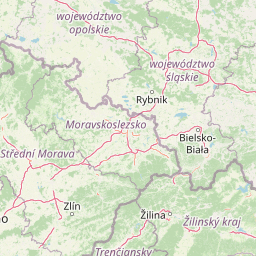
Though modest in size, Uhlířský vrch presents a clearly individual profile within the rolling Nízký Jeseník highlands of Czech Silesia. The hill rises to about 672 meters and is built on basalt, the bedrock of an extinct volcanic vent that once sent a lava flow eastward and northeastward across the surrounding terrain.
The southern slope bears the most visible trace of that volcanic past: an abandoned tuff quarry whose sandy tuffs and embedded volcanic bombs reveal the explosive character of the original eruption. The quarry walls and adjacent exposures are the physical core of the natural monument that protects roughly 3.54 hectares between 620 and 665 meters above sea level.
To the north and east, the summit opens into a more cultivated, humanized landscape. A roughly one-kilometer-long, four-row linden avenue planted in the 1760s climbs toward the hilltop, framing a defined axis between the town of Bruntál and the pilgrimage church on the summit. Because of its elevation relative to the surrounding countryside, the summit serves as a long-distance viewpoint, with open vistas over neighboring Nízký Jeseník ridges and, on clear days, the more dramatic skyline of the Hrubý Jeseník in the distance.
Uhlířský vrch ecosystems, habitats, and plant life
Uhlířský vrch is primarily valued as a geological rather than biological natural monument. Its core significance lies in the exposure of volcanic rocks: a basaltic main body overlain by predominantly sandy tuffs containing larger volcanic bombs, set within the broader sedimentary and volcanic geology of the Nízký Jeseník.
The protected area is small, covering about 3.54 hectares near the summit, and it is the rock exposures themselves, rather than vegetative communities, that constitute the main ecological interest. The hill belongs to the Odra river basin, and its slopes combine exposed rock with woodland typical of the Nízký Jeseník. The protected status, which has been in place since 1966 and falls within the broader Czech system of přírodní památka, recognizes this compact but scientifically instructive volcanic profile in a region otherwise better known for its sedimentary uplands.
Uhlířský vrch conservation status and protection priorities
The volcanic outcrops and former tuff quarry on the southern slope of Uhlířský vrch have been formally protected as a přírodní památka, a natural monument, since 26 April 1966. The designation was issued by the Okresní národní výbor Bruntál and aims to preserve the small but scientifically valuable exposures of basalt and sandy tuff with embedded volcanic bombs that document the hill's young eruptive history.
The protected area covers about 3.54 hectares between roughly 620 and 665 meters above sea level and is registered under code 472 in the national protected-area database. The site illustrates how even very small protected parcels can carry significant geological and didactic value, providing a near-surface window into the youngest phase of volcanism within the broader Nízký Jeseník landscape.
Uhlířský vrch cultural meaning and human context
Uhlířský vrch is anchored in a strongly Catholic, Silesian pilgrimage tradition that grew from the aftermath of the Thirty Years' War. The original 1653 wooden chapel was commissioned by Oswald of Liechtenstein as a deliberate, far-visible symbol of Catholic restoration in a region that had been heavily contested between confessions.
In the mid-eighteenth century this modest wooden structure was replaced by the Baroque Church of the Virgin Mary of Help, designed by the Krnov architect Jiří Friedrich Gans. Around the same period, the freeman and commander von Riedheim ordered the planting of the four-row linden avenue that physically and symbolically connects the town of Bruntál with the summit. The avenue, declared památné stromy in 1973, and the broader ensemble became a Czech cultural monument in the 1990s and won the national Alley of the Year title in 2022. This combination of religious architecture, historic avenues, and a restored Way of the Cross, with sculptures carved by the Bruntál artist František Nedomlel between 2001 and 2005, gives the hill a distinctive identity within the regional cultural landscape of Czech Silesia.
Top sights and standout views in Uhlířský vrch
Uhlířský vrch combines the geology of one of the Czech Republic's youngest extinct volcanoes with a Baroque pilgrimage ensemble on the summit: the Church of the Virgin Mary of Help, an eighteenth-century four-row linden avenue, and a recently restored Way of the Cross with fifteen locally carved wooden sculptures.
Its small protected quarry on the southern slope preserves sandy tuffs and embedded volcanic bombs, and the whole hill also functions as a panoramic viewpoint over the Nízký Jeseník and, in clearer weather, toward the Hrubý Jeseník mountains.
Best time to visit Uhlířský vrch
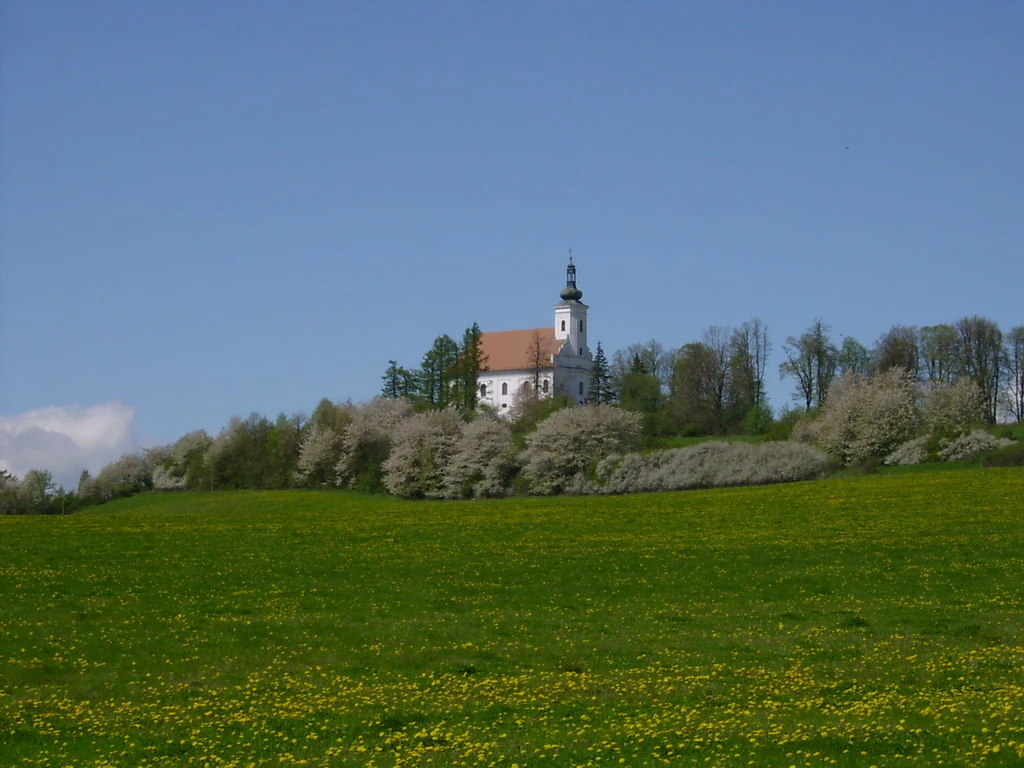
The summit's character shifts with the seasons in ways that matter for both scenery and atmosphere. Late spring into early summer is when the linden avenue most strongly defines the approach to the church, with the trees in fresh leaf and the avenue forming a green corridor from the outskirts of Bruntál up to the hilltop. Summer offers full canopy, long daylight over the surrounding ridges, and comfortable conditions for walking the roughly one-kilometer avenue.
Autumn brings the avenue's other defining moment, when the linden leaves turn color and the view from the summit over the Nízký Jeseník, and toward the distant Hrubý Jeseník, tends to be at its clearest. Winter is quieter and colder, occasionally with snow on the trees and the Baroque silhouette of the church standing out starkly above the white landscape, but visitors should expect shorter days and at times more demanding conditions along the open ridge.