
Why V Dubech stands out
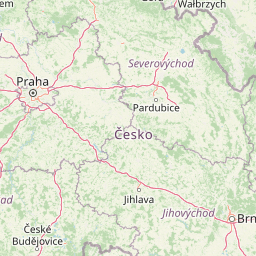
V Dubech is known primarily as a compact wetland nature monument that harbors extremely rare botanical and invertebrate species within the Český ráj region. The site is especially notable for hosting the only known locality of the Siberian iris (Iris sibirica) in the Bohemian Paradise, and the only known occurrence of the minute land snail Vertigo geyeri in the entire Czech Republic. Beyond these rare species, the site is also appreciated for its hydrological complexity: a wet meadow, a small pool, a slope spring, and a swampy alder thicket together create a hydrologically active mosaic that supports moisture-dependent flora and fauna. A solitary ancient pedunculate oak, declared a memorial tree, adds a striking visual landmark to the otherwise water-dominated environment.
V Dubech history and protected-area timeline
The landscape around V Dubech has been shaped historically by the long-standing management regime of the Žehrovská obora, a game reserve that traditionally restricted intensive agriculture and development in the area. This low-intensity land use allowed the wet meadows, springs, and alder thickets of the northern foot of the Příhrazské skály to persist in a relatively natural state over many decades.
Before formal protection, the site functioned mainly as a mosaic of meadow and wet woodland within the broader agricultural and forested setting of the Žehrov cadastral area. The growing recognition during the late twentieth century of the value of small wetland habitats for biodiversity prompted conservation authorities to act. On 1 January 1998, the District Office in Mladá Boleslav officially declared V Dubech a přírodní památka (natural monument), with the explicit intent of safeguarding the slatinná wet meadow, the small pond, the slope spring, and the surrounding alder swamp.
A separate but related conservation milestone occurred on 10 October 2000, when a solitary pedunculate oak (Quercus robur) standing within the site was designated as a památný strom (memorial tree) by the administration of CHKO Český ráj. With a trunk circumference of about 532 centimeters at breast height and an estimated age of around 200 years, this oak became recognized as both a biological and a cultural landmark within the protected area, closely tying the site's history to the broader tradition of notable tree preservation in the Czech Republic.
V Dubech landscape and geographic character
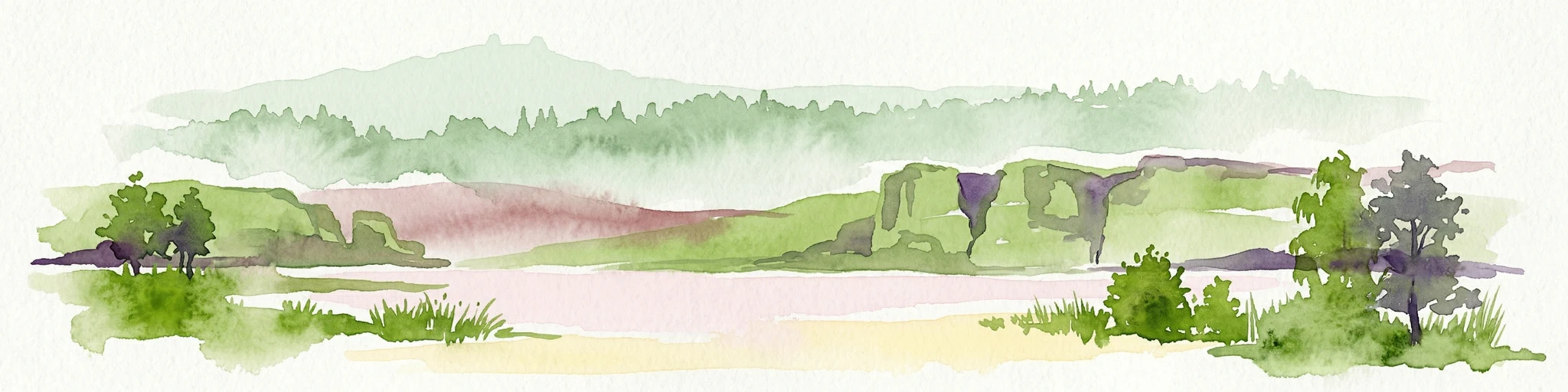
The physical landscape of V Dubech is defined not by dramatic relief but by water and gentle topography. The site lies at the foot of the Příhrazské skály, a sandstone block field whose rocky southern edge transitions abruptly into gentler, often waterlogged terrain. Within this transition zone, groundwater emerges along slope springs and feeds both small standing-water features and broader wet meadow surfaces.
The terrain is essentially flat to gently sloping, in stark contrast to the cliffs and rock towers that dominate the skyline above the monument. The wet meadow has developed on peaty, base-rich substrate, which gives it a slatinná (calcareous-fen-influenced) character unusual for its region. Soils here remain saturated for much of the year, and in some places the surface is so soft that water stands more or less permanently, creating a network of small wet patches, seepage channels, and pools.
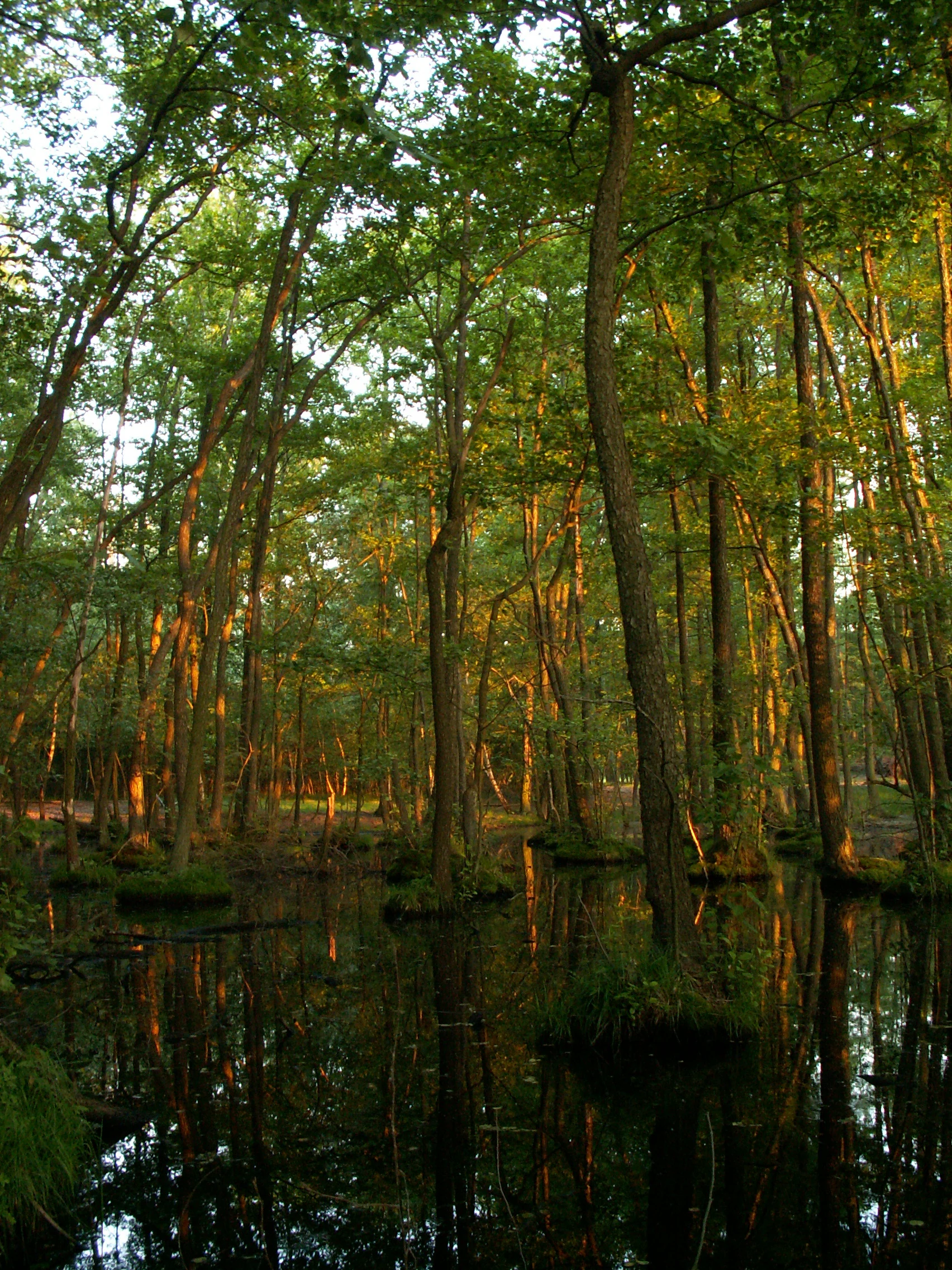
Surrounding this open wetland zone is a swampy alder woodland, where black alder (Alnus glutinosa) grows on saturated soils. The alder grove forms a soft, dark contrast to the bright open meadow it encloses, and it plays a major role in maintaining the hydrology of the site through groundwater uptake and shading. A solitary mature oak rises above this mosaic as a single conspicuous structural feature of the otherwise low and water-dominated scenery. Together, these elements make the landscape of V Dubech feel like a small, self-contained wetland pocket tucked beneath the much larger rocky backdrop of the Bohemian Paradise.
V Dubech ecosystems, habitats, and plant life
V Dubech is ecologically defined by the close coexistence of four distinct wet habitats in a small area: a slatinná louka (wet meadow with peat-forming character), a tiny standing-water pond, a continuously active slope spring, and a swampy alder carr. This juxtaposition creates an unusually rich microhabitat mosaic in which slight changes in elevation, soil moisture, and chemistry support very different plant communities within only a few meters.
The most distinctive ecological feature of the site is the calcareous-fen-like character of its wet meadow, with peat-influenced soils and base-rich groundwater. Such habitats have become increasingly rare and fragmented in the Czech landscape, and V Dubech preserves a relatively intact example within the Bohemian Paradise area. The presence of flowing spring water alongside still water in the pond and saturated soils in the alder woods means that moisture-dependent, cold-loving, and base-loving species can all find suitable niches within the same small area.
Vegetation at the site reflects this ecological complexity. Wet-meadow species dominate the open central areas, while the alder carr provides a structurally contrasting habitat of shaded, permanently moist soil. The hydrological stability of the area, supported by its position at the base of the sandstone massif and its enclosure within the historical game reserve, has allowed sensitive wetland species to persist. The site's biodiversity significance is therefore not simply a function of species richness, but of its capacity to support plant and animal communities that depend on very specific hydrological and edaphic conditions.
V Dubech wildlife and species highlights
The wildlife character of V Dubech is shaped by the dominance of moisture-rich habitats and the small size of the protected area, which together create highly localized microhabitats for sensitive invertebrates and moisture-loving vertebrates. The site's most famous faunal record is the land snail Vertigo geyeri, known in Czech as vrkoč Geyerův. V Dubech is recognized as the only locality in the entire Czech Republic where this tiny snail has been documented, giving the monument extraordinary zoological significance far beyond its modest surface area.
The pond and saturated soils also host aquatic and semi-aquatic invertebrates, including the water-violet Hottonia palustris (žebratka bahenní), a protected plant species associated with clean, nutrient-poor standing water. The presence of this species, together with the rare snail, indicates that the site's hydrology and water chemistry have remained in a relatively natural and undisturbed state.
Although the site is too small and wet to support large mammals, its alder woodland and the surrounding game reserve provide habitat for forest-dwelling species typical of the Bohemian Paradise. The varied structure of meadow, open water, and shaded carr also supports a range of insects and other invertebrates that depend on specific microclimates. In ecological terms, V Dubech's wildlife importance is concentrated in its rare, range-restricted species rather than in charismatic large fauna, making it a textbook example of how small protected wetlands can harbor disproportionately significant biodiversity.
V Dubech conservation status and protection priorities
V Dubech is a conservation site of considerable regional and even national importance, despite its modest size. Its designation as a přírodní památka (natural monument) in 1998 marked a formal recognition that the combination of slatinná meadow, pond, slope spring, and alder swamp is a habitat complex that cannot easily be replaced if lost. The monument is administered within the framework of the CHKO Český ráj Protected Landscape Area, which adds an additional layer of landscape-scale conservation.
From a conservation perspective, the site's most significant contribution is its role as the sole Czech refuge for certain species. The Siberian iris (Iris sibirica) is otherwise absent from the Bohemian Paradise, while the snail Vertigo geyeri occurs at V Dubech as its only known Czech locality. These occurrences give the site a national-level conservation weight and underscore the importance of maintaining its specific hydrological and edaphic conditions. Alterations to groundwater flow, water chemistry, or management intensity could rapidly degrade the habitats that sustain these populations.
The site also illustrates the broader conservation value of small, water-rich refuges within intensively used Central European landscapes. Its position within the Žehrovská obora game reserve has historically buffered it from agricultural intensification, but ongoing conservation management focuses on preserving the open wet-meadow character, preventing alder encroachment where open habitat is desired, and maintaining water quality in the pond and spring. Together, these efforts make V Dubech an exemplary small-scale conservation area within one of the Czech Republic's most visited protected landscapes.
V Dubech cultural meaning and human context
The cultural context of V Dubech is closely tied to the tradition of game reserves and ancient trees in the Czech countryside. The site lies within the Žehrovská obora, a historic enclosure that for generations shaped how the surrounding land was used, restricting cultivation and supporting a pattern of meadows, springs, and old trees. This long-standing relationship between humans and the land is part of why the site's habitats have survived in a relatively traditional form.
The recognition of the solitary old pedunculate oak as a památný strom (memorial tree) in 2000 reflects another strand of Czech cultural tradition: the formal honoring of remarkable individual trees as natural and historical landmarks. The oak's estimated age of around 200 years and its size place it firmly within this cultural practice, giving the wetland monument a visible monumental feature that connects it to broader Czech heritage of tree protection and rural memory.
While V Dubech itself is not associated with major settlements or built heritage, its location in the Bohemian Paradise, a region known for sandstone rock cities, castles, and folk legends, places it within a culturally rich landscape. Visitors to the wider Český ráj often associate the area with dramatic scenery and historic landmarks, and V Dubech offers a quieter, ecologically focused complement to that more famous cultural geography.
Top sights and standout views in V Dubech
V Dubech's standout qualities lie in the contrast between its small size and its exceptional ecological significance. Its compact wetland mosaic of slatinná meadow, pond, slope spring, and alder carr supports multiple rare and protected species within a few hectares, including species otherwise unknown elsewhere in the Bohemian Paradise or even the entire Czech Republic.
A solitary ancient pedunculate oak, recognized as a memorial tree, gives the monument a distinct visual and cultural landmark. Embedded within the Žehrovská obora and the broader Český ráj protected landscape, V Dubech also illustrates how the Bohemian Paradise contains quietly important natural treasures beyond its famous sandstone formations.
Best time to visit V Dubech
V Dubech is a year-round site in ecological terms, but its character changes significantly with the seasons. Late spring and early summer are typically the most rewarding periods for observing the wet meadow in bloom, when moisture-loving plants, including rare species like the Siberian iris, are most expressive. These seasons also tend to offer the richest combination of open water, fresh green vegetation, and active invertebrate life.
Late summer and early autumn can also be attractive, particularly for visitors interested in seed heads, autumn wetland coloration, and the visual prominence of the old oak, whose broad crown becomes especially noticeable as surrounding meadow vegetation shortens. Winter visits reveal the hydrological structure of the site most clearly, as open water, saturated soils, and the bare architecture of the alder trees become more visible. Throughout the year, the small size of the monument and the density of its habitats make careful, quiet observation the most rewarding way to experience the site.