Mori Atlas logo
Natural monumentValečské sklepy

Examining the ecological role of these volcanic underground passages in western Bohemia

Valečské sklepy Natural Monument and Protected Bat Habitat in the Karlovy Vary District

(Přírodní památka Valečské sklepy)

Valečské sklepy serves as a specialized natural monument within the Doupovské hory volcanic landscape of the Karlovy Vary District. This site features historic underground cellars integrated into a château park that now function as an essential hibernation refuge for the endangered western barbastelle and other bat species. The protected area provides a stable, micro-scale ecological niche within the broader forested terrain of western Bohemia.

natural monumentbat hibernation siteunderground cellarsDoupovské horyvolcanic landscapebeech forest

Valečské sklepy

Natural monument

Park overview

Structured park overview, official facts, and landscape profile for Valečské sklepy

Valečské sklepy park facts, protected area profile, and essential visitor context

Review the core facts for Valečské sklepy, including designation, size, terrain, visitor scale, habitats, and operating context in one park-focused overview.

About Valečské sklepy

Valečské sklepy is a tightly focused protected natural monument in the Czech Republic, centered on the remains of historic underground cellars in the Doupovské hory mountains. Although the protected surface itself is extraordinarily small, just 38 square meters, the monument's significance lies in a precise ecological function: its damp, temperature-stable underground chambers serve as a winter hibernation site for a community of bats, and have been formally protected on that basis since December 2016.

The site sits on the eastern slope of an unassuming hill built of Tertiary tephrite volcanic rock, part of the Rohozecká vrchovina geomorphological subunit. It lies within the park of the Valeč château, roughly 300 meters northwest of the château building itself, in the cadastral area of Valeč v Čechách. The hill and the surrounding forest fall within the Doupovské hory landscape, an area that also carries recognition at the European level as a significant site and as a bird protection area, so the cellars sit inside a much wider network of conservation designations.

The monument is split into three separate locations, none of them open to the public. Each entrance is fitted with a grate that blocks humans but is deliberately sized to allow bats to pass in and out freely, a design that reflects how the protection strategy here is built around the behavior of the animals themselves rather than around visitor infrastructure. Surrounding the entrances is a declared protective belt of 5.24 hectares, which buffers the immediate area from disturbance.

Ecologically, the surrounding forest is a flowering beech woodland, with European beech dominating alongside small-leaved linden and hornbeam. Beneath the canopy grow plants of conservation interest, including the strongly threatened long-leaved thoroughwax and protected species such as cowslip and Turk's cap lily, with white helleborine recorded close to one of the cellar entrances. The cellar complex is thus embedded in a forest habitat of its own regional value, even though the formal monument itself concerns only the entrances to the underground passages.

Quick facts and research context for Valečské sklepy

Valečské sklepy is a natural monument (přírodní památka) in the Czech Republic's system of small-scale protected areas, classified under IUCN Category III. It lies in the Doupovské hory mountains in the Karlovarský kraj, within the administrative district of Karlovy Vary, at an elevation of 563 to 571 meters above sea level.

The site was declared by the Regional Authority of the Karlovarský kraj with effect from 20 December 2016. Although only 38 square meters in core area, it is functionally a cave-and-cellar hibernation site for bats and forms part of the broader Doupovské hory European significant locality and bird protection area.

Protection and recognition

Analysis of terrestrial protected area designation and management records

Valečské Sklepy Protection Status and Documented Conservation Scope

Valečské sklepy maintains a documented terrestrial protection scope without imported international recognition sources. Reviewing this conservation framework clarifies the official designation history and administrative tracking parameters associated with the protected landscape.

Protection details

Protection scope
Terrestrial
Transboundary protection
No
Buffer area
0.05 km²
Park context

Deeper park guide and search-rich context for Valečské sklepy

Valečské sklepy history, landscape, wildlife, and travel context

Explore Valečské sklepy through its history, landscape character, ecosystems, wildlife, conservation priorities, cultural context, and seasonal travel timing in a structured park guide built for atlas discovery and search intent.

Why Valečské sklepy stands out

Valečské sklepy is best known for being a designated bat hibernation site. The underground cellars continue to host a stable population of the critically endangered western barbastelle (Barbastella barbastellus), together with a roster of other, mostly threatened bat species that use the vaults as a winter refuge in the heart of the Doupovské hory. Its secondary identity is cultural-historical. The cellars originated under a vanished medieval manor that later burned, were repurposed for the local Valeč brewery through the early twentieth century, and now persist as quiet, sealed passages whose preservation value lies almost entirely in their suitability for hibernating bats.
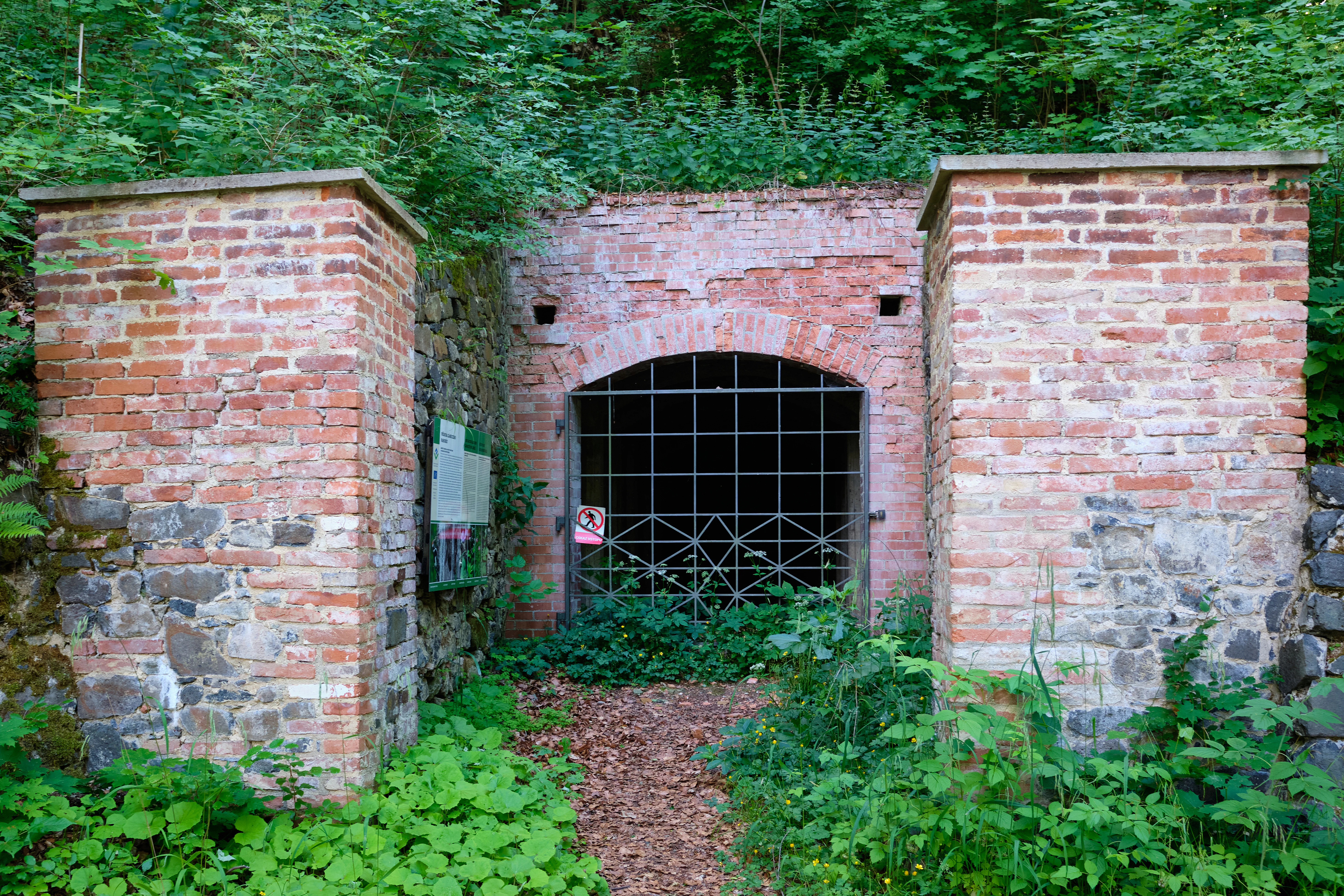
A brick entrance gate leading into a gated dark tunnel or cellar, set into a green hillside overgrown with foliage.
The entrance to the Valečské sklepy natural monument in the Czech Republic, known for its role as a bat hibernation site.

Valečské sklepy history and protected-area timeline

The area around Valečské sklepy was settled from the second half of the thirteenth century, and a manor house once stood close to the present-day cellars. That seat burned down in the fifteenth century, but it had already been associated with the underground passages that are now protected, and which were later taken over by the local estate brewery.

The cellars were used by the brewery until 1931, when brewing at Valeč ceased and the underground spaces were abandoned. From that point on they fell into relative disuse, but their stable microclimate began to make them increasingly important as a natural hibernation site for bats. After decades of informal use by wildlife, the Regional Authority of the Karlovarský kraj declared the site a přírodní památka (natural monument) effective from 20 December 2016, formalizing a protection status whose focus is the bat population rather than the cellar fabric itself.

Valečské sklepy landscape and geographic character

The protected site sits on the eastern slope of a low, unassuming hill in the Doupovské hory, an extensive volcanic mountain range in western Bohemia. The local hill is shaped by Tertiary tephrite, a fine-grained volcanic rock associated with the broader volcanic character of the Doupovské hory, and the monument falls within the Rohozecká vrchovina geomorphological subunit.

Above ground, the landscape reads as gently rolling forested terrain rather than dramatic relief. Elevations at the cellars themselves range from 563 to 571 meters above sea level, placing them in a foothill-to-mid-slope setting. Climatically the area belongs to the mildly warm climate zone classified as MT3 in Czech usage, with mean January temperatures of minus 3 to minus 4 degrees Celsius and mean July temperatures of 16 to 17 degrees Celsius, annual precipitation of 600 to 750 millimeters, snow cover lying for 60 to 100 days a year, and predominantly eutrophic cambisol soils. The actual protection surface is only 38 square meters across three dispersed openings, but the broader 5.24 hectare protective belt frames the site within a continuous forest landscape.

Valečské sklepy ecosystems, habitats, and plant life

Ecologically, the area carries two overlapping layers: a forest habitat above ground and a sheltered underground environment below. The forest around the cellars is a flowering beechwood in which European beech is the dominant tree, mixed with small-leaved linden and hornbeam. In the understory, conservation-relevant herbaceous plants occur, including the strongly threatened long-leaved thoroughwax, and protected species such as cowslip and Turk's cap lily. Close to one of the cellar entrances, a colony of the white helleborine orchid has also been recorded, suggesting that the microclimate near the cave mouths supports a distinctive local flora.

The protected cellars themselves are a very different kind of habitat. Their underground chambers, originally hewn for the medieval manor and later adapted for the Valeč brewery, offer stable temperatures and humidity that suit hibernating bats exceptionally well. The site's protected status, and the way the entrances have been fitted with bat-friendly grates, reflects a deliberate alignment between human heritage structures and the ecological process of bat hibernation.

Valečské sklepy wildlife and species highlights

The wildlife focus of Valečské sklepy is its bat community. The cellars host a stable winter population of the critically endangered western barbastelle (Barbastella barbastellus), which is the main reason the site is protected. Records collected between 2010 and 2013 added a roster of other bat species using the cellars, mostly in smaller numbers, including the critically endangered greater mouse-eared bat (Myotis myotis) and a series of strongly endangered or otherwise protected species: the northern bat (Eptesicus nilssonii), the serotine (Eptesicus serotinus), Bechstein's bat (Myotis bechsteinii), Daubenton's bat (Myotis daubentonii), the whiskered bat (Myotis mystacinus), Natterer's bat (Myotis nattereri), the common noctule (Nyctalus noctula), the common pipistrelle (Pipistrellus pipistrellus), the brown long-eared bat (Plecotus auritus), and the grey long-eared bat (Plecotus austriacus).

The surrounding woodland, while not the formal subject of the monument, provides foraging habitat for these bats, and the broader Doupovské hory context, including its status as a bird protection area, reinforces the importance of the cellars as part of a wider network of sites for protected fauna in the region.

Valečské sklepy conservation status and protection priorities

Valečské sklepy is one of the smallest protected natural monuments in the Czech system by area, yet conservation-wise it punches well above its size. The site is dedicated to a single, sharply defined ecological function: maintaining a viable winter hibernation site for a community of bats, centered on a stable population of the critically endangered western barbastelle. Its protection was deliberately calibrated to that function, with grates across the cellar entrances designed to exclude disturbance while still allowing bats to enter and exit freely.

Its conservation status is reinforced by its location inside the Doupovské hory European significant locality and bird protection area, placing the cellars within a network of landscape-level designations that connect small-scale sites like this one to broader regional conservation planning. The 5.24 hectare buffer zone around the three cellar openings adds a spatial safeguard for the immediate surroundings, while reliance on natural microclimate rather than active management keeps the site ecologically low-intervention yet ecologically high-value.

Valečské sklepy cultural meaning and human context

Valečské sklepy carries a layered but quiet human history. The cellars were already tied to a local manor in the medieval period, and when that manor burned down in the fifteenth century, the underground passages survived and were later repurposed for the estate brewery. They continued to serve that role until 1931, and the cultural footprint therefore straddles a vanishing medieval noble seat and the long industrial life of a rural brewery.

The site is located within the park of the Valeč château, close to the village of Valeč in the Karlovy Vary district, an area known for both its château heritage and the surrounding Western Bohemian countryside. The cultural and natural history of the cellars have effectively merged: a set of structures made by people is now valued and protected primarily because of what those structures mean for wildlife, an unusually direct example of how built heritage can be reframed as habitat.

Top sights and standout views in Valečské sklepy

Valečské sklepy is a textbook example of a micro-scale protected area: an extremely small, precisely targeted site whose importance derives from a single ecological function. Its highlights are the long-term, stable presence of the critically endangered western barbastelle, a bat-friendly entrance design that balances human exclusion with animal access, and the unusual way in which a centuries-old set of cellars has become formally valued as wildlife infrastructure rather than as historical architecture.

On a wider scale, the monument is also notable for sitting inside the Doupovské hory European significant locality and bird protection area, so a small cellar complex in a château park is linked into some of the larger-scale conservation designations of western Bohemia.

Best time to visit Valečské sklepy

Because the cellars themselves are sealed against public access and the monument's value is zootological rather than scenic, seasonality matters here mainly for the surrounding landscape and for the broader experience of the Doupovské hory. Snow cover lies on the ground for around 60 to 100 days a year in this elevation band, and winters are markedly colder than summers, with mean January temperatures around minus 3 to minus 4 degrees Celsius and mean July temperatures around 16 to 17 degrees Celsius.

For visitors interested in the wider landscape context, the warmer months offer longer days and easier walking conditions through the surrounding flowering beech forests, while winter brings a quieter, snow-dusted character to the Doupovské hory. Because the entire protected site is itself closed to entry at all times, the appropriate seasonal frame is less about the cellars and more about the forest, the château park, and the regional scenery around Valeč.

Monthly climate preview

Long term annual weather patterns and monthly averages for Karlovy Vary District

Valečské sklepy Climate Normals: Measured Temperature and Precipitation Rhythms

Historical records from 1991 through 2020 document measured monthly temperature swings and precipitation rates across a representative coordinate within Valečské sklepy. Reviewing the complete twelve month profile clarifies the full range of long term climate conditions mapped for this location.
Annual mean8 °C
-3 °C19 °C
Jan-3°
Feb-2°
Mar
Apr
May12°
Jun16°
Jul19°
Aug18°
Sep13°
Oct
Nov
Dec-2°
Warmest month
July

18.6 °C

Coolest month
January

-2.8 °C

Wettest month
June

2.5 mm/day

Driest month
February

1.2 mm/day

Park location guide

Geography guide, regional context, and park location map for Valečské sklepy

Valečské sklepy park geography, regions, and map view in Czechia

Understand where Valečské sklepy sits in Czechia through a broader geographic reading of the surrounding landscape, nearby location context, and its mapped position within the national park landscape.

How Valečské sklepy fits into Czechia

Czech Republic is a landlocked Central European country with a population of approximately 10.9 million people. The nation was established as an independent state on January 1, 1993, following the dissolution of Czechoslovakia. Its capital and largest city is Prague, with other major urban centers including Brno, Ostrava, Plzeň, and Liberec.

Wider geography shaping Valečské sklepy in Czechia

The Czech Republic is a landlocked country in Central Europe. It is bordered by Germany to the west, Austria to the south, Poland to the northeast, and Slovakia to the southeast. The landscape is predominantly hilly, with the territory covering 78,871 square kilometers.

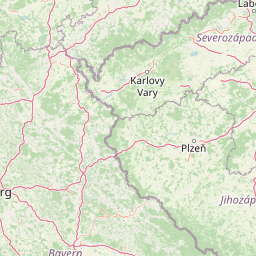
Map view of Valečské sklepy

Use this park location map to pinpoint Valečské sklepy in Czechia, understand its exact geographic position, and read its mapped placement within the surrounding landscape more clearly.

Pigeon | © OpenStreetMap contributors

Location context for Valečské sklepy

Karlovy Vary District

Explore detailed visual records of volcanic hillslopes, forested terrain, and protected cellar habitats.

Valečské sklepy Photos and Landscape Scenery: Visualizing Volcanic Terrain and Habitats

Visual records capture the volcanic hillslopes and forested terrain surrounding the historic underground vaults of Valečské sklepy. Photographic documentation reveals the subtle landscape character and micro-scale protected habitats defining this unique wildlife refuge.

A brick entrance gate leading into a gated dark tunnel or cellar, set into a green hillside overgrown with foliage.

Park atlas

Compare nearby protected landscapes and volcanic terrain across western Bohemia

Parks Near Valečské sklepy: Exploring Protected Areas in Surrounding Regions

Visitors reviewing Valečské sklepy can examine adjacent protected areas and regional conservation zones within western Bohemia. Comparing neighboring volcanic terrain and forest habitats provides broader geographic context for micro-scale nature reserves.
Natural monumentKarlovarský kraj
About 1.9 km away#1 closest

Northwest

Valeč Natural Monument: Geologic and Ecological Landscapes in the Karlovarský kraj

Tracing volcanic terrain and fossil sites in the Doupovské Hory

Valeč Natural Monument offers a deep look into the volcanic geology and protected wilderness of western Bohemia. Known for its historical paleontological finds and diverse forest cover, this landscape provides an essential case study for mineralogical research and habitat preservation within the wider regional geography.

Area
5.436 km²
Established
1992
IUCN
IV
Relief
Mountain
Natural monumentÚstí nad Labem Region
About 2.8 km away#2 closest

Northeast

Vrbina u Nové Vsi Natural Monument: Protected Habitat Mapping and Geographic Overview

Wetland and meadow conservation in the Ústí nad Labem Region

Vrbina u Nové Vsi provides a deep look into the habitat mosaic of the Doupov Mountains foothills. This protected area stands out for its concentrated distribution of ten distinct biotopes, ranging from wet alder woodlands to orchid-rich meadows, providing a comprehensive example of lowland conservation within a larger volcanic terrain context.

Area
0.113 km²
Established
2016
IUCN
IV
Relief
Upland
A soft, painterly watercolor illustration of a rolling green landscape with distant hills, grassy meadows, and patches of trees.
Protected landscapeChomutov District
About 9.3 km away#3 closest

North

Doupovská pahorkatina Nature Park: Mapped Geography and Protected Landscape Features

Upland volcanic terrain and steppe grasslands in Czech Republic.

Doupovská pahorkatina Nature Park protects a significant stretch of forest-steppe mosaics and rolling volcanic terrain in the southwestern part of the Chomutov District. This area stands out for its high density of dry grassland communities and wetland pockets along the Liboc river, providing a critical study of transitional geomorphology between the Doupov Mountains and the Žatecká pánev basin.

Area
47.7 km²
Established
1996
A watercolor painting showing a river valley with coniferous trees, rocky riverbanks, and distant rolling hills in a soft, pastel palette.
Protected landscapeCzechia
About 12 km away#4 closest

South

Přírodní park Horní Střela: Protected Landscape and Geography in Czechia

Geological canyons and basalt uplands in western Bohemia

Přírodní park Horní Střela showcases a layered landscape shaped by the Střela River. The area features deep canyons, rocky slate slopes, and characteristic basalt-topped summits that create a diverse ecological mosaic within the Czech landscape.

Area
99.92 km²
Established
1978
Relief
Upland
Climate
Temperate
Nature reserveÚstecký kraj
About 17 km away#5 closest

North

Vinařský rybník Nature Reserve: Geographic Map and Protected Wetland Landscape

Lowland basin geography and habitat boundaries in Ústecký kraj.

Vinařský rybník represents a vital nature reserve and lowland wetland in the Ústecký kraj region, showcasing a distinct landscape of shallow ponds, reedbeds, and alluvial sediments. This site forms a key component of the regional avian habitat network, offering a concentrated look at the geological and hydrological features of the Žatecká pánev basin through detailed landscape mapping.

Area
0.151 km²
Established
1990
IUCN
IV
Relief
Upland
A watercolor painting showing a rolling landscape with green hills, scattered trees, blossoming pink trees, and several large dark boulders in the foreground.
Natural monumentÚstecký kraj
About 20 km away#6 closest

North

Sluňáky Natural Monument: Geological Mapping and Protected Landscape Context

A preserved quartzite boulder field in the Ústecký kraj

Sluňáky represents a vital geological record within the Czech Republic, encompassing a distinctive group of silicified sandstone boulders. This natural monument serves as an important protected territory that illustrates the intersection of Tertiary geology and historical industrial extraction. The surrounding terrain reflects the complex volcanic and sedimentary history of the Doupovské hory foothills.

Area
0.032 km²
Established
1966
IUCN
III
Relief
Upland
A minimalist watercolor painting depicting rolling hills and a meadow landscape in soft shades of green and pink.
Natural monumentÚstí nad Labem Region
About 21 km away#7 closest

East

Soběchlebské terasy Natural Monument: Geography and Protected Ravine Landscapes

Regional protected area analysis in the Ústí nad Labem Region

Soběchlebské terasy is a specialized natural monument situated in the Louny district, protecting a deep, narrow stream valley carved by the Černocký stream. The landscape is characterized by its steep, terraced woodland slopes, providing an essential thermophilic environment for rare orchids and oak-dominated forest fragments within the northwestern Czech Republic.

Area
0.026 km²
Established
2011
IUCN
IV
Relief
Upland
A soft watercolor painting of a rolling, hilly landscape with hints of forest, rendered in muted green, pink, and yellow tones on a white background.
Natural monumentCentral Bohemia Region
About 21 km away#8 closest

Southeast

Malý Uran Natural Monument: Protected Rocky Valley Slopes in the Central Bohemia Region

Geological and Botanical Conservation Area

Malý Uran represents a compact but significant natural monument defined by its steep valley slopes and Precambrian bedrock. The site protects a localized juniper habitat flourishing on skeletal soils above the Kosobodský stream, providing a clear example of how rare geological substrates influence regional plant life and landscape structure.

Area
0.159 km²
Established
1996
IUCN
IV
Water
Minor water

Common questions about visiting, size, designation, and location context for Valečské sklepy

Valečské sklepy FAQs for park facts, access, geography, and protected area context

Find quick answers about Valečské sklepy, including protected-area facts, park geography, trail and visitor context, and how the park fits into its surrounding country and regional landscape.
MoriAtlas Explorer

Continue Your Protected Areas Search Across the Global Atlas

Deepen your exploration by continuing the structured search for national parks and protected areas worldwide. Utilize the comprehensive filtering capabilities to compare different conservation landscapes and refine your understanding of global park geography. Discover more about the distribution and characteristics of protected natural areas.

Global natural geography