
Why Accursed Mountains stands out
The Accursed Mountains are best known for their combination of intense glacial sculpting and karstic limestone relief, producing one of the most rugged and least-explored mountain landscapes in Europe. The 1,000-kilometre-long Dinaric system culminates here, with Maja Jezercë rising to 2,694 metres, deep canyons such as the 25-kilometre-long Rugova Gorge, glacial lakes clustered in the Buni Jezercë valley, and what are among the southernmost active glaciers anywhere in Europe. Equally defining is the richness of life: a flora with hundreds of relict and endemic plants, large Balkan mammal populations that have vanished elsewhere, the rare Balkan lynx, and one of Europe's strongest concentrations of butterfly species. The harshness implied by both of the range's traditional names, Albanian 'Bjeshkët e Nemuna' and South Slavic 'Prokletije', captures a landscape that has resisted both erosion and human settlement alike.
Accursed Mountains history and protected-area timeline
The traditional origins of the name 'Accursed Mountains' are wrapped in legend. One story has the Devil fleeing hell and carving the jagged glacial karsts in a single mischievous day, while another recounts a mother cursing the peaks as she and her children searched in vain for water in the scorching heat. A third tradition credits Slavic soldiers with the name, earned during the hardship of marching through the range.
Human presence in the mountains is ancient, with valleys inhabited since the Stone Age and villages documented by at least the 15th century. Over centuries, transhumant herding and clan-based highland society came to define the region, with distinct tribal communities such as the Hoti, Gruda, Kelmendi, Kastrati, Dukagjini, Shkreli, Shala, Nikaj, Krasniqi, Gashi, Kuči, and Rugova communities all tied to particular valleys.
In the modern era, the fall of communism triggered large-scale emigration from the highland interior, and many villages such as Boga, Theth, and Valbona are now inhabited mainly in summer months. Conventional history records the first ascent of Maja Jezercë by British climbers Sleeman, Elmalie and Ellwood on 26 July 1929; by early summer 1929 all major summits had been measured by Italian geodetes, overturning the earlier belief that Shkëlzen and Maja Radohimës were the highest peaks of the range. A landmark 1955 Yugoslav declaration created two small reserves on Maja e Ropës and Kozhnjar; national-level protections followed in Theth (1966), Valbona Valley (1996), Prokletije in Montenegro (2009), Bjeshkët e Nemuna in Kosovo (2012), and finally the enlarged Alps of Albania National Park (2022).
Accursed Mountains landscape and geographic character
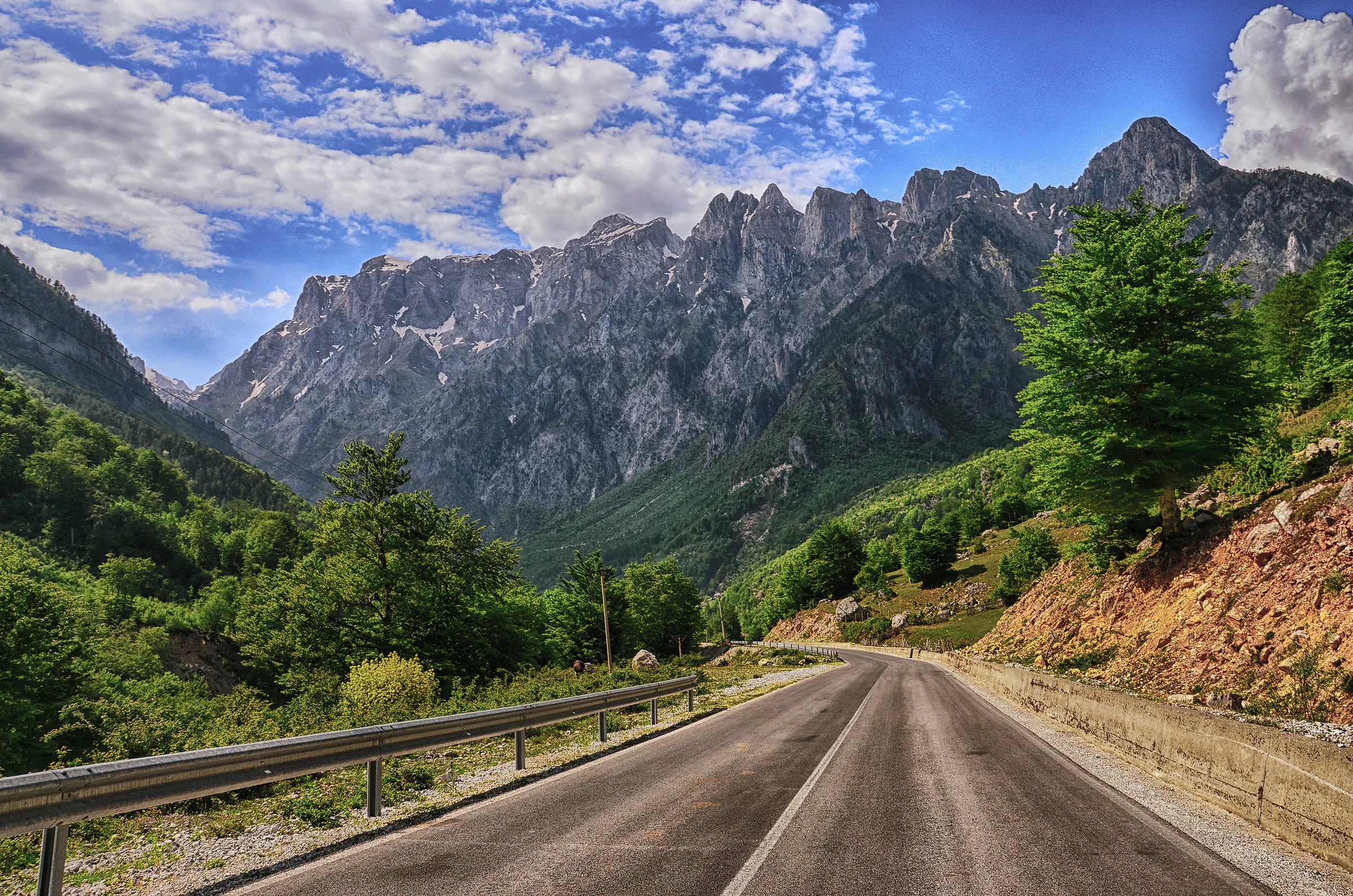
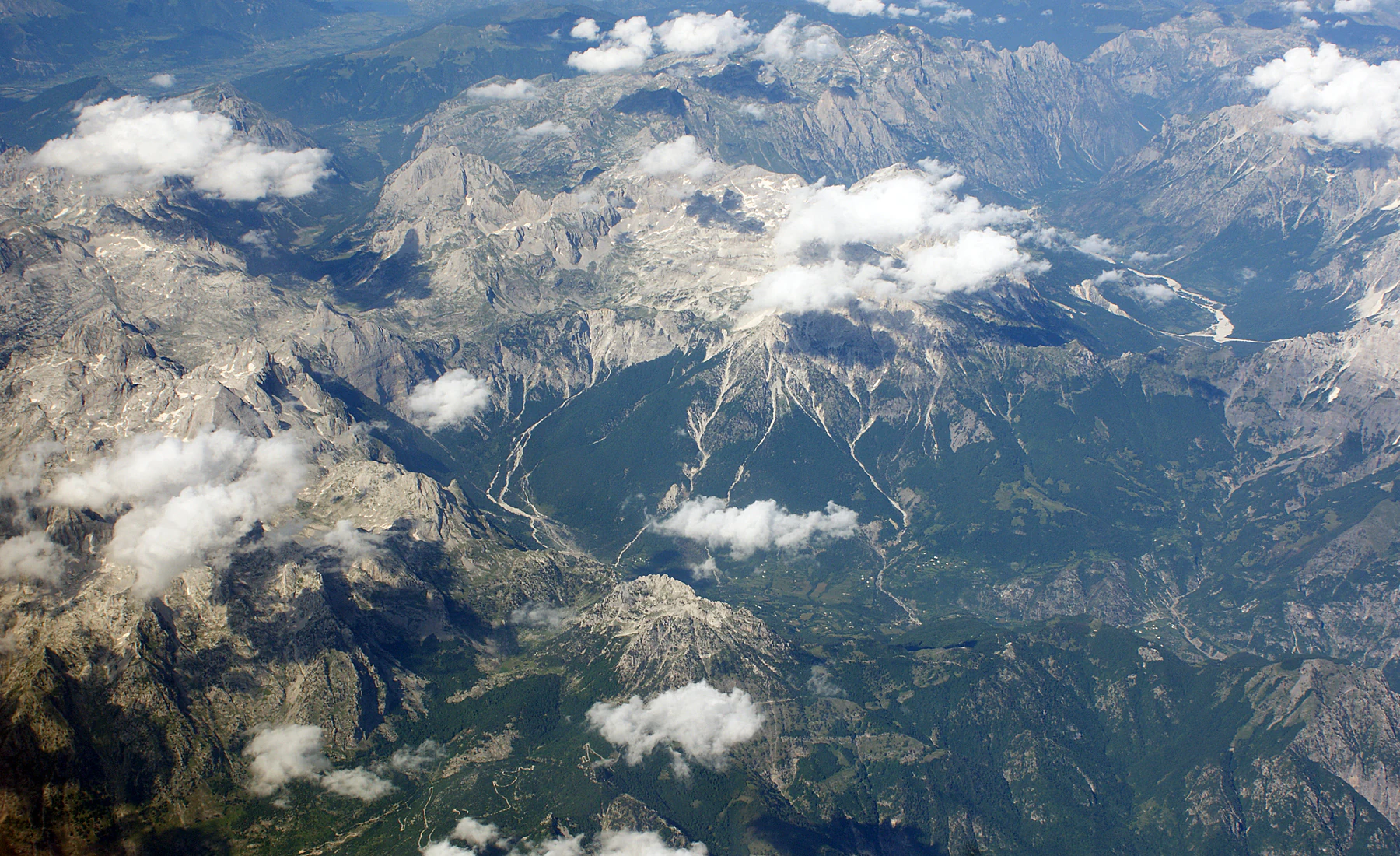
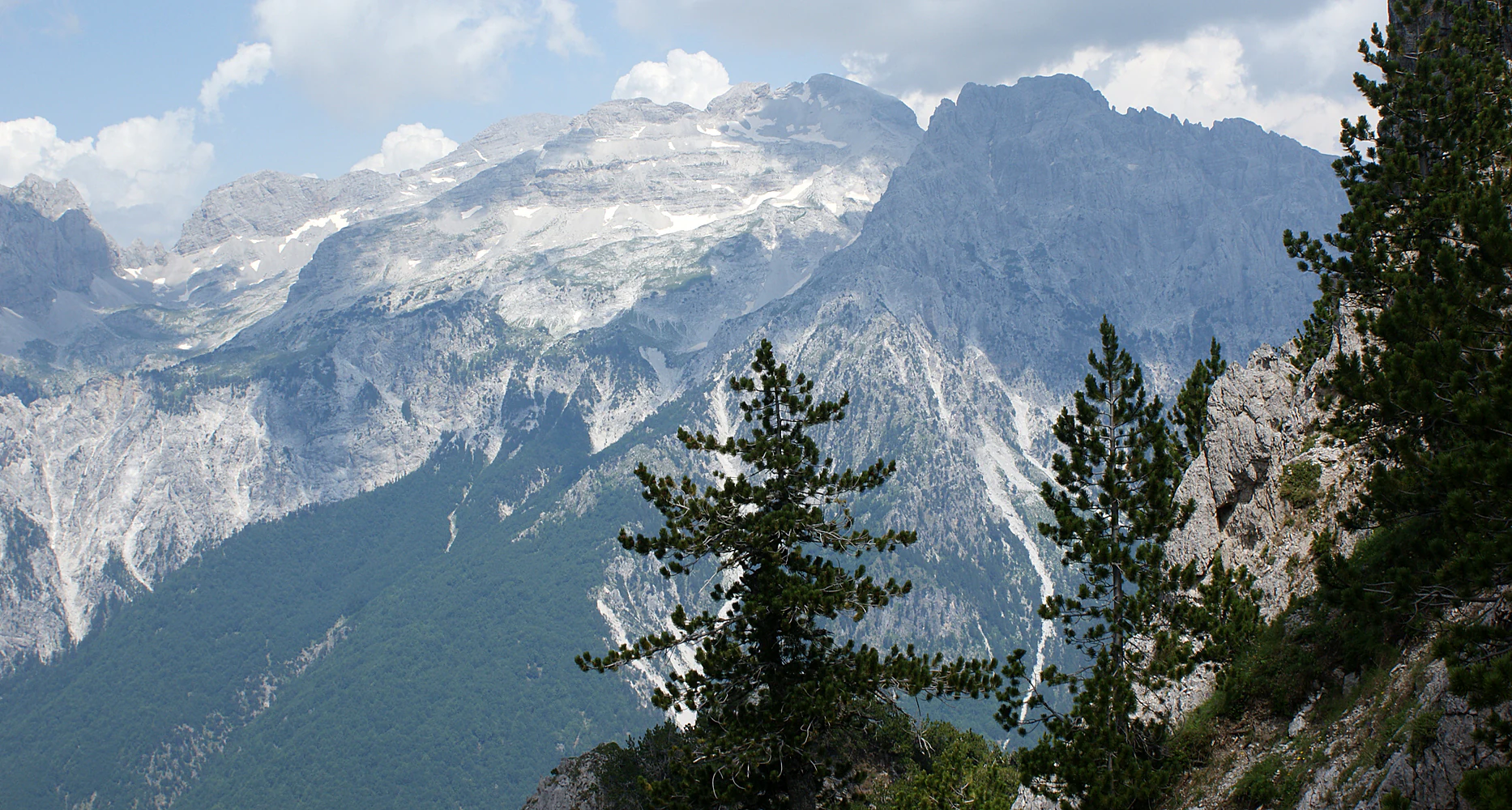
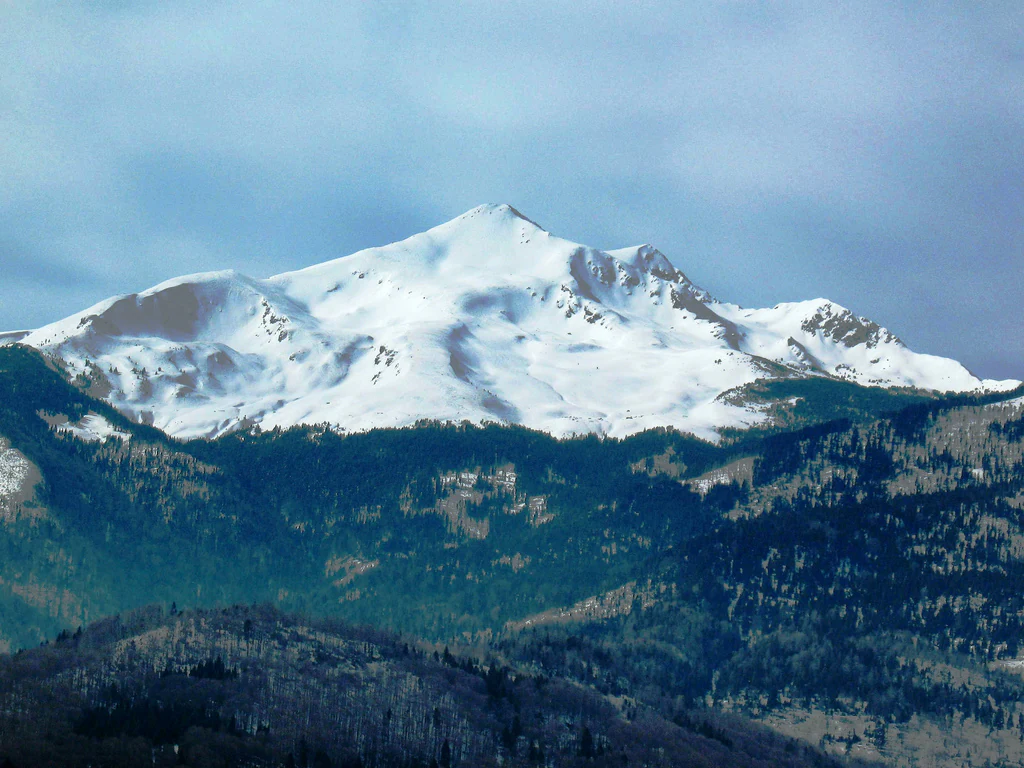
The defining scenic profile of the Accursed Mountains comes from a combination of karstic limestone relief and intense Pleistocene glaciation, producing a landscape of deep valleys, sheer cliffs, and jagged ridges. Maximum relief differences of around 1,800 metres occur within the Valbona, Grbaja, Ropojani, and Cem valleys, making the terrain feel compressed and almost pathless in the western and central parts of the range, while the eastern mountains are slightly gentler with lower relief.
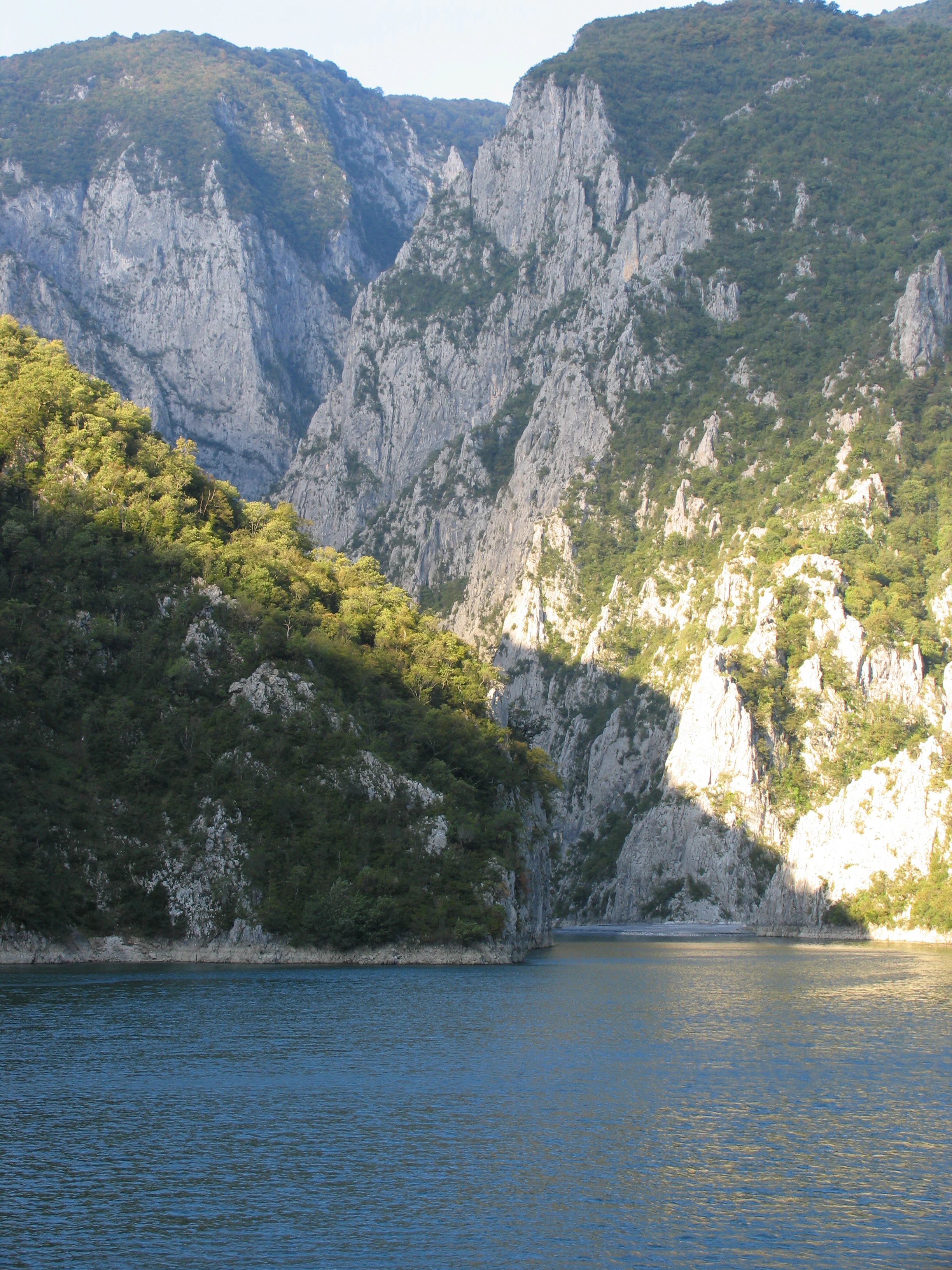
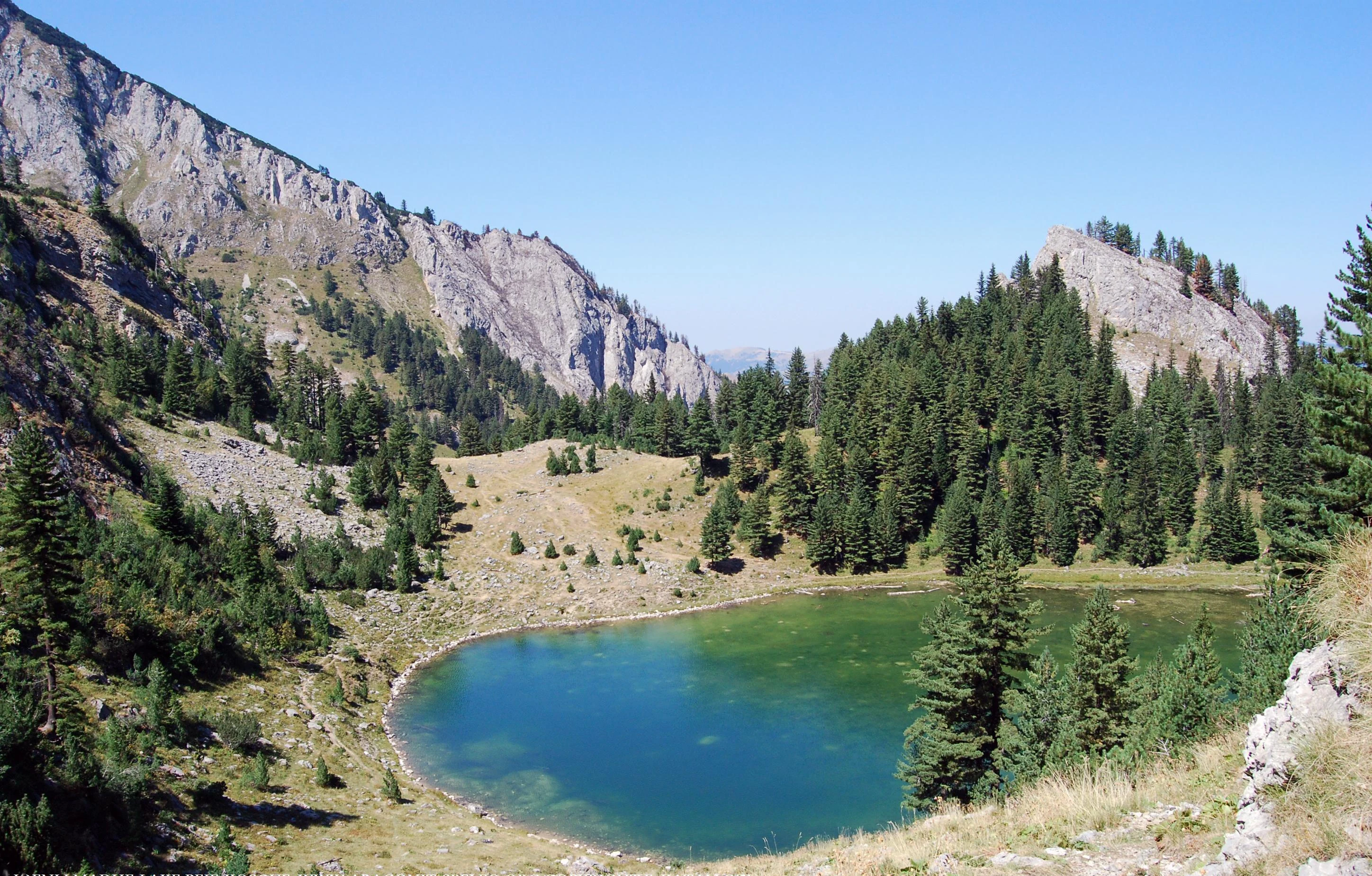
The walls and ridges are typical of a Dinaric karst high-mountain system: pointed peaks, overhanging crests, and limestone slabs that produce the appearance of hostile, unfriendly terrain, a quality that likely inspired the range's ominous name. Glacial erosion has cut deep troughs and left numerous glacial lakes, particularly in the Buni Jezercë 'Valley of the Lakes' near the Jezerca Peak on the Albanian side. The most spectacular canyon is the Rugova Canyon in Kosovo, a 25-kilometre-long river-cut gorge with vertical walls rising about 1,000 metres above the Lumbardhi i Pejës.
The south wall of Maja Harapit, at about 800 metres of vertical rock, is one of the highest continuous faces in the Balkans, and the surrounding massifs of Maja e Hekurave, Biga e Gimajive, and the Jezerca block offer some of the most dramatic high-alpine scenery anywhere in southeastern Europe. River scenery is equally remarkable, with the Drin dominating the southern slopes, the White Drin carving rocky gorges near Peja, the Tara and Lim defining northern valleys, and small but powerful streams such as the Lumbardhi i Pejës producing deep canyons inland. Waterfalls such as the White Drin Waterfall near Peja and the Grunas Waterfall in Theth are notable visual features of the range.
Accursed Mountains ecosystems, habitats, and plant life
The vegetation of the Accursed Mountains is among the richest on the Balkan Peninsula and one of the most important floristic centres of central Europe. In the Albanian portion alone, more than 1,600 wild plant species have been recorded, with more than fifty classified as endemic, sub-endemic, or endangered. The combination of significant altitude and favourable habitat supports one of the strongest concentrations of arcto-alpine relict flora on the peninsula: of around 77 species of arcto-alpine glacial flora documented across the Balkans, slightly more than 50 are present here.
The southern edge of the range has a sub-Mediterranean character, with evergreen shrubs in the deepest canyon valleys and on sunny slopes, while deciduous shibljak shrublands occupy the higher valleys. Across the full altitudinal range, one moves through upland valley vegetation into montane beech, fir, and Norway spruce forests, and finally into the treeless alpine and subalpine mats and the rocky, frost-shattered subnival zone near the summits. The Mediterranean black pine (Pinus nigra) thrives on dry rocky sites, while aspens, mountain maple, and Norway spruce occupy damper slopes. The Balkan pine (Pinus heldreichii) on carbonate rocks and the Macedonian pine (Pinus peuce) on silicate rocks are typical Balkan endemics that give the high forests a distinctive character.
Many of the plants here have unusually restricted distributions. Wulfenia baldaccii, an alpine plantain relative, is essentially confined to a narrow zone in the central Accursed Mountains; the Albanian lily (Lilium albanicum) and Viola ducagjinica grow only on specific peaks such as Maja Radohimës; Petasites doerfleri is limited to the Jezerca peaks; and Viola chelmea is otherwise found only in parts of Asia Minor. The Accursed Mountains are also the only European area that hosts the Tertiary relict Forsythia europaea, highlighting the range's role as a long-term botanical refuge that has preserved species lost elsewhere in Europe during the ice ages and subsequent climatic shifts.
Accursed Mountains wildlife and species highlights
The fauna of the Accursed Mountains is shaped by the same forces that shape the flora: deep glacial valleys, intact forest cover, and elevation that creates both refuge and barrier. The range is one of the last strongholds in southeastern Europe for large mammals that have largely disappeared from the rest of the continent. Brown bears, grey wolves, golden jackals, red foxes, European wildcats, wild boar, Eurasian otters, and all three Balkan deer species, roe deer, fallow deer, and red deer, still maintain viable populations here.
The carnivore of greatest conservation interest is the Balkan lynx, a subspecies of the Eurasian lynx. Reduced to very small numbers, it survives chiefly in the high country around Theth on the Albanian side, where an estimated 20 to 50 individuals roam, although poaching remains a serious threat. Chamois inhabit the high rock-and-scree zone, with around 720 individuals counted along the Kosovo–Montenegro border. Historically, mouflon roamed the range as well, though they are believed to have vanished around the time of the First World War.
The birdlife is equally distinctive. Raptors such as the golden eagle, snake eagle, honey buzzard, and peregrine falcon patrol the cliffs and alpine meadows, while forest grouse like the capercaillie and rock-dwelling species such as the rock partridge thrive in the mid-elevation habitat. Smaller specialities include the scops owl, Eurasian eagle owl, and snow finch in the high pass zone. With roughly 140 species recorded, the Accursed Mountains are also described as the richest area in Europe for butterflies.
Aquatic and reptile biodiversity is strong. The cold, clear rivers sustain marble trout populations of growing interest for conservation, while amphibians include the alpine salamander (at what may be its southernmost habitat), the fire salamander, yellow-bellied toad, and fire-bellied toad. Reptiles range from the fence lizard and green lizard to the Greek tortoise and several snakes, including venomous species such as the horned viper and adder. The range is also the only home of one endemic reptile, the Prokletije rock lizard (Dinarolacerta montenegrina), named after the massif it inhabits.
Accursed Mountains conservation status and protection priorities
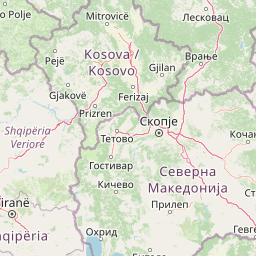
The Accursed Mountains carry conservation significance far beyond their borders. They represent one of the largest intact complexes of high-mountain wilderness left in southeastern Europe, anchoring a network of protected areas that spans three countries. Each of the three nations that share the range has established its own flagship national park on its side of the massif, creating a de facto conservation corridor across the border.
In Montenegro, Prokletije National Park was declared in 2009 and covers roughly 16,000 hectares of the Montenegrin portion of the range. The Kosovar side is protected through Bjeshkët e Nemuna National Park, established in 2012 over about 50,000 hectares, including substantial alpine terrain and the Rugova Canyon. Albania moved further in 2022, merging the former Theth National Park, the Valbona Valley National Park, and the Gashi River Strict Nature Reserve into the enlarged Alps of Albania National Park, which now covers around 86,000 hectares. Earlier conservation actions include a small floral mountain reserve covering Macedonian pine, pine, and beech on Maja e Ropës, declared in 1955 by Yugoslavia, and the Kozhnjar fauna reserve established the same year to safeguard chamois.
There is also a longer-term transboundary initiative: since 2010, Kosovo, Albania, and Montenegro have been working toward a Balkans Peace Park across the range's tri-border region, an effort to coordinate protection, tourism, and sustainable development across the same highland terrain that the three national parks now cover individually. Despite these frameworks, the range faces ongoing conservation pressure. Illegal logging is widespread and even affects parts of the protected zones, while summer forest fires are increasingly common. Hunting of large mammals, including wolves, chamois, foxes, badgers, and wild boar, often proceeds without regard to park boundaries, and the survival of the Balkan lynx remains precarious.
Accursed Mountains cultural meaning and human context
The Accursed Mountains are a deeply human landscape, despite their ruggedness, and centuries of transhumant pastoralism have shaped both the vegetation and the cultural geography of the valleys, with seasonal movement of livestock between lowland winter pastures and high summer settlements.
The range is ethnographically distinctive, historically home to numerous Albanian highland tribes whose names still echo the geography of the region, including the Hoti, Gruda, Kelmendi, Kastrati, Dukagjini, Shkreli, Shala, Nikaj, Krasniqi, Gashi, Kuči, and Rugova communities. Many villages have been inhabited since at least the 15th century, and some valleys show evidence of much older settlement back into the Stone Age. The result is a region of dispersed highland hamlets, clan-based identity, and a layered cultural memory tied closely to mountain pastures.
The origin of the very name 'Accursed Mountains' is wrapped in local legend, with stories ranging from the Devil escaping hell to a desperate mother cursing the dry peaks while searching for water, or Slavic soldiers struggling to march through them. Modern times have brought demographic shifts: the fall of communism triggered large-scale emigration, and many interior villages such as Boga, Theth, and Valbona are now inhabited mainly in summer, abandoned in winter when snow cuts them off for weeks, leaving the range sparsely populated and dependent on remittances, small-scale agriculture, semi-legal forestry, and a gradually growing rural-tourism economy.
Top sights and standout views in Accursed Mountains
The Accursed Mountains stand out as one of Europe's most concentrated assemblies of karstic relief, glacial history, and ecological richness, all compressed into a relatively small stretch of the western Balkans. Few ranges offer the same combination of steep alpine valleys, deep canyon gorges, abundant glacial lakes, and a highland culture still living in tune with seasonal pastoral rhythms.
The defining qualities include the range's position as the highest Dinaric massif, with Maja Jezercë at 2,694 metres the topmost peak of the entire Dinaric chain; its dramatic glacial and karstic landscape, including the deep Rugova Canyon, the Buni Jezerce lake cluster, and the highest rock faces in the Balkans; one of the wettest climates on the continent, sustaining lush forests and relict alpine vegetation; a flora of exceptional botanical richness, with more than 50 endemic or threatened plants and one of the most important arcto-alpine relict floras in southeastern Europe; and a fauna that includes the Balkan lynx, chamois, brown bear, wolf, and an extraordinary butterfly fauna of around 140 recorded species.
A further distinctive quality is the convergence of three national parks, in Albania, Kosovo, and Montenegro, around one continuous massif, an arrangement that has created the foundation for the proposed transboundary Balkans Peace Park and gives the Accursed Mountains an unusually rich role in modern Balkan conservation.
Best time to visit Accursed Mountains
The Accursed Mountains have the feel of a year-round adventure landscape, but the experience varies strongly with season. Spring and summer bring flowering alpine meadows, ice-free glacial lakes, and active high-country wildlife, while late summer and early autumn are often considered the most stable window for trekking and photography, with the snowline confined to the very highest peaks and most higher passes and trails comfortably walkable.
Late summer is also a major window for raptors and chamois sightings in open rocky terrain. Winter is a demanding season: deep snow, frequent closure of mountain roads, and seasonal isolation of interior villages. Snow can persist at high elevations even in summer in unusually wet years, adding dramatic atmosphere to the highest peaks but complicating access. The combination of heavy year-round precipitation, deep winter snow, and lingering summer snowfields shapes both the ecology of the range and the experience of anyone travelling through it.