
Mori Atlas logo
Nature reserveRezerwat przyrody Bagno Serebryskie

Analyzing the ecological boundaries and wetland terrain of this significant eastern Polish nature reserve.

Rezerwat przyrody Bagno Serebryskie: A Protected Calcareous Fen Landscape and Map Overview

Rezerwat przyrody Bagno Serebryskie represents a vital protected landscape in the Lubelskie Voivodeship of eastern Poland, defined by its expansive calcareous peatlands. This site functions as an essential refuge for rare flora and specialized wetland bird populations, set within the distinct low-lying terrain of the Obniżenie Dubieńskie mesoregion. Understanding the geographic distribution of its waterlogged sedge mats and mineral-rich substrates offers deeper insight into this unique alkaline-dependent ecosystem.

peatlandcalcareous fenwetlandbird sanctuaryaquatic warblerendangered birds
A stylized vector illustration of a scenic outdoor landscape showing a dirt path leading past birch trees toward a waterfall and distant mountains under a warm sun.

Rezerwat przyrody Bagno Serebryskie

Nature reserve

Park overview

Structured park overview, official facts, and landscape profile for Bagno Serebryskie Nature Reserve

Bagno Serebryskie Nature Reserve park facts, protected area profile, and essential visitor context

Review the core facts for Bagno Serebryskie Nature Reserve, including designation, size, terrain, visitor scale, habitats, and operating context in one park-focused overview.

About Bagno Serebryskie Nature Reserve

Bagno Serebryskie Nature Reserve occupies a distinctive position among Poland's protected peatlands. Located within the broader framework of the Chełm Landscape Park, the reserve focuses specifically on the calcareous fens that have developed on the mineral-rich substrate of eastern Poland's Obniżenie Dubieńskie mesoregion. These wetlands represent a habitat type that is uncommon both in Poland and across the wider European lowlands, where most surviving peatlands are acidic raised bogs rather than alkaline fens.

The reserve's ecological character is shaped by the interaction between calcareous geology and waterlogged soils. Limestone-rich groundwater supports a specialized flora of calcicole plants that would not survive in the more typical acidic peatland environments found elsewhere in the country. Among these are notable species such as the globeflower, large-flowered selfheal, military orchid, large-flowered anemone, and cross-leaved and narrow-leaved gentians. In the wettest sections of the reserve, dense stands of rusty sedge and tufted sedge, both Atlantic-origin species considered rare in Poland, form continuous carpets across the open peatland surface.

Beyond its botanical importance, Bagno Serebryskie has gained reputation as a key site for conservation of wetland-dependent birdlife. The mosaic of pools, sedge mats, and reed-fringed channels supports more than sixty protected bird species, including over thirty that breed within the reserve. Several of these, such as the aquatic warbler, the Eurasian curlew, the great snipe, the hen harrier, the spotted redshank, the Eurasian hobby, the jack snipe, and the Eurasian bittern, are classified as endangered or vulnerable across much of their range. The diversity of invertebrate life adds another layer of ecological significance, with the reserve's entomofauna reflecting the same calcareous wetland conditions that shape its plant communities.

The reserve is administered as part of the Chełm Landscape Park, and its protected status reflects concerns about drainage, peat extraction, and agricultural conversion that have affected similar wetlands elsewhere in the region. By setting aside the full peatland complex, the reserve preserves not only the open fen habitats but also the hydrological conditions on which they depend. This integrative approach makes Bagno Serebryskie a reference site for the conservation of calcareous peatlands in Poland and a meaningful contribution to the broader protection of European wetland biodiversity.

Quick facts and research context for Bagno Serebryskie Nature Reserve

Bagno Serebryskie Nature Reserve is a peatland reserve (rezerwat torfowiskowy) situated within the Chełm Landscape Park in eastern Poland. It lies in the Lublin Voivodeship, straddling the rural communes of Chełm and Ruda-Huta in Chełm County, and is geographically part of the Obniżenie Dubieńskie mesoregion.

The reserve was established in 1991 by order of the Minister of Environmental Protection, Natural Resources, and Forestry. It covers around 376 hectares of calcareous fen habitat, with a particularly high concentration of rare and protected plant and animal species.

Protection and recognition

Terrestrial protection status, management scope, and documented designation history

Rezerwat przyrody Bagno Serebryskie Protection Status and Recognition Data

Rezerwat przyrody Bagno Serebryskie maintains a documented terrestrial protection status with structured records on management scope. Official designation history and recognition sources outline the framework governing this protected area.

Protection details

Protection scope
Terrestrial
Transboundary protection
No
Park context

Deeper park guide and search-rich context for Bagno Serebryskie Nature Reserve

Bagno Serebryskie Nature Reserve history, landscape, wildlife, and travel context

Explore Bagno Serebryskie Nature Reserve through its history, landscape character, ecosystems, wildlife, conservation priorities, cultural context, and seasonal travel timing in a structured park guide built for atlas discovery and search intent.

Why Bagno Serebryskie Nature Reserve stands out

Bagno Serebryskie is best known for its calcareous peatlands, specialized alkaline-loving plant communities, and its importance as a refuge for endangered wetland birds. The reserve stands out among Polish protected areas for its concentration of rare Atlantic-origin plants, and it has been recognized for its significance to the conservation of the aquatic warbler at a European level.
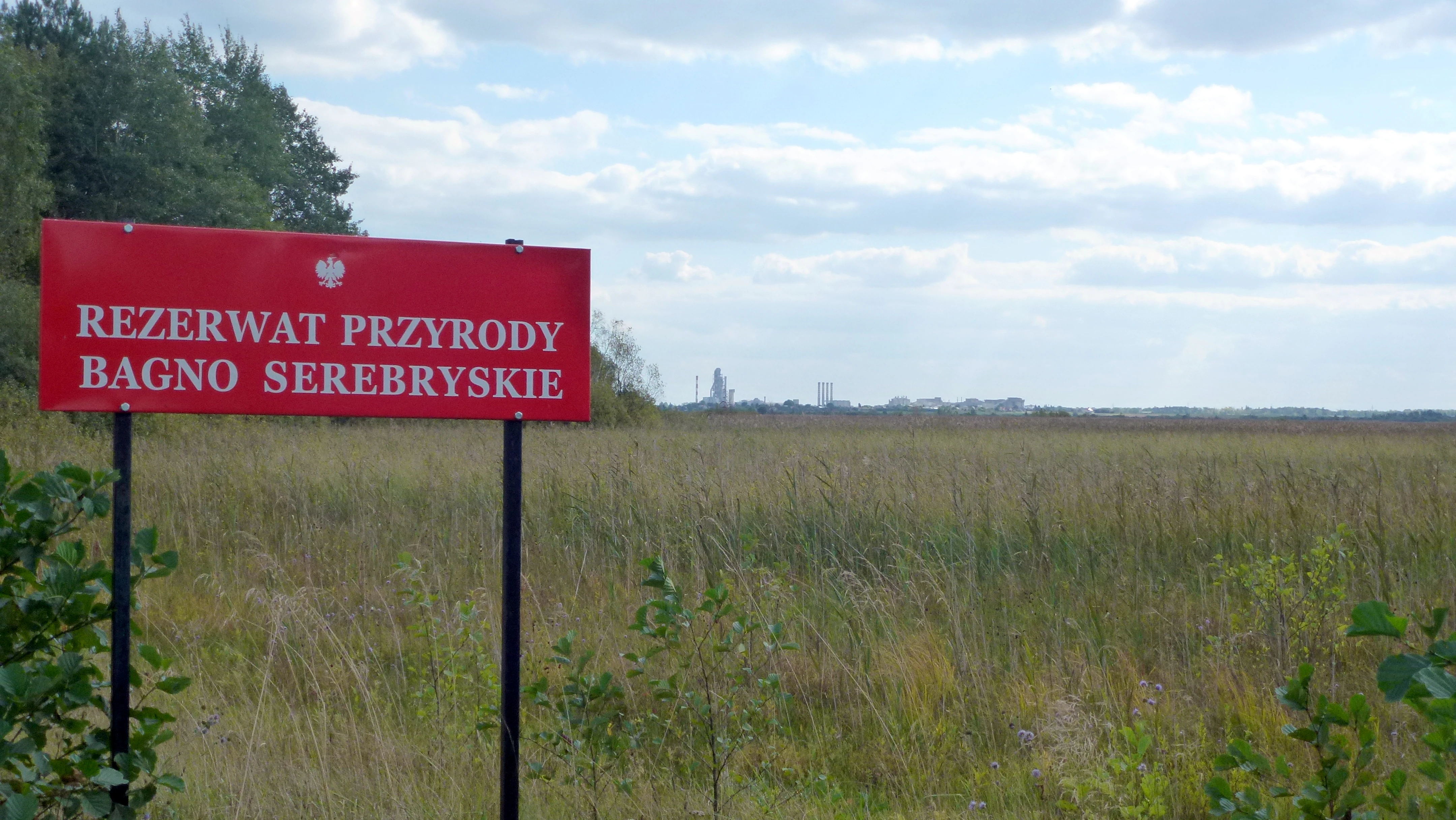
A red rectangular sign with white text reading Rezerwat przyrody Bagno Serebryskie stands on two black posts in front of a vast, grassy peatland landscape under a cloudy sky.
A red park information sign marks the entrance to Bagno Serebryskie Nature Reserve in Poland.

Bagno Serebryskie Nature Reserve landscape and geographic character

The landscape of Bagno Serebryskie is defined by flat, open peatland terrain typical of eastern Poland's lowland basins. The reserve lies within the Obniżenie Dubieńskie, a mesoregion characterized by gentle depressions and mineral-rich substrates that have supported the development of calcareous fens rather than the more common acidic bog systems.

The terrain is waterlogged for much of the year, with sedge-dominated mats, shallow standing water, and slow-moving channels threading through the open expanse. The flat topography and lack of woodland cover within the core peatland area give the reserve an expansive, marshy character, while transitional margins meeting agricultural land and forested patches create additional habitat structure along the edges of the protected zone.
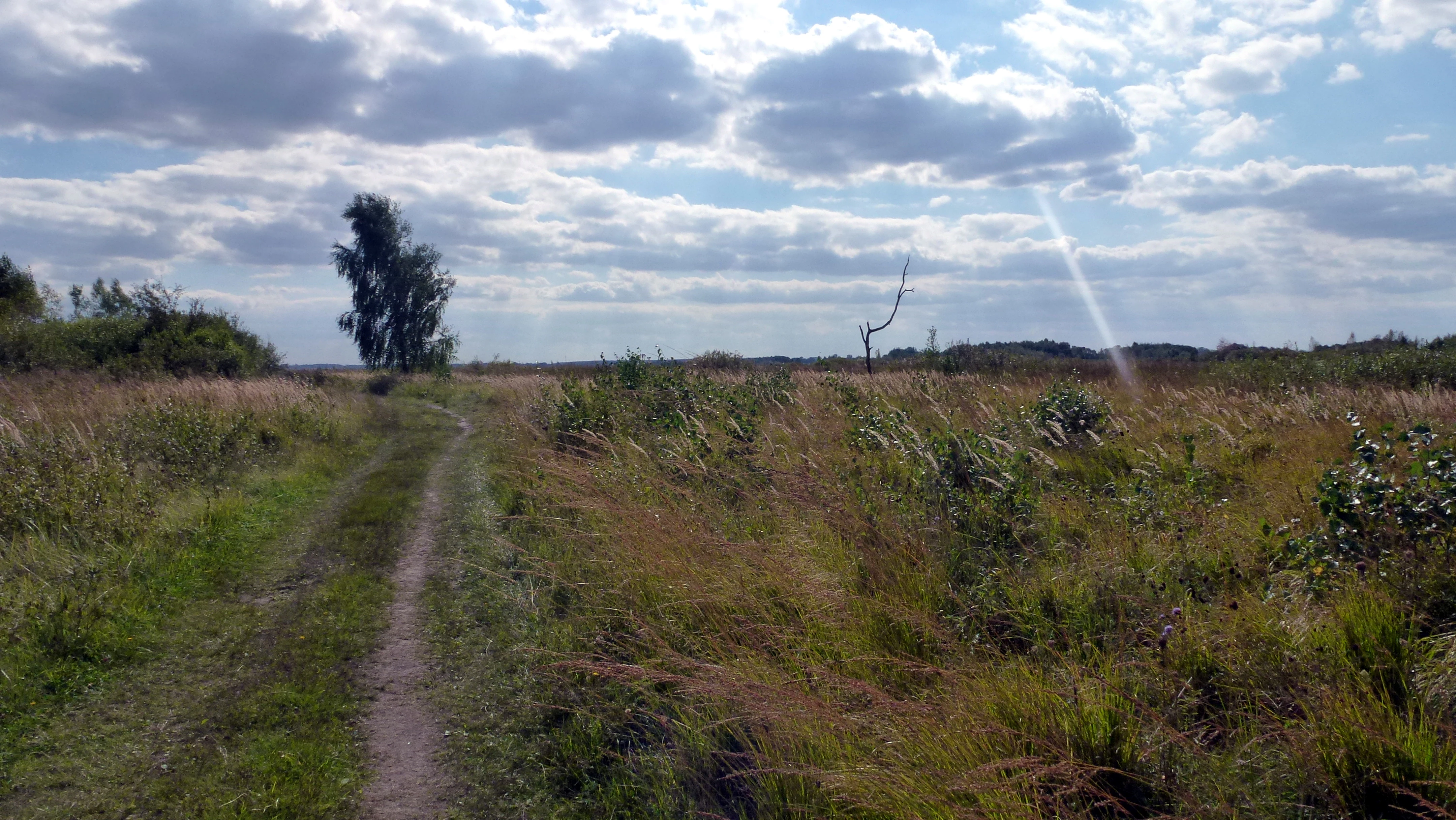
A narrow dirt path leads through a vast, grassy peatland landscape under a bright, partly cloudy sky.
A dirt trail winds through the open wetlands of Bagno Serebryskie Nature Reserve.

Bagno Serebryskie Nature Reserve ecosystems, habitats, and plant life

Bagno Serebryskie protects one of Poland's most notable examples of calcareous peatland, a habitat type shaped by the underlying limestone-influenced hydrology of the region. The resulting alkaline conditions support a flora very different from that of the acidic raised bogs more commonly associated with Polish peatlands. Calcicole species dominate the botanical interest of the reserve, and the presence of Atlantic-origin sedges gives the habitat a distinctive biogeographic character.

The vegetation structure is layered, ranging from open water and submerged aquatics through dense sedge mats and reedbed margins, up to taller herbaceous communities at the peatland edges. This mosaic of microhabitats creates the ecological conditions that sustain the reserve's unusually high species diversity across multiple taxonomic groups. The peatland functions as an integrated wetland system, where hydrology, soil chemistry, and plant communities are closely linked and mutually reinforcing.
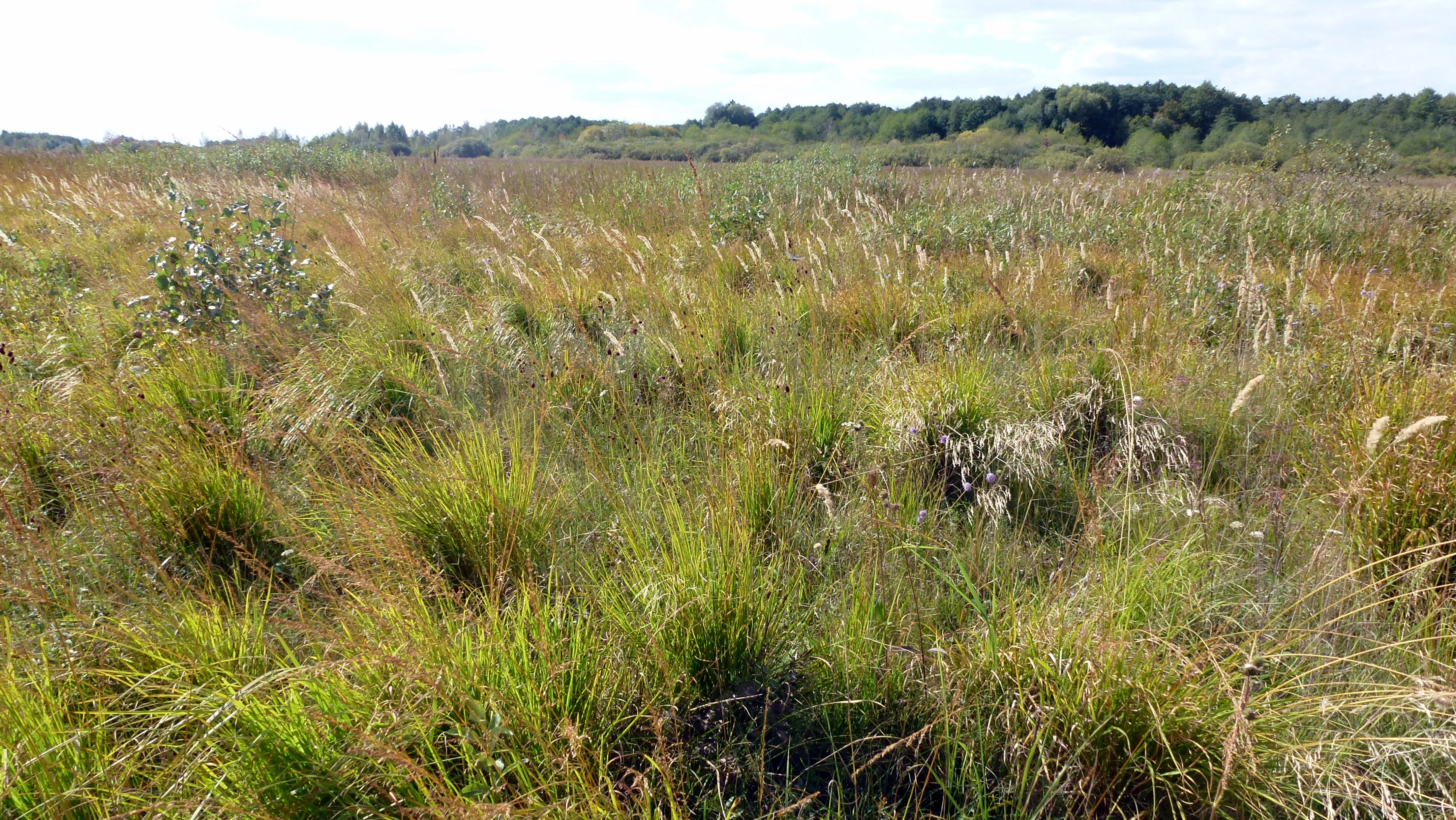
An eye-level wide shot of an open, grassy peatland landscape with a distant treeline under a bright sky.
A view of the open fen landscape within Bagno Serebryskie Nature Reserve, characterized by grasses and shrubs.

Bagno Serebryskie Nature Reserve wildlife and species highlights

The reserve is most celebrated for its birdlife, with over sixty protected bird species recorded and more than thirty confirmed as breeding within its boundaries. The aquatic warbler holds particular importance: this globally threatened passerine depends on sedge-dominated wetlands for nesting, and Bagno Serebryskie is recognized as one of the significant sites for the species' conservation at the European level. Other notable or threatened breeding birds include the Eurasian curlew, the great snipe, the hen harrier, the spotted redshank, the Eurasian hobby, the jack snipe, and the Eurasian bittern, each reflecting the value of the reserve's mosaic of wet meadows, sedge beds, and shallow pools.

The invertebrate fauna is similarly rich, with the calcareous peatland environment supporting a specialized entomofauna that adds to the site's ecological distinction. The combination of rare plants, varied wetland microhabitats, and associated insect communities makes the reserve a relatively complete example of an intact calcareous peatland ecosystem, with wildlife value extending well beyond any single species group.

A wide panoramic view of a green, flat peat bog landscape with scattered shrubs and a few distant trees under a clear sky.
A panoramic view of the peat bog landscape at Bagno Serebryskie Nature Reserve.

Bagno Serebryskie Nature Reserve conservation status and protection priorities

Bagno Serebryskie was established in 1991 specifically to preserve its calcareous peatlands and the rare species they support. The reserve's founding reflected growing awareness of the vulnerability of Polish peatlands to drainage, agricultural conversion, and peat extraction, all of which had degraded similar sites elsewhere in the region. By formal protection of the full wetland complex, the reserve safeguards not only the surface habitats but also the hydrological regime on which the calcareous fens depend.

At a wider scale, the reserve is recognized for its importance to the conservation of certain species that are in decline across Europe. Most notably, it has been highlighted as a key site for the protection of the aquatic warbler, a species whose breeding range has contracted significantly in recent decades. The designation as part of the Chełm Landscape Park adds another layer of landscape-level protection, surrounding the strict reserve with a buffer of managed countryside that helps maintain the ecological integrity of the peatland core.

Top sights and standout views in Bagno Serebryskie Nature Reserve

The reserve's highlights include its exceptional calcareous peatland, one of the most botanically distinctive wetland habitats in Poland, and its outstanding importance for endangered wetland birds, especially the aquatic warbler. Dense stands of Atlantic-origin sedges and a rich assemblage of calcicole plants give the site strong scientific and conservation value, while its inclusion within the Chełm Landscape Park reinforces its role as a flagship wetland protected area in eastern Poland.
Monthly climate preview

Long-term temperature ranges and precipitation patterns across the representative coordinate

Rezerwat przyrody Bagno Serebryskie Climate Normals and Average Temperatures

Rezerwat przyrody Bagno Serebryskie exhibits measured annual temperature variations and monthly precipitation levels spanning from winter minimums to summer maximums. Reviewing the complete twelve-month statistical profile clarifies the broader long-term climatological rhythm recorded at the reference point.
Annual mean8 °C
-4 °C20 °C
Jan-4°
Feb-3°
Mar
Apr
May14°
Jun18°
Jul20°
Aug20°
Sep14°
Oct
Nov
Dec-3°
Warmest month
July

20.1 °C

Coolest month
January

-4.4 °C

Wettest month
July

2.7 mm/day

Driest month
January

1.2 mm/day

Park location guide

Geography guide, regional context, and park location map for Bagno Serebryskie Nature Reserve

Bagno Serebryskie Nature Reserve park geography, regions, and map view in Poland

Understand where Bagno Serebryskie Nature Reserve sits in Poland through a broader geographic reading of the surrounding landscape, nearby location context, and its mapped position within the national park landscape.

How Bagno Serebryskie Nature Reserve fits into Poland

Poland, officially the Republic of Poland, is a Central European country spanning from the Baltic Sea in the north to the Carpathian Mountains in the south. It borders Germany, Czech Republic, Slovakia, Ukraine, Belarus, Lithuania, and Kaliningrad Oblast. The country has a temperate climate, diverse landscapes, and is known for its rich history, cultural heritage, and strong economic position within the EU.

Wider geography shaping Bagno Serebryskie Nature Reserve in Poland

Poland occupies 312,696 km2 in Central Europe, extending from the Baltic Sea coast in the north to the Sudetes and Carpathian Mountains in the south. It borders Germany to the west, Czech Republic and Slovakia to the south, Ukraine and Belarus to the east, and Lithuania and Kaliningrad Oblast to the northeast. The landscape includes lowland plains, uplands, and mountain ranges.

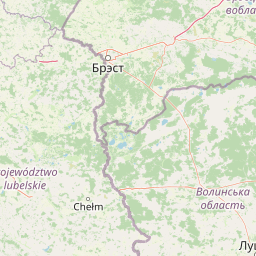
Map view of Bagno Serebryskie Nature Reserve

Use this park location map to pinpoint Bagno Serebryskie Nature Reserve in Poland, understand its exact geographic position, and read its mapped placement within the surrounding landscape more clearly.

Pigeon | © OpenStreetMap contributors

Location context for Bagno Serebryskie Nature Reserve

Lubelskie Voivodeship

Visual exploration of calcareous fens, waterlogged terrain, and wetland habitats

Rezerwat przyrody Bagno Serebryskie Photos and Landscape Scenery

Photographic records capture the expansive lowland basins, shallow standing water, and sedge-dominated mats defining the protected wetland ecosystem. Visual reference materials reveal the unique botanical character, limestone-rich substrates, and open marsh terrain characteristic of eastern Poland.

A red rectangular sign with white text reading Rezerwat przyrody Bagno Serebryskie stands on two black posts in front of a vast, grassy peatland landscape under a cloudy sky.

A narrow dirt path leads through a vast, grassy peatland landscape under a bright, partly cloudy sky.

An eye-level wide shot of an open, grassy peatland landscape with a distant treeline under a bright sky.

A wide panoramic view of a green, flat peat bog landscape with scattered shrubs and a few distant trees under a clear sky.

A rustic, wooden bird-watching observation tower stands on the left in a vast, open peatland field under a cloudy sky.

Park atlas

Compare regional wetland reserves and neighboring lowland conservation landscapes

Parks Near Rezerwat przyrody Bagno Serebryskie and Surrounding Protected Areas

Visitors exploring Rezerwat przyrody Bagno Serebryskie can examine adjacent lowland wetlands and regional protected areas to understand eastern Poland's diverse peatland habitats. Comparing nearby nature reserves reveals broader ecological patterns across neighboring river basins and limestone fens.
A watercolor illustration showing a soft, stylized landscape of rolling green hills, distant mountains, and coniferous trees against a white background.
Protected landscapeLublin Voivodeship
About 4.4 km away#1 closest

North

Chełmski Park Krajobrazowy: A Detailed Atlas of the Protected Landscape in Lublin Voivodeship

Exploring the calcareous peatlands and diverse wetland topography

Located in eastern Poland, Chełmski Park Krajobrazowy is a protected landscape shaped by unique geological features and rich botanical habitats. This overview explores the park's transition from upland hills to lowland depressions, its internal nature reserves, and its function as a critical biodiversity center within the Lublin Voivodeship landscape.

Area
164.57 km²
Established
1983
Relief
Upland
Climate
Temperate
Protected areaLublin Voivodeship
About 14 km away#2 closest

Northeast

Poleska Dolina Bugu Protected Landscape: Mapped Atlas and Geographic Overview

Key Natura 2000 river valley site in Lublin Voivodeship

Poleska Dolina Bugu is a regionally vital protected area comprising six connected enclaves along the Bug River. The site features a mosaic of oxbow lakes, alkaline fens, molinia meadows, and riparian woodlands that define the lowland geography of eastern Poland. Access structured data on this Habitats Directive site to understand its surface composition, floodplain connectivity, and specialized conservation habitats.

Area
81.732 km²
Relief
Lowland
Scope
Terrestrial
Water
Major water bodies
Nature reservePoland
About 16 km away#3 closest

Northwest

Rezerwat przyrody Bachus: Protected Nature Reserve and Forest Atlas in Eastern Poland

Mapping sessile oak woodlands and protected landscape boundaries

Rezerwat przyrody Bachus is a notable nature reserve in Poland, recognized for its role in preserving sessile oak within the broader Chełmski Landscape Park. This atlas entry provides geographic context on the reserve, detailing its position within the lowland terrain of the Lubelskie region and its importance as an edge-of-range forest sanctuary.

Area
0.826 km²
Established
1958
Relief
Lowland
Climate
Temperate
Nature reserveLublin Voivodeship
About 21 km away#4 closest

Southeast

Żmudź Nature Reserve: A Protected Mosaic of Xerothermic Grassland and Calcareous Terrain

Calcareous habitat protection in the Lublin Voivodeship

Żmudź represents a highly specific protected landscape in southeastern Poland, focused on the conservation of rare xerothermic grassland communities and calcareous soil formations. This site serves as a vital ecological record of the Lublin Upland, featuring a distinct texture of juniper thickets, open rock outcrops, and sun-exposed limestone slopes that support diverse plant populations.

Area
0.441 km²
Established
2011
Relief
Lowland
Scope
Terrestrial
A watercolor painting showing a panoramic view of a marshy landscape with green grasses, light-colored water, and distant trees on a white background.
National parkLublin Voivodeship
About 22 km away#5 closest

Northwest

Poleski Park Narodowy: Protected Wetlands and Glacial Geography in Lublin Voivodeship

Exploration of peatlands, kettle lakes, and boreal-style marshes

Poleski Park Narodowy encompasses a diverse mosaic of fens, transitional bogs, and dense marsh forests within the Lublin Voivodeship. This protected area serves as a primary reference for understanding the glacial-relict biodiversity and flat, water-defined terrain characteristic of the historic Polesie region in eastern Poland.

Area
97.6 km²
Established
1990
Visitors
41K annual
Relief
Lowland
Nature reserveLubelskie Voivodeship
About 23 km away#6 closest

North

Rezerwat przyrody Małoziemce: Nature Reserve Protected Areas and Geographic Map Context

A faunal reserve within the Łęczna-Włodawa Lake District

Rezerwat przyrody Małoziemce represents a specialized faunal protected area in Lubelskie Voivodeship. Established for the preservation of heron breeding colonies, the site is defined by its lowland, marshy terrain and its strategic inclusion within the larger Sobiborski Landscape Park. This entry provides detailed geographic perspective on how this forest and wetland complex fits into the regional network of protected landscapes near the Polish-Ukrainian border.

Area
0.38 km²
Established
1988
Scope
Terrestrial
Nature reserveLublin Voivodeship
About 31 km away#7 closest

Northwest

Jezioro Świerszczów Nature Reserve: A Detailed Geographic Atlas of Eastern Polish Protected Lands

Regional peatland and lake basin landscape context

Located in Lublin Voivodeship, Jezioro Świerszczów represents an essential study in lowland mire ecosystems. The reserve protects a small lake and surrounding transitional peatland, supporting a compact landscape mosaic that includes aquatic vegetation, alder carrs, and oak-hornbeam forest zones.

Area
0.461 km²
Established
1959
Relief
Lowland
Climate
Temperate
Protected landscapeLublin Voivodeship
About 33 km away#8 closest

Southeast

Strzelecki Park Krajobrazowy: Protected Landscape Geography and Mapped Natural Terrain

A forest-rich protected area along the Bug River in Poland.

Strzelecki Park Krajobrazowy is defined by its extensive pine forests and the expansive valley of the Bug River. This protected landscape contains a network of oxbow lakes, diverse wetland pockets, and vital bird habitats, mapping a distinct ecological corridor within the Lublin Voivodeship region of eastern Poland.

Area
120.26 km²
Established
1983
Relief
Lowland
Scope
Terrestrial

Common questions about visiting, size, designation, and location context for Bagno Serebryskie Nature Reserve

Bagno Serebryskie Nature Reserve FAQs for park facts, access, geography, and protected area context

Find quick answers about Bagno Serebryskie Nature Reserve, including protected-area facts, park geography, trail and visitor context, and how the park fits into its surrounding country and regional landscape.
MoriAtlas Explorer

Continue Your Protected Areas Search Across the Global Atlas

Deepen your exploration by continuing the structured search for national parks and protected areas worldwide. Utilize the comprehensive filtering capabilities to compare different conservation landscapes and refine your understanding of global park geography. Discover more about the distribution and characteristics of protected natural areas.

Global natural geography