Mori Atlas logo
Nature reserveRezerwat przyrody Bachus

Mapping the ecological significance and biogeographic boundaries of this sessile oak nature reserve

Rezerwat przyrody Bachus: A Protected Deciduous Forest Landscape in Eastern Poland

Rezerwat przyrody Bachus serves as a critical conservation enclave within the Lubelskie Voivodeship of eastern Poland, covering over 80 hectares of protected deciduous woodland. Situated inside the Chełmski Landscape Park, this reserve plays a key role in the regional atlas by protecting sessile oak stands at the eastern edge of their natural European distribution. The landscape features gently rolling lowland terrain, representing a vital study area for understanding forest ecology and protected land management in the Obniżenie Dubieńskie mesoregion.

forest reservedeciduous forestsessile oakoak woodlandedge-of-range speciesnature reserve

Rezerwat przyrody Bachus

Nature reserve

Park overview

Structured park overview, official facts, and landscape profile for Rezerwat przyrody Bachus

Rezerwat przyrody Bachus park facts, protected area profile, and essential visitor context

Review the core facts for Rezerwat przyrody Bachus, including designation, size, terrain, visitor scale, habitats, and operating context in one park-focused overview.

About Rezerwat przyrody Bachus

Rezerwat przyrody Bachus is a modest but ecologically focused Polish forest reserve situated in the eastern part of the country, in the Lubelskie Voivodeship, within Chełm County and the Sawin commune. Although its total area is relatively small at around 82.59 hectares, the reserve carries clear conservation value because of the vegetation it shelters and the broader protected landscape it forms part of.

The reserve sits inside the boundaries of the Chełmski Park Krajobrazowy, a regional landscape park that protects a larger mosaic of natural and cultural landscapes in this part of eastern Poland. Bachus is also placed administratively within the lands of the Chełm Forest District (Nadleśnictwo Chełm), operated by Poland's State Forests. Geographically, the area belongs to the Obniżenie Dubieńskie mesoregion, a lowland that borders the nearby Pagóry Chełmskie hills.

The core reason for the reserve's existence is biogeographic. It was designated to preserve a fragment of deciduous forest that includes sessile oak near the eastern margin of the species' native European range. Such edge-of-range forests often have special value for understanding species ecology, climate adaptation, and long-term forest dynamics. Because sessile oak is one of the principal broadleaf tree species of central European lowland and hill forests, a protected stand at the edge of its range forms an important reference point for forest conservation in Poland.

Quick facts and research context for Rezerwat przyrody Bachus

Bachus is a forest nature reserve in eastern Poland, within the Lubelskie Voivodeship and the Sawin commune. It covers approximately 82.59 hectares and was established in 1958 by an order of the Minister of Forestry and the Wood Industry. The reserve sits inside the Chełmski Park Krajobrazowy, a regional landscape park that surrounds it.

The reserve's founding purpose is to protect a stand of deciduous forest containing sessile oak at the edge of its natural geographic distribution. It is classified as an active protection reserve (ochrona czynna), which in Poland indicates ongoing direct management to maintain conservation values rather than passive preservation alone.

Protection and recognition

Examine the terrestrial protection scope and documented conservation status for Rezerwat przyrody Bachus.

Rezerwat przyrody Bachus Protection Status and Formal Designation Data

Rezerwat przyrody Bachus maintains a recorded terrestrial protection scope within the broader network of conserved natural areas. Structured designation records outline the official status and management framework governing this protected landscape.

Protection details

Protection scope
Terrestrial
Transboundary protection
No
Park context

Deeper park guide and search-rich context for Rezerwat przyrody Bachus

Rezerwat przyrody Bachus history, landscape, wildlife, and travel context

Explore Rezerwat przyrody Bachus through its history, landscape character, ecosystems, wildlife, conservation priorities, cultural context, and seasonal travel timing in a structured park guide built for atlas discovery and search intent.

Why Rezerwat przyrody Bachus stands out

The reserve is best known for protecting a population of sessile oak (dąb bezszypułkowy, Quercus petraea) growing near the boundary of the species' natural range. This edge-of-range occurrence gives the woodland a particular biogeographic importance, as sessile oak largely reaches its eastern European limit in this part of Poland. The reserve also preserves the broader deciduous forest community associated with this oak stand.
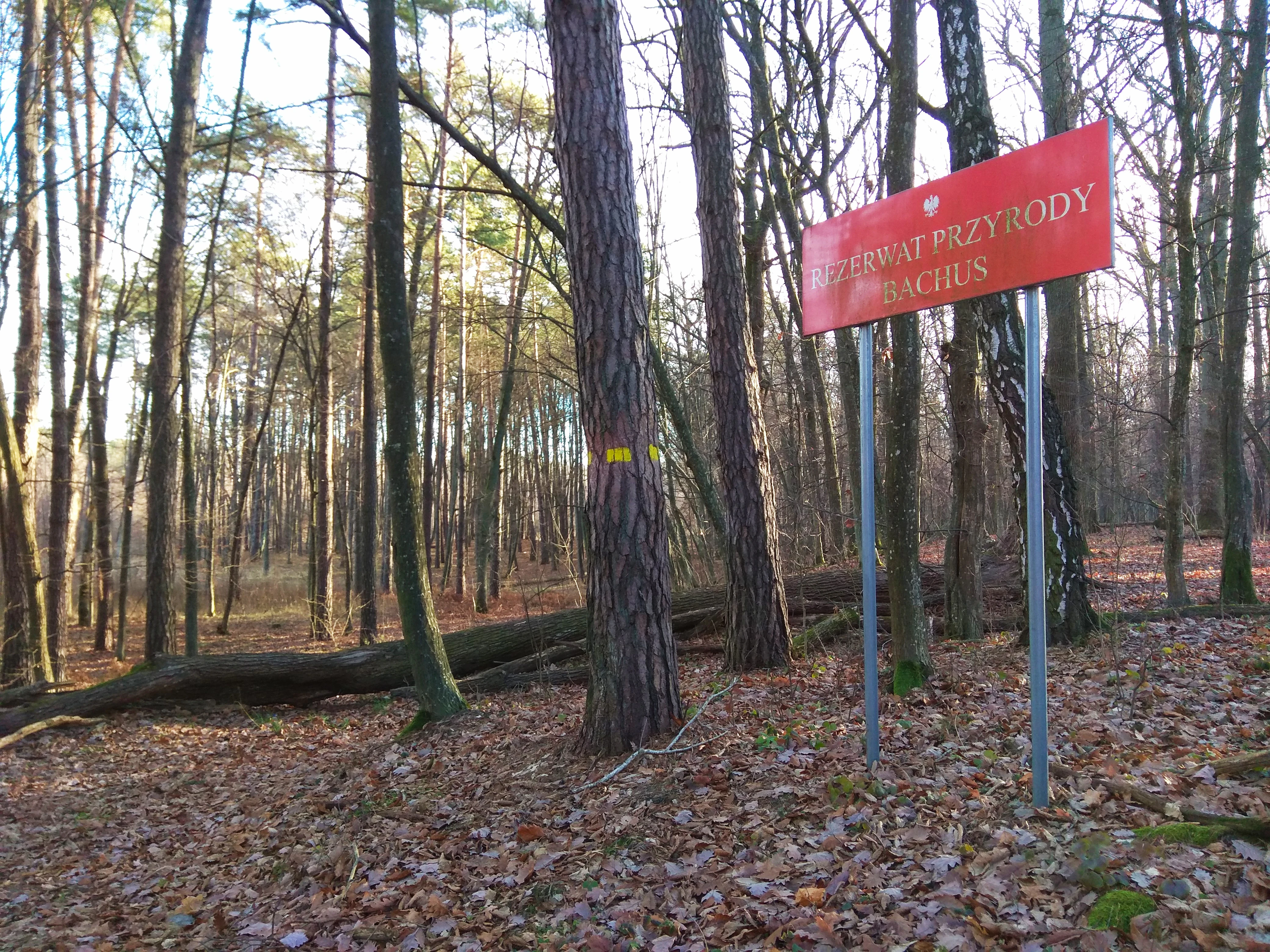
A red rectangular sign with white text that reads REZERWAT PRZYRODY BACHUS, mounted on two metal posts in a forested area with fallen trees.
A red park entrance sign at Rezerwat przyrody Bachus.

Rezerwat przyrody Bachus history and protected-area timeline

Bachus was established in 1958 under an order of the Minister of Forestry and the Wood Industry, issued on 18 July 1958, which formally recognized the area as a nature reserve. The establishing document (Zarządzenie Ministra Leśnictwa i Przemysłu Drzewnego) was published in the official legal gazette of the Polish People's Republic as Monitor Polski No. 63, item 361.

The founding objective recorded in the establishing act was the protection of a deciduous forest containing sessile oak at the boundary of its natural range. This targeted founding purpose has continued to define the reserve's identity. It is also currently classified as an active protection area, meaning conservation management, rather than passive protection alone, remains part of its official status.

Rezerwat przyrody Bachus landscape and geographic character

The reserve lies within the Obniżenie Dubieńskie mesoregion, a lowland area in eastern Poland that adjoins the slightly more elevated Pagóry Chełmskie. This part of Poland is characterized by gently rolling terrain rather than sharp relief, with glacial and periglacial landforms that have shaped a mosaic of lowlands and low hills.

Within this broader lowland setting, the Bachus reserve covers a relatively compact block of forest. The protected area, approximately 82.59 hectares in size, reflects a typical small-scale lowland forest reserve embedded in a wider agricultural and forested landscape. Its position within the larger Chełmski Park Krajobrazowy adds additional landscape context: the reserve forms one of several protected forest enclaves within a regional landscape park that highlights the natural and scenic value of the Lubelskie countryside.

Rezerwat przyrody Bachus ecosystems, habitats, and plant life

The defining ecological feature of the reserve is a fragment of deciduous forest that includes sessile oak as a characteristic species. Sessile oak is a key broadleaf tree of temperate European woodlands, and Polish stands of this species contribute to the species' eastern range of occurrence across the continent.

The protected woodland is not a uniform monoculture but a deciduous forest community, meaning a mix of broadleaf tree species and associated ground vegetation typical of central and eastern European lowland forests. By conserving a representative sample of this community, particularly one anchored by sessile oak at the edge of its range, the reserve helps maintain habitat complexity and forest genetic resources that are otherwise vulnerable to land-use change in surrounding areas.

Rezerwat przyrody Bachus wildlife and species highlights

The available source material does not provide specific wildlife details about Rezerwat Bachus. As a deciduous forest reserve embedded in a larger landscape park, it would be expected to host typical woodland fauna of eastern Poland, but the sourcing does not support detailed wildlife descriptions for this profile.

Rezerwat przyrody Bachus conservation status and protection priorities

Bachus is significant primarily for biogeographic conservation rather than for size or fame. Its protection of sessile oak at the edge of the species' natural range gives the reserve an outsized scientific and conservation value. Edge-of-range populations are often of particular interest because they may hold unique genetic variation and can serve as reference points for studying how tree species respond to environmental conditions near the limits of where they naturally grow.

The reserve is also legally placed under active protection status. In the Polish conservation system this means conservation managers can apply direct interventions, such as habitat tending or restoration measures, to maintain the forest's character and the populations it protects. Being situated inside the Chełmski Park Krajobrazowy adds a second layer of protection, since the surrounding landscape park provides a broader buffer of regulated land use across the region.

Top sights and standout views in Rezerwat przyrody Bachus

Rezerwat Bachus is a small but well-defined foothold of deciduous forest conservation in eastern Poland, centered on sessile oak at the edge of its natural range. Its location within the Chełmski Park Krajobrazowy connects it to a wider network of protected landscapes in the Lubelskie region. The reserve's compact size belies its specific biogeographic focus: protecting a tree species precisely where its natural range runs out is a meaningful contribution to forest conservation in Poland.

Best time to visit Rezerwat przyrody Bachus

As a forest reserve with quiet foot access typical of small Polish nature reserves, Bachus would generally be most appealing in late spring through early autumn, when broadleaf foliage is fully developed and woodland vegetation is most visually expressive. Deciduous oak forests tend to be particularly characterful in autumn, when oak leaves change color and the canopy structure becomes more visible. Specific seasonal access information is not supported by the source material, so timing recommendations here are kept broad.
Monthly climate preview

Long-term monthly averages for temperature and precipitation patterns across the protected landscape

Rezerwat przyrody Bachus Climate Normals and Annual Temperature Range

Historical data records monthly temperature variations alongside daily precipitation rates sampled from representative coordinates. Reviewing the complete twelve-month climatology reveals long-term atmospheric patterns across the protected area.
Annual mean8 °C
-4 °C21 °C
Jan-4°
Feb-3°
Mar
Apr
May14°
Jun18°
Jul21°
Aug20°
Sep14°
Oct
Nov
Dec-2°
Warmest month
July

20.6 °C

Coolest month
January

-4.2 °C

Wettest month
July

2.5 mm/day

Driest month
January

1.2 mm/day

Park location guide

Geography guide, regional context, and park location map for Rezerwat przyrody Bachus

Rezerwat przyrody Bachus park geography, regions, and map view in Poland

Understand where Rezerwat przyrody Bachus sits in Poland through a broader geographic reading of the surrounding landscape, nearby location context, and its mapped position within the national park landscape.

How Rezerwat przyrody Bachus fits into Poland

Poland, officially the Republic of Poland, is a Central European country spanning from the Baltic Sea in the north to the Carpathian Mountains in the south. It borders Germany, Czech Republic, Slovakia, Ukraine, Belarus, Lithuania, and Kaliningrad Oblast. The country has a temperate climate, diverse landscapes, and is known for its rich history, cultural heritage, and strong economic position within the EU.

Wider geography shaping Rezerwat przyrody Bachus in Poland

Poland occupies 312,696 km2 in Central Europe, extending from the Baltic Sea coast in the north to the Sudetes and Carpathian Mountains in the south. It borders Germany to the west, Czech Republic and Slovakia to the south, Ukraine and Belarus to the east, and Lithuania and Kaliningrad Oblast to the northeast. The landscape includes lowland plains, uplands, and mountain ranges.

Map view of Rezerwat przyrody Bachus

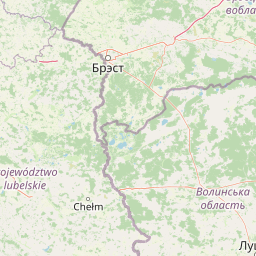
Use this park location map to pinpoint Rezerwat przyrody Bachus in Poland, understand its exact geographic position, and read its mapped placement within the surrounding landscape more clearly.

Pigeon | © OpenStreetMap contributors

Visual reference collection highlighting oak woodland habitats and terrain across the eastern Polish lowlands.

Rezerwat przyrody Bachus Photos and Protected Forest Landscape Scenery

Photographic documentation reveals the distinct canopy structure, deciduous forest habitats, and vegetation patterns preserved within the protected reserve boundaries. Visual exploration of the terrain provides deeper context for understanding the ecological character of the oak woodlands situated in eastern Poland.

A red rectangular sign with white text that reads REZERWAT PRZYRODY BACHUS, mounted on two metal posts in a forested area with fallen trees.

Park atlas

Compare surrounding forest reserves and regional landscapes in eastern Poland

Other Parks and Protected Areas Near Rezerwat przyrody Bachus

Browse protected areas and lowland forest enclaves located near Rezerwat przyrody Bachus. Continuing into adjacent regional landscapes offers a broader view of woodland conservation across eastern Poland.
A watercolor painting showing a panoramic view of a marshy landscape with green grasses, light-colored water, and distant trees on a white background.
National parkLublin Voivodeship
About 6.2 km away#1 closest

Northwest

Poleski Park Narodowy: Protected Wetlands and Glacial Geography in Lublin Voivodeship

Exploration of peatlands, kettle lakes, and boreal-style marshes

Poleski Park Narodowy encompasses a diverse mosaic of fens, transitional bogs, and dense marsh forests within the Lublin Voivodeship. This protected area serves as a primary reference for understanding the glacial-relict biodiversity and flat, water-defined terrain characteristic of the historic Polesie region in eastern Poland.

Area
97.6 km²
Established
1990
Visitors
41K annual
Relief
Lowland
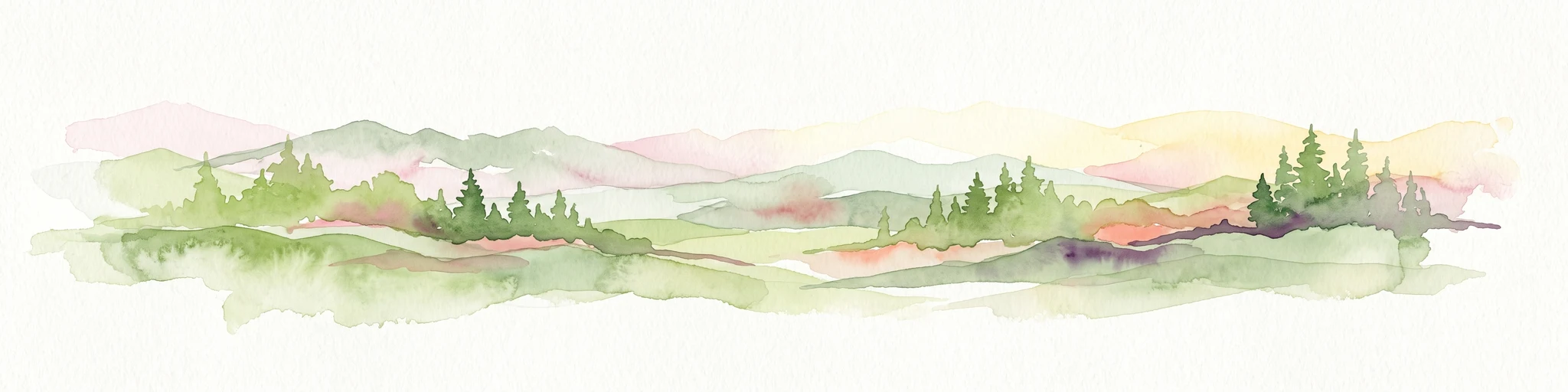
A watercolor illustration showing a soft, stylized landscape of rolling green hills, distant mountains, and coniferous trees against a white background.
Protected landscapeLublin Voivodeship
About 12 km away#2 closest

Southeast

Chełmski Park Krajobrazowy: A Detailed Atlas of the Protected Landscape in Lublin Voivodeship

Exploring the calcareous peatlands and diverse wetland topography

Located in eastern Poland, Chełmski Park Krajobrazowy is a protected landscape shaped by unique geological features and rich botanical habitats. This overview explores the park's transition from upland hills to lowland depressions, its internal nature reserves, and its function as a critical biodiversity center within the Lublin Voivodeship landscape.

Area
164.57 km²
Established
1983
Relief
Upland
Climate
Temperate
Protected areaLublin Voivodeship
About 15 km away#3 closest

East

Poleska Dolina Bugu Protected Landscape: Mapped Atlas and Geographic Overview

Key Natura 2000 river valley site in Lublin Voivodeship

Poleska Dolina Bugu is a regionally vital protected area comprising six connected enclaves along the Bug River. The site features a mosaic of oxbow lakes, alkaline fens, molinia meadows, and riparian woodlands that define the lowland geography of eastern Poland. Access structured data on this Habitats Directive site to understand its surface composition, floodplain connectivity, and specialized conservation habitats.

Area
81.732 km²
Relief
Lowland
Scope
Terrestrial
Water
Major water bodies
Nature reserveLubelskie Voivodeship
About 15 km away#4 closest

Northeast

Rezerwat przyrody Małoziemce: Nature Reserve Protected Areas and Geographic Map Context

A faunal reserve within the Łęczna-Włodawa Lake District

Rezerwat przyrody Małoziemce represents a specialized faunal protected area in Lubelskie Voivodeship. Established for the preservation of heron breeding colonies, the site is defined by its lowland, marshy terrain and its strategic inclusion within the larger Sobiborski Landscape Park. This entry provides detailed geographic perspective on how this forest and wetland complex fits into the regional network of protected landscapes near the Polish-Ukrainian border.

Area
0.38 km²
Established
1988
Scope
Terrestrial
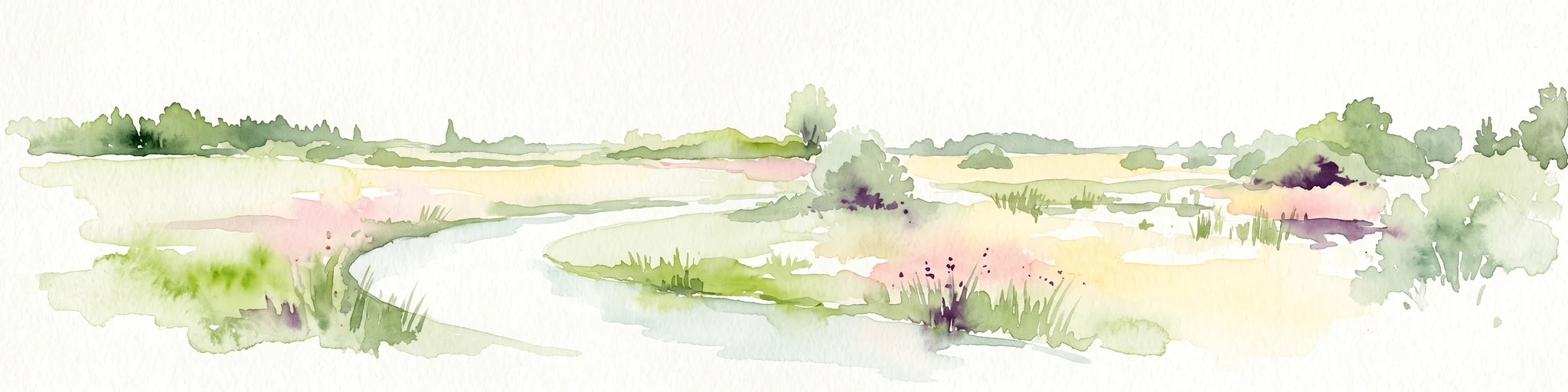
A horizontal watercolor illustration of a marshy landscape featuring a winding stream, soft green grasses, and clusters of wetland vegetation against a light background.
Nature reserveLubelskie Voivodeship
About 16 km away#5 closest

Southeast

Rezerwat przyrody Bagno Serebryskie: Protected Wetland and Calcareous Fen Geography in Lubelskie

Mapped terrain and ecological boundaries of a Polish nature reserve.

Investigate the environmental character of Rezerwat przyrody Bagno Serebryskie, an expansive protected wetland in eastern Poland. This site preserves rare alkaline-loving plant communities and vital avian habitats, showcasing the complex marshy terrain and geographic significance of the Lubelskie Voivodeship region.

Area
3.766 km²
Established
1991
Relief
Lowland
Scope
Terrestrial
Nature reserveLublin Voivodeship
About 18 km away#6 closest

West

Jezioro Świerszczów Nature Reserve: A Detailed Geographic Atlas of Eastern Polish Protected Lands

Regional peatland and lake basin landscape context

Located in Lublin Voivodeship, Jezioro Świerszczów represents an essential study in lowland mire ecosystems. The reserve protects a small lake and surrounding transitional peatland, supporting a compact landscape mosaic that includes aquatic vegetation, alder carrs, and oak-hornbeam forest zones.

Area
0.461 km²
Established
1959
Relief
Lowland
Climate
Temperate
National parkPoland
About 18 km away#7 closest

Northwest

Polesie National Park: Protected National Park in Poland's Eastern Lowlands

Explore its mapped wetland geography and unique glacial terrain.

Polesie National Park represents a key protected landscape within eastern Poland, notable for its vast wetland complexes, including extensive peat bogs and marshes interspersed with pine forests on sandy dunes. This national park showcases a distinct geography shaped by glacial processes, offering a unique perspective on lowland ecosystems and their conservation. MoriAtlas allows for a structured discovery of its protected boundaries and the surrounding regional context, providing an atlas-driven understanding of this vital natural territory.

Area
97.52 km²
Established
1979
IUCN
II
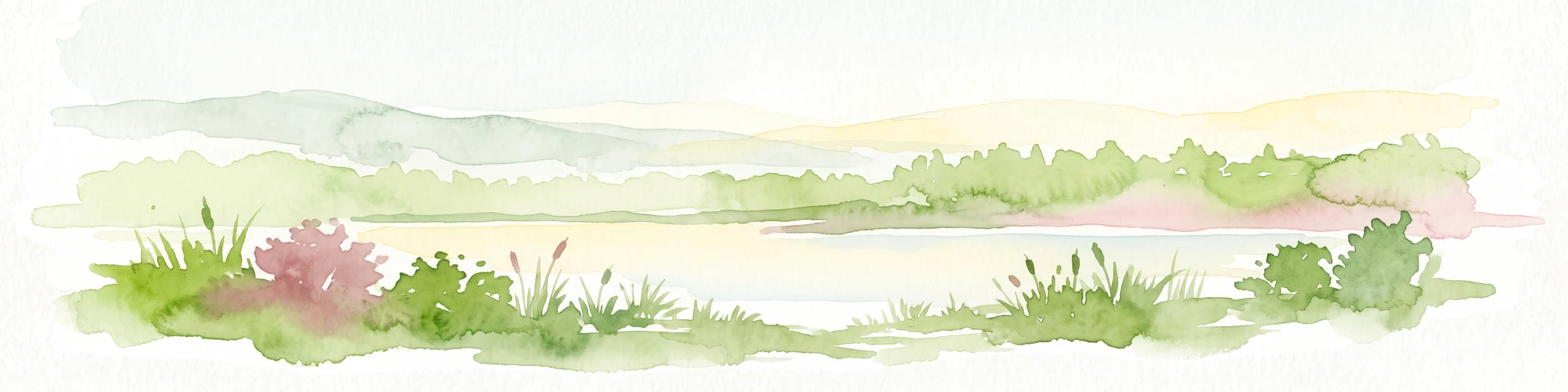
A horizontal watercolor illustration depicting a calm lake with marshy shores, reeds, and distant low hills.
Nature reserveWojewództwo lubelskie
About 23 km away#8 closest

Northeast

Rezerwat przyrody Jezioro Orchowe: Protected Area and Wetland Geography Map

Wetland ecosystems and peatland terrain in Województwo lubelskie.

The Rezerwat przyrody Jezioro Orchowe nature reserve protects a distinct dystrophic lake and surrounding mire complex in eastern Poland. This site offers deep insight into the transition between aquatic, peatland, and forested habitats within a glacial depression of the Bug river valley. Its documented plant communities represent a key reference for understanding the ecological structure of the wider Polesie lowland region.

Area
0.582 km²
Established
1996
Relief
Lowland
Climate
Temperate

Common questions about visiting, size, designation, and location context for Rezerwat przyrody Bachus

Rezerwat przyrody Bachus FAQs for park facts, access, geography, and protected area context

Find quick answers about Rezerwat przyrody Bachus, including protected-area facts, park geography, trail and visitor context, and how the park fits into its surrounding country and regional landscape.
MoriAtlas Explorer

Continue Your Protected Areas Search Across the Global Atlas

Deepen your exploration by continuing the structured search for national parks and protected areas worldwide. Utilize the comprehensive filtering capabilities to compare different conservation landscapes and refine your understanding of global park geography. Discover more about the distribution and characteristics of protected natural areas.

Global natural geography