Why Border Ranges National Park stands out
Border Ranges National Park is best known for its exceptional Gondwana-era rainforests and the striking Antarctic beech forests that dominate the higher elevations. The park protects a critical biodiversity hotspot where northern and southern Australian flora species converge, creating the McPherson-Macleay overlap zone. This ecological phenomenon results in an unusual mixture of species typically found in separate geographic regions. The park also contains remarkable volcanic geological features including ancient volcanic plugs that remain as remnant peaks from the extinct Tweed Volcano, one of the largest shield volcanoes in the world. The panoramic views from Blackbutts Lookout across the Tweed Valley, an erosional caldera considered larger than Tanzania's Ngorongoro Crater, provide another distinctive characteristic.
Border Ranges National Park history and protected-area timeline
Border Ranges National Park was officially established on 8 June 1979, formalizing protection for this significant rainforest area that had long been recognized for its ecological and geological values. Prior to protection, the area experienced extensive logging throughout the 20th century, with timber from the ancient forests supplying nearby sawmills. The removal of valuable timber species altered some areas of the park, though substantial old-growth forest remains in higher elevation sections. Following establishment, the park gained additional recognition when the Gondwana Rainforests of Australia were inscribed as a World Heritage Site in 1986, placing Border Ranges among Australia's most globally significant protected areas. In 2007, the Gondwana Rainforests were added to the Australian National Heritage List, further cementing the park's status within the nation's conservation framework. The establishment of the park also provided framework for managing the scenic and ecological values of this mountainous border region while accommodating continuing infrastructure corridors.
Border Ranges National Park landscape and geographic character
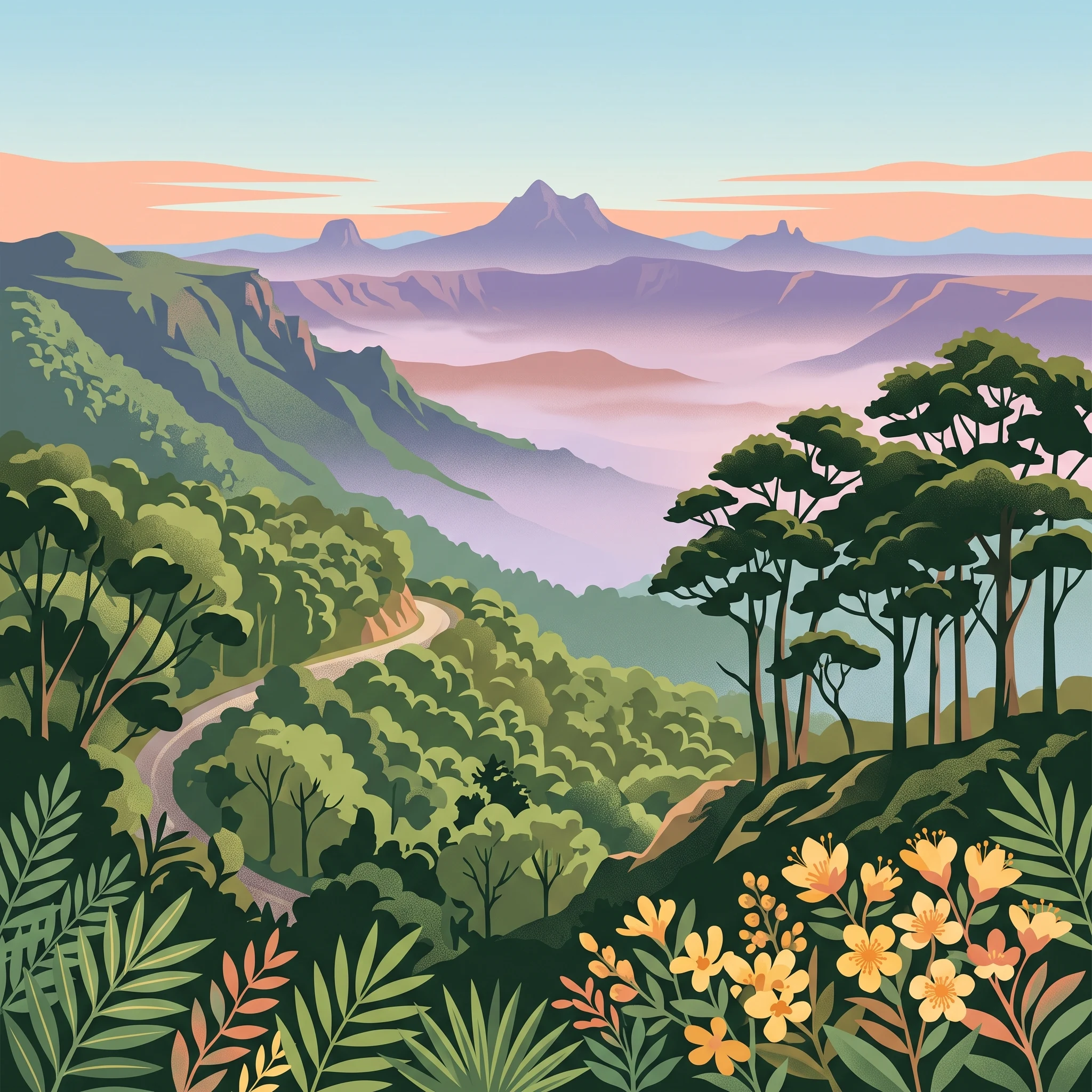
The physical landscape of Border Ranges National Park is defined by its location on the eroded remnants of the Tweed Volcano, one of the largest volcanic structures in the region. The McPherson Range, Tweed Range, Lamington Plateau and Levers Plateau represent the erosion-resistant remnants of this ancient volcanic shield, standing as elevated terrain along the Queensland-New South Wales border. Volcanic plugs remain throughout the park, appearing as distinctive rocky peaks that punctuate the forested landscape. The Tweed Valley, visible from Blackbutts Lookout, represents an enormous erosional caldera that has been breached by the Pacific Ocean on its eastern flank, yet remains larger in surface area than the famous Ngorongoro Crater in Tanzania. The terrain supports multiple rainforest types that change with elevation, from subtropical rainforests in lower areas through cool temperate forests at higher elevations. Deep gullies and creek lines dissect the plateau surfaces, with Brindle Creek and Sawpit Creek providing classic rainforest stream scenes with their moss-covered boulders and towering canopy.
Border Ranges National Park ecosystems, habitats, and plant life
The ecological character of Border Ranges National Park centers on its remarkable rainforest systems, which represent some of the most significant remaining Gondwana-era forests in Australia. The park contains extensive stands of Antarctic beech (Nothofagus moorei), a southern hemisphere beech species that forms distinctive temperate rainforest communities in the higher elevations. The 64 kilometre road circuit passes through all three major rainforest types found in the park: subtropical, cool temperate and warm temperate rainforest, each supporting different assemblages of plant species. The park lies within the McPherson-Macleay overlap zone, a biogeographic region where the distributions of northern and southern Australian species meet and intermingle. This results in exceptional plant diversity, with species from typically separate geographic regions occurring together. The montane rainforests of the park support one of Australia's most diverse spider faunas, highlighting the importance of these ecosystems for invertebrate conservation.
Border Ranges National Park wildlife and species highlights
Border Ranges National Park supports diverse wildlife populations across its multiple habitat types. The lower elevation eucalypt forests provide habitat for commonly encountered marsupials including eastern grey kangaroos, red-necked wallabies and koalas. The dense understorey and forest floor habitat supports smaller mammals such as pademelons and potoroos. The park's significance for biodiversity has been reinforced by recent discoveries, including the rediscovery of the Hastings River mouse within the park boundaries. Birdlife is particularly diverse, with the park forming part of the Scenic Rim Important Bird Area identified by BirdLife International. This designation reflects the area's importance for threatened bird species, including the rare Albert's lyrebird which inhabits the forest understorey. The variety of habitat types from subtropical rainforest to cool temperate forest supports different bird communities, while the dense vegetation provides crucial shelter and foraging resources.
Border Ranges National Park conservation status and protection priorities
Border Ranges National Park plays a central role in the conservation of Australia's Gondwana-era rainforests as a core component of the World Heritage-listed Gondwana Rainforests of Australia. This World Heritage inscription recognizes the outstanding universal value of these forests in representing Earth's evolutionary history, with the Border Ranges containing some of the most significant examples of ancient rainforest types. The park's inclusion in the Scenic Rim Important Bird Area further emphasizes its conservation significance, as this designation identifies areas of international importance for bird conservation. The protection of the McPherson-Macleay overlap zone is particularly valuable, as this biogeographic transition area supports species assemblages found nowhere else on Earth. The diverse spider fauna of the montane rainforests represents another conservation priority, with the park harboring species found in few other locations. Management focuses on protecting these irreplaceable ecosystems while providing sustainable visitor access through the gravel road circuit.
Border Ranges National Park cultural meaning and human context
Border Ranges National Park is situated in the traditional lands of Indigenous peoples, though detailed information about specific cultural connections to this landscape is limited in available sources. The park occupies a mountainous border region between New South Wales and Queensland that has long served as a natural corridor for movement between the coastal lowlands and interior ranges. The Lions Road and Sydney-Brisbane rail corridor that pass through the park represent modern infrastructure corridors that continue this historical role of the mountain passes. The park's landscape has been shaped by both natural processes over geological time and more recent human activities including extensive logging in the 20th century. The establishment of the protected area in 1979 formalized recognition of the region's natural values while acknowledging the need to preserve these forests for future generations.
Top sights and standout views in Border Ranges National Park
The Border Ranges offers visitors the opportunity to traverse multiple rainforest types along its 64 kilometre gravel circuit road, experiencing the transition from subtropical to cool temperate forest in a single journey. Blackbutts Lookout provides spectacular panoramic views across the Tweed Valley toward Mount Warning, with the caldera landscape creating one of the most distinctive outlooks in eastern Australia. The Antarctic beech forests at higher elevations represent rare examples of this ancient Gondwana-era tree species, with their distinctive smooth bark and interlocking canopy. The park's position within the World Heritage-listed Gondwana Rainforests connects it to a global recognition of evolutionary significance. Visitors can also experience the diverse wildlife including koalas in lower elevation forests and the elusive Albert's lyrebird in the denser understorey areas.
Best time to visit Border Ranges National Park
Border Ranges National Park can be visited throughout the year, with each season offering different experiences of the park's landscapes. The cooler winter months from June to August often provide clearer visibility for panoramic views from lookouts like Blackbutts, though mist and fog are common in the higher elevation rainforest areas throughout the year. Summer months from December to February bring warmer conditions and increased rainfall, which maintains the rainforest's lush character but may affect visibility and road conditions. The park's rainforest environment maintains high humidity year-round, so visitors should come prepared for variable conditions regardless of the season. Spring and autumn offer moderate temperatures and represent comfortable periods for walking and exploring the various trails and viewpoints within the park.