Why Carlsbad Caverns National Park stands out
Carlsbad Caverns is renowned worldwide for its accessible and exceptionally well-preserved cave system, featuring one of the largest underground chambers in the Western Hemisphere. The Big Room alone contains an impressive concentration of speleothems, including the iconic Rock of Ages, the Totem Pole, and the Giant Dome. Beyond the geological wonders, the park is famous for its dramatic bat flight, where up to 793,000 Mexican free-tailed bats emerge nightly during the summer breeding season. The combination of accessible cave exploration, spectacular formations, and unique wildlife experiences makes this park a standout destination among American national parks.
Carlsbad Caverns National Park history and protected-area timeline
The history of Carlsbad Caverns begins with the exploratory adventures of Jim White, a teenager who in 1898 entered the cave using a homemade wire ladder and named many of its prominent rooms and formations, including the Big Room, King's Palace, and Queen's Chamber. The cave drew increasing attention throughout the early 20th century, leading to formal protection efforts. On October 25, 1923, President Calvin Coolidge signed a proclamation establishing Carlsbad Cave National Monument, citing the cavern's extraordinary proportions and unusual beauty. Additional executive orders in 1924 and 1928 reserved further lands. On May 14, 1930, Congress passed legislation establishing Carlsbad Caverns National Park, directing the National Park Service to administer the area. The visitor center with elevators opened in 1932, replacing the laborious descent on foot. In 1978, President Jimmy Carter signed the National Parks and Recreation Act, creating Carlsbad Caverns Wilderness and adding another layer of protection to preserve the park's natural state.
Carlsbad Caverns National Park landscape and geographic character
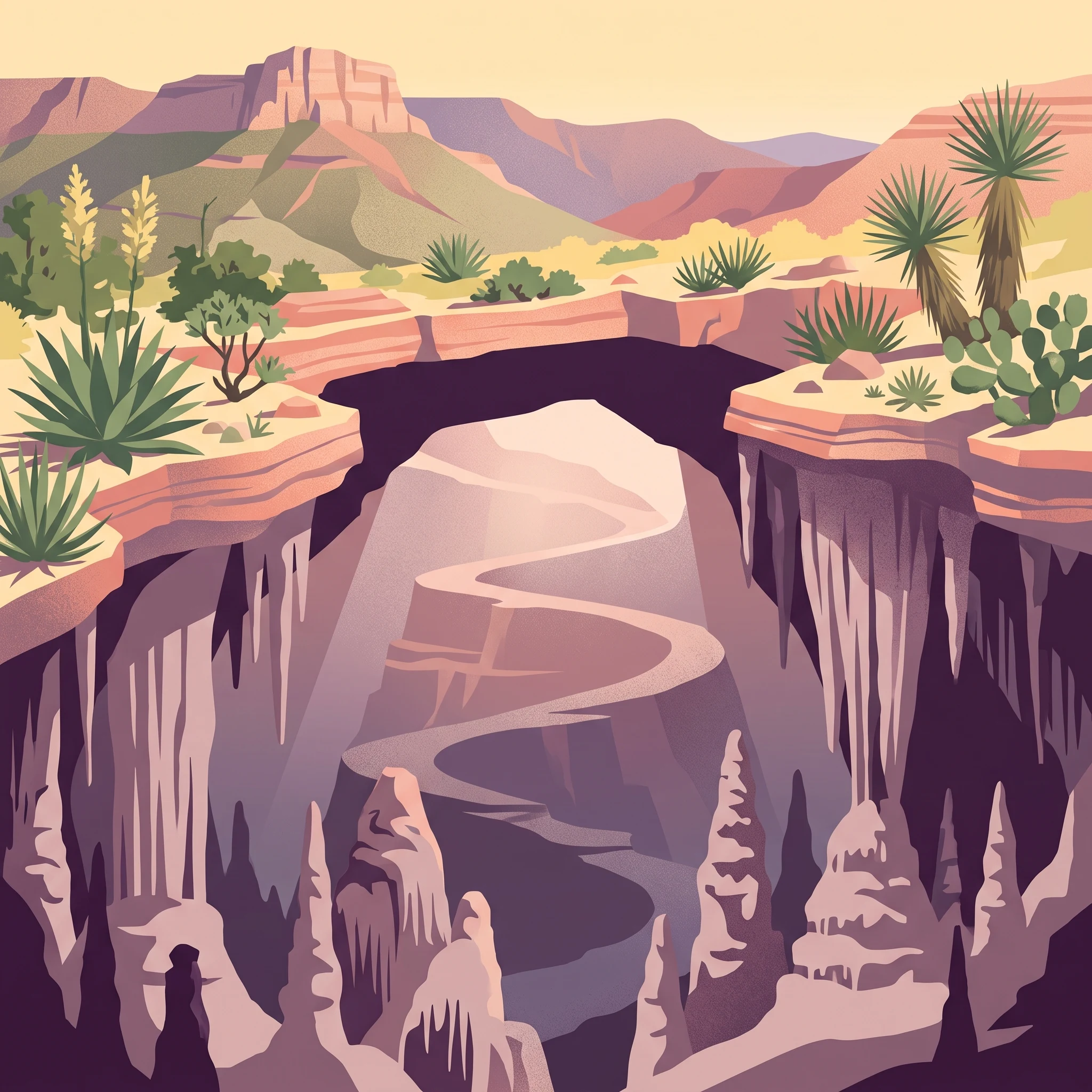
The surface landscape of Carlsbad Caverns National Park presents the stark beauty of Chihuahuan Desert scrubland in the rain shadow of the Guadalupe Mountains. The mountains themselves represent the exposed remnants of the Capitan Reef, a Permian-age limestone formation that once formed an ancient coastline. Above the cave entrance, the desert supports typical southwestern vegetation including creosote bush, mesquite, and various cacti. The cave's natural entrance, created by erosion within the last million years, serves as the dramatic portal into the underground world. Below ground, the limestone passages contain the park's true geological treasures: vast chambers decorated with millennia of mineral deposits. The landscape around Rattlesnake Springs, a detached unit of the park, provides a striking contrast as a riparian oasis supporting cottonwood trees and丰富的鸟类生活, demonstrating how water sources create biological islands in the desert.
Carlsbad Caverns National Park ecosystems, habitats, and plant life
The ecological character of Carlsbad Caverns encompasses two distinct realms: the subterranean cave ecosystem and the surrounding desert environment. Within the cave, the ecosystem is defined by darkness, stable temperatures, and the mineral-rich formations that continue slowly developing through mineral precipitation. The cave hosts seventeen bat species, with Mexican free-tailed bats forming the largest colonies. Above ground, the desert ecosystem supports a surprising diversity of life adapted to arid conditions. Rattlesnake Springs exemplifies the park's ecological importance, designated as an Important Bird Area by the National Audubon Society with over 300 bird species recorded. The springs represent a wooded riparian area in the desert, creating a habitat critical for migratory birds and providing water in an otherwise arid landscape. This contrast between the subterranean and surface environments illustrates the park's ecological complexity.
Carlsbad Caverns National Park wildlife and species highlights
The wildlife legacy of Carlsbad Caverns centers most prominently on its bat populations, which represent one of the park's most spectacular natural phenomena. Mexican free-tailed bats, numbering in the hundreds of thousands during summer months, emerge nightly from the cave in dense, corkscrewing flocks that create an unforgettable spectacle for visitors. The bat flight typically begins around sunset from late May through mid-October, with peak viewing occurring in July and August when juvenile bats join the adults. While the exact historical population is debated, modern estimates suggest peak counts of approximately 793,000 bats using thermal imaging technology. The park's surface environment supports desert wildlife including reptiles, small mammals, and diverse bird species, particularly notable at Rattlesnake Springs where the riparian habitat attracts species rarely found in the surrounding arid landscape. The cave environment itself, while hosting fewer species, contains uniquely adapted organisms including cave-dwelling invertebrates.
Carlsbad Caverns National Park conservation status and protection priorities
Carlsbad Caverns holds significant conservation recognition as both a World Heritage Site and a designated wilderness area. The 1995 World Heritage designation acknowledged the cave system's global significance as one of the most accessible and best-preserved cave complexes in the world. The creation of Carlsbad Caverns Wilderness in 1978 ensured that approximately two-thirds of the park will remain undeveloped, protecting both the underground resources and the surface desert habitat. Conservation efforts extend to the bat populations, which have faced declines likely linked to pesticide use. The park also serves as a protected area for Lechuguilla Cave, one of the longest and deepest limestone caves in the United States, where access is limited to scientific expeditions to preserve its delicate speleothems and pristine underground environment.
Carlsbad Caverns National Park cultural meaning and human context
The park's name derives from the city of Carlsbad, New Mexico, which itself takes its name from the Czech town formerly known as Karlsbad (now Karlovy Vary), named after Charles IV, Holy Roman Emperor. This European naming connection reflects the broader history of the American Southwest. The human history of the cave itself began with Jim White's 1898 exploration, whose homemade ladder and early documentation helped bring attention to the cavern's remarkable features. The park contains two entries on the National Register of Historic Places: The Caverns Historic District and the Rattlesnake Springs Historic District. The exploration history continues today, with new passages discovered as recently as 2019, demonstrating that even well-documented caves still hold secrets.
Top sights and standout views in Carlsbad Caverns National Park
The Big Room ranks as the crown jewel of Carlsbad Caverns, measuring nearly 4,000 feet long and containing one of the most concentrated displays of speleothems in North America. The Queen's Chamber is widely considered the most beautiful area, while the Lake of the Clouds represents the cave's lowest known point. The annual bat flight viewing program offers visitors a chance to witness thousands of bats emerging at sunset, a phenomenon that has drawn crowds since the early 20th century. Rattlesnake Springs provides a contrasting surface experience, with its riparian habitat supporting exceptional bird diversity. The park's three public cave tours (Carlsbad Cavern, Slaughter Canyon Cave, and Spider Cave) offer varying levels of exploration, from fully developed trails to adventurous guided caving experiences.
Best time to visit Carlsbad Caverns National Park
The optimal time to experience Carlsbad Caverns depends on interests, with the bat flight viewing season from Memorial Day weekend through mid-October offering the most distinctive wildlife spectacle. Summer months, particularly July and August, provide the best bat viewing as new pups join the adults in their nightly emergence. The cave maintains a consistent temperature year-round, making underground exploration comfortable in any season. Surface activities like hiking are most pleasant during spring and fall when temperatures are moderate. Peak visitation typically occurs on weekends following Memorial Day and the Fourth of July. Free entrance is often offered on holidays including Martin Luther King Jr. weekend, National Park Week, and Veterans Day weekend.